
Polymorphism in Drug Substances: The ICH Q6A Decision Tree, Solid-State Characterization, and Process-Induced Form Conversion Risk
A drug substance that exists as multiple crystalline forms — differing in lattice structure, thermodynamic stability, and solubility — is not an unusual compound. It is the majority of small…
On this pageArticle overview
A drug substance that exists as multiple crystalline forms — differing in lattice structure, thermodynamic stability, and solubility — is not an unusual compound. It is the majority of small molecule APIs. The regulatory question is never whether polymorphism exists. The question is whether you have characterized the solid-state landscape completely enough to know which form you are controlling, why that form is selected, and what would happen if the manufacturing process produced a different form. FDA chemistry reviewers have seen submissions where the answer to all three questions is unclear, and the deficiency letters document exactly what a complete answer requires.
That is not a hypothetical risk. It is the regulatory precedent that built modern solid-state CMC practice: an incomplete polymorph evaluation has caused a global product recall, and FDA now reviews Section 3.2.S.3.1 with that history in mind. Every polymorphism CMC package is read against the standard of “could this be the submission where the wrong form was never detected” — and the sections below describe exactly what a complete answer looks like.
The ICH Q6A Decision Tree for Solid-State Properties — What a Complete Polymorph Screen Looks Like
ICH Q6A Decision Tree #4 exists because of a regulatory precedent every solid-state chemist should know by name: in 1998, Abbott Laboratories withdrew ritonavir (Norvir) capsules from the market after a thermodynamically more stable polymorph, Form II, began appearing during commercial manufacturing and crystallizing out of the semisolid formulation. Published pharmaceutical literature documents Form II as substantially less soluble than the originally characterized Form I — the precise ratio varies across published reports, and any specific multiple cited to a regulator should be sourced to the primary characterization literature rather than asserted from memory. The consequence was a multi-month supply disruption and a reformulation program, and it is the regulatory precedent that established ICH Q6A Decision Tree #4 as a mandatory evaluation, not optional characterization.
A defensible polymorph screen should be broad enough to identify forms that can reasonably arise from the molecule, process, and storage environment. Solvent/antisolvent studies, temperature cycling, slurry conversion, humidity exposure, seeding, evaporation, cooling, or other approaches may be appropriate depending on the compound. ICH Q6A Decision Tree #4 does not prescribe a universal solvent count, temperature program, or slurry recipe; the scope must be scientifically justified.
A screen described as complete after four solvents at a single temperature is the single most common Section 3.2.S.3.1 deficiency pattern FDA reviewers cite — and it is avoidable with a properly scoped program executed before the NDA is filed, not remediated after a deficiency letter arrives.
Crystal Form Characterization and Specification — Building the Analytical Evidence Package That Satisfies FDA Review
When XRPD is used to identify or control a crystalline form, the method and acceptance criteria should be sufficiently specific and validated or qualified for the intended purpose. ICH Q6A does not impose a universal rule of ‘three peaks at ±0.2°’ for every polymorphic specification. Peak selection, whole-pattern comparison, reference-standard strategy, and tolerances should be justified against the analytical method and the risk of form conversion.
The full characterization panel goes beyond XRPD and DSC. Thermogravimetric analysis (TGA) distinguishes solvates and hydrates from anhydrous forms by their characteristic weight-loss profile; solid-state NMR (ssNMR), using 13C CP-MAS chemical shift differences, resolves local molecular environment differences between polymorphs that XRPD alone can miss in partially crystalline or low-crystallinity samples; and dynamic vapor sorption (DVS) identifies the relative humidity thresholds at which hydration or dehydration transitions occur — data that becomes directly relevant to the process risk discussion in Section 3 below. A quantitative specification limiting an alternate crystalline form to a defined threshold — for example, no more than 1% of a clinically relevant alternate form by quantitative XRPD — requires a validated calibration curve built from physical mixtures of the two forms, not an assumed linear response.
The deficiency pattern reviewers cite most often here is a specification that states a pass/fail identity criterion without the underlying quantitative method, leaving the reviewer unable to confirm what “consistent with Form A” actually means in practice, or what level of Form B would have been detected if present.
Process-Induced Form Conversion Risk — The Drug Product Manufacturing Threat to DS Specification Compliance
A crystal form specification set at the drug substance release stage is only meaningful if the form entering the patient is the same form that was characterized and clinically qualified — and the drug product manufacturing process is where that assumption most often breaks. Wet granulation is the highest-risk unit operation for anhydrous-to-hydrate conversion: published solid-state pharmaceutical literature documents conversion beginning within minutes of water contact for susceptible APIs at elevated water activity, which is why a process risk assessment that treats wet granulation as a generic unit operation, without an in-process XRPD check on granules post-drying for a known hygroscopic API, leaves an unaddressed gap between the DS specification and the DP reality.
High-energy milling and micronization present a related but mechanistically distinct risk: mechanical energy input can convert crystalline material to a partially amorphous state, detectable by XRPD peak broadening or by isothermal microcalorimetry, and an amorphous fraction identified in the polymorph screen with meaningfully higher aqueous solubility than the target form is a bioavailability-relevant finding, not a housekeeping observation, if the drug product process includes a milling step that was never assessed for amorphous content generation. Roller compaction and other dry granulation approaches carry a third risk pathway: compression force can induce phase transitions in pressure-sensitive polymorphs during dry granulation, a mechanism distinct from both hydration and amorphization and one that requires its own in-process control strategy.
The deficiency reviewers cite most consistently in this category is a DS specification correctly identifying Form A with no corresponding in-process control anywhere in the DP manufacturing process — leaving the submission unable to demonstrate that the form released at drug substance stage is the form present in the finished dosage form the patient receives.
The XGene Polymorphism CMC Risk Architecture
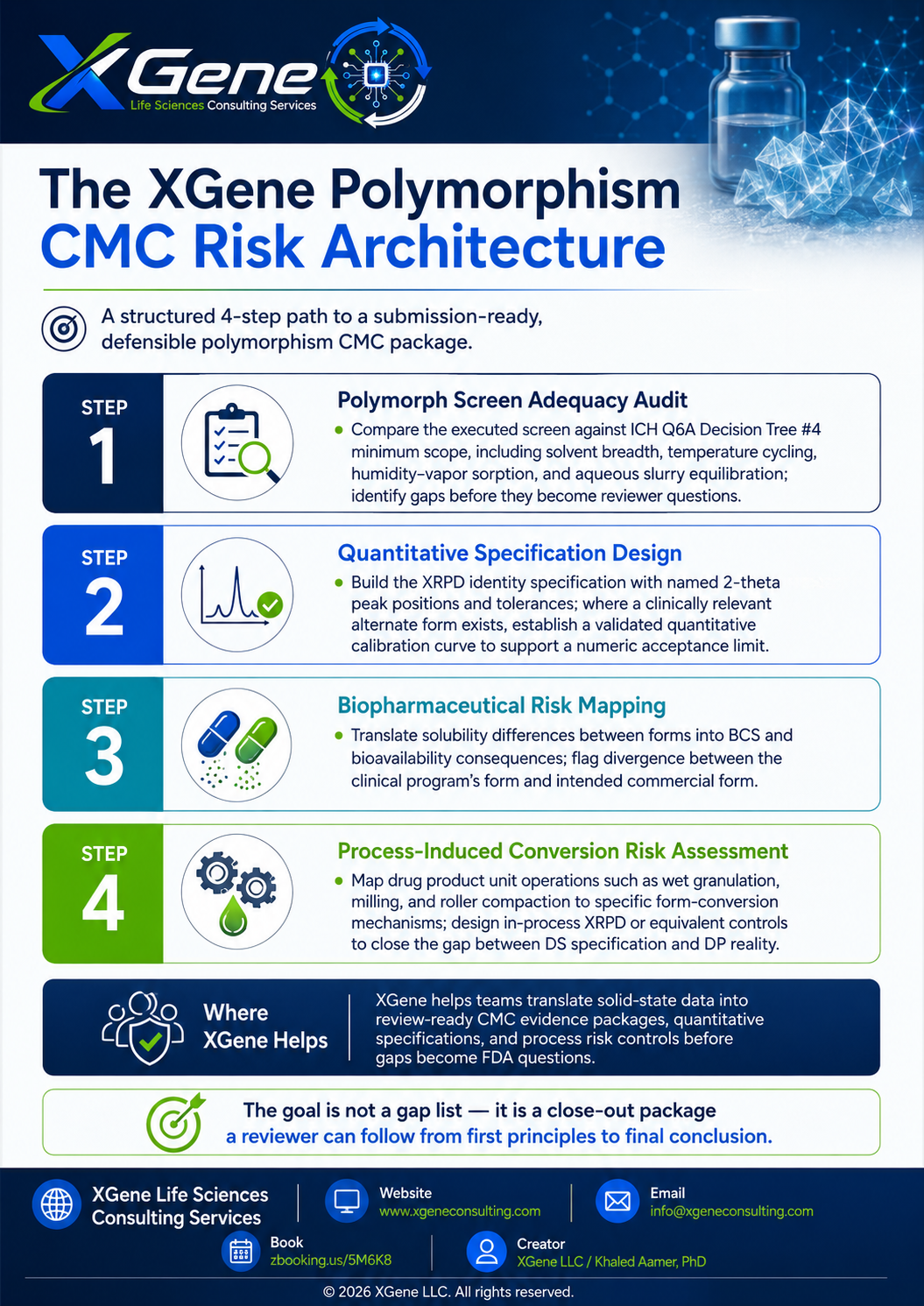
The XGene Polymorphism CMC Risk Architecture is a structured, four-step methodology that converts solid-state characterization data into a submission-ready, defensible polymorphism CMC package spanning Sections 3.2.S.3.1, 3.2.S.4, and 3.2.P.2.
Step 1 — Polymorph Screen Adequacy Audit: Compare the executed polymorph screen against the the product-specific ICH Q6A Decision Tree #4 evaluation — solvent breadth, temperature cycling, humidity-vapor sorption, and aqueous slurry equilibration — and identify any gap before it becomes a reviewer’s question.
Step 2 — Quantitative Specification Design: Build the XRPD identity specification with named 2-theta peak positions and tolerances, and — where a clinically relevant alternate form exists — establish the validated quantitative calibration curve required to support a numeric acceptance limit.
Step 3 — Biopharmaceutical Risk Mapping: Translate the solubility difference between characterized forms into its BCS and bioavailability consequence, flagging any scenario where the clinical program’s form and the intended commercial form diverge.
Step 4 — Process-Induced Conversion Risk Assessment: Map every drug product unit operation — wet granulation, milling, roller compaction — against its specific form-conversion mechanism, and design the in-process XRPD or equivalent control needed to close the gap between DS specification and DP reality.
The output is a submission-ready CMC evidence package that maps each regulatory expectation to a specific document, dataset, or validated method — not a gap list, but a close-out package a CDER chemistry reviewer can follow from first principles to final conclusion without encountering an unverified assertion.
A polymorphism CMC package that treats solid-state characterization as a checkbox rather than a scientific narrative is not a documentation shortcut — it is an unresolved question about whether the clinical and commercial product are the same material. The cost of resolving that question after an NDA deficiency letter, or after a manufacturing-stage form conversion is discovered post-approval, is measured in remediation programs, supply disruptions, and the kind of regulatory trust rebuilding that took Abbott years to complete. The cost of resolving it before filing is a properly scoped screen and a quantitative specification.