
The ICH Q11 Three-Part Justification — What FDA and EMA Require for Starting Material Designation and Where Programs Fall Short
The starting material designation in a drug substance synthesis is one of the highest-stakes decisions in small molecule CMC development — and it is made years before the NDA submission…
On this pageArticle overview
The starting material designation in a drug substance synthesis is one of the highest-stakes decisions in small molecule CMC development — and it is made years before the NDA submission by chemists who may not fully appreciate its regulatory consequences. FDA and EMA have different default positions on what qualifies as an acceptable starting material. A starting material proposed too close to the drug substance draws a complete response requesting earlier designation. A starting material proposed too early locks the sponsor into GMP manufacturing of commodity chemicals. Getting the balance right requires a structured justification that FDA chemistry reviewers can follow from commercial availability through impurity fate to final DS specification.
ICH Q11 starting material justification failures arise when the three-part qualification — commercial availability, adequate structural contribution, and impurity control adequacy — is not argued with specific mechanistic evidence for each criterion, leaving FDA reviewers unable to confirm that impurities introduced at the designated starting material step are controlled to specification by the manufacturing process between SM and the drug substance.
The ICH Q11 Three-Part Justification — What FDA and EMA Require for Starting Material Designation and Where Programs Fall Short
ICH Q11 and its February 2018 Q&A require applicants to consider all of the Q11 general principles when selecting and justifying a starting material. Commercial availability can simplify the justification for a genuinely commercially available chemical, but it is not a universal prerequisite. The central regulatory argument is process based: the proposed starting material, its impurity profile, the downstream chemistry, and the drug-substance control strategy must together provide adequate understanding and control. ICH Q11 does not specify that a starting material must contain a fixed percentage of the final carbon skeleton.
Impurity Fate and Purge Strategy — The Mechanistic Evidence Architecture That Closes the SM-to-DS Control Argument
Impurity fate and purge should be evaluated quantitatively when that evidence is needed to justify the starting-material control strategy. Purge-factor calculations, spike/purge studies, process knowledge, and downstream testing can all be useful, but ICH Q11 does not define a universal ≥10-fold purge threshold. Acceptance criteria should be based on the impurity risk, process capability, applicable ICH impurity thresholds, and the overall drug-substance control strategy.
FDA vs. EMA Divergence, DMF Architecture, and the Strategic Decision Framework for Global Submissions
Q11 does not set a fixed FDA-versus-EMA step-count rule for starting-material acceptance. Regulatory scrutiny increases when a proposed starting material is structurally close to the drug substance or when too little of the manufacturing process remains under the applicant’s control, but the decision is made against the full Q11 principles and product/process-specific evidence rather than a universal four-step or three-to-four-step threshold.
The XGene ICH Q11 Starting Material Justification Architecture
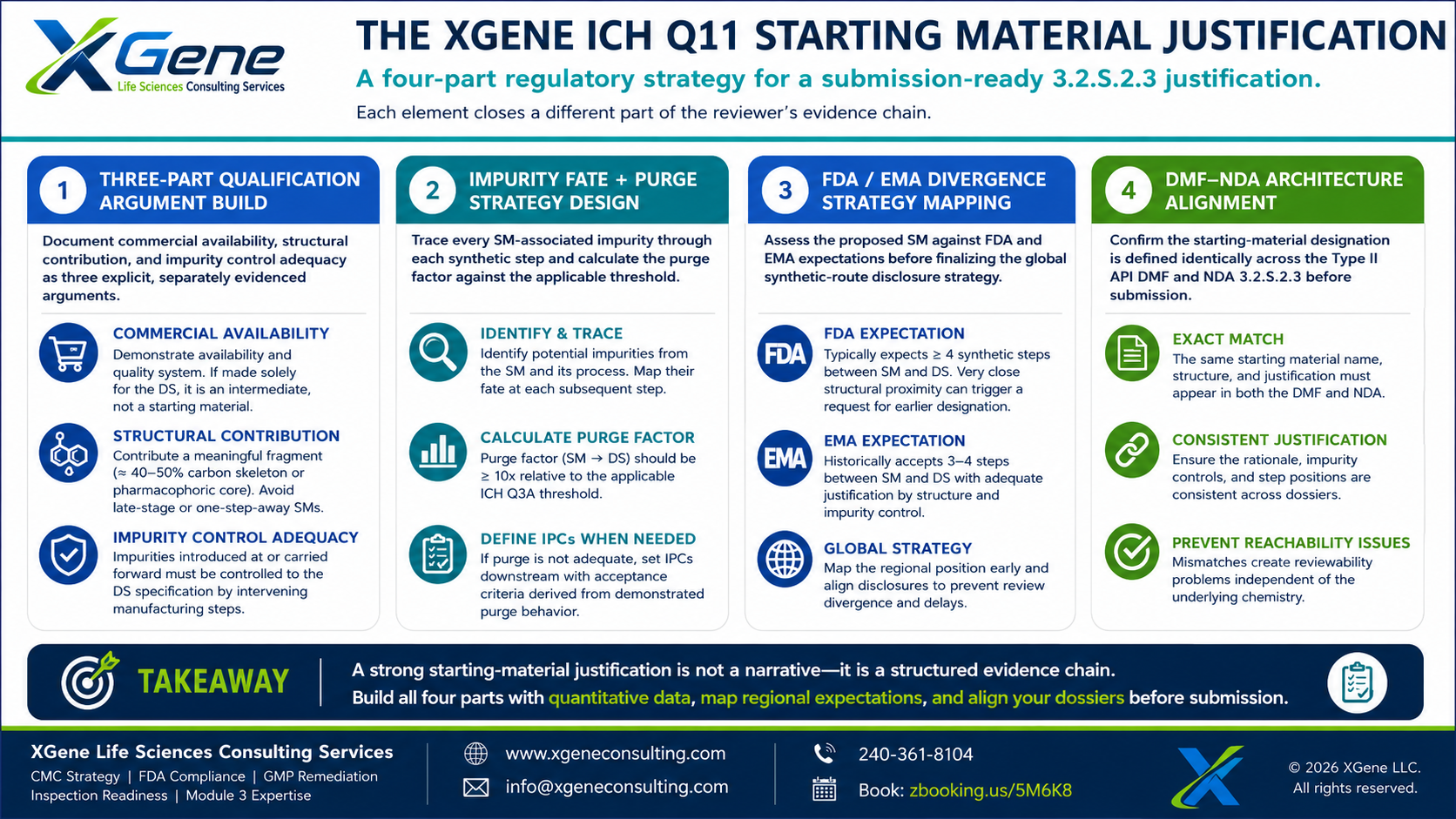
The XGene ICH Q11 Starting Material Justification Architecture is a structured regulatory strategy for defending starting material designation across complex multi-step synthetic routes in FDA and EMA submissions.
Three-Part Qualification Argument Build — Document commercial availability, structural contribution (with a carbon-skeleton comparison diagram), and impurity control adequacy as three explicit, separately evidenced arguments rather than one combined narrative.
Impurity Fate and Purge Study Design — Trace every SM-associated impurity through each synthetic step and calculate a purge factor against the ICH Q3A threshold, using a product- and impurity-specific quantitative purge target justified by the control strategy.
FDA/EMA Divergence Strategy Mapping — Assess the proposed SM against both FDA’s ≥4-step expectation and EMA’s structural proximity standard before finalizing a single global synthetic route disclosure strategy.
DMF-NDA Architecture Alignment — Confirm the SM designation is defined identically across the Type II API DMF and the NDA 3.2.S.2.3 section before submission, eliminating the reviewability mismatch risk.
The output is a submission-ready 3.2.S.2.3 justification narrative that CDER and EMA reviewers can follow from starting material to drug substance specification — not a gap list, but a close-out package.
A starting material designation made years before NDA submission, without the three-part ICH Q11 argument built alongside it, is a decision the sponsor will have to re-litigate at exactly the moment it has the least flexibility to change course — during chemistry review, against a PDUFA clock, with reachability and purge data that should have been generated during process development rather than reconstructed under deadline pressure.
For your complex drug substance synthetic route, can you identify today whether your ICH Q11 starting material justification in 3.2.S.2.3 includes a structural comparison demonstrating the SM’s contribution as a significant fragment of the DS carbon skeleton, an impurity fate and purge study covering all impurities identified in your SM supplier’s certificate of analysis with calculated purge factors, and reachability data from at least 3 commercial batches confirming the SM specification range is reflective of actual production variability?
A scenario I see recur across programs preparing simultaneous US/EU filings: the synthetic route team picks one starting material designation, assuming it will satisfy both agencies, only to discover during pre-submission consultation that FDA wants the SM moved one step earlier than EMA requires. At that point, the sponsor is choosing between two different 3.2.S.2 architectures or accepting a slower US review — a decision that should have been scoped during route selection, not during the regulatory strategy meeting six months before filing. Has your SM designation been stress-tested against both FDA’s and EMA’s default step-count expectations, or only against one?
The starting material designation in a drug substance synthesis is decided years before NDA submission — but FDA and EMA don’t share identical defaults for how many steps must separate it from the drug substance, and getting the justification wrong creates a complete response risk that surfaces only at chemistry review.
Khaled Aamer, PhD breaks down the ICH Q11 three-part justification, the purge factor standard, and the FDA/EMA divergence that shapes global submission strategy.
Read the full analysis at the link above.