
3.2.S.2.2 Description of Manufacturing Process and Process Controls: Writing a Reviewable Route-of-Synthesis Narrative
"The description of the manufacturing process is insufficient to assess the controls in place for the critical steps identified."
On this pageArticle overview
“The description of the manufacturing process is insufficient to assess the controls in place for the critical steps identified.”
This deficiency — or a close variant — appears in a significant proportion of NDA/ANDA CMC complete response letters for drug substance sections. The cause is almost never that the process is inadequate. It is that the description does not communicate it with the specificity FDA expects.
After two decades writing and reviewing CTD Module 3 sections for NDA, ANDA, and BLA submissions, I have read hundreds of 3.2.S.2.2 narratives. The ones that generate deficiency-free first-cycle reviews share a defining characteristic: they are written as if the reviewer has never seen the drug substance before and has no access to the batch records. Every temperature range, every solvent identity, every critical step designation, every in-process control acceptance criterion is in the text. The ones that generate a second cycle are almost always missing something the author considered too obvious to write down.
THE ROUTE OF SYNTHESIS NARRATIVE: WHAT FDA REVIEWERS READ TO ASSESS PROCESS UNDERSTANDING
The regulatory architecture for 3.2.S.2.2 is anchored in ICH Q11 Section A4 and Section 3.2, which together establish what the description must contain: a flow diagram of the synthetic process, a narrative that includes reaction conditions for each step, and identification of starting materials, reagents, solvents, and intermediates. The flow diagram is not decorative — it is the structural scaffold on which a reviewer builds their understanding of the entire route. Each node in the diagram should correspond to a numbered step in the narrative, and each step in the narrative should contain, at minimum, the identity of the reaction (what chemical transformation is occurring), the temperature range, pressure conditions where relevant, time parameters, the solvent or solvent system, and the stoichiometric ratio of key reagents and catalysts.
The FDA’s 2017 Guidance for Industry on Q11 Implementation makes clear that “sufficient detail” is not a qualitative standard — it is measured by whether the description allows an assessor to evaluate whether the process is designed to produce material consistently meeting the drug substance specification. Under 21 CFR 314.50(d)(1)(ii), the submission must describe the manufacturing and controls used for the drug substance, and deficiency letters routinely invoke this CFR basis when the narrative is inadequate. The implication is direct: a process description that omits the temperature range for a crystallization step, or lists a catalyst without specifying the loading, is not merely incomplete on a stylistic level — it fails a regulatory requirement with a specific CFR citation.
The mechanistic failure scenario that drives this home involves controlled crystallization steps. When the polymorphic form of the drug substance is a registered attribute — as it is for a significant number of small molecule NDAs where form impacts bioavailability or stability — the crystallization conditions in 3.2.S.2.2 are the process controls that justify the form control in 3.2.S.4. If the narrative describes the crystallization as “cooling to ambient temperature in ethanol,” but the actual process involves a seeding protocol at a defined temperature window with a controlled cooling rate, and this is omitted, the reviewer cannot assess whether the registered form is reliably produced. The S.4 specification for solid-state form becomes an orphan — it has a test but no manufacturing rationale. This disconnect between S.2.2 and S.4 is a frequent deficiency pattern and it is avoidable through methodical cross-referencing during authoring.
STARTING MATERIAL JUSTIFICATION UNDER ICH Q11: THE REGULATORY THRESHOLD FOR WHERE GMP BEGINS
The selection of starting materials is one of the highest-stakes decisions in S.2.2 authorship because it defines where GMP manufacturing begins and, consequently, how much process history and control data the agency can require. ICH Q11 Section 3.2 establishes the criteria for starting material selection: the proposed starting material should be a commercially available chemical with a defined specification, it should represent a significant structural fragment of the drug substance, and the number of steps conducted under GMP should be appropriate given the complexity and risk profile of the synthesis.
FDA reviewers apply these criteria critically. A starting material selected two steps from the final drug substance, where those two steps include a critical stereoselective transformation that generates a genotoxic intermediate, will receive far more scrutiny than one where GMP encompasses five or more synthetic steps with full process characterization data. When the proposed starting material is a late-stage precursor and the ICH Q11 criteria are not explicitly addressed in a starting material justification document — which should appear in 3.2.S.2.3 but must be consistent with the narrative in 3.2.S.2.2 — a deficiency is almost certain.
The specific deficiency language that appears in FDA complete response letters in this area is worth quoting directly: “The starting material justification does not address whether the proposed starting material represents a significant structural fragment of the drug substance in accordance with ICH Q11 criteria.” That sentence in a CRL costs months.
CRITICAL STEPS, INTERMEDIATES, AND THE PROCESS CONTROLS SECTION ARCHITECTURE
The identification of critical steps is where the scientific and regulatory obligations of 3.2.S.2.2 converge most visibly. ICH Q8(R2) defines a critical process parameter as one whose variability has an impact on a critical quality attribute, and this definition is the explicit basis on which critical step designation must be justified in the process description. The deficiency language mirrors the guidance gap precisely: “Critical steps are identified but the scientific rationale is not provided” is a direct consequence of a table that lists steps as critical without linking each designation to a specific CQA and a documented understanding of the causal relationship.
Under ICH Q10 §3.2.1, the pharmaceutical quality system must ensure that process performance and product quality are monitored through a defined program of continued process verification – a requirement that reinforces the need for a complete, traceable process description in S.2.2.
The architecture of a compliant process controls section within 3.2.S.2.2 requires that for every in-process control listed at a critical step, an acceptance criterion appears in the text of the section itself — not by cross-reference to the batch record, not “as per the Master Batch Record,” and not in an appendix. Approximately 30 to 40 percent of the IPC-related deficiencies I have reviewed over the years stem from this single omission: acceptance criteria exist in the batch record and are simply not transcribed into the CTD section. The reviewer reads the submission. The reviewer does not have the batch record.
The fate of genotoxic intermediates deserves specific treatment. If any intermediate in the synthetic route is a known or potential mutagenic impurity as assessed under ICH M7(R1), the process description must address its fate — the steps at which it is generated, the steps at which it is removed, and the in-process controls that monitor its reduction to acceptable levels. The phrase “purged in subsequent processing steps” is not sufficient. The mechanism of purge, the control that demonstrates purge effectiveness, and the linkage to the S.4 specification limit for the corresponding impurity must be traceable from within 3.2.S.2.2. EMA’s CHMP Guideline EMA/CHMP/CVMP/QWP/BWP/70278/2012 on process validation reinforces this expectation from a European perspective, requiring that the process description demonstrate understanding of the relationship between process parameters and impurity profiles.
(Note: although this guideline is primarily written for drug product process validation, its principle that process descriptions must demonstrate understanding of the relationship between parameters and impurity profiles applies equally to drug substance sections.)
The XGene S.2.2 Completeness Standard (Element 4, below) operationalizes this fate‐mapping requirement into a simple audit checklist.
XGene S.2.2 Process Description Completeness Standard A Four-Element Review Protocol
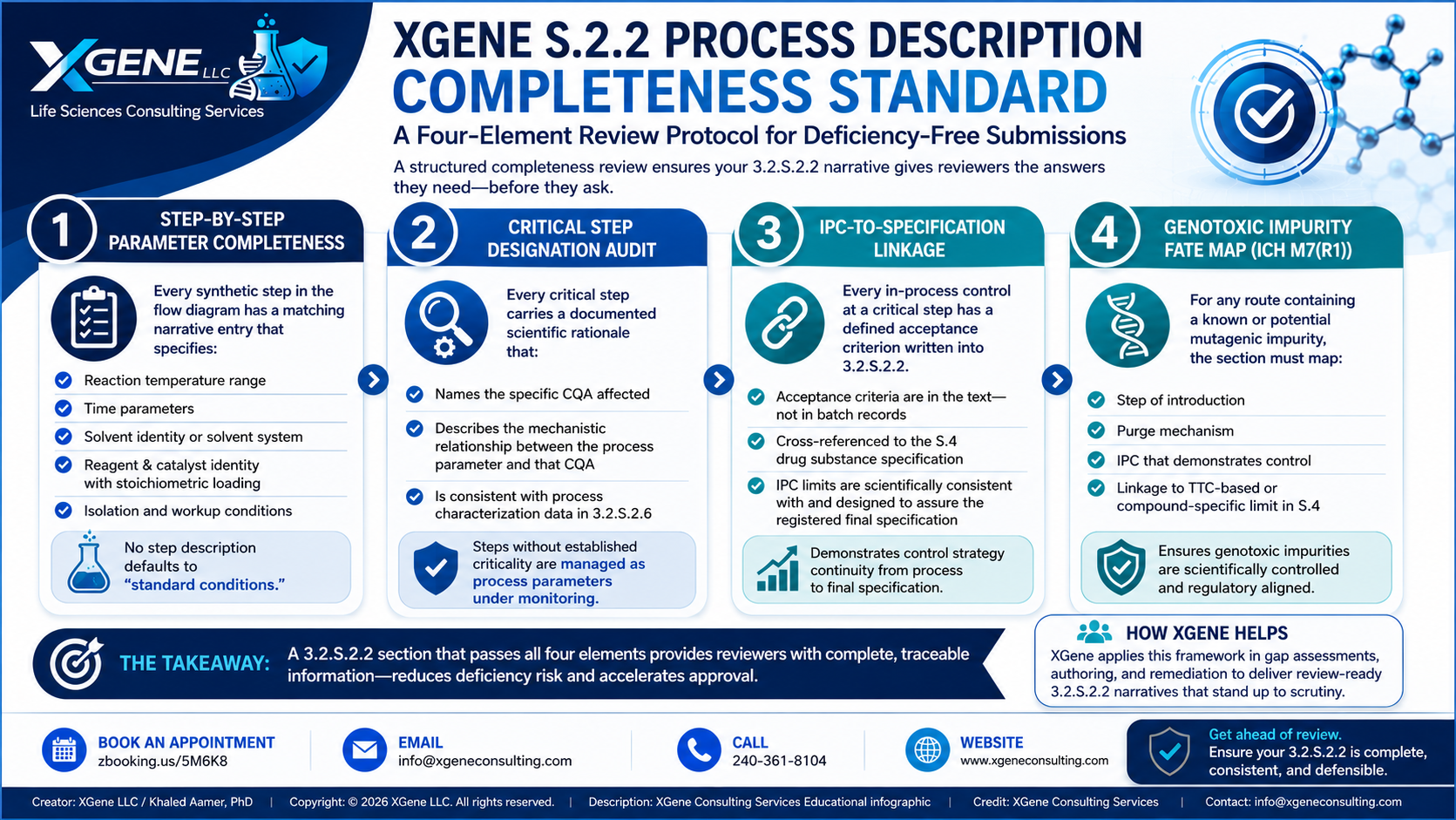
Before any 3.2.S.2.2 section is finalized for submission, XGene applies a structured completeness review against four elements:
Element 1 — Step-by-Step Parameter Completeness: Every synthetic step in the flow diagram has a corresponding narrative entry that specifies, at minimum: reaction temperature range, time, solvent identity, reagent and catalyst identity with stoichiometric loading, and isolation/workup conditions. No step description defaults to “standard conditions.”
Element 2 — Critical Step Designation Audit: Every step designated as critical carries a written rationale that names the specific CQA affected, describes the mechanistic relationship between the process parameter and that CQA, and is consistent with the process characterization data in 3.2.S.2.6. Steps where criticality has not been established through development data are not designated as critical — they are designated as process parameters under monitoring.
Element 3 — IPC-to-Specification Linkage: Every in-process control listed at a critical step has a defined acceptance criterion written into the 3.2.S.2.2 text. The section is cross-referenced to the S.4 drug substance specification to demonstrate that IPC limits are scientifically consistent with, and designed to assure, the registered final specification.
Element 4 — Genotoxic Impurity Fate Map per ICH M7(R1): For any route containing a known or potential mutagenic impurity, a fate map is constructed within the section showing the step of introduction, the purge mechanism, and the IPC that demonstrates control, linked to the TTC-based or compound-specific limit in S.4.
A 3.2.S.2.2 section that passes all four elements of this protocol is, in my experience, a section that gives reviewers answers to the questions they have not yet asked. That is the standard the section needs to meet.
For your most recently filed drug substance manufacturing process description: can you confirm today that every critical step has a documented rationale based on impact to a specific CQA, and that every in-process control has a defined acceptance criterion in the text of 3.2.S.2.2?
If the answer is anything other than an immediate yes, the risk of a CMC deficiency on that point is real. I would be glad to discuss what a targeted gap assessment looks like for sections already in preparation or under FDA review.
If you cannot confirm all four elements, XGene offers a targeted 3.2.S.2.2 gap assessment that delivers a red‐line review and a remediation roadmap in 10 business days.