
Salt and Co-Crystal Selection: CMC Documentation of Pharmaceutical Form Decisions in Module 3
Salt selection is the first CMC decision that determines whether your drug will be manufacturable, stable, and bioavailable — and it is a decision made before most of the regulatory…
On this pageArticle overview
Salt selection is the first CMC decision that determines whether your drug will be manufacturable, stable, and bioavailable — and it is a decision made before most of the regulatory framework that will eventually govern your NDA submission even exists. The problem is not the chemistry. Programs that reach NDA review with salt-form problems have usually made technically sound pharmaceutical form decisions but documented them inadequately — leaving FDA chemistry reviewers unable to confirm that the salt stoichiometry is consistent across manufacturing batches, that the counterion is controlled as an integral component of the drug substance, or that salt disproportionation risk in the drug product has been evaluated.
Salt and co-crystal CMC packages fail at FDA review because the pharmaceutical form selection rationale, the comparative characterization data, and the counterion specification are treated as preformulation history rather than regulatory obligations — leaving reviewers unable to verify salt stoichiometry consistency, counterion purity control, or the mechanistic basis for the pharmaceutical form designation that determines regulatory classification.
Salt vs. Co-Crystal: The Regulatory Classification Boundary and Why It Determines Your Drug Substance CMC Architecture
FDA’s February 2018 co-crystal guidance treats a pharmaceutical co-crystal that meets the guidance criteria as having a regulatory classification similar to a polymorph of the API; it is not regarded as a new API. The guidance uses evidence of nonionic interaction, including ΔpKa as a decision aid where ionizable groups are present, and expects evidence that substantial dissociation occurs before the site of pharmacological activity. A co-crystal composed of two or more APIs is treated as a fixed-dose combination product.
Salt Screening, Stoichiometry Confirmation, and Counterion Specification: The CMC Documentation FDA Expects in 3.2.S
A defensible salt-selection program evaluates counterions and conditions that are scientifically appropriate for the API’s ionization behavior, developability risks, intended dosage form, safety, manufacturability, and intellectual-property strategy. Development programs often use comparative solubility, crystallinity, hygroscopicity, stability, stoichiometry, and processability data, but FDA does not prescribe a universal number of counterions, a five-fold solubility target, a fixed DVS threshold, or a universal counterion-content specification.
Salt Disproportionation in Drug Product: The Drug Substance–Drug Product Interface Risk Most Programs Underestimate
Salt disproportionation — the conversion of the salt form back to the free acid or base, driven by the pH microenvironment inside the formulation — is a mechanistic risk that published pharmaceutical stability literature documents as reproducibly observed for weakly basic APIs (pKa 7–9) formulated with microcrystalline cellulose, where the pH microenvironment in the wet mass runs approximately 4.5–5.0, with free base formation documented to onset within 5–15 minutes of water contact during wet granulation. The mechanism is straightforward and consequential: a basic counterion salt combined with acidic excipients creates a pH microenvironment at or below the API’s pKa, the salt dissolves and recrystallizes as the free base, and the downstream consequences are dissolution failure, content uniformity out-of-specification results, and reduced bioavailability — none of which trace back cleanly to “salt disproportionation” unless the formulation team was specifically looking for it. Raman spectroscopy mapping of the tablet core is the validated method published literature documents for detecting free base formation in situ, with an acceptance criterion commonly set at 95% or greater of drug-containing pixels identified as the intended salt form — and a 3.2.P.2 pharmaceutical development section for a weakly basic drug substance formulated with MCC that does not include DVS and Raman mapping data has left the single highest-risk drug substance–drug product interface issue for that chemical class entirely unaddressed.
The XGene Pharmaceutical Form CMC Architecture
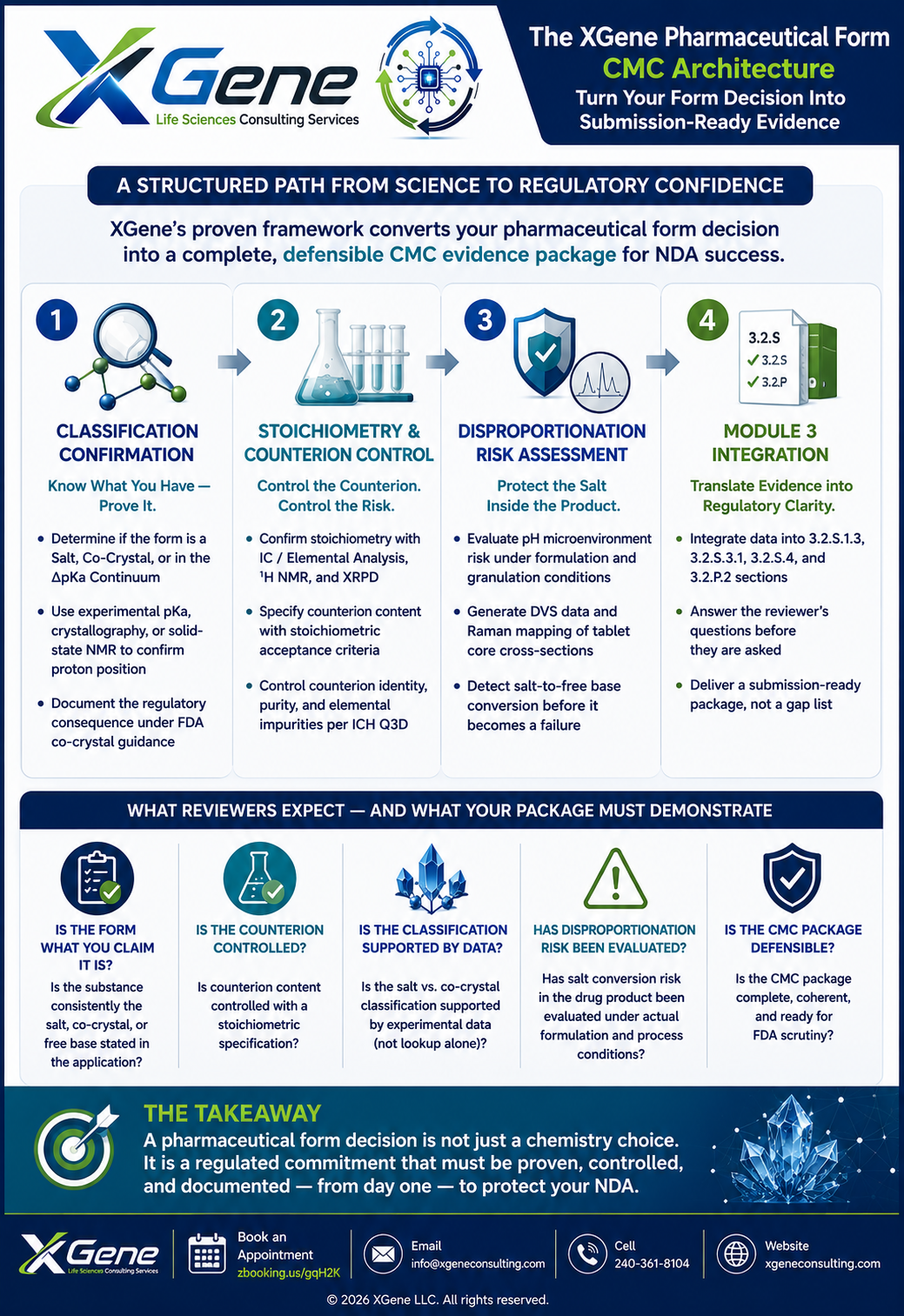
The XGene Pharmaceutical Form CMC Architecture is a structured regulatory strategy for salt and co-crystal drug substance programs that closes the gap between pharmaceutical form chemistry and Module 3 documentation.
1. ΔpKa-Based Classification with Experimental Confirmation — Calculate ΔpKa as the first-pass classification tool, then require crystallographic or ssNMR confirmation for any result in the 1–2 ambiguous range before the salt vs. co-crystal designation is finalized.
2. Stoichiometry and Counterion Specification Build — Confirm salt stoichiometry by elemental analysis/IC and NMR integration, and build a standalone counterion specification (identity, purity, heavy metals) for any non-compendial counterion.
3. Salt Disproportionation Risk Screening — Run DVS and Raman mapping studies specifically for weakly basic APIs paired with acidic excipients under wet granulation conditions, before the formulation is locked.
4. FDA Co-Crystal Pathway Determination — Apply the 2018 FDA co-crystal guidance’s GRAS-excipient-vs.-drug-substance logic explicitly, documenting the classification rationale in the CMC package rather than assuming default new-drug-substance treatment.
The output is a submission-ready 3.2.S.1.3, 3.2.S.3.1, 3.2.S.4, and 3.2.P.2 documentation package that maps each pharmaceutical form decision to the specific regulatory obligation it creates — not a gap list, but a close-out package.
A salt or co-crystal program that treats form selection as preformulation history rather than an ongoing regulatory obligation is deferring a documentation debt to the moment it is least convenient to pay — an FDA information request during NDA review, when the underlying screening data may be years old and the original scientists may no longer be reachable to reconstruct the rationale.