
3.2.P.7 Drug Product Container Closure System: Extractables, Leachables, and a Modern Risk-Based E&L Framework
Container-closure suitability and product-contact-material risk are long-standing CMC expectations. The current architecture should distinguish binding requirements and final guidance from evolving scientific frameworks: USP / provide extractables/leachables assessment frameworks; industry…
On this pageArticle overview
Container-closure suitability and product-contact-material risk are long-standing CMC expectations. The current architecture should distinguish binding requirements and final guidance from evolving scientific frameworks: USP <1663>/<1664> provide extractables/leachables assessment frameworks; industry consortia such as BPOG can provide useful scientific practice for particular systems; the draft ICH Q3E guideline issued through FDA in November 2025 provides an emerging global risk-based E&L framework; and FDA issued a new draft Container Closure Systems guidance in August 2026. Draft Q3E and the August 2026 FDA guidance should be treated as current regulatory direction, not as final implemented requirements.
The Regulatory Foundation: FDA Container Closure Guidance, USP <661>, and the Extractables/Leachables Distinction
Section 3.2.P.7 of the eCTD is the designated location for the drug product container closure system package. Its regulatory obligations extend well beyond a simple description of the packaging components. FDA’s foundational guidance — Container Closure Systems for Packaging Human Drugs and Biologics (1999) — established three overarching criteria that every P.7 submission must satisfy: the container closure system must be suitable for its intended use, it must provide adequate protection to the drug product throughout its shelf life, and it must be compatible with the drug product formulation under all anticipated storage and use conditions. These three criteria, broadly stated in the 1999 guidance, have been operationalized in the years since through a growing body of compendial standards, industry best practices, and increasingly specific FDA review expectations.
The container closure description in P.7 must be complete and unambiguous. For each primary packaging component — bottle, closure, stopper, plunger, blister foil, prefillable syringe barrel, cartridge — the submission must identify the material of construction, the manufacturer, and the manufacturing process where relevant. Elastomeric components require particular specificity. A bromobutyl rubber stopper, for example, is not simply characterized as “rubber.” The vulcanization chemistry, the accelerants used, the curing agents, and the composition of any surface treatment or coating must all be disclosed, because these manufacturing residuals are precisely the substances that appear in extractables profiles and, under worst-case conditions, in leachables studies conducted on finished product. A deficiency letter that reads “Applicant has not provided sufficient characterization of the elastomeric closure components to enable assessment of extractables/leachables risk” is among the most common P.7 findings in FDA complete response letters, and it almost always traces back to a description section that treated the stopper as a commodity item rather than a chemically complex component.
USP <661> — Plastic Packaging Systems and Their Materials of Construction — provides the compendial baseline. Compliance with <661> demonstrates that the plastic materials used have been characterized according to standardized physicochemical and biological reactivity protocols. For many oral solid dosage forms packaged in HDPE bottles, <661> compliance combined with compendial biological reactivity testing (USP <87> and <88>) constitutes an adequate demonstration of suitability. This is the foundation of what the XGene E&L Risk-Tiered Assessment Program designates as Tier 1 coverage: the lowest-risk configuration, where contact material is non-reactive plastic, the dosage form is solid, and the route of administration presents the lowest systemic exposure concern.
The picture changes substantially when the drug product is an aqueous liquid, a suspension, an injectable, an ophthalmic solution, or an inhalation product. In these configurations, the contact conditions — temperature, duration, surface area to volume ratio, and solvent polarity of the formulation — combine to drive meaningful extraction of chemical entities from the container closure materials into the drug product. It is here that USP <1663> (Assessment of Extractables Associated with Pharmaceutical Packaging/Delivery Systems, 2016) and USP <1664> (Assessment of Drug Product Leachables Associated with Pharmaceutical Packaging/Delivery Systems, 2016) become operative. These two chapters define the scientific framework for extractables and leachables studies with sufficient methodological specificity to guide both study design and the analytical chemistry required for submission-ready data.
The distinction between extractables and leachables is fundamental and must be maintained with precision throughout P.7. Extractables are chemical entities obtained from a packaging component or delivery system under laboratory conditions using aggressive solvent extraction — conditions that deliberately exceed those encountered during product manufacture and shelf life. Extractables studies are conducted on the component itself, using polar solvents (e.g., water, dilute acid), non-polar solvents (e.g., hexane, ethyl acetate), and aqueous matrices representative of the formulation, at elevated temperature and extended contact times. The analytical methods applied typically include GC-MS for volatile and semi-volatile organics, LC-MS for non-volatile organics, and ICP-MS for elemental impurities. The extractables profile is a worst-case inventory of what the material is capable of contributing. It is not a prediction of what patients will be exposed to — that is the role of leachables data.
Leachables are chemical entities that actually migrate into the drug product under normal manufacturing and storage conditions. Leachables studies are conducted on finished drug product samples — typically drawn from the long-term stability program — and analyzed using methods validated to achieve sensitivity at or below the Analytical Evaluation Threshold (AET).
Threshold determination follows a risk-based framework. The Safety Concern Threshold (SCT) of 0.15 μg/day for OINDPs represents the daily intake below which a leachable is considered to present negligible safety concerns from both carcinogenic and non-carcinogenic toxic effects [citation:4][citation:10]. For non-OINDP products, the general organic leachable SCT is 1.5 μg/day. The Analytical Evaluation Threshold (AET) is derived by converting the SCT from daily exposure units to concentration units relevant to the specific drug product — such as μg/canister, μg/mL, or μg/g [citation:12]. The AET is calculated using the product’s dose parameters (e.g., actuations per day, labeled actuations per container) and the mass of the critical component [citation:2][citation:8][citation:15].
BPOG publications can be useful industry references, particularly for biopharmaceutical and single-use-system E&L study design, but they are not FDA regulations or universally mandated test protocols. Where used, the study design should be justified for the actual material, formulation, route, dose, contact conditions, and patient exposure.
The XGene E&L Risk-Tiered Assessment Program: Tier 1, 2, and 3 Framework
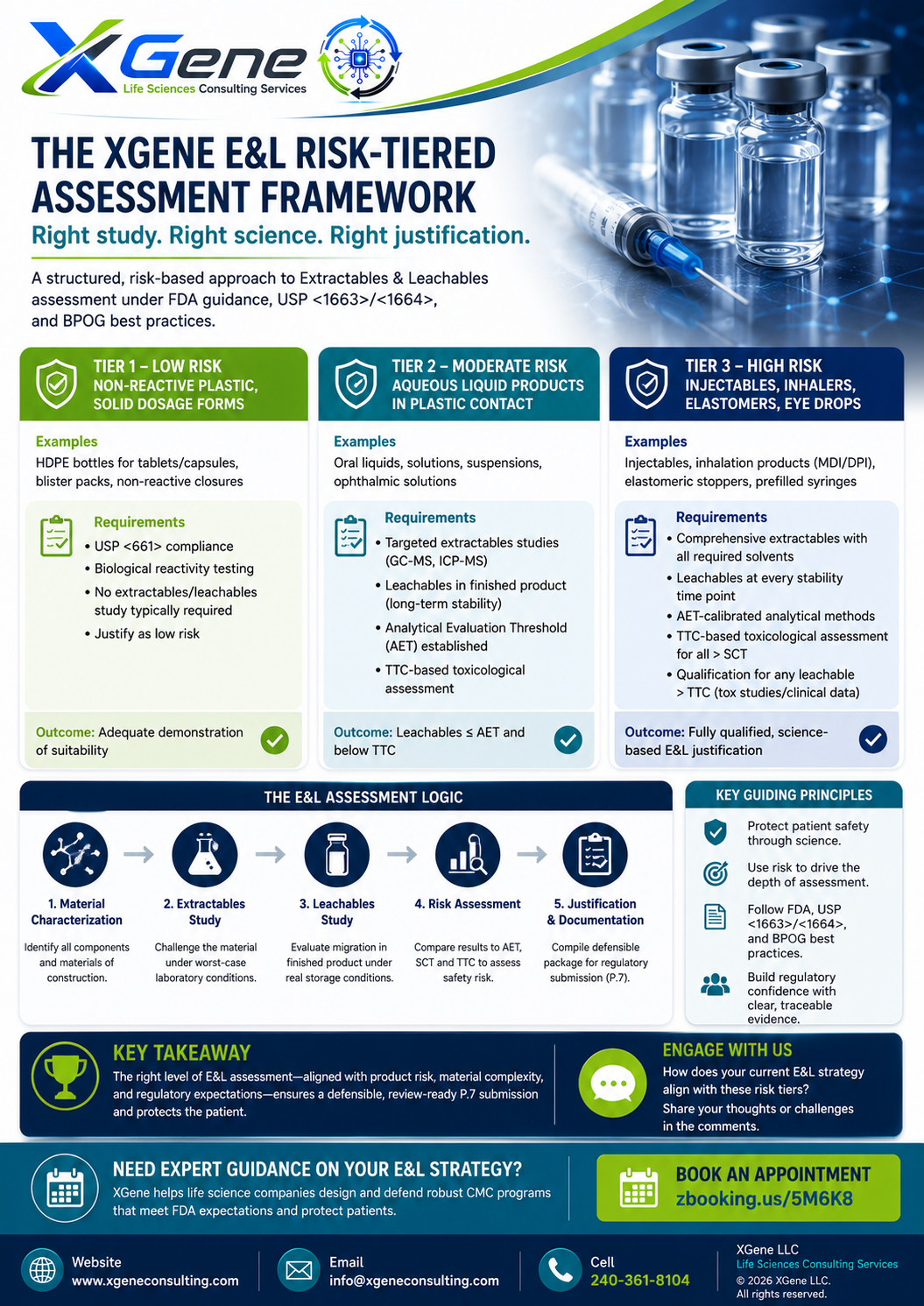
The XGene E&L Risk-Tiered Assessment Program formalizes the relationship between these technical requirements and the risk level of the specific drug product configuration. Tier 2 — applicable to aqueous liquid drug products in plastic contact, including solutions, suspensions, and oral liquids — requires targeted extractables studies using GC-MS and ICP-MS on the primary contact materials, followed by leachables confirmation at long-term stability time points. The leachables data must demonstrate that no identified leachable exceeds the applicable SCT at the proposed maximum daily dose, and that the analytical methods used achieve detection at or below the calculated AET. Tier 3 is reserved for the highest-risk configurations: inhalation drug products, ophthalmic solutions, parenteral products, and any product in direct contact with elastomeric components. At Tier 3, the full BPOG/USP <1663>/<1664> framework applies without abbreviation. This means a comprehensive extractables profile using all required solvent systems, AET-calibrated analytical methods for leachables monitoring at every scheduled stability interval, and toxicological assessment for every identified leachable above the SCT.
Inhalation Product Requirements and the Complete P.7 Documentation Package
For inhalation drug products, the regulatory bar is set higher still. FDA’s 1998 guidance on Metered-Dose Inhaler (MDI) and Dry Powder Inhaler (DPI) Drug Products specifically addresses container closure E&L requirements, and the direct deposition of leachables into the respiratory tract at every actuation creates an exposure pathway with essentially no first-pass attenuation. This is why the MDI/DPI leachables qualification framework in practice often requires full toxicological risk assessments for leachables at levels well below the standard non-genotoxic thresholds, and why FDA has issued complete response letters to inhaler submissions solely on the basis of inadequate leachables monitoring.
A complete P.7 package in a well-prepared NDA or ANDA includes the container closure system description with component specifications and CoA references, the extractables study reports with full analytical data and chromatographic documentation, the leachables study data from the stability program, the AET calculation with supporting SCT derivation and dose parameters, the toxicological assessment for all identified leachables above the SCT, and any qualification studies conducted for leachables that required further characterization. The risk tier assignment — whether Tier 1, 2, or 3 — should be explicitly stated and justified in the P.7 narrative. Reviewers expect to see the logic chain: dosage form and route, contact materials, contact conditions, risk tier, study design chosen, analytical sensitivity achieved relative to AET, and safety conclusion.
For your current drug product container closure system, has an extractables/leachables risk tier been formally assigned based on route of administration and material contact conditions — and if Tier 2 or 3 applies, has a USP <1663>/<1664>-aligned study been completed with AET calculations documented before filing?
Building a Risk-Tiered E&L Program That Satisfies FDA Review for Every Dosage Form
XGene E&L Risk-Tiered Assessment Program
TIER 1 — LOWEST RISK Applicable to: Solid oral dosage forms (tablets, capsules) in non-contact plastic (HDPE bottles, blister foil not in solution contact) Contact conditions: Dry, ambient, low SA/vol ratio, no solvent-mediated extraction Required coverage: USP <661> compendial compliance + USP <87>/<88> biological reactivity testing Analytical requirement: No dedicated extractables/leachables study required; compendial testing sufficient Stability requirement: No leachables monitoring; standard stability program Threshold application: Not required at this tier Regulatory basis: FDA Container Closure Guidance 1999; USP <661>
TIER 2 — MODERATE RISK Applicable to: Aqueous liquid drug products (oral solutions, suspensions, topicals) in direct plastic contact; non-parenteral, non-inhaled, non-ophthalmic routes Contact conditions: Aqueous or semi-aqueous, ambient to refrigerated temperatures, moderate duration and SA/vol ratio Required coverage: Targeted extractables study using GC-MS (volatile/semi-volatile organics) and ICP-MS (elemental impurities) on primary contact materials; leachables confirmation study at long-term stability time points Analytical requirement: Methods validated to achieve detection at or below the calculated AET (AET derived from SCT: 1.5 μg/day for general organic leachables, converted using product dose parameters) Stability requirement: Leachables monitoring at long-term stability time points Threshold application: SCT-based safety evaluation for all leachables identified above the SCT; qualification required for leachables above the Qualification Threshold (QT) Regulatory basis: USP <1663> (2016); USP <1664> (2016); BPOG Best Practices Guide 2014; ICH Q3D(R1) 2019
TIER 3 — HIGHEST RISK Applicable to: Inhalation drug products (MDI, DPI, nebulizer); ophthalmic solutions; parenteral products (IV, IM, SC, intrathecal); any drug product in direct contact with elastomeric components (stoppers, plungers, septa) Contact conditions: Aqueous or polar organic formulation, direct mucosal/parenteral deposition, elevated temperature stress during sterilization/fill, extended contact duration, high SA/vol ratio for elastomers Required coverage: Full BPOG/USP <1663>/<1664> extractables program — polar, non-polar, and aqueous solvent extraction; GC-MS + LC-MS (non-volatile organics) + ICP-MS; comprehensive leachables monitoring at all scheduled stability intervals Analytical requirement: AET-calibrated analytical methods with documented LOQ at or below the calculated AET for each analyte class. For OINDPs, SCT = 0.15 μg/day; for non-OINDP products, SCT = 1.5 μg/day. The AET is calculated from the SCT using the product’s dose parameters (actuations per day, labeled actuations, component mass) [citation:2][citation:8][citation:10]. Method qualification with spike recovery data; chromatographic data in submission. Stability requirement: Leachables monitoring at every scheduled stability interval (0, 3, 6, 9, 12, 18, 24, 36 months as applicable); trend analysis required; out-of-trend leachables trigger toxicological reassessment Threshold application: SCT-based toxicological risk assessment for all leachables above the applicable SCT. For OINDPs, SCT = 0.15 μg/day; for non-OINDP products, SCT = 1.5 μg/day [citation:4][citation:14]. Leachables above the Qualification Threshold (QT) require formal qualification (in vitro genotoxicity, repeat-dose tox, or clinical safety data as appropriate). Elastomer specifics: Vulcanization chemistry, accelerants, and curing agents documented; extractables profile includes N-nitrosamines, 2-mercaptobenzothiazole (MBT), thiurams — substances specifically flagged in FDA complete response letters for parenteral and inhalation submissions Regulatory basis: FDA Container Closure Guidance 1999; USP <661>; USP <1663> (2016); USP <1664> (2016); BPOG Best Practices Guide 2014; ICH Q3D(R1) 2019; ISO 10993-18; FDA MDI/DPI Guidance 1998
KEY DOCUMENTATION IN A COMPLETE P.7 PACKAGE (TIER 2 AND TIER 3): 1. Container closure system description: component identity, material of construction, manufacturer, manufacturing process (including vulcanization details for elastomers) 2. Component specifications and Certificates of Analysis with extractables-relevant tests 3. Extractables study report: study design rationale, solvent selection, extraction conditions, full analytical data with chromatograms, identified compounds with CAS numbers, semi-quantitative concentrations 4. AET calculation worksheet: SCT source, dose parameters (actuations per day, labeled actuations, component mass), AET derivation [citation:2][citation:8][citation:10] 5. Leachables study report: sampling plan, stability time points covered, methods with LOQ documentation, all detected leachables above LOQ with concentrations and trend data 6. Toxicological risk assessment: SCT comparison for each identified leachable, Cramer classification (for non-OINDP), qualification conclusion 7. Qualification studies (where required): genotoxicity data, repeat-dose toxicity summaries, or clinical safety arguments for leachables above the QT 8. Container Closure Integrity Testing (CCIT) data: method selection rationale, acceptance criteria, results at release and stability