
FDA Inspection Front Room Protocol — What to Say and What Not To
The most consequential decisions during an FDA inspection are not made in the laboratory or on the manufacturing floor — they are made in the first two hours in the…
On this pageArticle overview
The most consequential decisions during an FDA inspection are not made in the laboratory or on the manufacturing floor — they are made in the first two hours in the front room, when the tone, scope, and trajectory of the entire inspection is being established by what your team says, how they say it, and what they volunteer without being asked.
That is not an overstatement. In twenty-five years of pharmaceutical GMP and regulatory practice, I have watched experienced, technically competent teams walk into an opening meeting and hand a Form FDA 482 investigator a roadmap to every open deviation, every incomplete CAPA, and every manufacturing area with systemic documentation issues — not because the investigator asked the right questions, but because the company’s representatives did not understand that the front room is a professional discipline requiring trained execution, not a casual conversation requiring subject matter expertise alone. The difference between a no-observation exit and a Warning Letter is often traceable not to the underlying quality of the manufacturing operation but to the quality of front room management on day one.
The Opening Meeting: Setting the Inspection Scope in the First 90 Minutes
Every FDA inspection begins with a formal opening meeting, and that opening meeting is the single highest-leverage event in the entire inspection timeline. Under the FDA Investigations Operations Manual Chapter 5, investigators are authorized to conduct establishment inspections under the statutory authority of Section 704 of the Federal Food, Drug, and Cosmetic Act (21 U.S.C. § 374) — inspection authority is a statutory grant, not a codified CFR part, and their discretion to expand or narrow the scope of an inspection within that grant is broad. The Compliance Program Guidance Manual 7356.002 — which governs Drug Manufacturing Inspections — establishes that investigators may examine any manufacturing area, review any manufacturing record, and interview any employee relevant to GMP compliance. The practical implication is that what gets said in the opening meeting can either constrain or invite expansion of that investigator discretion.
The company’s opening statement should be exactly that — a prepared, practiced statement, not an improvised tour of your quality management system. Five to ten minutes is the appropriate duration. It should cover the site overview, the product portfolio manufactured at the facility, the employee count and organizational structure at a high level, and the site’s recent regulatory history including prior inspections, 483 observations, and CAPA completion status. What it should not do, under any circumstances, is volunteer areas of concern, preview ongoing investigations, or signal where the quality system has active vulnerabilities. This is not evasion — the company is legally obligated to respond to specific investigator requests honestly and completely. But a prepared statement is not a request, and volunteering information not asked for in an opening statement is a professional error with real regulatory consequences.
The type of inspection determines how the opening meeting must be calibrated. A routine surveillance inspection under the CPGM 7356.002 framework gives the investigator broad discretionary scope — they may sample across manufacturing systems, review batch records for multiple products, and evaluate quality systems at a system level. The opening statement for a surveillance inspection should be factual, organized, and crisp, giving the investigator a clear and accurate picture of the facility without providing unnecessary navigational cues toward areas of vulnerability. A pre-approval inspection is fundamentally different: it is product-specific, focused on data integrity and process validation for the application product, and the opening meeting can and should confirm the scope definition so that the inspection stays aligned with the PAI objectives rather than drifting into general surveillance territory. A for-cause inspection — triggered by a consumer complaint, recall, field alert report, or prior unresolved 483 observations — presents the highest-risk front room environment, because the investigator arrived with a defined focus and a prior basis for regulatory concern. In a for-cause inspection, the opening statement must be precisely scoped, legally reviewed before delivery, and executed with exceptional discipline. CPGM 7356.002 is explicit that for-cause inspections — whether initiated as follow-up compliance inspections to verify corrective action after a prior regulatory action, or triggered by field alert reports, complaints, or recalls — are scoped as focused coverage of the specific area of concern rather than the full-system sweep of a routine surveillance inspection, and that focused coverage is investigatively deeper on the triggering issue, not lighter. A front room team that treats a for-cause inspection like a routine surveillance visit is making a serious professional miscalculation.
The regulatory affairs or quality professional chairing the opening meeting carries the responsibility of establishing the professional register for the entire inspection. Investigators are experienced professionals conducting a regulatory compliance evaluation under federal authority. Treating the opening meeting as an opportunity to demonstrate your organization’s commitment to quality through expansive self-disclosure is a mistake. The opening meeting is an opportunity to demonstrate your organization’s competence through a focused, accurate, well-prepared presentation that respects the investigator’s authority while establishing the company’s professional credibility.
SME Training and the Answer-Only-What-Was-Asked Discipline
Subject matter experts are the operational backbone of an inspection. They are the individuals the investigator will spend the most time with — walking manufacturing areas, reviewing batch records, explaining manufacturing processes and equipment qualifications, discussing deviations and CAPA status. And they are, in most pharmaceutical organizations, the least formally trained participants in the inspection.
The technical competence of a subject matter expert is necessary but not sufficient for effective inspection performance. What SMEs need, and rarely receive through formal preparation programs, is training in the specific discipline of answering regulatory investigator questions — a discipline with one foundational principle that is harder to execute consistently under inspection pressure than it appears: answer only the question asked.
This principle is not about being uncooperative. It is about being precise. FDA investigators are trained professionals who ask targeted questions based on regulatory knowledge, document review, and observation. When an SME answers beyond the question asked — elaborating on adjacent processes, volunteering context that was not requested, explaining why something was done differently than it might appear — they are providing the investigator with information that was not elicited, about topics that may not have been on the inspection agenda. Every piece of unsolicited information is a potential new thread in an investigation that started with a focused question about something else. ICH Q10 establishes that a pharmaceutical quality system is an integrated enterprise, and experienced FDA investigators understand that principle operationally: one thread, followed consistently, connects to adjacent systems, and a well-trained investigator will follow it.
The answer-only-what-was-asked protocol requires three complementary behaviors. First, SMEs must understand the exact boundaries of their assigned domain. Each SME should be designated for a specific manufacturing area or quality system, trained to handle questions within that domain, and clearly not expected to speak to areas outside it. When a question falls outside an SME’s domain, the correct answer is to offer to connect the investigator with the appropriate subject matter expert — not to speculate, not to answer partially, not to expand into adjacent territory to be helpful. Second, SMEs must be trained to handle ambiguous questions by asking for clarification rather than interpreting broadly and answering comprehensively. Asking a clarifying question is a sign of professional precision, not evasiveness. Third, and critically, SMEs must be coached that “I don’t know, but I will find that information for you” is a complete and professionally appropriate answer. Speculation under inspection pressure — answering a question the SME does not have full information on rather than acknowledging the knowledge boundary — is one of the most common and most consequential front room errors. An incorrect answer to an investigator question creates a discrepancy when the correct documentation is eventually reviewed. That discrepancy becomes an observation about data reliability or management comprehension that did not need to exist.
Document production is the third axis of SME-related front room management. No document should reach the front room without passing through back room review. The back room — staffed by regulatory affairs, quality, and legal personnel — is responsible for reviewing every record requested by the investigator before it is produced, ensuring that what is provided is complete, accurate, and not inadvertently accompanied by additional records that were not requested. A document log should be maintained for every record produced during the inspection. Original documents should be retained unless the investigator specifically requests originals; certified copies satisfy the production requirement in the vast majority of inspection document exchanges. This workflow is not bureaucratic friction — it is a quality control step for the inspection itself, ensuring that the information flowing from the company to the investigator is verified and intentional.
The Closing Meeting: Managing Potential 483 Observations Before They Are Written
The closing meeting is the last moment at which an inspection can be actively managed toward a favorable outcome, and it is consistently underutilized. FDA investigators typically present potential Form FDA 483 observations at the closing meeting before they are formally issued. That presentation is not a formality — it is an opportunity for the company to engage with each potential observation, provide clarifying information, demonstrate that a finding reflects an isolated deviation rather than a systemic gap, or establish that a corrective action is already underway and documented.
The closing meeting requires the same professional discipline as the opening meeting, but with higher technical stakes. Before the investigator presents observations, the back room team should have worked throughout the inspection to maintain a real-time triage list of every potential finding — every document the investigator spent significant time reviewing, every question that prompted an “I will find that for you” response, every manufacturing area that received extended scrutiny. That pre-closing observation list drives the company’s preparation: what clarifying information can be provided, which deviations have documented corrective actions that were not referenced during the inspection floor walk, where does the company have a factual basis to provide context that could change the characterization of a finding.
At the closing meeting itself, the company should listen to each potential observation fully before responding, ask clarifying questions to confirm its understanding of the investigator’s concern, and then provide factual information or documentation that addresses the concern — calmly, specifically, and without argument. Challenging an investigator’s conclusion directly or appearing to minimize a genuine finding creates adversarial dynamics that complicate the post-inspection regulatory relationship. Providing accurate, well-documented information that gives the investigator a complete factual picture, including information that may not have been available during the inspection body, is both appropriate and frequently effective.
The FDA Investigations Operations Manual, Chapter 5, Subchapter 5.2.3, is clear that each observation documented on Form FDA 483 is recorded at the investigator’s individual professional judgment as to what conditions may, in that investigator’s assessment, constitute a violation — and that the Form FDA 483 itself does not represent a final Agency determination of noncompliance. That professional discretion is real and should be respected. What the closing meeting accomplishes, when executed well, is ensuring that every observation on the 483 that is issued reflects the investigator’s considered judgment on complete information — not an inference drawn from incomplete records or an SME answer that was imprecise under pressure. That distinction is the difference between a 483 response that corrects a documented deficiency and a Warning Letter that addresses a systemic regulatory breakdown.
The 483 response process should be initiated within 48 hours of inspection close, regardless of whether the company intends to contest any observation. Demonstrating organizational responsiveness in the immediate post-inspection window communicates the operational culture of the quality system more effectively than any policy document can — and FDA’s evaluation of 483 responses considers the speed of initial engagement as a signal of the seriousness with which the site takes regulatory compliance.
XGene Inspection Front Room Management Protocol
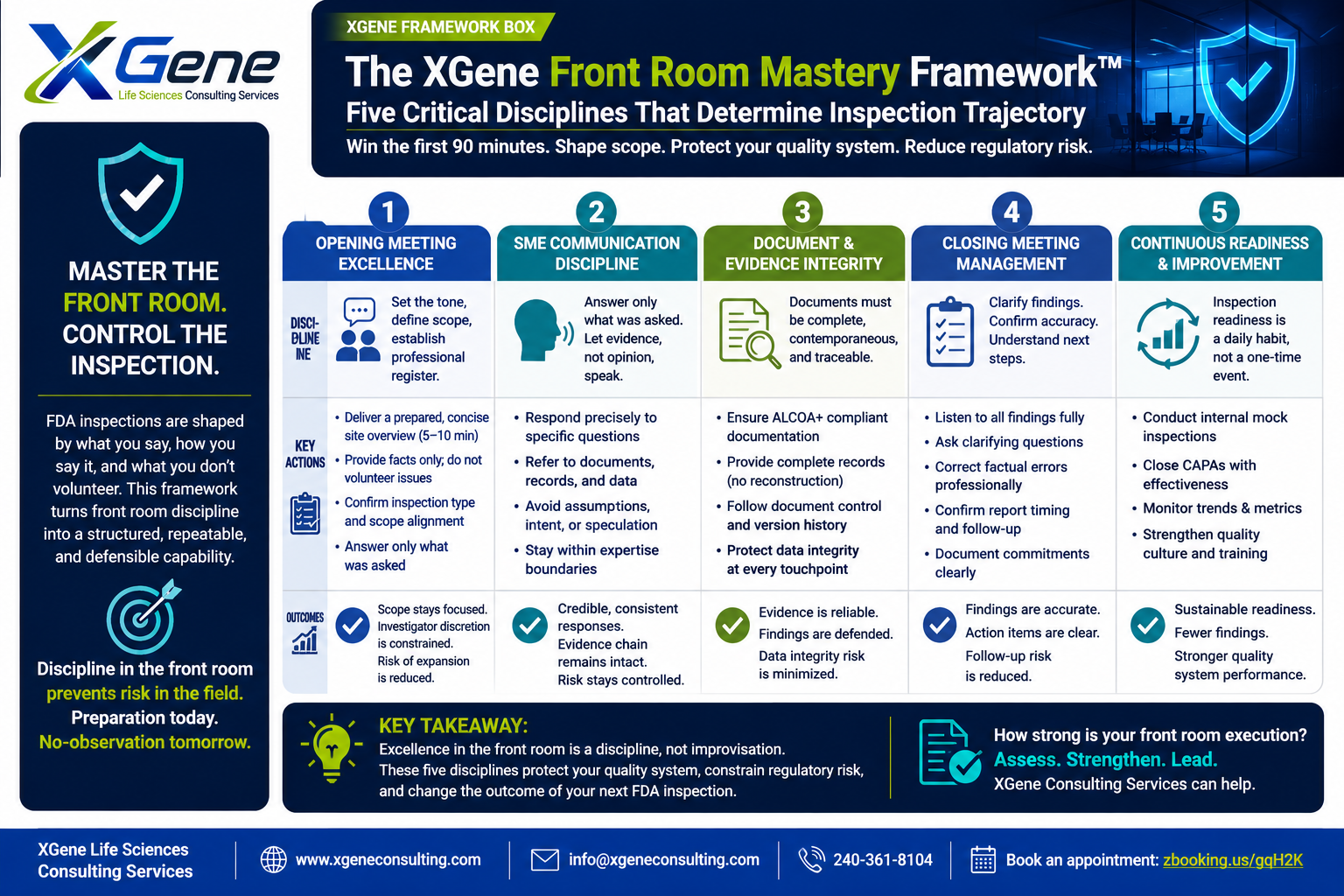
1. SME Role Definition and Domain Mapping Designate a specific subject matter expert for each manufacturing area and quality system covered by the inspection scope. Document each SME’s designated domain in writing before the inspection begins. SMEs are authorized to speak to their domain only; cross-domain questions are redirected to the appropriate SME or referred to the back room.
2. Opening Statement Development and Practice Prepare a formal opening statement of five to ten minutes covering site overview, product portfolio, employee count, and regulatory history. Practice the statement with a mock investigator. Confirm that no areas of concern, open investigations, or systemic quality issues are volunteered in the statement or in response to informal pre-opening conversation.
3. Answer-Only-What-Was-Asked Protocol Train every SME on the four permissible responses to investigator questions: a direct answer to the question asked; a clarifying question when the question is ambiguous; a referral to the appropriate SME when the question is outside the designated domain; and “I don’t know, but I will find that information for you” when the answer is not immediately certain. Speculative or partially informed answers are not permitted.
4. Document Production Workflow with Back Room Review Establish a back room staffed by regulatory affairs, quality, and legal personnel responsible for reviewing every document before it reaches the front room. Maintain a document production log throughout the inspection. Produce certified copies by default; produce originals only if specifically requested by the investigator.
5. Real-Time Scope Monitoring Assign a back room team member to track every investigator question, document request, and area of extended scrutiny throughout the inspection day. Update the pre-closing observation triage list continuously. Flag any pattern suggesting scope expansion and alert the front room lead before the investigator formalizes a new line of inquiry.
6. Closing Meeting Preparation with Pre-Closing Observation Triage Before the closing meeting, review the pre-closing observation triage list and prepare factual responses, supporting documentation, and CAPA status summaries for every potential finding. Enter the closing meeting with complete information for each anticipated observation. Listen fully before responding. Provide factual context; do not argue.
7. Post-Inspection 483 Response Initiation Within 48 Hours Assign 483 response ownership within 24 hours of inspection close. Draft the initial response framework — observation-by-observation, with root cause, corrective action, and completion timeline — within 48 hours. Submit the formal response within 15 business days unless an extension has been discussed with the district office. Document every response commitment in your CAPA system.