
Module 3 Authorship — The Method That Gets CMC Packages Approved
The CMC package FDA receives is not evaluated solely on the science it contains — it is evaluated on whether the scientific narrative is coherent, internally consistent, and written in…
On this pageArticle overview
The CMC package FDA receives is not evaluated solely on the science it contains — it is evaluated on whether the scientific narrative is coherent, internally consistent, and written in a way that allows a reviewer to reach an approval decision without having to resolve contradictions between sections.
That distinction is not rhetorical. FDA’s MAPP 5015.10, which governs how Office of Pharmaceutical Quality reviewers evaluate the CMC section of an NDA or BLA, makes clear that a reviewer’s job is not to reconstruct your scientific argument from disconnected data packages — it is to follow the argument you have already made and determine whether it is adequately supported. When the argument is absent, incomplete, or internally inconsistent, the review does not continue in your favor; it generates an information request that resets the clock. In a competitive development environment where a single Complete Response Letter can cost a program six to twelve months, Module 3 authorship is not a documentation task. It is the submission strategy itself.
The problem most CMC teams have is not a lack of science. It is a lack of authorship — the trained capacity to integrate pharmaceutical development rationale, process understanding, analytical control strategy, and specification justification into a single unified scientific argument. ICH M4Q(R1), the CTD Quality guideline that establishes the architecture of Module 3, was designed to enable that argument. Most Module 3 packages fail to make it.
Who Should Write Module 3: The Author Qualification Problem That Causes Review Failures
The most common structural failure in Module 3 authorship is organizational rather than scientific: sections are written by whoever owns the underlying data, and no one is responsible for the document as a coherent whole. A formulation scientist writes 3.2.P.2. An analytical chemist writes 3.2.P.5. A regulatory associate writes the Quality Overall Summary in Module 2.3.P. No one integrates them. The result is a package where each section is individually defensible but collectively incoherent — where the acceptance criteria in the specification table do not explicitly trace back to the development data that generated them, where the QOS reads like a section-by-section digest rather than a regulatory argument, and where an FDA reviewer encounters the first internal inconsistency approximately twenty pages in.
ICH Q8(R2), Pharmaceutical Development, establishes that the 3.2.P.2 section is not a chronological account of formulation history — it is a presentation of the design space rationale with supporting data. That distinction matters because 3.2.P.2 is the scientific foundation on which every downstream section depends. Every critical quality attribute identified in P.2.1, every formulation design decision documented in P.2.2, every manufacturing process understanding claim in P.2.3 — these become the referenced rationale for process controls in 3.2.P.3, specification acceptance criteria in 3.2.P.5, and the integrated narrative in 2.3.P. When 3.2.P.2 describes what your team did over three years of development instead of what your final product design requires and why, the foundation collapses, and every section downstream loses its evidentiary anchor.
The authorship qualification problem is that writing a regulatory-grade 3.2.P.2 is not a scientific task — it is a rhetorical task performed with scientific material. An FDA reviewer reading MAPP 5015.10 expects to see the link between your development knowledge and your control strategy made explicit, in prose, with cross-references to the data. That requires a co-authorship model in which the CMC scientist who owns the development knowledge and the regulatory writer who understands the reviewer’s decision framework are working on the same document at the same time — not handing files back and forth three weeks before submission.
The Structure of a Module 3 Section That Reviewers Can Navigate Without Queries
FDA’s 1987 Guidance on the Format and Content of the Chemistry, Manufacturing, and Controls Section of an NDA remains the foundational document for how Module 3 sections should be architecturally organized — not because it is the most current guidance, but because it describes the information hierarchy that reviewers still expect to navigate. Within that hierarchy, the operative principle is that every claim must be traceable to its evidentiary basis within the same document, and every cross-reference must resolve to a specific section and data set rather than a general statement. When a specification acceptance criterion appears in 3.2.P.5.1 and no cross-reference to 3.2.P.2 data exists, the reviewer faces a binary choice: query it or accept it without understanding the basis. Reviewers query it.
The architecture that prevents this begins with 3.2.P.2 as a structured rationale document — not a narrative summary. ICH Q11, Development and Manufacture of Drug Substances, applies this same principle to the drug substance: development data, process parameter characterization, and control strategy must connect to form a coherent argument for why the defined control space is adequate. The same architecture applies to the drug product. When 3.2.P.3 describes critical process parameters and the ranges in 3.2.P.3.3 cannot be traced back to the design space justification in 3.2.P.2.3, the process section becomes unsupported assertion. When 3.2.P.3.5 references a process validation protocol rather than completed validation data, the review stops — not as a technicality, but because the CTD architecture requires that the data package be complete at the time of submission, not in progress.
The QOS, governed by ICH M4Q(R1) and the associated FDA Questions and Answers guidance, is the most misunderstood document in the Module 3 package. It is not a summary. It is the reviewer’s primary decision document — the place where the sponsor’s scientific argument is made at the level of regulatory conclusion, with every critical claim explicitly referenced to the supporting Module 3 section. A QOS written as a section-by-section digest, restating specification numbers without explaining their scientific basis and describing process steps without connecting them to development rationale, does not help a reviewer reach an approval decision. It tells the reviewer that no integrated argument has been made and that they will have to find one themselves — which is when deficiency letters get written.
Cross-Referencing Between 3.2.S and 3.2.P: The Consistency Errors That Generate Deficiency Letters
Internal consistency between the drug substance (3.2.S) and drug product (3.2.P) sections of Module 3 is not a proofreading requirement — it is a regulatory requirement with substantive review consequences. When the drug substance specification in 3.2.S.4.1 states an assay acceptance criterion of 98.0–102.0% and the drug product development section references a different incoming material range in 3.2.P.2, the reviewer does not call it a typo. The reviewer issues a deficiency requesting reconciliation of the specifications across sections, explanation of why the ranges differ, and confirmation that the drug product formulation studies were conducted using material within the stated specification range. That deficiency requires a substantive response, not a correction.
The same consistency requirement applies within the drug product sections. The batch formula in 3.2.P.3.2 must match the batch description referenced in the QOS. The overage values in the batch formula must match the justification provided in 3.2.P.3.6. The release and shelf-life specifications in 3.2.P.5.1 must match the values cited in the stability data presentation in 3.2.P.8. When these cross-section numbers do not align — and they frequently do not in packages assembled by multiple authors without an integration review — a reviewer identifying a single discrepancy is motivated to check every other cross-reference in the package. The deficiency letter that results is not one question. It is a systematic documentation failure documented across every section where the inconsistency has downstream implications.
The mechanism by which these errors compound is organizational. In a typical NDA or BLA submission timeline, 3.2.S is authored months before 3.2.P, and 2.3.P is written last. If no integration review occurs at the QOS authorship stage, the QOS writer is working from finalized section content that has not been cross-checked for numerical consistency. FDA’s M4Q(R1) Questions and Answers guidance explicitly addresses the expectation that Module 2 narratives are consistent with Module 3 data and that discrepancies constitute grounds for additional information requests. The guidance is not ambiguous on this point: the QOS is a regulatory document, not a convenience summary, and it is evaluated accordingly.
The XGene Module 3 Authorship Standard: What Every Section Must Demonstrate
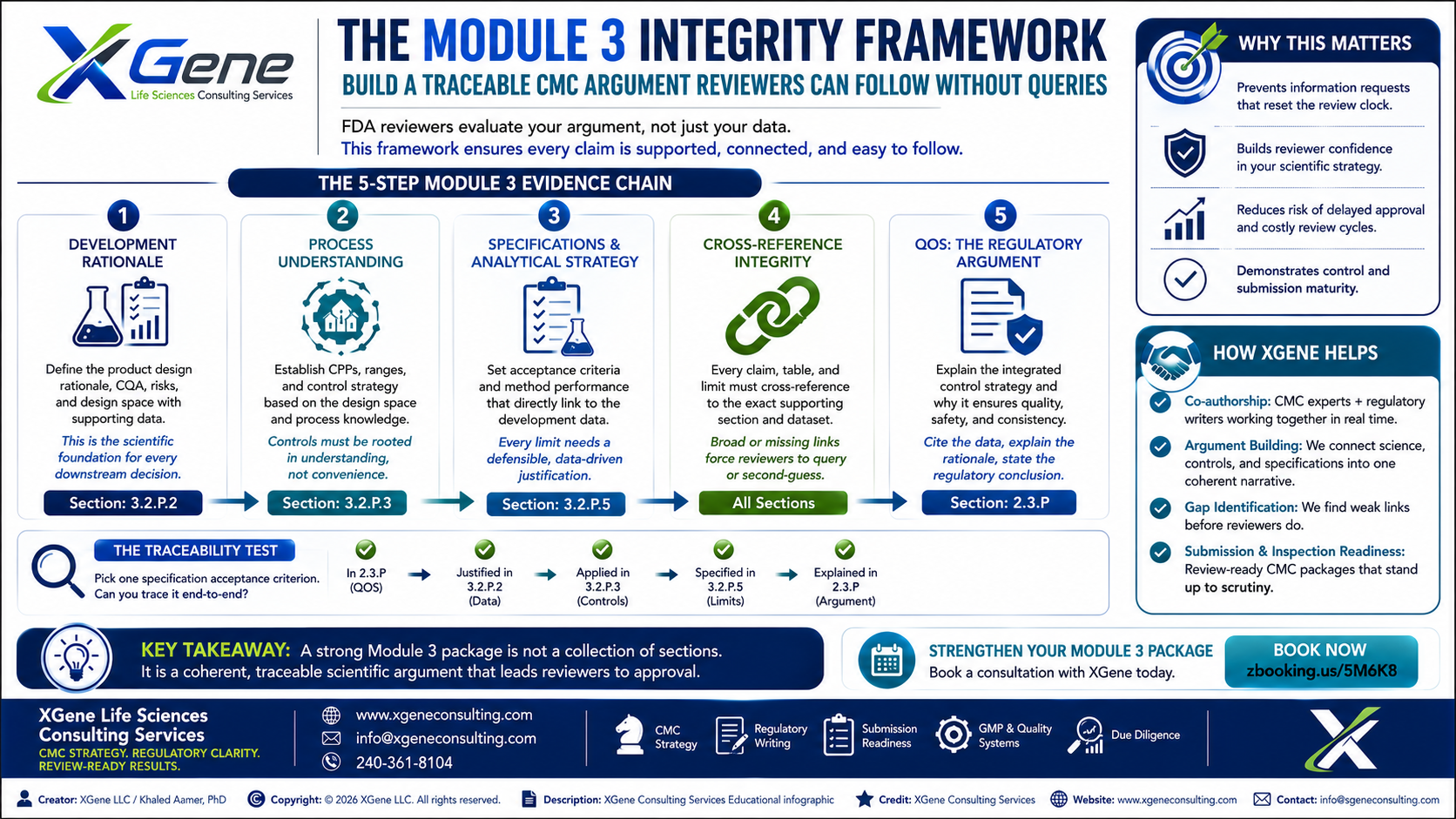
1. CMC Narrative Architecture Document — Before authorship begins, map the scientific argument across all Module 3 sections: identify which development datasets in 3.2.P.2 justify each acceptance criterion in 3.2.P.5, which process characterization data in 3.2.P.2.3 supports each critical process parameter range in 3.2.P.3.3, and which analytical method validation conclusions in 3.2.P.5.3 anchor the QOS control strategy narrative in 2.3.P. This document is the authorship blueprint — it defines the argument before the prose is written.
2. Named Section Ownership with CMC Scientist Co-Authorship — Assign each Module 3 section to a named CMC scientist with the technical expertise to own the content, paired with a regulatory writer responsible for the document architecture. No section is authored by regulatory affairs alone; no section is authored by a scientist who does not understand what cross-references that section must supply to the QOS and to downstream sections. This pairing is enforced, not optional.
3. Cross-Reference Checkpoint Review — At 80% draft completion, conduct a structured cross-reference audit: verify that every specification acceptance criterion in 3.2.P.5.1 and 3.2.S.4.1 cites the specific dataset in 3.2.P.2 or 3.2.S.2 that generated it; confirm that batch formula values in 3.2.P.3.2 match QOS batch descriptions; confirm that CPP ranges in 3.2.P.3.3 trace to process development rationale; confirm that process validation in 3.2.P.3.5 references completed data, not protocols. Every discrepancy is logged against the authorship blueprint and resolved before QOS authorship begins.
4. Pre-Submission Integration Review Against Reviewer Decision Criteria — Conduct a final review of the complete Module 3 package using MAPP 5015.10 reviewer decision criteria as the evaluation framework: can a reviewer follow the scientific argument from 3.2.P.2 through 3.2.P.5 and 3.2.P.3 to the QOS without encountering an unresolved cross-reference, an unsupported acceptance criterion, or a specification inconsistency between sections? Deficiencies identified in this review are resolved pre-submission, not in response to an FDA information request.
The output of the XGene Module 3 Integrated Authorship Framework is a submission-ready CMC package in which every acceptance criterion, process control, and QOS narrative claim is anchored to a specific dataset, every cross-reference resolves without contradiction, and the reviewer’s path from scientific argument to approval decision has been pre-built rather than left to the reviewer to reconstruct.
Companies that treat Module 3 as a documentation exercise rather than a scientific argument strategy discover the cost of that framing at the point of review — in the form of a Complete Response Letter that lists five to twelve information requests that were preventable, each requiring a substantive written response and, in many cases, additional studies. That outcome does not represent a science failure. It represents an authorship failure: the team had the data to support approval and lacked the integrated document architecture to present it. The teams that consistently achieve first-cycle approvals are not necessarily running more rigorous development programs than their peers — they are more rigorous about how they translate that development knowledge into the regulatory argument that FDA reviewers need to act on. Authorship competency, applied systematically before submission, is not overhead. It is the difference between a first-cycle approval and a six-month delay.