
The Ionizable Lipid pKa Principle: Why the Chemistry You Select at Formulation Development Becomes the CQA You Cannot Escape at BLA
The apparent pKa of the ionizable lipid component is not a routine physicochemical descriptor. It is the master variable from which endosomal escape efficiency, organ biodistribution, immune activation profile, and…
On this pageArticle overview
The apparent pKa of the ionizable lipid component is not a routine physicochemical descriptor. It is the master variable from which endosomal escape efficiency, organ biodistribution, immune activation profile, and systemic tolerability all emerge — simultaneously and inseparably. When a formulation scientist selects an ionizable lipid structure and a target mole fraction, that choice encodes a pH-dependent ionization behavior that will govern how the finished drug product behaves from the moment it enters circulation to the moment its nucleic acid payload reaches the cytosol of the target cell. The tragedy in many LNP development programs is not that teams fail to understand the principle — it is that they treat pKa as a characterization output rather than a design input, and they pay for that inversion at the worst possible time: in response to a regulatory deficiency letter during BLA review.
The Biphasic Mechanism: Stealth in Circulation, Fusogenic in the Endosome
The mechanism is precise and worth stating in full. At physiologic pH 7.4, an ionizable lipid with an apparent pKa in the range of 6.2–6.5 carries a net-neutral or near-neutral surface charge. This neutrality is not cosmetic. It is the molecular basis of stealth. Charged nanoparticles in circulation are recognized rapidly by complement proteins and opsonins, and cleared by mononuclear phagocyte system macrophages in the liver and spleen — a pathway that shortens circulatory half-life and reduces the probability of reaching the intended target cell population. A near-neutral surface charge at pH 7.4 suppresses this opsonization cascade, extends systemic exposure, and permits hepatic accumulation via the fenestrated sinusoidal endothelium that remains accessible to particles in the 50–100 nm range. The structural logic is elegant: the ionizable lipid is designed to be invisible to the immune system during transit and weaponized once it arrives.
The second half of the mechanism operates in the endosomal compartment. After receptor-mediated endocytosis, the LNP is trapped within an early endosome that rapidly acidifies toward pH 5.0–5.5 as the vesicle matures toward a late endosome and lysosome. At this reduced pH, an ionizable lipid with pKa 6.2–6.5 becomes substantially protonated. The resulting positive charge density at the lipid bilayer interface creates electrostatic interactions with the anionic phospholipids of the endosomal membrane — phosphatidylserine and bis(monoacylglycero)phosphate in particular — that destabilize the lamellar membrane structure and drive the formation of inverted hexagonal and cubic non-lamellar phases. These non-lamellar intermediates are membrane-fusogenic: they physically disrupt the endosomal membrane and release the nucleic acid cargo into the cytosol before lysosomal nuclease degradation can occur. This is endosomal escape, and it is entirely pKa-dependent. A lipid with a pKa too high — above 7.0 — retains positive charge at physiologic pH, is cleared in circulation before endocytosis occurs, and activates innate immune pathways. A lipid with a pKa too low — below 5.8 — is insufficiently protonated in the endosomal pH window, fails to drive membrane disruption, and achieves poor cytosolic delivery. The endosomal escape window is narrow, and the pKa must be tuned to sit precisely above it.
From Onpattro to Pulmonary Delivery: How the Target pKa Changes with Administration Route
The founding precedent for this principle in approved LNP therapeutics is DLin-MC3-DMA, the ionizable lipid in patisiran (Onpattro), the first FDA-approved siRNA drug product. The BLA public approval package reviewed by FDA CDER in 2018 documents a pKa of approximately 6.44 for DLin-MC3-DMA in the finished drug product formulation. This value was not accidental. It was the product of systematic structure-activity relationship work that preceded IND filing, and it established the hepatic delivery phenotype of Onpattro: high potency in hepatocytes, defined biodistribution to liver, and a manageable immunogenicity profile compared to earlier cationic lipid formulations. The 6.44 figure became a reference point against which subsequent hepatic-targeting ionizable lipids are benchmarked, and it anchors the defensible target range of 6.2–6.5 for liver-directed LNP products that has since been reinforced by mechanistic data published by Kulkarni et al. in Nature Nanotechnology and by the foundational structure-activity work by Semple et al. in Nature Biotechnology.
The route-of-administration dependence of the pKa target is equally important and more frequently underappreciated. Hepatic delivery through the sinusoidal endothelium and receptor-mediated endocytosis in hepatocytes involves an endosomal acidification kinetics profile that is well-characterized and consistent with the 6.2–6.5 pKa window. Pulmonary delivery via inhalation or intratracheal administration operates under different constraints: the airway epithelial cell endosomal environment is less aggressively acidified, and the optimal ionizable lipid pKa for lung-targeted LNPs shifts toward the 6.8–7.4 range. Programs developing inhaled mRNA therapeutics — for respiratory syncytial virus, influenza, or cystic fibrosis — that borrow the Onpattro ionizable lipid pKa target without route-specific mechanistic justification are operating without a defensible rationale, and that absence will be identified in a well-organized pharmaceutical development section review.
The Emergent Property Problem: Why Finished Formulation pKa Is a Mandatory CQA
The emergent property problem is what makes pKa a formulation-level CQA rather than a component-level test. The apparent pKa measured on an isolated ionizable lipid in aqueous solution — by, for example, pH-metric titration of the neat compound — is categorically not equivalent to the apparent pKa of the finished LNP formulation. The ionizable lipid does not exist in isolation in the finished drug product; it exists in a multicomponent lipid bilayer matrix alongside phospholipid, cholesterol, and PEG-lipid at defined mole fractions. The pKa emerges from the local dielectric environment of the lipid head group within that matrix — and that environment is sensitive to the mole fractions of all surrounding lipid species. This is not a theoretical concern. Experimental data consistently demonstrate that mole fraction shifts of 2–3% in any major lipid component produce shifts of 0.4–0.8 pH units in the apparent pKa of the ionizable lipid in the finished formulation. A shift of 0.5 pH units in the hepatic pKa window of 6.2–6.5 is not noise — it spans the entire defensible specification range. It is the difference between a product that achieves endosomal escape and one that does not.
This is the mechanistic foundation for the regulatory position that ICH Q8(R2) demands and that FDA’s Draft Guidance on Drug Products Including Biological Products That Contain Nanomaterials (2017, updated 2022) reinforces: critical quality attributes must be identified through a science-based understanding of the relationship between formulation parameters and clinical performance. The apparent pKa of the ionizable lipid in the intact finished drug product satisfies every element of a CQA definition under the ICH framework. It is measurable, it is linked to mechanism of action, it is sensitive to manufacturing variation, and changes in its value have direct consequences for endosomal escape efficiency, biodistribution, immune activation, and the safety and efficacy outcomes that the clinical program is designed to demonstrate. There is no alternative characterization endpoint that captures this biology as directly or as completely. Particle size does not. Encapsulation efficiency does not. Lipid identity by HPLC does not. The pKa, measured on the intact finished drug product, is irreplaceable — and it must be in your QTPP before your pre-IND meeting, not discovered as an afterthought at BLA readiness review.
XGene LNP Formulation CQA and pKa Specification Architecture
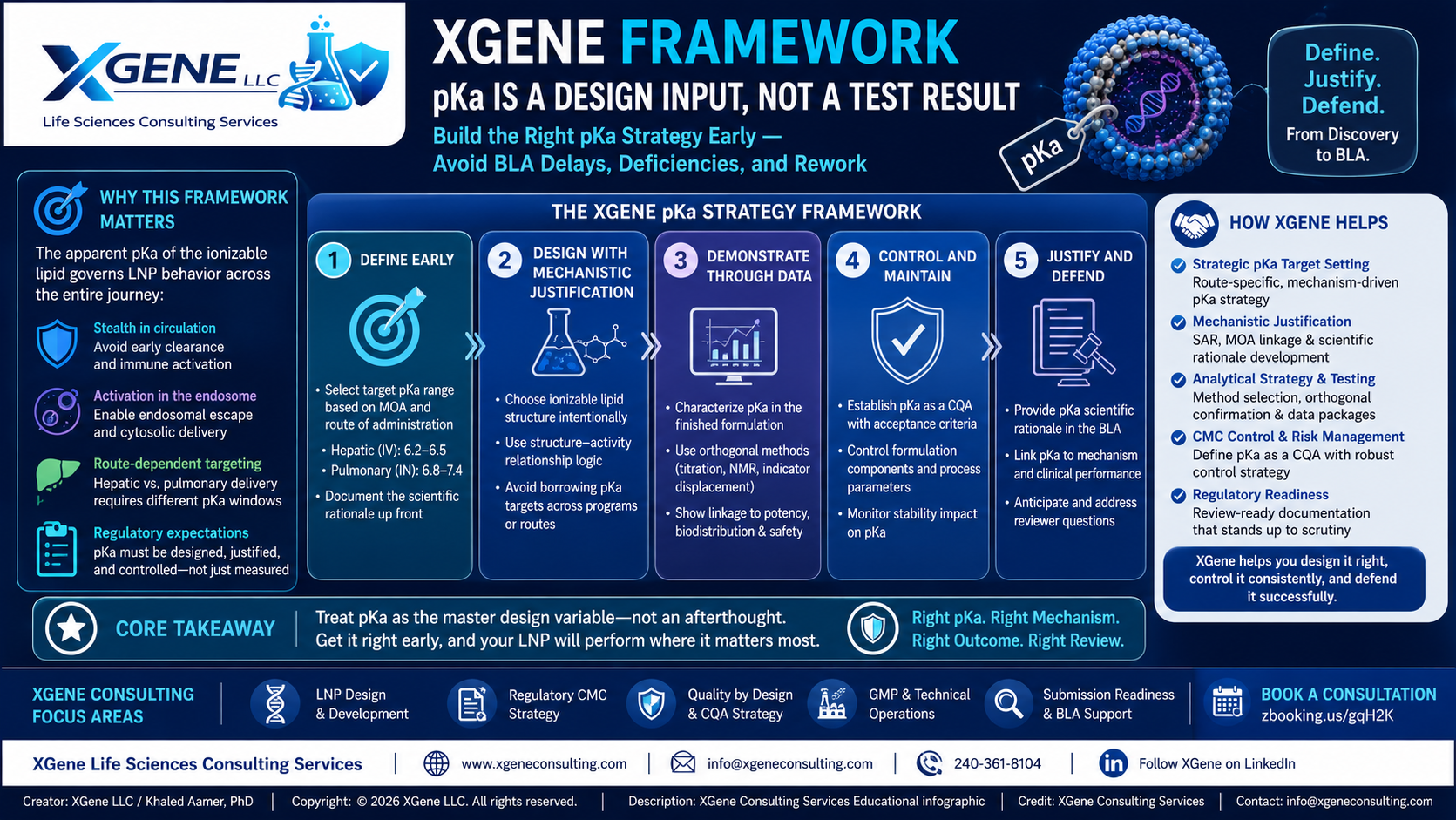
Step 1 — Define Target pKa from Mechanism Establish the target apparent pKa from in vitro endosomal escape efficiency data. For hepatic delivery, the defensible target range is 6.2–6.5 pH units, anchored to the DLin-MC3-DMA precedent (pKa ~6.44) and mechanistic endosomal pH window (5.0–5.5). For pulmonary delivery, adjust target range to 6.8–7.4 with route-specific mechanistic justification documented in the pharmaceutical development section. The target must appear in the QTPP and be linked explicitly to the route of administration and the endosomal escape mechanism before pre-IND submission.
Step 2 — Work Backward to Ionizable Lipid Structural and Mole Fraction Ranges From the target pKa, define the structural constraints on the ionizable lipid head group and tail architecture, and the acceptable mole fraction ranges for all lipid components. Document that mole fraction shifts of 2–3% in any major component can shift apparent pKa by 0.4–0.8 pH units. Use this sensitivity data to set tight mole fraction specifications at the drug product manufacturing step — not at the lipid excipient release step alone.
Step 3 — Design TNS Method Qualification and Validation Plan The TNS (2-(p-toluidino)-6-naphthalenesulfonic acid) assay must be performed on intact finished drug product across a pH gradient of 2.5–11.0 using validated buffer systems. The sigmoidal fluorescence response curve inflection point defines the apparent pKa. Method qualification must include pH-gradient buffer system suitability criteria, demonstration that assay results are not confounded by excipient fluorescence interference, and inter-laboratory precision data demonstrating that pKa variation across sites is within ±0.3 pH units. TNS on isolated ionizable lipid or on lipid film without full formulation assembly does not constitute an adequate measurement for the finished drug product CQA.
Step 4 — Construct Specification Range with Statistical Justification The lot release specification range for apparent pKa should be set at ±0.5 pH units around the target value based on the following justification: mechanistic data linking pKa to endosomal escape efficiency, manufacturing history demonstrating lot-to-lot variation of ±0.2–0.3 pH units under controlled process conditions, and the sensitivity analysis from Step 2 quantifying the impact of mole fraction variation. Wider specification ranges require additional clinical bridging data. The specification must appear in the drug product control strategy, the lot release certificate, and the pharmaceutical development section’s design space description consistent with ICH Q8(R2).