
3.2.S.1 Drug Substance General Information: The Identity Foundation Every CMC Submission Must Get Right
FDA's most common opening question for a new drug substance file is not about impurities or stability — it is about identity. When the structural representation, nomenclature, and physicochemical characterization…
On this pageArticle overview
FDA’s most common opening question for a new drug substance file is not about impurities or stability — it is about identity. When the structural representation, nomenclature, and physicochemical characterization in 3.2.S.1 are inconsistent with the rest of Module 3, every downstream section is suspect before the technical review begins.
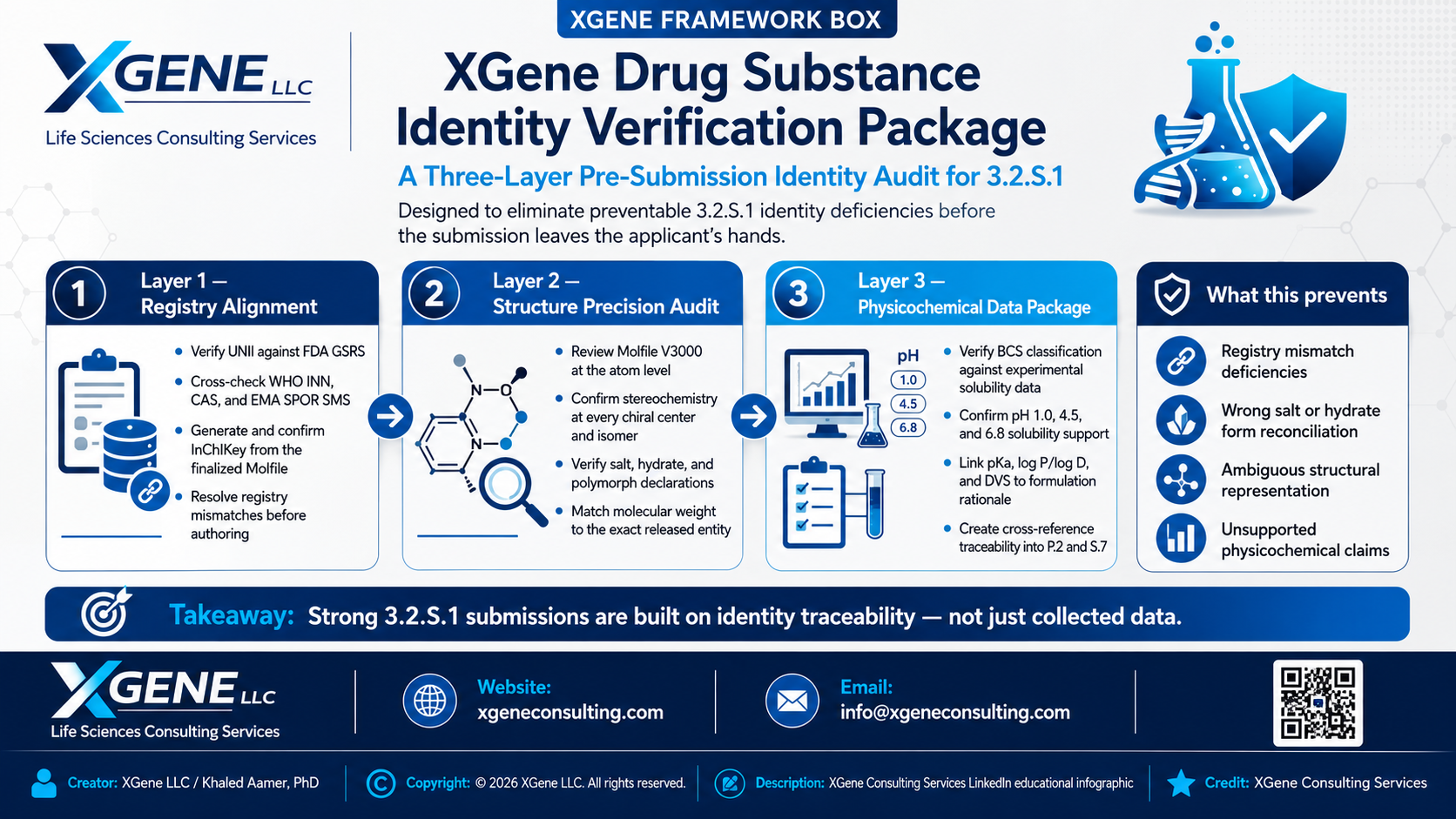
A reviewer who encounters a molecular weight stated for the anhydrous free base while the manufacturing section describes a hydrochloride salt monohydrate has one immediate, rational response: stop trusting the package and start auditing it. That audit does not stay in 3.2.S.1. It radiates into the specification limits in 3.2.S.4.1, the reference standard characterization in 3.2.S.5, and the dissolution acceptance criteria in 3.2.P.5.6. The business consequence of an incomplete identity foundation is not a single deficiency letter — it is a synchronized review hold across multiple CTD sections that extends the NDA/BLA clock by months. Section 3.2.S.1 is not administrative housekeeping; it is the authoritative identity anchor that the reviewer uses to verify cross-module consistency throughout the entire CMC package.
What 3.2.S.1 Must Establish: The Identity Foundation Every CMC Submission Requires
ICH Q11 §A2.1 defines the drug substance description requirement as encompassing the physical, chemical, biological, and microbiological properties relevant to the drug substance — including its name, structure, general properties, and manufacturer. That language is deliberately broad, but FDA’s PQ-CMC Implementation Guide v2.0 operationalizes it into structured data fields that the eCTD must populate: the UNII code verified against the FDA GSRS registry, the INN assigned through the WHO INN Programme, the USAN where applicable, the CAS registry number, the IUPAC 2013 Recommendations-compliant chemical name, and the InChI standard identifier with its InChIKey generated per the InChI Trust specification. These are not parallel options — they are a coordinated identity package, and a mismatch between any two of them in the same submission is a deficiency.
The UNII code deserves particular attention because it is the interoperability node between FDA’s GSRS and EMA’s SPOR SMS. When the UNII code in a submitted 3.2.S.1 does not match the current FDA GSRS registry entry — a deficiency pattern that appears with enough regularity to be considered routine — the immediate consequence is that the reviewer cannot programmatically cross-reference the substance identity to FDA’s internal records. The EMA side of this problem is structurally identical: SPOR SMS uses the same UNII as its substance linkage identifier, so an uncorrected GSRS mismatch in an NDA creates a cascading identity error in a parallel MAA without the sponsor necessarily recognizing the connection. Before any submission package is locked for eCTD publishing, the UNII must be verified against the live GSRS API — not against a cached internal document that may reflect a superseded registry entry.
The InChIKey is the machine-readable identity fingerprint that reviewers and systems use to verify structural uniqueness. A mismatch between the InChIKey in 3.2.S.1 and the structure depicted in 3.2.S.3.1 — the structure elucidation section — is one of the most operationally damaging deficiencies in this section because it signals to the reviewer that the 2D structural file and the identity declaration were generated independently and never reconciled. This is precisely the scenario the InChI Trust standard exists to prevent: the InChIKey must be computationally derived from the Molfile V3000 that appears in 3.2.S.3.1, not typed independently.
Nomenclature, Structure Elucidation, and the Polymorphism Declaration: Where Reviews Stall
The 2D structural representation submitted in 3.2.S.1 must be in Molfile V3000 format with explicit stereochemistry encoded — not implied, not described only in the IUPAC name, but drawn and flagged in the connection table. For chiral centers, the R/S designation must be defined in the structure file, and the absolute stereochemistry must be supported by experimental evidence cited in or cross-referenced to 3.2.S.3.1. A reviewer who sees an undefined chiral center at, for example, C-4 in the structural representation will issue a direct deficiency: “The absolute stereochemistry at C-4 is not defined in the structural representation.” That deficiency is not resolved by adding a sentence to the text — it requires regenerating the Molfile with correct stereochemistry encoding and resubmitting the structured data. If the drug substance has E/Z isomerism, the same requirement applies. The structure is a regulatory record, not an illustration.
The polymorphic form declaration in 3.2.S.1 is where many sponsors create a problem they do not recognize until a much later review cycle. If the drug substance is manufactured in a specific crystalline form — and for most small molecules with meaningful aqueous solubility limitations, the polymorphic form directly influences bioavailability and processing behavior — that form must be declared in 3.2.S.1 and controlled in 3.2.S.4. Declaring “Form I” in the general information section and then failing to include a polymorphic form specification in 3.2.S.4.1 generates a cross-section inconsistency that a thorough reviewer will cite under ICH Q6A §2.1 (Universal Specification Tests), which establishes identity as a universal specification requirement and treats polymorphic form as a potential identity attribute when it affects drug performance. The practical consequence: a deficiency in S.4 that traces its origin to an incomplete S.1 declaration.
For salt and hydrate forms, the molecular weight stated in 3.2.S.1 must precisely match the form as manufactured and controlled throughout the submission. The molecular weight of the free base and the hydrochloride salt monohydrate are not interchangeable entries — they represent different physical entities, and their misuse in 3.2.S.1 propagates into potency calculations in 3.2.P.4, label claim derivation, and the reference standard assignment in 3.2.S.5. This is one of the most common molecular weight deficiency patterns issued by FDA reviewers and one of the most preventable.
General Properties: Physicochemical Characteristics That Define Your Control Strategy
The physicochemical data in 3.2.S.1 — aqueous solubility pH profile, log P/log D with temperature and pH documented, pKa values, hygroscopicity by DVS, and BCS classification — are not standalone characterization entries. They are the scientific rationale engine for the formulation development rationale in 3.2.P.2. When a sponsor asserts a BCS classification in 3.2.S.1 without experimental solubility data measured across the physiologically relevant pH range of 1.2 to 6.8 at a documented temperature — using at least three replicates and a validated methodology such as USP Apparatus II shake-flask — the reviewer will issue a deficiency consistent with the FDA Guidance for Industry: ANDAs Specifications (2021): “The BCS classification is asserted without experimental solubility data across the physiologically relevant pH range (1.2–6.8).” That deficiency does not stay in S.1. It undermines the biopharmaceutics classification that may be supporting a biowaiver argument in 3.2.P.2 and, where applicable, a biowaivers submission under FDA’s BCS-based bioequivalence framework.
The hygroscopicity assessment by dynamic vapor sorption is directly relevant to the polymorphic and hydrate form stability during manufacturing and storage. A DVS result showing significant moisture uptake at ambient conditions, not documented in 3.2.S.1 and not addressed in the storage condition rationale in 3.2.S.7, is a gap that an EMA reviewer examining Module 3 coherence will find before the assessor reaches the stability section. The practical rule is this: every physicochemical property in 3.2.S.1 that has a formulation, processing, or stability implication must have a documented cross-reference to the section where that implication is addressed — specifically linking S.1 physicochemical data to P.2 formulation rationale, S.4 specifications, and S.7 storage conditions. A 3.2.S.1 section that stands alone from the rest of Module 3 has already failed its primary function.
The identity and characterization data at the drug substance level also establish the baseline for USP <197> spectrophotometric identification and ICH Q6A Decision Tree #1 (which governs impurity acceptance criteria, not identity-test selection). The identity test in the drug substance specification must be scientifically justified by the physicochemical characterization in S.1 — and a reviewer who cannot trace that justification will ask for it explicitly.
When 3.2.S.1 is treated as a form to be populated rather than an identity architecture to be validated, the downstream cost is not a single corrective response — it is a coordinated deficiency pattern across S.3, S.4, S.5, and P.5 that signals to the reviewer a fundamental disconnect between the characterization program and the submission package. FDA reviewers do not issue identity deficiencies in isolation; they issue them as the entry point to a broader credibility assessment of the CMC package. Sponsors who discover this dynamic during a first review cycle lose not only clock time but also the reviewer confidence that is difficult to rebuild in subsequent response cycles. The 3.2.S.1 section is written once, reviewed first, and referenced throughout — it deserves the engineering discipline of a control strategy document, not the attention of a final formatting check.
Can you open your current 3.2.S.1 today and confirm that the UNII code matches the FDA GSRS entry, the molecular weight is stated for the correct salt/hydrate form, and the BCS classification is supported by documented experimental solubility data across pH 1.2–6.8?