
FDA 483 Recurring Observations — Pattern Recognition for CMC Teams
FDA has cited laboratory controls as its most frequent drug manufacturing observation for 14 consecutive years. The problem is not that pharma companies do not know the regulation. The problem…
On this pageArticle overview
FDA has cited laboratory controls as its most frequent drug manufacturing observation for 14 consecutive years. The problem is not that pharma companies do not know the regulation. The problem is that they keep misdiagnosing what the observation actually means.
I have written 483 responses across six sterile manufacturing remediations. The pattern is consistent: the same observation categories return inspection after inspection because the response addresses the procedural surface, not the management system condition underneath. What follows is what those five recurring observations actually signal — and what a technically defensible CAPA looks like at each one.
1. Laboratory Controls — 21 CFR 211.160(b) and 211.165
The regulation requires scientifically sound specifications, sampling plans, and test procedures that assure conformance to identity, strength, quality, and purity. The citation almost never lands because the SOP was missing. It lands because the SOP existed and was not followed.
Firms then rewrite the SOP, add a training record, and close the CAPA. Six months later, the same observation returns in a different lab. The unaddressed condition is the absence of a management review process that detects procedural drift before an FDA investigator does.
2. Out-of-Specification Investigations — 21 CFR 211.192
FDA’s expectations are set in the 2006 Guidance for Industry: Investigating Out-of-Specification (OOS) Test Results. Phase I (laboratory investigation) must be completed and documented before Phase II (full investigation) begins. The most cited failure is invalidating an OOS in Phase I using assignable cause without scientifically sound justification.
The second most cited failure is closing the investigation at the implicated batch without extending to retain samples from other batches manufactured under similar conditions. I have reviewed OOS files where 11 of 14 invalidations had no documented analyst error, no instrument malfunction, and no chain-of-custody break — only a re-test that passed. FDA reads that pattern as a quality unit declining to investigate.
3. Data Integrity and Automated Systems — 21 CFR 211.68
Computers must be validated, with backup procedures and audit trails. FDA investigators now arrive with forensic data review training and pull audit trails from Empower, Chromeleon, and OpenLAB before the opening meeting ends. Shared logins, disabled audit trails, and backdated entries are the artifacts they look for.
The threshold for escalation from 483 observation to Warning Letter drops sharply when the same failure mode appears in more than one analyst’s work. A single analyst with a shared password is a personnel issue. Three analysts on the same instrument with the same shared password is a quality system failure, and the agency treats it that way.
4. Equipment Cleaning Validation — 21 CFR 211.67
Cleaning procedures must be validated and documented. The citations cluster in four places: worst-case product selection without scientific justification, swab recovery studies conducted at concentrations and surfaces that do not match production, failure to adopt health-based exposure limits per EMA’s 2014 guideline, and residue trends that approach the limit without triggering an investigation.
The cleaning program built in 2008 against a 10-ppm or 1/1000th-dose criterion is not defensible in a 2026 inspection. HBELs are now the baseline expectation, and an inspector who finds you operating on legacy criteria reads it as a program that has not kept pace with current scientific knowledge.
5. Process Validation and Continued Process Verification — 21 CFR 211.100 with FDA 2011 PV Guidance
FDA’s 2011 Process Validation Guidance describes three stages: process design, process qualification, and continued process verification. Stage 3 CPV requires ongoing statistical monitoring of critical quality attributes and critical process parameters at commercial scale. Firms that completed PPQ and stopped have a CPV gap, and that gap is increasingly the finding on inspection.
The defensible CPV program produces trended data on CQAs and CPPs with defined control limits, a documented review cadence, and a procedure that escalates out-of-trend signals before they become OOS. Without that, the firm cannot demonstrate a continued state of control — which is the entire point of Stage 3.
The XGene 483 Root Cause Depth Test
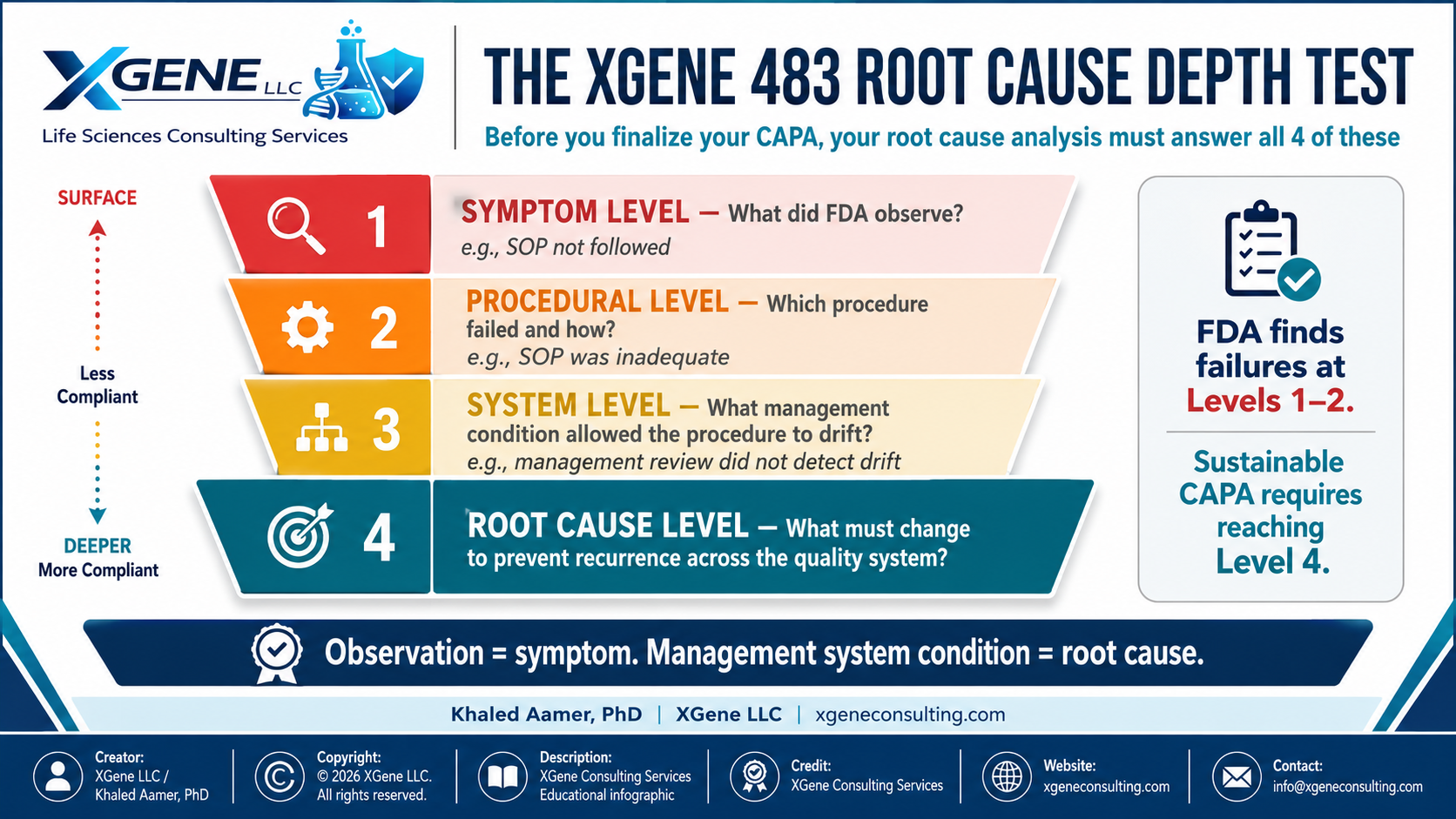
Before you finalize your CAPA, your root cause analysis must answer all four of these:
At what level of the quality management system did the failure originate — individual, procedural, or systemic?
What management system condition allowed the failure to persist without detection until the FDA inspection?
Does the corrective action address the management system condition, or only the procedural symptom?
Is the effectiveness check defined with a measurable metric, a timeframe, and a responsible owner — or is it a commitment to “monitor compliance”?
If any answer is missing, the CAPA will not survive the next inspection. ICH Q10 Section 3.2 requires corrective actions to address root cause and preventive actions to extend to similar processes and systems, with effectiveness checks defined and verified. A CAPA that fails the depth test fails Q10.
Most 483 responses treat the observation as the problem. The observation is the symptom. The firms that cycle through the same observation categories inspection after inspection are not failing to fix procedures — they are failing to fix the management system conditions that allow procedures to drift from practice.
A technically defensible CAPA for a laboratory controls observation does not start with retraining. It starts with asking why the current management review process did not detect the deviation before FDA did. Across the six sterile sites I have remediated to VAI status, the pattern that closed those programs was the same: a 42% reduction in repeat deviations and a 55% reduction in invalidated OOS rates came from fixing the management system layer, not from rewriting SOPs.
The business consequence of stopping at the procedural layer is measurable. Repeat observations escalate inspection classification, extend remediation timelines, delay product approvals, and increase the probability of consent decree exposure. The firms that break the cycle are the ones whose CAPA process is designed to fail the depth test on purpose — and to keep working until it passes.
When your team writes a 483 CAPA, does it trace the root cause to the management system level — or does it stop at the procedure level? The answer predicts whether you will see the same observation at your next inspection.