
GMP Remediation — XGene’s Structured Framework for 483 Responses
Most 483 responses fail not because the company failed to address the observation — but because the response addressed the symptom FDA described while leaving the quality system gap that…
On this pageArticle overview
Most 483 responses fail not because the company failed to address the observation — but because the response addressed the symptom FDA described while leaving the quality system gap that caused it fully intact.
I have reviewed hundreds of 483 responses over a 25-year career spanning FDA inspections, Warning Letter negotiations, and CAPA program builds across both large pharma and contract manufacturing environments. The single most consistent predictor of a Warning Letter is not the severity of the original observation. It is the architecture of the response.
What a 483 Response Commits You To: The Legal and Regulatory Obligations
An FDA Form 483 is not a citation. It is a list of inspectional observations — conditions or practices that, in the investigator’s professional judgment, represent violations of the Federal Food, Drug, and Cosmetic Act or its implementing regulations under 21 CFR Part 211. Your written response to those observations is a voluntary but consequential act. FDA has no regulatory mechanism to compel a 483 response, yet the agency’s expectations are well-documented: responses should be submitted within 15 business days of the close of inspection, with a 30-day extension available if you provide adequate justification for why additional time is needed. This timeline is grounded in FDA’s longstanding inspectional practice and reinforced by the agency’s Compliance Program guidance, which directs investigators to evaluate the timeliness and adequacy of the response as part of the inspection close-out and classification process.
What most organizations fail to appreciate is the legal weight that attaches the moment you submit that response. FDA will evaluate everything you commit to against the actual state of your facility during any subsequent inspection. If your response promises SOP revision by a named date, FDA will look for that SOP revision. If it promises retraining, FDA will ask for the training record. If it promises an effectiveness check, FDA will want to see the verification data. A 483 response is, in practical terms, a self-imposed consent agreement — and failing to execute on its commitments converts a manageable inspection finding into documentary evidence of a systemic compliance failure. That is the mechanism by which Warning Letters are triggered under FDA’s enforcement policy, referenced in 21 CFR 314.81 and 601.12 for NDA and BLA holders respectively, where post-approval reporting and quality obligations intersect with the agency’s authority to escalate.
The timeline matters enormously. FDA’s typical pattern from an inadequate 483 response to a Warning Letter issuance runs six to twelve months. That window is not dead time — it is the period during which FDA’s district office and CDER’s compliance function are evaluating your response, reviewing it against inspection data, and making a determination about whether your quality system is capable of self-correction. A credible, well-constructed response can stop that clock. An inadequate one accelerates it.
The Five GMP Remediation Failure Modes FDA Recognizes and Escalates
The first and most common failure mode is the single-layer response. The company addresses the specific observation — disposes of a batch, re-qualifies an instrument, retrains the analyst — and submits documentation of that action as a complete response. FDA’s Quality Systems Approach to Pharmaceutical cGMP Regulations, published in 2006, was explicit in framing quality compliance as a systemic function, not a transactional one. A response that closes the individual instance without addressing the quality system condition that permitted it tells FDA that your organization does not understand the difference between a deviation and a system failure.
The second failure mode is attributing root cause to human error without conducting system analysis. Human error is a conclusion that terminates investigation, not a root cause that enables prevention. If an analyst made a calculation error, the root cause is not that the analyst was careless. The root cause may be that the calculation was performed manually in an environment with competing interruptions, that no independent check step existed in the procedure, or that the procedure itself was ambiguous regarding significant figures. ICH Q9(R1), the current revision of the pharmaceutical quality risk management guideline, provides the framework for structured root cause analysis — fishbone diagrams, 5-Why methodology, fault tree analysis — all of which produce systemic findings that can be mapped directly to the cited 21 CFR Part 211 subsection. When your root cause analysis does not map to a regulatory requirement, it is almost certainly incomplete.
The third failure mode is vague commitments with non-specific timelines. CAPA entries that read “training will be completed” with no date, “procedures will be revised” with no responsible owner, or “management will monitor” with no defined metric are not commitments — they are intentions. FDA investigators are trained to identify this pattern, and they document it during re-inspection. Every commitment in a 483 response must carry four attributes: a specific completion date, a named responsible person, a measurable success criterion, and an independent verification mechanism. The absence of any one of these four elements is sufficient to render the CAPA non-credible in FDA’s evaluative framework.
The fourth failure mode is the SOP revision reflex. Revising an SOP is the most commonly proposed corrective action in the industry and one of the least credible in isolation. Unless your root cause analysis has demonstrated that SOP inadequacy was the actual cause of the observation — and not merely a contributing factor — proposing SOP revision as a corrective action signals to FDA that the investigation was superficial. ICH Q10’s framework for pharmaceutical quality systems requires that corrective actions address the verified root cause, not the nearest available procedural artifact.
The fifth failure mode is the absence of an effectiveness check. This is where the overwhelming majority of otherwise competent 483 responses collapse. The CAPA is designed, documented, and executed — but no mechanism exists to verify that the action actually prevented recurrence. Effectiveness verification is not a regulatory luxury. It is the mechanism by which a CAPA becomes a closed loop rather than a linear sequence of paper-generating activities. If your response does not define what evidence will be collected, by whom, over what timeframe, and against what standard, FDA has no basis to conclude that your quality system is self-correcting. That judgment — that the system cannot self-correct — is the core of every Warning Letter.
Structuring a Remediation Program That Addresses Root Cause Systemically
A credible 483 response requires three simultaneous and integrated layers of work, not a sequential checklist. The distinction is architectural, and it determines everything.
The first layer is Immediate Corrective Action — the documented evidence that the specific condition FDA observed has been addressed. This layer must be completed and documented before the response is submitted, not committed to for future completion. If FDA observed out-of-specification results being retested without a documented justification, the immediate corrective action is not “we will revise the OOS procedure.” It is a completed review of all OOS investigations conducted under the same procedure over the preceding 12 months, a determination of whether any affected batches remain on the market, and a documented disposition decision for each. That is Layer 1 evidence.
The second layer is Root Cause Analysis, conducted using ICH Q9(R1) risk tools and explicitly mapped to the 21 CFR Part 211 subsection cited in the observation. The analysis must go at least three causal levels deep before it reaches a systemic finding. Root cause analysis co-authored by regulatory affairs without meaningful participation from the manufacturing and quality operations staff who work in the affected system is one of the most persistent and damaging patterns in the industry. The people closest to the process are the ones who understand why the system allowed the deviation to occur, and their input is structurally necessary for a credible investigation.
The third layer is Systemic Preventive Action — the structural changes to the quality system that prevent recurrence across all potentially similar conditions, not just the specific one FDA cited. This layer must include specific completion dates, named responsible persons, measurable success criteria, and an independent effectiveness verification plan that defines the data to be collected, the standard against which it will be evaluated, and the timeline for that evaluation. When remediation extends beyond six months, FDA expects interim progress reports — a commitment to provide them proactively is itself a credibility signal.
The XGene Three-Layer 483 Response Architecture
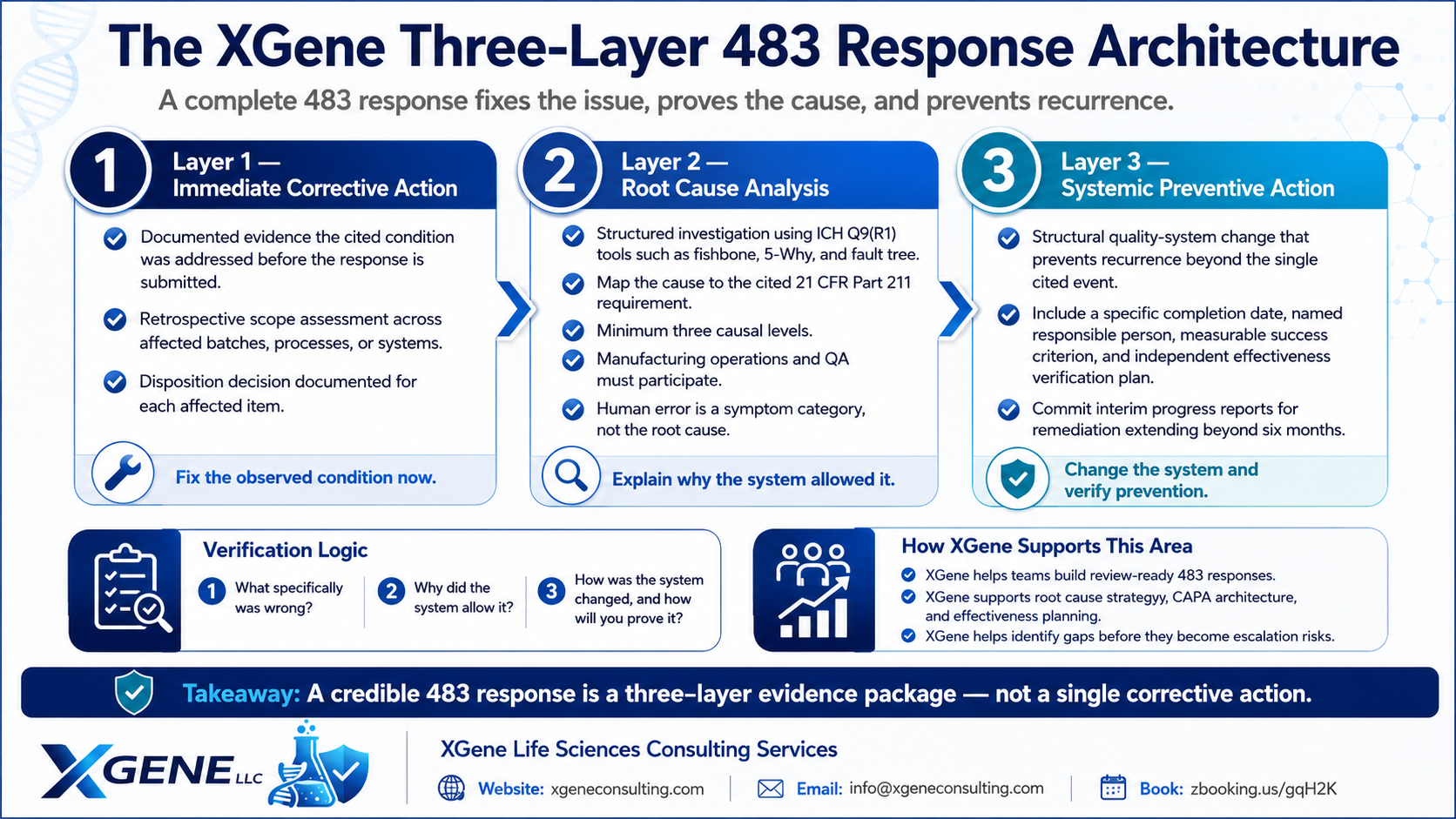
Layer 1 — Immediate Corrective Action Documented evidence that the cited condition has been addressed prior to response submission. Includes retrospective scope assessment: how many batches, processes, or systems were affected by the same condition? Disposition decision documented for each.
Layer 2 — Root Cause Analysis Structured investigation using ICH Q9(R1) tools (fishbone, 5-Why, fault tree) mapped to the specific 21 CFR Part 211 subsection cited. Co-authored by manufacturing operations and QA — not regulatory affairs alone. Minimum three causal levels. Human error is a symptom category, not a root cause.
Layer 3 — Systemic Preventive Action Quality system structural change with: specific completion date (no “ongoing” entries), named responsible person, measurable success criterion (a metric, not an activity), independent effectiveness verification plan (defined data, defined standard, defined timeline). Progress reports committed for any remediation extending beyond six months.
Verification Logic: The test of a complete response is simple. For each observation, can you answer: What specifically was wrong? Why did the system allow it? How has the system been changed so it cannot happen again, and how will you prove it?