
Warning Letter Response — CMC Strategy Before the 15-Day Clock Starts
This distinction is not semantic. It is the difference between a response that closes a Warning Letter in a single review cycle and one that triggers an escalation path ending…
On this pageArticle overview
This distinction is not semantic. It is the difference between a response that closes a Warning Letter in a single review cycle and one that triggers an escalation path ending in an import alert, a consent decree, or both. I have spent twenty-five years in pharmaceutical GMP and regulatory affairs watching companies navigate FDA enforcement actions, and the pattern of failure is almost always the same: the response is written before the scope is understood. The 15-business-day clock that FDA sets under its Regulatory Procedures Manual Chapter 4 creates pressure that is entirely real, but the organizations that manage Warning Letters most effectively treat that window as a scoping and alignment phase first, and a drafting phase second. The companies that treat it as fifteen days to produce a finished document almost always produce the wrong document.
To understand why, you have to understand what an FDA Warning Letter actually is. It is not a citation. It is not an inspection report. It is a formal agency communication informing a regulated entity that FDA has reviewed the evidence from an inspection, application review, or surveillance activity and has determined that the company is in significant violation of federal law — typically the Federal Food, Drug, and Cosmetic Act and the regulations promulgated under it, including 21 CFR Part 211 for current Good Manufacturing Practice. The Warning Letter is FDA’s signal that voluntary compliance has not been achieved and that the agency is prepared to use additional regulatory authority if it is not. Under the FDA Regulatory Procedures Manual Chapter 4, a Warning Letter response is expected within fifteen business days of receipt. That deadline is not a target — it is the threshold at which FDA’s patience for voluntary action effectively expires. Extensions are rarely granted and, when granted, require written justification and advance coordination with the issuing district office.
The Three-Tier Response Framework FDA Expects
What FDA expects in a response is not merely an acknowledgment of the observations or a promise to do better. The agency’s own CDER MaPP 4060.1 and its broader enforcement posture make clear that an acceptable response must demonstrate three things simultaneously: that the company has conducted a genuine root cause investigation into each cited violation, that it has established a Corrective and Preventive Action plan with specific timelines and identified owners, and that it has initiated — or can articulate a credible path toward — long-term systemic remediation. These three tiers are not sequential in FDA’s evaluation. A response that presents a thorough root cause analysis alongside vague CAPA language will not close a Warning Letter. A response that commits to detailed CAPA steps without demonstrating that the company understood why the violation occurred will not close a Warning Letter. The three tiers are evaluated as a package, and all three must be credible, specific, and technically coherent.
The manufacturing and GMP Warning Letter category, which constitutes the majority of pharmaceutical enforcement actions, typically involves observations that appear discrete on the surface — a failure in environmental monitoring, a deviation in process validation documentation, inadequate cleaning validation — but which are rarely discrete in their underlying cause. FDA investigators and the reviewers who draft Warning Letters are trained to look for quality system breakdowns, not individual procedural failures. When FDA cites a company under 21 CFR 211.192 for failure to investigate unexplained discrepancies, or under 21 CFR 211.68 for inadequate computer system validation, the citation is almost always a manifestation of a deeper failure in the quality management system as described under ICH Q10 principles. A response that addresses the cited regulation without addressing the quality system gap that allowed the condition to persist will not satisfy FDA, regardless of how technically precise the regulatory language is.
The 48-Hour Scope Mapping Phase
This is why the 48-hour scope mapping phase that precedes drafting is so consequential. Before a single word of response is written, a company needs to have answered a set of questions that most organizations never formally ask. How many observations are in the Warning Letter? How many distinct quality system domains do those observations touch? Are any observations linked to application commitments made under 21 CFR 314.81(b)(1) or related post-approval reporting obligations? Are any observations connected to data integrity concerns — a category that FDA treats with particular gravity and which often triggers separate application integrity review? What is the relationship between the Warning Letter observations and the 483 observations issued at the conclusion of the inspection? Did the prior 483 response, if one was submitted, adequately characterize the scope of the problem, or did it create commitments that now contradict the more thorough investigation the Warning Letter demands?
These questions require contributions from CMC, manufacturing, quality assurance, regulatory affairs, and — in many cases — outside GMP counsel. A response drafted by a regulatory affairs team in isolation, without the active participation of the manufacturing and quality functions that own the processes cited, will almost always fail to demonstrate the operational credibility FDA expects. FDA reviewers read responses carefully. They look for evidence that the people who wrote the response understand how the cited process actually works, why the failure occurred at a mechanistic level, and what operational changes — not just procedural additions — have been put in place. A response that reads as though it was written by lawyers and regulatory generalists without deep manufacturing input signals to FDA that the company does not yet understand its own problem.
The timeline architecture of a Warning Letter response also demands explicit management. Fifteen business days to deliver a response that covers root cause investigation, CAPA development, and systemic remediation architecture for what may be ten or fifteen complex observations is, in most circumstances, insufficient time to complete those activities. This is not a flaw in the FDA enforcement system — it is a deliberate design. FDA expects companies to use the response to commit to a remediation program and to establish the milestones and governance structure under which that program will be executed over the twelve to twenty-four months it typically takes to fully resolve a GMP Warning Letter. The fifteen-day response is the opening document of a regulatory relationship that may last two years. It must be written with that horizon in mind.
From Warning Letter to Consent Decree: The Escalation Path
If the response is inadequate — and FDA’s determination of adequacy is calibrated against the three-tier standard, not against the company’s own assessment — the escalation path is clear. An inadequate response within thirty days of Warning Letter issuance can contribute to import alert conditions under the FDA’s Regulatory Procedures Manual authority, which can effectively halt product entry into the U.S. market. Continued non-compliance after the Warning Letter, particularly where multiple Warning Letters have been issued or where the same observations have been cited in successive inspections, creates the factual predicate for a consent decree of permanent injunction, which involves DOJ and creates operational constraints on the facility that can persist for years. The transition from Warning Letter to consent decree is not abrupt — it follows a documented escalation path in which every inadequate response is a step toward the next enforcement action.
The companies that resolve Warning Letters in a single FDA review cycle — which itself takes six to nine months after a response is submitted before FDA issues a close-out letter or signals the need for a re-inspection — are the ones that treated the fifteen-day window not as a deadline for delivering a finished product but as the boundary of an intensive scoping, investigation formation, and response architecture phase. They formed a Warning Letter Project Management Office or equivalent governance structure within the first week. They mapped every observation to the quality system domain it implicated, not just the regulation it cited. They did not draft commitments they could not keep. And they communicated proactively with FDA when circumstances required a timeline adjustment, rather than defaulting to silence and hoping the reviewer would not notice.
An FDA Warning Letter response is a legal and regulatory document. It will determine whether your program remains on its current timeline, faces an import alert, or enters a reinspection cycle. The difference between a response that resolves the Warning Letter and one that triggers escalation is whether the company understood the full scope of FDA’s concerns before responding to any individual observation.
The 15-day clock is real. But the 48 hours before you start drafting are where the outcome is actually determined.
The XGene Warning Letter Response Architecture: Commitments FDA Will Accept
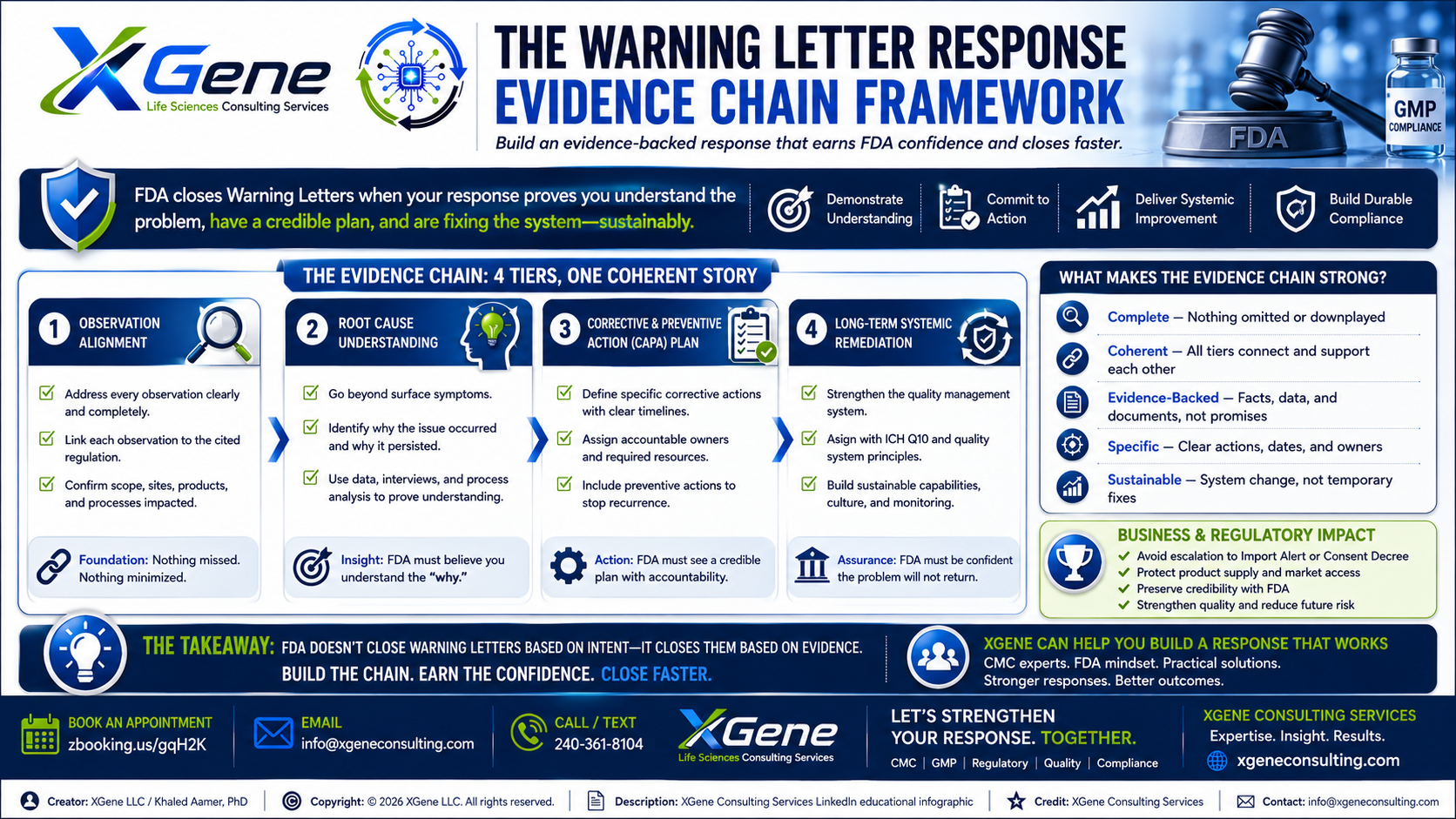
PHASE 1 — 48-HOUR SCOPE MAPPING Before drafting begins, map every Warning Letter observation to its corresponding 21 CFR citation, the quality system domain it implicates under ICH Q10, the 483 observation it originated from (if any), and any prior response commitments that may now be inconsistent with a more complete root cause understanding. Identify observations that implicate data integrity, application commitments under 21 CFR 314.81(b)(1), or post-approval reporting obligations separately — these require specialized handling and escalation within the response architecture.
PHASE 2 — INVESTIGATION TEAM FORMATION Assign an interdisciplinary Warning Letter Response Team within 24 to 48 hours of receipt. This team must include functional owners from manufacturing, quality assurance, CMC/regulatory affairs, and — where data integrity or application integrity observations are present — outside GMP counsel. The team is not assembled to draft a document. It is assembled to conduct an investigation of sufficient depth to support the three-tier response FDA will evaluate.
PHASE 3 — ROOT CAUSE ARCHITECTURE For each observation, develop a root cause analysis that connects the cited regulatory violation to its quality system failure point. The root cause document must be traceable: from the observation as FDA cited it, through the investigation findings, to the identified systemic condition that allowed the violation to occur. Root cause conclusions that terminate at “procedural error” or “training gap” without reaching the quality system failure that made the error possible will not support a credible response.
PHASE 4 — RESPONSE DOCUMENT CONSTRUCTION Construct the response as a three-tier document for each observation: (1) Root cause investigation findings with supporting evidence; (2) CAPA with specific completion timelines, named functional owners, and measurable acceptance criteria; (3) Long-term systemic remediation with milestone-based governance. Timelines must be realistic and operationally defensible. Commitments made in a Warning Letter response are enforceable — if FDA conducts a re-inspection and finds a commitment has not been met, the inadequate response itself becomes additional evidence of non-compliance.
PHASE 5 — REMEDIATION GOVERNANCE AND FDA COMMUNICATION PROTOCOL Establish a Warning Letter Project Management Office or equivalent governance body responsible for milestone tracking, evidence collection, and proactive FDA communication. The close-out of a GMP Warning Letter requires demonstrated, sustained compliance — not a single corrective action. The governance structure must have executive sponsorship, defined escalation paths, and a communication protocol that ensures FDA receives updates before it has to ask for them.