
Regulatory Record
FDA Form 483
FDA investigators closed an 11-inspection-day review of Wells Pharma of Houston LLC's 503B outsourcing facility on April 13, 2026, issuing a six-observation Form 483 (Amendment 1, issued April 14, 2026) to President…
Wells Pharma of Houston LLC FDA 483: 6 Observations at Houston, Texas and the Quality Management System/CAPA Pattern Every 503B Outsourcing Facility Should Assess
Source Context
On this recordRecord overview
Regulatory Event
FDA investigators closed an 11-inspection-day review of Wells Pharma of Houston LLC’s 503B outsourcing facility on April 13, 2026, issuing a six-observation Form 483 (Amendment 1, issued April 14, 2026) to President and CFO Andrew C. Corbin. Dallas District Office investigator Camerson E. Moore’s report spans sterile compounding technique, laboratory controls, stability testing, and quality unit document control — and two of the six observations, covering labeling control and quality-unit document control, are explicitly flagged by the investigator as “a repeat observation.” A Form 483 documents inspectional findings, not adjudicated violations; Wells Pharma has 15 business days to respond in writing, and FDA’s Center for Drug Evaluation and Research will evaluate that response before deciding whether further action is warranted. What elevates this 483’s significance is timing: it follows, by roughly five months, a Warning Letter (713015, issued November 7, 2025) already citing this facility for sterile drug products compounded or held under insanitary conditions.
When FDA marks two observations on the same 483 as repeats, it is telling the firm something specific — that a condition the company already committed to correct was found unresolved on reinspection. Here, observation 5 documents an unsecured filing cabinet holding issued, printed Cefazolin labels in the labeling production area (cited under 21 CFR 211.125), with neither the pharmacist nor the quality unit able to identify who held the key at the time of the walkthrough. Observation 6, cited under 21 CFR 211.22(d), documents that the quality unit’s corrective and preventive action (CAPA) response to a nearly identical prior labeling-control finding — CAPA HOU-2025-012 — did not adequately define corrective controls, and that the quality unit was not exercising document control over in-process refrigeration logs, which were found recorded on an obsolete revision of the temperature-monitoring form. Two repeat findings in the same inspection, on two different systems, is not a documentation lapse — it is evidence that the quality unit’s CAPA process is not verifying that corrective actions actually close the underlying gap before declaring them effective.
What the Record Documents
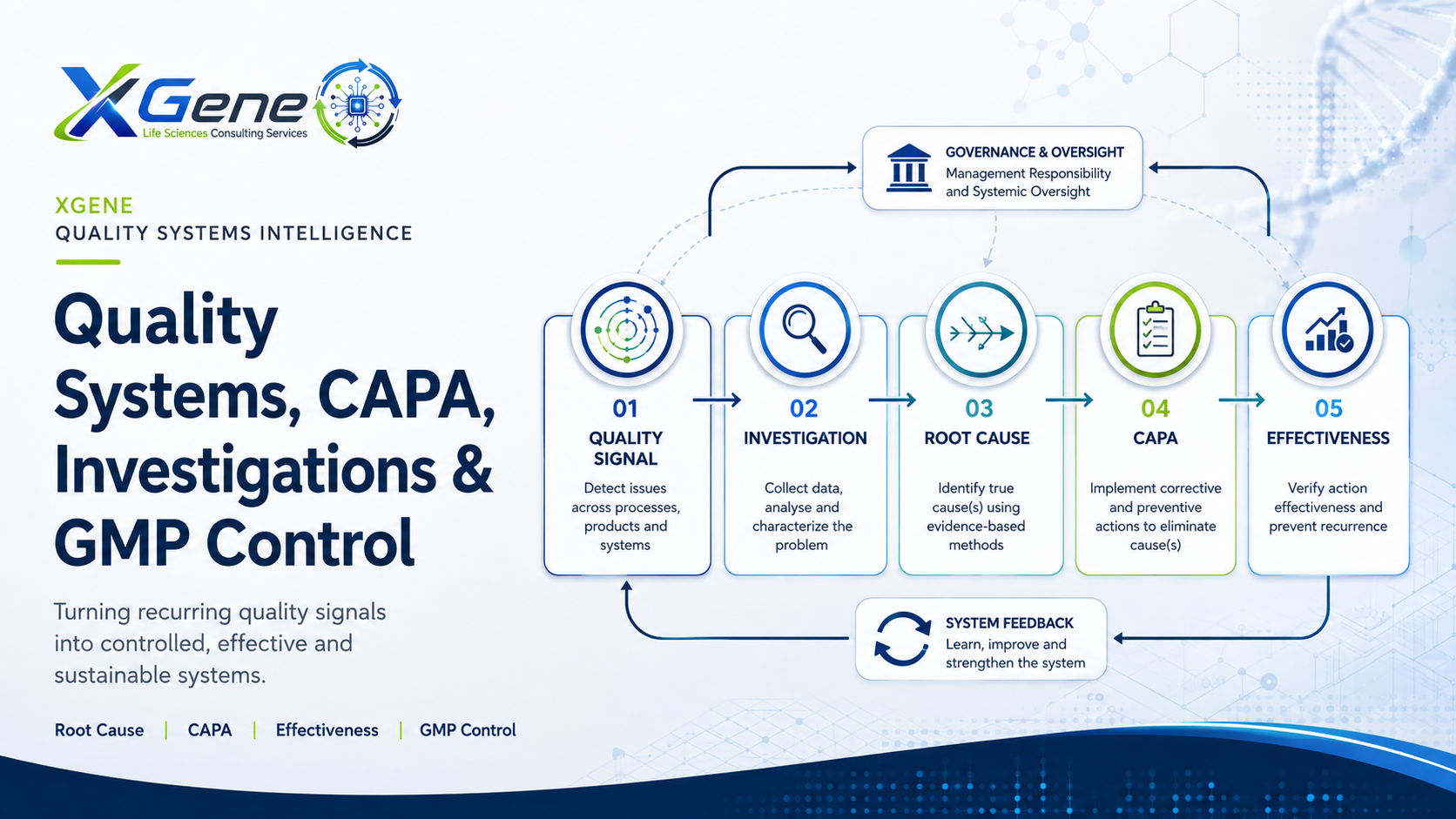
ICH Q10 — the International Council for Harmonisation’s Pharmaceutical Quality System guideline — is built on the premise that CAPA, change management, and management review function as a closed loop: a deviation or observation triggers a root-cause investigation, a correction is implemented, and the quality unit independently verifies, through a defined effectiveness check, that the correction actually functions under real operating conditions before the CAPA is closed. Wells Pharma’s own CAPA record for the labeling-control finding illustrates where that loop broke: CAPA HOU-2025-012 addressed the immediate labeling-security concern but, per the current 483, failed to establish controls durable enough to prevent the same condition — an unsecured cabinet of issued labels — from recurring. A CAPA that closes on schedule but does not resolve the systemic condition is, in ICH Q10 terms, a documentation exercise rather than a functioning quality system control.
This is precisely why QMS-level observations are difficult to remediate inside a 15-business-day response window. Addressing the aseptic technique findings in observation 1, cited under 21 CFR 211.113(b) — inadequate transfer-disinfection procedures for sterile bottles moved between the ISO 5 hood and the ISO 7 cleanroom, hard-to-disinfect pens used to write in batch records inside the ISO 7 cleanroom, and dynamic smoke studies that did not adequately characterize airflow around simulated interventions — requires revalidating procedures and requalifying personnel, not just issuing a memo. Correcting the stability program deficiencies in observations 2 and 3, cited under 21 CFR 211.166(a), where 2021 and 2024 stability data for compounded Cefazolin already showed pH and assay results exceeding specification within 30 to 60 days while 60- and 75-day beyond-use dates remained assigned and product continued to be distributed, requires new stability studies and, potentially, beyond-use-date reductions across an entire product line — work that extends well past a two-week window. A written response can commit to this work; it cannot complete it.
Technical and Quality Context
Facilities that draw repeat QMS observations on top of an existing Warning Letter have historically faced one of two outcomes: a targeted reinspection focused specifically on verifying that the repeat findings are now closed, or additional formal correspondence if the response is judged inadequate to the compounding-quality concerns already on record. For a 503B outsourcing facility, the stakes are heightened further because hospital and health-system customers increasingly condition purchasing decisions on a clean compliance history, making the commercial cost of a further enforcement action considerably higher than the underlying corrective work would have cost.
Quality directors at other 503B and sterile compounding facilities should use this 483 as a prompt to test their own CAPA program for the same failure mode: pull the last two years of CAPAs tied to any repeat or recurring observation and verify, independently of the CAPA owner, whether the documented effectiveness check actually tested the condition that recurred — not just whether the corrective task was completed on time. The same review should extend to stability-supported beyond-use dating for any compounded sterile product where dating was extended based on retrospective or aggregated data rather than a prospectively designed stability protocol, cited here under 21 CFR 211.165(f) for the specific released lot involving an incorrect compendial test method.
Decision Relevance
XGene Consulting supports 503B outsourcing facilities and hospital compounding pharmacies through CAPA effectiveness verification, root-cause investigation redesign, stability program remediation, and Warning Letter and 483 response preparation built to withstand exactly this kind of repeat-observation scrutiny. If your site is carrying open CAPAs tied to a prior FDA finding, now is the time to verify they actually closed the gap.
Primary regulatory references
Connected intelligence
Continue through the evidence graph.
Article
OOS Root Cause Analysis — Moving Beyond ‘Analyst Error’
"Analyst error" is not a root cause — it is a conclusion in search of evidence, and FDA’s May 2022 Level 2 revised OOS guidance is…Article
Chiral Drug Substances: Stereospecific Synthesis, Enantiomeric Purity, and the ICH Q6A Specification Strategy
More than half of the small molecule drugs approved by FDA in any given year contain at least one stereocenter. For most of those programs, the…Article
CAPA Effectiveness Verification — Closing the Loop FDA Actually Closes
An FDA investigator reviewing your CAPA system is not interested in how many CAPAs you have opened — they are interested in how many you have…Article
CareFusion 213, LLC (BD) Class I Recall — ChloraPrep Sterile Antiseptic Applicators: The Sterile Manufacturing System Failure Behind the Recall and What Every Aseptic Processing Director Must Address
CareFusion 213, LLC, a subsidiary of Becton, Dickinson and Company (BD), has recalled two configurations of its BD ChloraPrep One-Step and FREPP Clear sterile antiseptic applicators…From record to action
Use the evidence in context.
Continue into related XGene analysis or discuss the technical implication when the issue needs action.