
CAPA Effectiveness Verification — Closing the Loop FDA Actually Closes
An FDA investigator reviewing your CAPA system is not interested in how many CAPAs you have opened — they are interested in how many you have closed with demonstrated effectiveness,…
On this pageArticle overview
An FDA investigator reviewing your CAPA system is not interested in how many CAPAs you have opened — they are interested in how many you have closed with demonstrated effectiveness, and the gap between those two numbers is one of the most reliable indicators of quality system maturity.
That observation does not describe a theoretical concern about documentation practices. It describes the actual finding pattern that FDA investigators report across pharmaceutical manufacturing inspections year after year — facilities that have built robust CAPA intake processes, invested in formal root cause analysis tools, trained their quality teams on fishbone diagrams and 5-Why methodology, and assigned responsible owners with committed timelines, only to treat the final step of the process — effectiveness verification — as a documentation checkbox that gets completed weeks or months after the corrective action was implemented, with whatever data happens to be available at the time. The result is a CAPA system that looks complete in the electronic quality management system and is functionally broken at its most important juncture. ICH Q10, the international standard for pharmaceutical quality systems that FDA has formally adopted as a CGMP guidance framework, is explicit that the CAPA system must include the results and effectiveness of CAPAs taken and that CAPA effectiveness must be an agenda item at management review. FDA’s Quality Systems Approach to Pharmaceutical cGMP Regulations guidance (2006) reinforces this by treating the CAPA subsystem as one of the six quality system components that support the overarching quality management system — not as a standalone corrective action log, but as a closed-loop process whose closure depends on demonstrated effectiveness. The loop that most pharmaceutical quality systems have failed to close is the one that runs from corrective action implementation back to confirmed elimination of root cause, with objective evidence.
What FDA Expects From CAPA Effectiveness Verification: The Legal and Quality System Standard
The regulatory basis for CAPA effectiveness verification in pharmaceutical manufacturing is distributed across multiple regulatory instruments, and the distribution matters because it means that the requirement is not confined to a single guideline that a quality team can choose to interpret narrowly. Under 21 CFR 211.192, laboratory records and investigations of out-of-specification results must include a record of the corrective action taken and the follow-up to confirm that the corrective action was effective. That provision governs laboratory operations specifically, but its logic extends to the broader CAPA context: a corrective action is not complete when it has been implemented — it is complete when follow-up has confirmed it was effective. FDA’s enforcement history under 21 CFR 211.192 includes Warning Letters citing inadequate investigation follow-up as a distinct deficiency from the underlying investigation failure, a pattern that confirms the agency’s expectation that corrective action and effectiveness confirmation are both required elements of the regulatory obligation, not sequential components of which only the first is enforceable.
Under 21 CFR 820.100 — the CAPA regulation that applies to medical device manufacturers but whose framework FDA has consistently cited as the relevant standard for quality system maturity across pharmaceutical and combination product contexts — the requirements are stated with unusual specificity. The regulation requires establishing and maintaining procedures for implementing corrective and preventive action, analyzing processes and quality records to identify existing and potential causes of nonconforming product or other quality problems, and verifying or validating the corrective and preventive action to ensure that such action is effective and does not adversely affect the finished device. The verification requirement in 21 CFR 820.100 is not discretionary and not qualified by risk tier — it applies to every CAPA, and it requires that effectiveness be confirmed through verification or validation. FDA’s inspection experience in device manufacturing, where CAPA system adequacy is among the most frequently cited deficiency categories, has informed the agency’s expectations for pharmaceutical quality systems as FDA has pushed toward the quality systems framework articulated in the 2006 guidance. The pharmaceutical manufacturer operating today under the quality systems framework faces the practical expectation that their CAPA program will demonstrate the same closed-loop verification discipline that device CAPA regulations require explicitly.
ICH Q10 Section 3.2.2 addresses the CAPA system as one of the enablers of pharmaceutical quality systems and specifies that the process for CAPA includes sources for CAPA, results and effectiveness of CAPAs taken, and that management review must include CAPA status and trending. The use of the word “results” alongside “effectiveness” is not redundant — it reflects the distinction between what the corrective action did (the result: the procedure was revised, the equipment was calibrated, the operator was retrained) and whether what it did eliminated the root cause (the effectiveness: the deviation has not recurred, the OOS rate returned to baseline, the process capability metric improved to target). A CAPA record that documents results without demonstrating effectiveness has closed the corrective action but has not closed the quality risk. FDA’s Quality Systems Approach guidance makes this concrete by describing the CAPA subsystem as responsible for analyzing root causes, implementing corrective actions, and assessing the effectiveness of those actions — three sequential obligations, not two. FDA Warning Letters that cite CAPA system inadequacy consistently identify the effectiveness assessment step as the absent component: the investigations were conducted, the corrective actions were documented, and the quality system recorded the CAPA as closed without any evidence that anyone subsequently confirmed the root cause was gone.
ISO 9001:2015, which underlies the quality management system framework adopted by pharmaceutical manufacturers seeking integration across their global operations, requires under clause 10.2 that the organization take action to control and correct the nonconformity, deal with the consequences, evaluate the need for action to eliminate the causes of the nonconformity, implement any action needed, review the effectiveness of any corrective action taken, and update risks and opportunities determined during planning if necessary. The word “review” in clause 10.2 is an explicit requirement that the effectiveness of the action taken be subsequently confirmed — not assumed. ISO 9001:2015 does not specify how that review is conducted or what data is required to demonstrate effectiveness. The pharmaceutical CGMP context, through ICH Q10, the 2006 FDA guidance, and the enforcement record under 21 CFR 211 and 820, provides the specification that ISO 9001:2015 intentionally leaves to the regulated industry: effectiveness verification must be performed against a criterion defined before implementation, within a timeframe appropriate to the type of corrective action, using a data source specified in advance, and must be conducted by a function independent of the function that implemented the corrective action.
The Five Steps of Defensible Effectiveness Verification That Most Programs Skip
The most consequential structural failure in pharmaceutical CAPA programs is not in the first four steps of a typical CAPA process — problem identification, root cause analysis, corrective action definition, corrective action implementation — but in the fifth, the step where the quality system must answer the question: did the corrective action eliminate the cause, and how do you know? The answer to that question, in a defensible CAPA program, must be pre-specified before the corrective action is implemented. It must be specific, measurable, time-bound, linked to a defined data source, and assigned to an independent verifier. These are not aspirational attributes of a mature quality program. They are the minimum conditions under which effectiveness verification has any evidentiary value to FDA.
The first step is defining the effectiveness criterion before corrective action implementation, not after. This is the step that most CAPA programs skip entirely, and its absence renders the entire effectiveness verification process retrospectively self-serving. When the effectiveness criterion is defined after the corrective action has already been running for three months, the organization has available to it the knowledge of what data is available and what it shows — and there is a structural incentive, conscious or otherwise, to select a criterion that the available data supports. When the criterion is defined before implementation — as a condition of CAPA approval, documented in the CAPA record at the point of corrective action authorization — the criterion has evidentiary weight because it was established before the outcome was known. The criterion must specify the measurable outcome that would confirm the root cause has been eliminated. For a CAPA addressing an OOS trend in a specific analytical procedure attributed to inadequate analyst training on the integration technique, the pre-specified criterion might read: “Zero OOS results attributable to integration technique failure in Analyst Group X over the 90-day period following completion of retraining, verified against the laboratory deviation log and the audit trail for integration events in the CDS.” That criterion is specific, measurable, time-bound, data-sourced, and evaluable by an independent reviewer without subjective judgment about what constitutes effectiveness.
The second step is defining the verification timeframe appropriate to the type of corrective action. Industry practice, informed by FDA inspection experience and the quality systems framework, applies different timeframes to different corrective action categories based on how quickly the corrective action’s effect can be detected in process data. For process changes — revised procedures, modified process parameters, equipment upgrades — a three-to-six month post-implementation observation window is generally appropriate because process performance data accumulates within that timeframe and any recurrence of the root cause condition would be expected to produce observable signals. For culture and training changes — revised training programs, behavioral changes, management system restructuring — a six-to-twelve month observation window is generally required because the behavioral effects of training interventions take longer to manifest in measurable process data and because single-event recurrence rates during short observation windows may not reliably reflect whether the systemic cause has been addressed. These are not absolute rules — the timeframe appropriate to any specific CAPA depends on the nature of the root cause and the detectability of recurrence — but they are the practitioner benchmarks against which FDA investigators assess whether a CAPA’s effectiveness verification window was designed to detect recurrence or designed to expire before recurrence could be observed.
The third step is defining the verification data source before implementation. The data source for effectiveness verification must be the data stream that would most directly reveal recurrence of the root cause — not the data stream that is most conveniently available or most likely to show a favorable result. For a CAPA addressing a cleaning validation failure attributed to inadequate rinse sampling technique, the verification data source should be the subsequent cleaning validation results and the post-cleaning environmental monitoring data — not a training completion record confirming that the retraining was delivered, which confirms that the corrective action was implemented but not that it was effective. The distinction between confirming implementation and confirming effectiveness is the central analytical error that produces closed CAPAs with no demonstrated effectiveness: the CAPA is closed when the training record is signed, the procedure revision is approved, and the equipment qualification is complete — all of which document that corrective actions were taken, none of which document that the root cause no longer produces failures.
The fourth step is conducting independent verification — having the effectiveness assessment performed by a function that did not implement the corrective action. The organizational logic of this requirement is identical to the independence requirement for audit trail review and OOS investigation: a reviewer who has accountability for the outcome being assessed cannot produce an independent assessment of that outcome. The quality assurance function that did not design the retraining program, did not execute the process change, and does not manage the operational function where the corrective action was implemented is the appropriate independent verifier — not as a bureaucratic formality, but because an independent verifier brings no stake in the outcome and can assess the verification data against the pre-specified criterion without the interpretive pressure that faces the function whose corrective action is under review. FDA Warning Letters citing ineffective CAPA systems consistently note situations where effectiveness was assessed by the same function that implemented the corrective action — a structural conflict that undermines the reliability of the finding regardless of what the assessment concluded.
The fifth step is documenting the outcome with explicit closure or re-opening language. A CAPA effectiveness verification record that concludes the corrective action was effective but provides no data demonstrating the criterion was met is a documentation artifact, not a quality record. The verification record must state the pre-specified criterion, the data reviewed, the period of review, the identity of the independent reviewer, and the finding: either the criterion has been demonstrated (effectiveness verified — CAPA closed) or the criterion has not been demonstrated (effectiveness not verified — CAPA re-opened for root cause reassessment). The re-opening path is as important as the closure path. A CAPA that is re-opened because effectiveness verification demonstrated that the corrective action did not eliminate the root cause is not a quality system failure — it is the quality system functioning correctly. The failure is the CAPA that is closed without a verification record, or closed with a verification record that is not linked to pre-specified criteria.
FDA’s timeliness metrics for CAPA performance reflect a consistent expectation that the quality system operates with discipline: more than ninety percent of CAPAs should be closed within their committed timeline; CAPAs that remain open beyond one hundred eighty days require documented justification, not merely an updated target date; and the appearance in management review data of a significant number of CAPAs approaching or exceeding one hundred eighty days without documented justification is an indicator that the CAPA system is being used as a holding mechanism rather than a resolution vehicle. Under ICH Q10, CAPA status and effectiveness are mandatory agenda items at management review — not optional reporting elements, but required inputs to the management review process that generates the output commitments for quality system improvement. A management review that receives a CAPA dashboard showing total open CAPAs, total closed CAPAs, and average closure time, without a separate metric for the percentage of closed CAPAs with documented effectiveness verification, is a management review that lacks the data to fulfill its ICH Q10 function.
Recurring CAPAs and the Systemic Root Cause Signal: What FDA Sees in Your CAPA Trends
A recurring CAPA — a CAPA opened against a root cause or deficiency category that has already been the subject of a prior closed CAPA — is the highest-severity signal available in a pharmaceutical quality system’s own data that the CAPA process has failed to close the loop it was designed to close. FDA investigators who observe recurring CAPAs during inspection are not observing an isolated corrective action failure. They are observing evidence that the quality system’s root cause analysis was insufficient, that the corrective action was aimed at a symptom rather than the cause, that the effectiveness verification was inadequate to detect or characterize recurrence, or some combination of all three. The regulatory consequence of a recurring CAPA pattern is not limited to an observation on the CAPA system itself — it extends to the quality system as a whole, because recurring CAPAs raise the question of whether the quality system has the analytical capability to identify and eliminate the actual causes of recurring quality problems, or whether the CAPA process is producing the appearance of resolution without the reality.
The detection of recurring CAPAs requires a trending algorithm that most CAPA management systems provide as a feature but most quality organizations have not configured and operationalized as a routine quality indicator. The algorithm is conceptually simple: for any CAPA closed with documented effectiveness, the quality system should monitor, on a rolling basis, whether the same root cause category, the same unit operation, the same analytical procedure, or the same equipment system generates a new CAPA within a defined period following the closure of the prior CAPA. The period matters — a recurrence twelve months after the prior CAPA closure may reflect a different failure mode than a recurrence two months after closure, and the quality system’s response to those two signals should be different. A recurrence within the effectiveness verification window means the verification was premature or the criterion was insufficient. A recurrence after the effectiveness verification window closed means the root cause was correctly addressed but a new contributing factor has emerged. Distinguishing between those two interpretations requires the quality system to have both the trending capability to detect the recurrence and the analytical discipline to investigate it with the rigor appropriate to a second-generation CAPA on a previously addressed issue.
The management review requirement under ICH Q10 creates the formal quality system structure within which recurring CAPA trends are expected to be addressed at the level of organizational accountability necessary to produce systemic change. A quality site director or VP of Quality who receives a management review CAPA dashboard showing three open CAPAs in the analytical laboratory’s OOS category, two of which are re-opens of CAPAs closed in the prior year, is receiving a signal that demands a systemic assessment — not of the individual CAPAs, but of the quality management system’s capacity to identify and eliminate root causes in that functional area. The management review obligation is to receive that signal, acknowledge it in the management review record, assign accountability for a systemic assessment, and monitor the output of that assessment in the next management review cycle. A management review that receives the dashboard, notes “three open laboratory CAPAs,” and proceeds without addressing the recurrence pattern has received the quality signal and failed to respond to it. That failure is itself a finding — not about the individual CAPAs, but about the quality system’s management review function.
The XGene CAPA Effectiveness Architecture
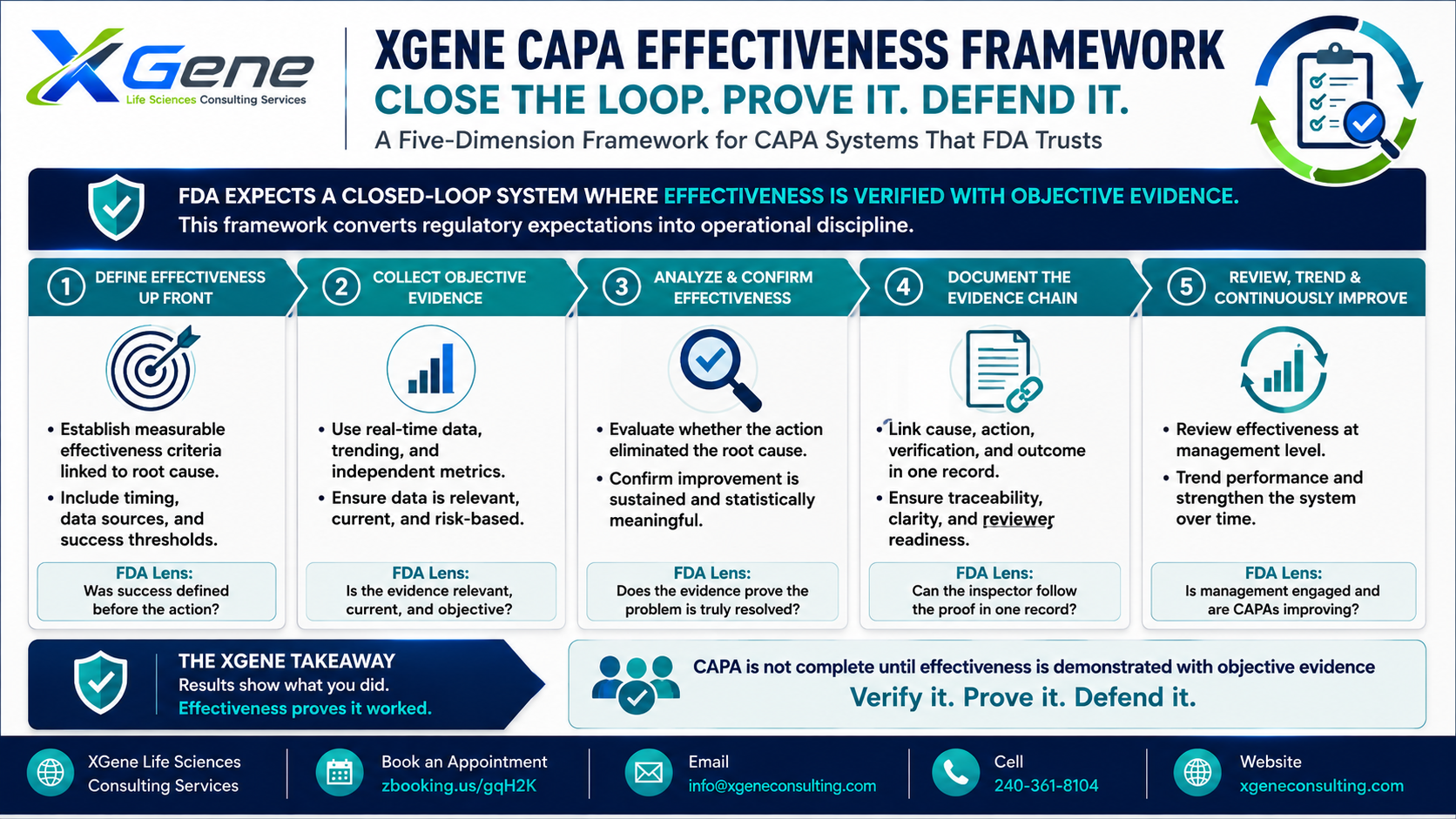
From Open Finding to Demonstrated Closure
The XGene CAPA Effectiveness Architecture is a five-component integrated program designed to close the gap between corrective action implementation — where most CAPA programs invest their effort — and demonstrated effectiveness, where most CAPA programs fail. The Architecture operates from CAPA opening through effectiveness verification and through management review, treating each component as a required element of the closed-loop quality control that FDA and ICH Q10 both describe as the standard for CAPA program maturity.
Component 1 — Pre-Implementation Effectiveness Criterion Definition Template: The Architecture requires that every CAPA record include a completed effectiveness criterion definition before the corrective action is approved for implementation. The template captures five fields: the specific, measurable outcome that would confirm the root cause has been eliminated (stated in terms of process data, not implementation activity); the data source from which that outcome will be assessed (the deviation log, the OOS register, the process capability data, the audit trail for the relevant system); the timeframe for the verification assessment (three to six months for process changes, six to twelve months for culture and training changes, with documented rationale for any deviation from these defaults); the independent verifier (identified by function, not by name, confirming that the verifier has no accountability for the corrective action being assessed); and the re-opening criterion (the condition under which the CAPA will be re-opened for root cause reassessment if the effectiveness criterion is not met within the specified timeframe). The pre-implementation template is a condition of CAPA approval — no corrective action is authorized for implementation without a completed template, and the quality unit reviews the template for specificity and measurability before issuing implementation authorization. A criterion that reads “no recurrence of similar events” fails the specificity test and is returned for revision. A criterion that reads “zero OOS results attributable to analyst integration technique failure in the OOS log for the identified analytical method during the 90-day post-retraining observation period” meets the template standard.
Component 2 — Effectiveness Verification Execution Protocol: The Architecture specifies the procedural steps by which the independent verifier conducts and documents the effectiveness verification at the end of the pre-specified timeframe. The protocol requires the verifier to retrieve the pre-specified data source for the full verification timeframe, assess that data against the pre-specified criterion without reference to alternative data sources, document both data findings and the criterion assessment, and produce a verification record that is traceable to the original CAPA and to the pre-implementation template. The protocol explicitly prohibits criterion revision after implementation — if the original criterion is found to be unassessable at the time of verification, the CAPA is re-opened with a documented finding that the effectiveness design was inadequate, not closed with a retrospectively revised criterion. This prohibition is the procedural control that prevents the most common mode of effectiveness verification gaming: adjusting the criterion at the time of assessment to match whatever data is available.
Component 3 — CAPA Closure Decision Framework: The Architecture operates a binary closure decision: verified (CAPA closed with documented effectiveness record) or not demonstrated (CAPA re-opened for root cause reassessment). Partial effectiveness findings — situations where the data shows improvement but the criterion has not been fully met — are treated as not demonstrated and trigger re-opening. The re-opening generates a new root cause analysis that includes review of the prior root cause analysis for completeness, assessment of whether the corrective action addressed the proximate cause rather than the systemic cause, and evaluation of whether the verification timeframe was sufficient to detect recurrence. The re-opening is documented as a second-generation CAPA linked to the original, creating a traceable record of the quality system’s analysis progression that is available to FDA during inspection as evidence of a quality system actively working toward root cause elimination rather than toward CAPA closure volume.
Component 4 — Recurring CAPA Detection Algorithm: The Architecture implements an automated or manual trending mechanism — depending on the EQMS platform in use — that flags any new CAPA whose root cause category, process area, procedure, equipment identifier, or analytical method matches a CAPA closed within the prior twenty-four months. The flag initiates a documented review comparing the prior and new CAPA, assessing whether the prior effectiveness verification was adequate, and determining whether the new CAPA represents a true recurrence or a different failure mode in the same process area. The outcome of that review — recurrence of prior root cause, new root cause in same area, or independent failure — is documented in the new CAPA record and determines whether a systemic quality system assessment is required. True recurrences trigger a systemic assessment. New root causes in a recurring failure area trigger a formal trending review of that process area. Independent failures proceed through standard CAPA process.
Component 5 — Management Review CAPA Dashboard with Effectiveness Rate Trending: The Architecture provides a standardized management review data package that includes four CAPA performance metrics alongside the standard open/closed counts and timeliness measures: the percentage of CAPAs closed in the review period with a completed pre-implementation effectiveness criterion template; the percentage of closed CAPAs in which effectiveness was verified as demonstrated (versus closed with not-demonstrated finding triggering re-open); the number of CAPAs open beyond one hundred eighty days with documented justification on file; and the number of recurring CAPAs detected in the review period. These four metrics, trended over time and reported at each management review cycle, provide the quality system data that ICH Q10 requires management review to evaluate. A facility whose management review dashboard shows ninety-five percent pre-implementation criterion completion, eighty-eight percent demonstrated-effectiveness closure rate, zero CAPAs open beyond one hundred eighty days without documented justification, and two recurring CAPAs with initiated systemic assessments is operating a CAPA program that can be presented to FDA with confidence. A facility whose management review dashboard shows CAPA count and average closure time, with no effectiveness rate data, is operating a CAPA counting program — and the FDA investigator who asks to see the effectiveness verification records for five closed CAPAs will identify that distinction in the first hour of the inspection.
The closed-loop quality system that FDA and ICH Q10 describe as the standard for pharmaceutical quality system maturity is not closed by opening CAPAs, not closed by implementing corrective actions, and not closed by documenting that corrective actions were completed on time. It is closed by demonstrating, with objective data assessed against a pre-specified criterion by an independent verifier, that the root cause identified by the investigation no longer exists in the process. The CAPA number in the quality management system is a placeholder for that demonstration, not a substitute for it. Every CAPA marked closed without a defensible effectiveness verification record is an open quality risk that the quality system has decided to stop tracking — and FDA’s expectation is that the quality system never made that decision.