
Water Dripping Onto Your API Production Floor Is Not a Maintenance Issue. It Is an FDA Enforcement Issue. Alchymars’ May 2026 Warning Letter Explains Why.
FDA's Warning Letter to Alchymars ICM SM Private Limited, issued May 21, 2026 (MARCS-CMS 724429), documents something that is rare in its physical vividness but entirely predictable in its regulatory…
On this pageArticle overview
FDA’s Warning Letter to Alchymars ICM SM Private Limited, issued May 21, 2026 (MARCS-CMS 724429), documents something that is rare in its physical vividness but entirely predictable in its regulatory consequence: water condensation actively falling from ceiling surfaces and equipment onto the working space where active pharmaceutical ingredients were being manufactured, resulting in standing water around production reactors. The investigator also observed cracks in the facility surfaces, staining around equipment, and a preventive maintenance program that — in FDA’s assessment — was inadequate to prevent or address these conditions. These findings, cited under the equipment maintenance requirements applicable to API manufacturing and the obligation to maintain buildings and facilities in a suitable condition, carry a message that every quality director overseeing a manufacturing facility needs to internalize: physical facility condition is not a facilities management problem. It is a pharmaceutical quality problem. And FDA will treat it as one.
The first observation documents a failure to ensure that equipment is maintained in a good state of repair. For an API manufacturing facility, this obligation flows from the same cGMP logic that governs every other aspect of the manufacturing environment: equipment that is deteriorating, improperly maintained, or not managed through an effective lifecycle program creates an unpredictable manufacturing environment in which product quality cannot be reliably assured. FDA’s inspection of the Alchymars facility in Alathur, Tamil Nadu, found specific evidence of deteriorated equipment — conditions observed directly by the investigator, not inferred from records. The firm had an inventory of equipment and some maintenance activity on record. What it did not have was a preventive maintenance program with the infrastructure to detect deterioration early, escalate unresolved deficiencies, and make documented lifecycle decisions about equipment that was no longer performing within acceptable parameters. The difference between having maintenance records and having an effective PM program is precisely what this Warning Letter documents.
The second observation addresses the physical state of the buildings and facilities themselves: water condensation from ceiling and equipment surfaces dripping onto the active production floor, with standing water around reactors, cracks in surfaces, and visible staining. Under cGMP, the requirement to maintain buildings and facilities in a clean and orderly condition, and in a state of good repair, is not aesthetic. It is functional. Water dripping onto an API production surface is a contamination vector. Cracks in pharmaceutical manufacturing surfaces are harborage points for microbial growth, particulate accumulation, and cleaning failures. The staining around reactors is physical evidence that these conditions have been present long enough to leave a mark. FDA’s investigator documented not a single event but a facility in a state of ongoing degradation — and the firm’s response, in FDA’s assessment, was inadequate to substantiate that product quality had not been affected.
That last point — the inadequacy of the firm’s own investigation — is where this Warning Letter becomes most instructive. FDA’s letter states explicitly that Alchymars’ investigation was inadequate because the firm lacked sufficient data to substantiate the conclusion that the observed facility conditions had not impacted product quality. This is a critical regulatory distinction. When a facility investigation concludes “no impact on product quality” without the data to support that conclusion, FDA does not accept the conclusion. A conclusion without evidence is not a quality determination — it is an assertion. FDA’s expectation, consistent with the OOS investigation framework of the October 2006 FDA Guidance and the broader quality system principles of ICH Q10 §3.2.2 (CAPA System), is that an adequate investigation generates the evidence needed to support its conclusion, rather than simply stating the conclusion and considering the matter closed. For Alchymars, the failure to generate adequate investigation data was itself an observation — layered on top of the physical conditions that prompted the investigation in the first place.
The systemic failure pattern here is one I have seen at multiple API manufacturing sites, and it follows a consistent sequence. A facility begins manufacturing with equipment and buildings in acceptable condition. Preventive maintenance is planned but not rigorously executed — tasks are deferred, inspection findings are logged but not resolved within defined timeframes, and the maintenance function does not have the authority or the quality system linkage to escalate unresolved deficiencies to a decision gate. Deterioration accumulates incrementally, and because each individual deficiency seems manageable in isolation, no single event triggers the response that the cumulative condition demands. By the time an FDA investigator observes water dripping onto the production floor, the facility has been in declining condition for months or years. The investigation that follows the observation is conducted under pressure, without the baseline data that would have been generated by a proactive PM program, and it cannot reconstruct what product was manufactured in what conditions over what period. The conclusion “no impact on product quality” is reached not because the evidence supports it but because the investigation had no other evidence to offer.
The firm’s recommendation to engage a qualified CGMP consultant, as stated in FDA’s letter, underscores the depth of the remediation required. Consultant recommendations in Warning Letters are not routine. They appear when FDA’s inspection record indicates that the current quality leadership infrastructure cannot remediate the identified deficiencies without external expertise. In a facility where physical conditions have degraded to the level documented in this letter — and where the investigation response demonstrated an inability to apply the evidentiary standard FDA requires — the remediation scope extends well beyond writing corrective action plans. It requires rebuilding the quality oversight architecture that should have prevented the degradation.
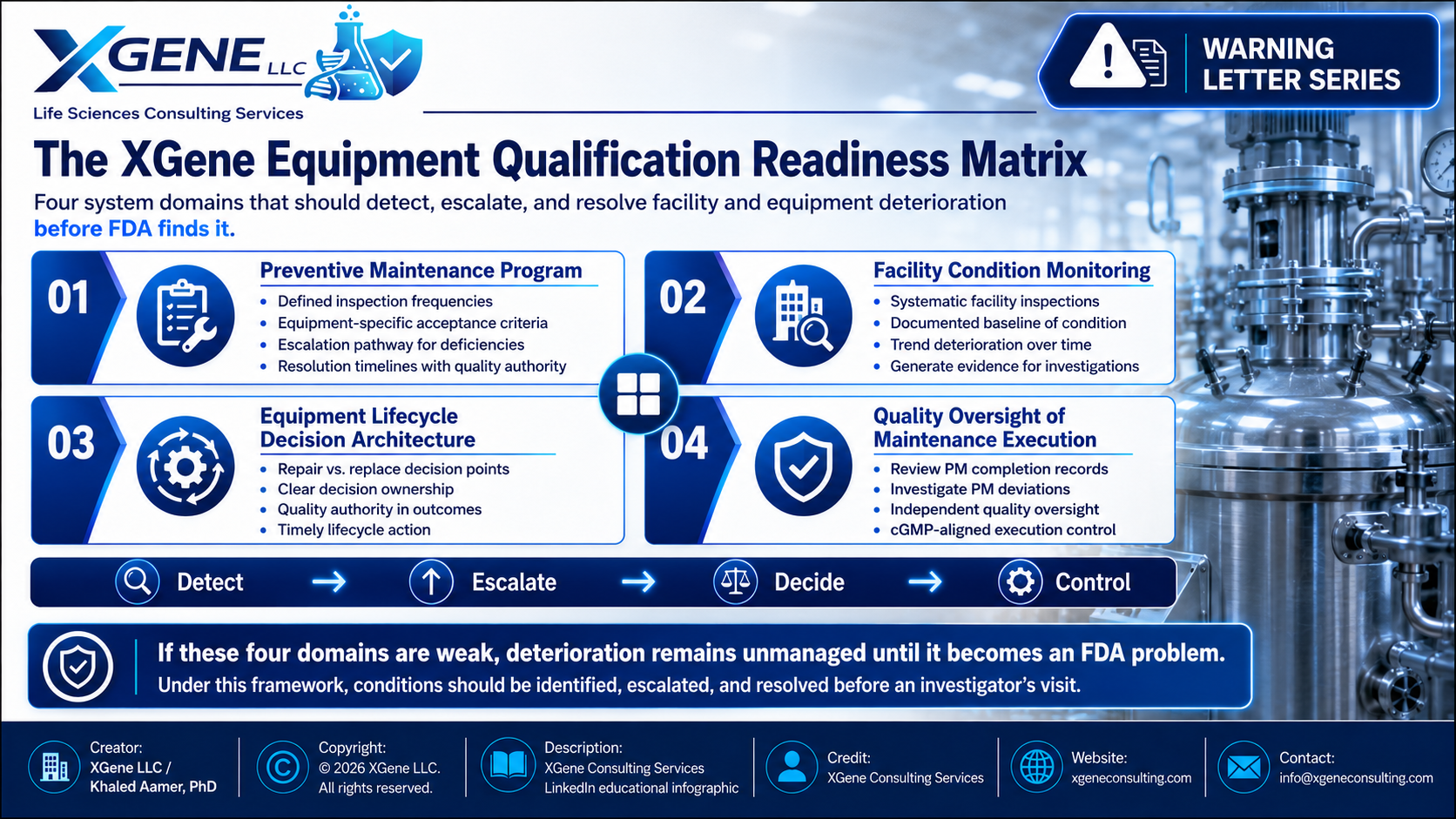
The XGene Equipment Qualification Readiness Matrix addresses this failure pattern across four domains. The first domain evaluates the preventive maintenance program itself — not whether PM exists on paper but whether it has defined inspection frequencies, specific acceptance criteria for each equipment class, a documented escalation pathway when deficiencies are identified, and a resolution timeline with quality unit authority to halt manufacturing when unresolved deficiencies pose contamination risk. The second domain evaluates facility condition monitoring — the systematic inspection program that generates a documented baseline of facility condition against which deterioration can be tracked over time, creating the evidence base that an adequate investigation requires. The third domain assesses the equipment lifecycle decision architecture: at what point does a “requires repair” designation become a “requires replacement” decision, who makes that decision, and what authority does the quality organization have in the outcome? The fourth domain evaluates quality oversight of maintenance execution — whether the quality unit reviews PM completion records, investigates PM deviations, and maintains the independent oversight of the maintenance function that cGMP requires. Had Alchymars been operating under this assessment framework, the conditions FDA documented in May 2026 would have been identified, escalated, and resolved well before an investigator’s visit.
There is a deeper observation about what the water on the floor at Alchymars actually represents. Physical facility deterioration in an API manufacturing facility is never purely a physical problem. It is an organizational signal. A facility where water drips onto production reactors and cracks persist in manufacturing surfaces is a facility where someone saw these conditions and made a decision — consciously or by default — not to stop manufacturing until they were corrected. That decision reflects the real operating priority of the quality system: production continuity over quality assurance. No procedure captures that priority explicitly. No SOP says “defer facility repair to avoid production interruption.” But the facility condition at the time of FDA’s inspection is the documented record of how that trade-off was resolved, repeatedly, over time. The Warning Letter is the consequence.
When a facility deficiency is identified in your manufacturing environment — equipment deterioration, a ceiling crack, condensation on a production surface — what is the documented path from identification to resolution, who in your quality organization has the explicit authority to halt production when that path stalls, and what is the maximum elapsed time your PM program permits before an unresolved deficiency becomes a quality event requiring investigation?