
Regulatory Record
FDA Warning Letter
On July 16, 2026, FDA issued Warning Letter 320-26-104 to Island Kinetics, Inc. d.b.a. CoValence Laboratories, Chandler, Arizona, following an inspection conducted January 14 to 23, 2026 at Facility Establishment Identifier (FEI)…
CoValence Laboratories Warning Letter: Process Validation Failure and the CMC Pattern Every OTC Drug Quality Director Must Recognize
Source Context
On this recordRecord overview
Regulatory Event
On July 16, 2026, FDA issued Warning Letter 320-26-104 to Island Kinetics, Inc. d.b.a. CoValence Laboratories, Chandler, Arizona, following an inspection conducted January 14 to 23, 2026 at Facility Establishment Identifier (FEI) 3002408934. The primary finding is not a single deficiency but a manufacturing operation that never established process validation for its Over-the-Counter (OTC) drug portfolio in the first place — and FDA’s letter documents at least four distinct manufacturing controls failures that trace back to the same root cause: a firm that has been operating commercial drug manufacturing processes without demonstrating, through data, that those processes are reproducible and in a state of control.
The core citation is 21 CFR 211.100(a) — failure to establish adequate written procedures for production and process control designed to assure that drug products have the identity, strength, quality, and purity they purport to possess. FDA’s inspection found that CoValence lacked process validation data for all of its OTC drug products. Two specific formulas — identified in the letter by redacted formula and lot numbers — were released to commerce without any process validation, meaning the firm never demonstrated at commercial scale that the manufacturing process consistently produces product meeting its specifications. More significantly, FDA documented that the firm routinely operated a critical manufacturing parameter beyond its own qualified limit for one OTC formula, and that CoValence’s director of quality confirmed, during the inspection, that no process validation had ever been performed at the actual operating condition used in commercial production. That is a materially different finding than a company that validated a process and later drifted outside range — this is a firm that qualified one operating envelope on paper and manufactured commercial product entirely outside it, without the quality unit connecting that gap to product risk.
This pattern is not unprecedented or unique to small OTC manufacturers. FDA’s 2011 Warning Letter to Abbott Nutrition’s Columbus, Ohio facility cited the same structural failure in a very different product category: Abbott had not established validated operating ranges for critical process parameters governing its spray drying and blending operations for Similac infant formula, and had not demonstrated through Stage 2 process qualification data that the process reliably met its predetermined quality attributes. The resulting recall of roughly five million cans of infant formula was, at the time, the largest nutritional product recall in FDA’s history, driven directly by the absence of a validated contamination control approach a properly executed Stage 2 qualification would have surfaced. CoValence’s finding is the same failure mode at a different scale: an unvalidated process is an unvalidated risk profile, regardless of whether the product is infant formula, a topical acne treatment, or an injectable.
What the Record Documents
CoValence’s response to FDA committed to a process validation protocol covering products manufactured since July 16, 2025, and to executing three qualification batches for one formula by February 2026. FDA found this inadequate for a reason every Chemistry, Manufacturing, and Controls (CMC) quality director should internalize: the response addressed only prospective manufacturing and said nothing about the batches already released and distributed before that date, and provided no interim control plan for product shipped while validation activities remain incomplete. A process validation remediation plan that only fixes the forward-looking manufacturing schedule leaves an unaddressed population of already-distributed product manufactured under conditions the firm itself now admits were never demonstrated to be reproducible.
The second finding — inadequate equipment cleaning validation — compounds the risk. FDA found that CoValence lacked a documented rationale for which products it selected as worst case for its cleaning validation studies, and lacked an analytical method capable of identifying and measuring specific drug residues on shared manufacturing equipment. Cleaning validation without a defensible worst-case justification and without a residue-specific analytical method is not validation; it is an assumption of adequacy with no data behind it. For a facility manufacturing multiple topical drug brands — the letter names TreeActiv Cystic Acne Spot Treatment, Ayadara Warrior Two Acne Spot Treatment, and Skin Script Cranberry Turnover Peel — cross-contamination risk on common equipment is a patient safety question, not a documentation exercise. CoValence’s response opened a Corrective and Preventive Action (CAPA) and committed to engaging a consultant to produce a worst-case justification, but FDA found it inadequate because it omitted a risk assessment of product already distributed and any evidence that current cleaning procedures are actually effective.
Technical and Quality Context
The third finding is a water system validation failure, and it is the most operationally serious of the four. The specific system type is redacted, but FDA’s references to USP specifications, biofilm formation, and ongoing chemical and microbiological suitability make clear this is a pharmaceutical water system. CoValence modified it in October 2024 — adding a production point of use and replacing a storage tank — without adequate requalification. Separately, its contract testing laboratory reported multiple water quality results exceeding USP specifications at points of use on that system, and CoValence did not investigate or remediate those exceedances. FDA’s letter is explicit about the mechanism of risk: pharmaceutical water systems operating without validated control are vulnerable to biofilm formation, which can drive microbial and endotoxin levels upward in ways that routine grab-sample testing may not catch in time. A system configuration change — new point of use, different tank material — without a documented risk assessment and requalification protocol under a change control system consistent with International Council for Harmonisation (ICH) Q10 is the equipment requalification trigger failure FDA’s process validation guidance and enforcement history repeatedly cite.
The fourth finding, cited under 21 CFR 211.192, is a failure to thoroughly investigate viscosity out-of-specification (OOS) results identified during stability testing. FDA found that CoValence’s stability program generated multiple viscosity OOS results without adequate root cause determination, CAPA, or even a documented scientific justification for the viscosity specification itself. This finding is inseparable from the process validation failure above it: without validated, characterized manufacturing conditions, a quality unit has no baseline against which to determine whether a stability viscosity excursion reflects a laboratory error, a formulation issue, or manufacturing process variability. FDA said as much directly, faulting CoValence’s response for failing to assess “the link between your unvalidated processes, unqualified equipment, and the observed viscosity failures.” An OOS investigation conducted against an unvalidated process is an investigation with no defensible endpoint.
FDA’s letter also documents unapproved new drug and misbranding violations under sections 505(a), 301(d), and 502(ee) of the FD&C Act for three of CoValence’s OTC products, finding that label claims such as “most effective treatment for cystic and severe acne” exceed what is permitted under OTC Monograph M006 for topical acne drug products. This is a distinct but compounding regulatory exposure specific to OTC monograph manufacturers: a firm can simultaneously face a Current Good Manufacturing Practice (CGMP) enforcement action for process and quality system failures and a labeling enforcement action for claims that push a monograph-compliant product into unapproved new drug territory. For OTC drug quality and regulatory teams, label claim review against the applicable monograph is not a marketing function separate from CMC compliance — FDA is evaluating both in the same inspection and the same letter.
Decision Relevance
FDA also noted that CoValence was cited for similar CGMP violations in prior inspections conducted in 2016 and 2020, and stated plainly that repeated failures demonstrate inadequate executive management oversight and control over drug manufacturing. That finding triggered FDA’s recommendation, under 21 CFR 211.34, that the firm engage a qualified CGMP consultant — with the explicit caveat that using a consultant does not relieve the firm’s own executive management of responsibility for resolving the underlying systemic flaws.
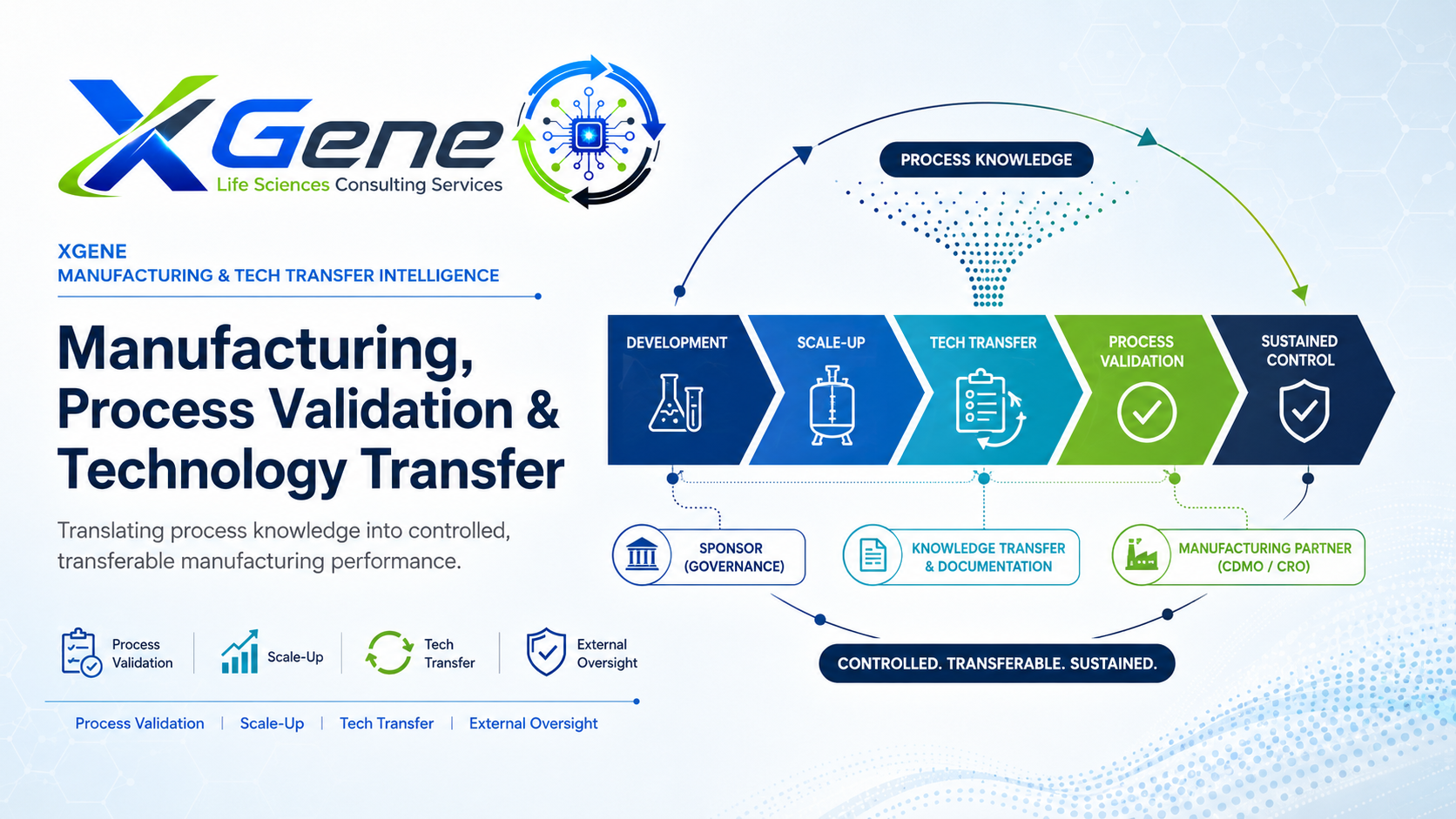
For OTC drug manufacturers producing multiple topical brands on shared equipment through contract or house-label arrangements, the CoValence letter is a clear signal: process validation, cleaning validation, and utility system validation are not independent checkboxes — they are one interconnected lifecycle, and a gap in one erodes the defensibility of data in the others. Companies facing similar exposure — unvalidated legacy processes, water systems modified without requalification, or OOS investigations that cannot be scientifically closed because the underlying process was never characterized — need a Stage 1/2/3 process validation lifecycle approach applied retrospectively to existing commercial products, not only prospectively to new ones. XGene’s process validation practice works with CMC and quality teams to build that retrospective qualification and risk assessment framework, including the water system requalification and cleaning validation worst-case justification work FDA specifically found missing here, before a routine inspection becomes a repeat-violation warning letter.
Primary regulatory references
Connected intelligence
Continue through the evidence graph.
Article
OOS Root Cause Analysis — Moving Beyond ‘Analyst Error’
"Analyst error" is not a root cause — it is a conclusion in search of evidence, and FDA’s May 2022 Level 2 revised OOS guidance is…Article
Chiral Drug Substances: Stereospecific Synthesis, Enantiomeric Purity, and the ICH Q6A Specification Strategy
More than half of the small molecule drugs approved by FDA in any given year contain at least one stereocenter. For most of those programs, the…Article
CAPA Effectiveness Verification — Closing the Loop FDA Actually Closes
An FDA investigator reviewing your CAPA system is not interested in how many CAPAs you have opened — they are interested in how many you have…Article
CareFusion 213, LLC (BD) Class I Recall — ChloraPrep Sterile Antiseptic Applicators: The Sterile Manufacturing System Failure Behind the Recall and What Every Aseptic Processing Director Must Address
CareFusion 213, LLC, a subsidiary of Becton, Dickinson and Company (BD), has recalled two configurations of its BD ChloraPrep One-Step and FREPP Clear sterile antiseptic applicators…From record to action
Use the evidence in context.
Continue into related XGene analysis or discuss the technical implication when the issue needs action.