
3.2.S.3.1 Elucidation of Structure: Building the Analytical Evidence Package That Proves Your Compound Is What You Say It Is
A structural-elucidation package is not simply a collection of spectra. It is an integrated identity argument showing that the material described in the dossier is the drug substance intended for…
On this pageArticle overview
A structural-elucidation package is not simply a collection of spectra. It is an integrated identity argument showing that the material described in the dossier is the drug substance intended for clinical and commercial use. The evidence should be internally consistent, scientifically interpretable, and appropriate to the structural complexity of the molecule.
ICH M4Q places elucidation of structure and other characteristics in CTD section 3.2.S.3.1. The ICH CTD Quality Q&A further clarifies that studies conducted to determine physicochemical characteristics of the drug substance belong in this section, while general properties are summarized in 3.2.S.1.3. The purpose of S.3.1 is therefore broader than attaching NMR and MS files: it is to present the structural and physicochemical evidence needed to support the identity claim made elsewhere in the dossier.
Building an Orthogonal Structural Evidence Package
ICH Q6A does not prescribe a fixed five-technique structure-elucidation package. What it does establish is an important identification principle: identification testing should be sufficiently specific to discriminate the new drug substance from closely related compounds likely to be present, and a single chromatographic retention time is not regarded as sufficiently specific. Applied to structural characterization, this supports an orthogonal strategy in which complementary techniques interrogate different features of the proposed structure.
The appropriate analytical suite depends on the molecule. For a conventional small molecule, the package commonly includes solution NMR, mass spectrometry, IR, and — where structurally informative — UV/Vis. More complex structures may require two-dimensional NMR, high-resolution MS, single-crystal X-ray diffraction, chiroptical methods, solid-state methods, or other techniques. The regulatory standard is not convenience and not a universal checklist; it is whether the selected evidence adequately establishes the proposed structure and relevant stereochemical and solid-state characteristics.
The current EMA Guideline on the Chemistry of Active Substances replaced CPMP/QWP/130/96 Rev. 1. The superseded guideline remains useful historically, but current EU authoring should anchor structural-characterization expectations to the effective guideline and applicable ICH requirements rather than cite the superseded document as the governing standard.
NMR, Mass Spectrometry, IR, and UV/Vis: What Each Method Should Prove
Proton and carbon NMR are central to small-molecule structural elucidation because they provide information on chemical environment, connectivity, symmetry, and substitution pattern. For complex structures, two-dimensional experiments such as COSY, HSQC, HMBC, NOESY/ROESY, or other appropriate techniques can establish connectivity and spatial relationships. A complete assignment table is often the most effective way to make the evidence reviewable: each reported signal should be mapped to the corresponding atom or structural feature using a consistent numbering scheme.
High-resolution mass spectrometry can provide strong support for the molecular formula when the measured exact mass is compared with the theoretical value for the proposed composition. A fixed ±5 ppm criterion is a common analytical benchmark in many HRMS applications, but it is not a universal FDA regulatory acceptance criterion. The appropriate mass-accuracy expectation should be justified for the instrument, method, ion species, calibration strategy, and intended evidentiary purpose. The submission should report the measured exact mass, calculated exact mass, ion assignment, mass error, and relevant acquisition conditions.
Infrared spectroscopy provides complementary functional-group and, when measured in the solid state, potentially solid-form information. Its role should be defined within the overall evidence package rather than treated as a mandatory stand-alone proof of structure. Where an IR method is also used for release identification, the relationship between the characterization spectrum, reference standard, and specification test should be internally consistent.
UV/Vis spectroscopy is useful where the molecule contains a chromophore whose absorption characteristics contribute meaningful structural or analytical information. It is not required for every molecule. Where used, the dossier should identify the solvent, spectral range, absorption maxima, and the structural rationale for the observed bands, and should reconcile the characterization data with any UV-based identification or assay method used elsewhere in the control strategy.
Stereochemistry: Establish What Is Relevant and Use an Appropriate Method
For chiral drug substances, the stereochemical composition and the configuration relevant to identity, quality, safety, and efficacy must be understood and controlled. FDA’s guidance on development of new stereoisomeric drugs states that stereoisomeric composition should be known and that appropriate stereochemically specific or selective methods should be used based on the substance and manufacturing process. ICH Q6A Decision Tree #5 addresses when chiral identity, assay, and enantiomeric-impurity procedures may be needed.
Absolute configuration should be established using an approach capable of supporting the assignment for the specific molecule. Single-crystal X-ray diffraction can provide direct structural evidence when suitable crystals and crystallographic conditions are available. Chiroptical techniques such as ECD or VCD, correlation to a compound of known configuration, stereospecific synthesis supported by mechanistic evidence, NMR approaches with chiral derivatization or shift reagents, or combinations of methods may also be appropriate. The earlier draft overstated single-crystal X-ray crystallography as a universal requirement; it is better treated as one strong option within a scientifically justified stereochemical evidence strategy.
Polymorphism and Solid-State Characterization
ICH Q6A addresses polymorphism in section 3.3.1(c), with Decision Trees #4(1) through #4(3) describing when and how polymorphic forms should be investigated and controlled. Decision Tree #1 concerns impurity acceptance criteria and should not be cited for polymorphism. Where solid form can affect drug-product performance, bioavailability, stability, manufacturability, or other relevant attributes, the selected form and the controls needed to maintain it should be scientifically justified.
XRPD is commonly the primary technique for distinguishing crystalline forms, supported where appropriate by DSC, TGA, solid-state IR or Raman, microscopy, solid-state NMR, moisture-sorption analysis, or other methods. The goal is not to force every technique into every dossier; it is to establish whether multiple forms exist, determine whether they matter, identify the form associated with the proposed process and material, and control that form when its impact is clinically or pharmaceutically relevant.
Structural characterization of specified impurities belongs primarily in the impurity strategy rather than being folded indiscriminately into the drug-substance structural-elucidation narrative. ICH M4Q places impurity information in 3.2.S.3.2, while impurity reference-standard characterization is addressed in 3.2.S.5. For mutagenic impurities, the current guideline is ICH M7(R2), not M7(R1). Structural certainty should be sufficient to support the mutagenicity assessment and control strategy, including in silico evaluation where applicable.
The XGene Structural Evidence Package Standard
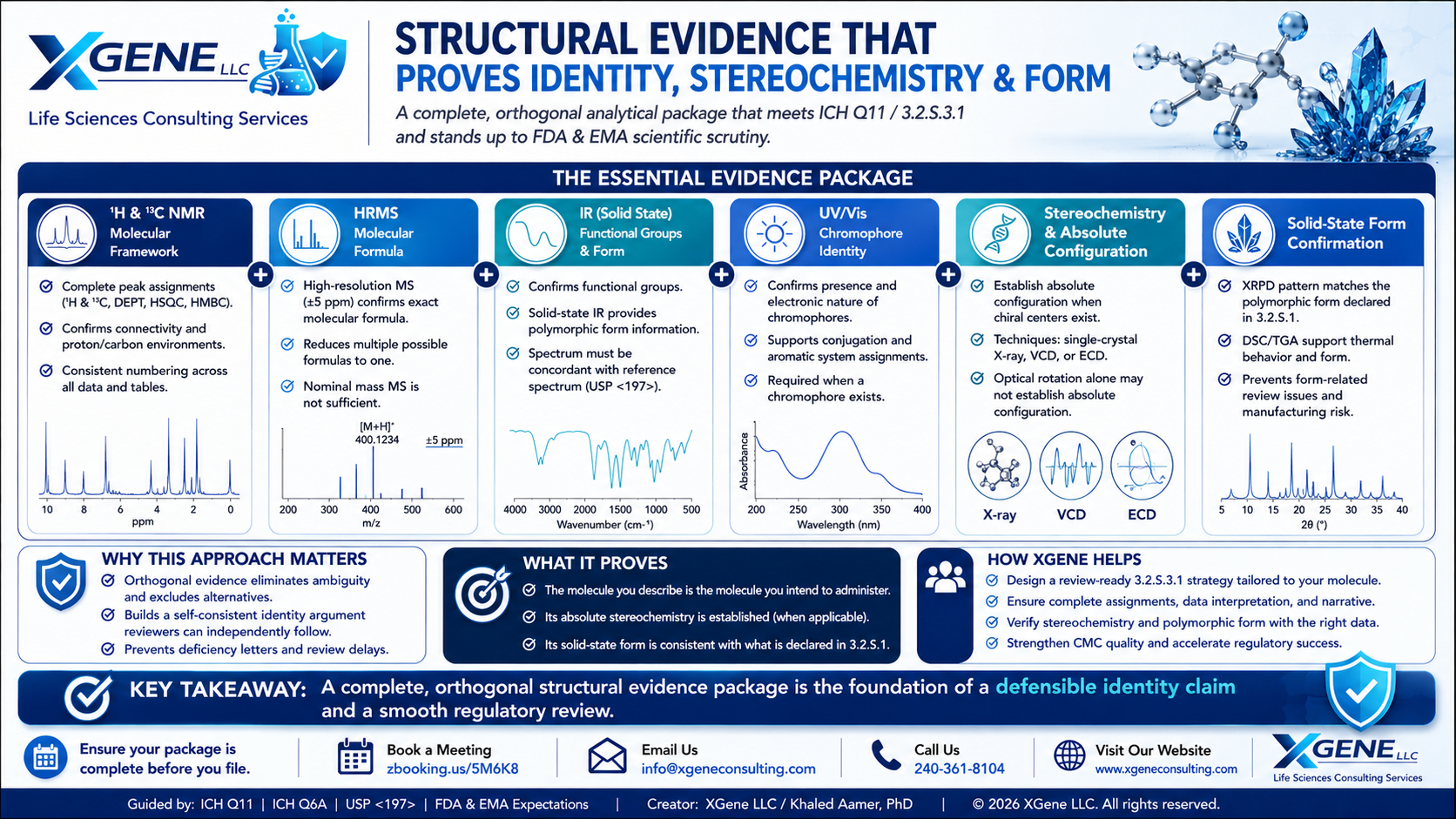
Step 1 — Structure-to-Spectrum Traceability: Build a numbered structural formula and use it consistently across 1H NMR, 13C NMR, and any 2D NMR experiments needed to resolve connectivity or stereochemical relationships. The submission should allow a reviewer to understand why the observed spectral features support the proposed structure without reconstructing the analysis independently.
Step 2 — Formula and Molecular-Mass Confirmation: Use an appropriately characterized mass-spectrometric method to support molecular mass and, where HRMS is used, molecular formula. Report the measured and theoretical exact masses, ion species, mass error, and relevant acquisition conditions rather than relying on nominal mass alone.
Step 3 — Stereochemical Evidence Proportionate to Risk: For chiral substances, establish relative and/or absolute stereochemistry using scientifically appropriate methods. Choose X-ray crystallography, chiroptical analysis, stereochemical correlation, synthetic-route evidence, or another justified approach based on the molecule and the strength of the assignment required.
Step 4 — Solid-State Identity and Form Control: Where solid form matters, connect XRPD and complementary thermal or spectroscopic data to the form described in the dossier and to the manufacturing process that is expected to reproducibly generate that material.
Step 5 — Cross-Consistency with the Control Strategy: Reconcile the S.3.1 characterization package with nomenclature and structure in S.1, impurity information in S.3.2, reference standards in S.5, and identification or other relevant tests in S.4. The strongest package is one in which every structural claim is supported by evidence and every downstream control is consistent with the characterized material.
The result should be a reviewer-traceable identity argument, not a checklist. The analytical methods are selected because each resolves a material structural question, and together they support the drug substance’s identity, stereochemistry, solid-state characteristics, and control strategy at the level appropriate to the molecule.
A well-built 3.2.S.3.1 section therefore does more than demonstrate analytical completeness. It protects the integrity of the entire drug-substance dossier. If the structure, stereochemical assignment, polymorphic identity, impurity relationships, or reference-standard linkage are inconsistent, the resulting questions can propagate into specifications, analytical procedures, manufacturing controls, and stability interpretation. The most efficient strategy is to establish those relationships before submission and make them explicit in the dossier.
Primary Regulatory References