
Risk Assessment in GMP Remediation — The ICH Q9 Practical Application
Most pharmaceutical quality risk assessments are produced in response to a regulatory request rather than to support a genuine decision — and the difference is immediately visible to an FDA…
On this pageArticle overview
Most pharmaceutical quality risk assessments are produced in response to a regulatory request rather than to support a genuine decision — and the difference is immediately visible to an FDA reviewer who reads dozens of risk assessments per year and can distinguish a document that shaped a decision from one that justified a decision already made.
That distinction sits at the center of what ICH Q9(R1) clarified when it was finalized in 2023. The revision did not introduce fundamentally new risk management tools — FMEA, Fault Tree Analysis, Preliminary Hazard Analysis, and risk ranking and filtering were all present in the original 2005 guidance. What the revision did was address a systemic implementation failure that the industry had been quietly reproducing for nearly two decades: treating quality risk management as a documentation exercise rather than a decision-support discipline. Understanding what changed in Q9(R1), and applying it correctly to GMP remediation programs, is the difference between closing a Warning Letter in 18 months and explaining to an FDA district office why you are still remediating in month 36.
What ICH Q9(R1) Added to Quality Risk Management for GMP Programs
The 2023 revision to ICH Q9 introduced several targeted clarifications that carry direct operational implications for GMP remediation programs. The most consequential is the formality-proportionality principle. Q9(R1) explicitly clarified that the formality of the risk management process should be commensurate with the level of risk — not with the regulatory visibility of the situation. This sounds self-evident, but it corrects a persistent industry behavior: escalating risk assessment formality for any situation involving a regulatory agency, regardless of the actual risk level, and producing minimal formal documentation for genuinely high-risk manufacturing decisions made internally. The result had been a body of industry risk assessments that were inversely correlated with their operational value.
The second major addition was the explicit treatment of subjectivity and human factors in risk assessment outputs. Q9(R1) acknowledges directly that risk assessments are not objective calculations — they reflect the judgment, experience, and cognitive biases of the people who perform them. The guidance now calls for transparency about the assumptions underlying risk scores, documentation of uncertainty in those scores, and communication of that uncertainty to decision-makers. For GMP remediation programs, this is operationally significant: it means a well-executed risk assessment for a Warning Letter response must not only produce a priority ranking of observations but must also document where the team had low confidence in its severity or occurrence scores, and what additional data would resolve that uncertainty.
The third clarification in Q9(R1) — and perhaps the most important for remediation programs specifically — concerns the re-assessment obligation. The original Q9 guidance described risk management as a cyclical process, but the revision strengthened the language around formal re-assessment after risk control measures are implemented. Re-assessment is not optional follow-up; it is the step that determines whether the identified risk has actually been reduced. In the context of a GMP remediation program, this means that a CAPA that addresses the root cause of a finding does not close the loop on the risk assessment — only a post-implementation re-assessment that confirms the severity, occurrence, or detectability scores have moved in the expected direction closes that loop.
Clause 3 of ICH Q9(R1) is the anchor for all of this: risk to quality must be evaluated in the context of risk to the patient. This is not rhetorical. It means that the severity dimension of every quality risk assessment must be anchored to patient safety impact — not to regulatory consequence, not to batch rejection cost, not to inspection observation category. A firm that rates the severity of a data integrity gap at 6 out of 10 because it led to a critical observation in the 483 has scored the wrong thing. The severity score should reflect the probability that the data integrity gap allowed a quality defect to reach a patient undetected. The regulatory consequence is a downstream effect of the quality risk, not the risk itself.
FMEA Applied to GMP Remediation: Prioritizing 483 Findings by Patient Risk
Failure Mode and Effects Analysis is the most widely used quantitative tool in pharmaceutical quality risk management, and for GMP remediation programs it is the right tool for the right problem — provided it is applied with the discipline the methodology requires. FMEA generates a Risk Priority Number for each failure mode by multiplying three scores: severity of the effect on the patient, likelihood of occurrence based on manufacturing data, and likelihood of detectability given current control systems. Each dimension is scored on a 1–10 scale, and the resulting RPN — which ranges from 1 to 1,000 — provides a basis for prioritizing corrective action investment.
The operational convention that most pharmaceutical quality systems use is that an RPN at or above 100–125 triggers immediate corrective action. This threshold is not mandated by regulation, but it represents a pragmatic boundary that most industry risk functions have settled on based on experience with what RPN ranges correspond to risk levels that are genuinely unacceptable versus risk levels that warrant monitoring and planned improvement. The threshold should be documented in the quality system, consistently applied, and defensible to an FDA reviewer who asks why certain findings were prioritized over others.
In a GMP remediation program responding to a Warning Letter, the FMEA discipline that is most frequently missing is the severity scoring step. Companies routinely score severity against the regulatory category of the observation — critical, major, minor — rather than against the patient impact scale Q9(R1) requires. A critical 483 observation related to a procedural documentation gap may carry a low patient safety severity if the underlying process was controlled and product was not affected. A minor observation related to an environmental monitoring trend may carry a very high patient safety severity if the trend suggests contamination control system degradation. Regulatory category and patient safety severity are correlated but not identical, and conflating them produces a remediation priority list that is optimized for the wrong objective.
The occurrence dimension requires manufacturing data — not judgment. Occurrence scores should be drawn from deviation frequencies, OOS rates, audit findings, and process performance data. A firm that assigns occurrence scores through a workshop discussion, without reference to actual manufacturing history, is producing a risk assessment with no empirical grounding in the detectability dimension. Firms frequently conflate detectability with current procedure — assuming that because a procedure exists to detect a failure mode, detectability is high. The correct assessment is whether the control system is actually capable of detecting the failure mode when it occurs, which requires an honest evaluation of whether the procedure is followed consistently, whether the person executing it has the training and authority to escalate, and whether the escalation pathway actually reaches a decision-maker in time to prevent impact.
Preliminary Hazard Analysis is the appropriate tool for the early-stage scoping work in a GMP remediation program — before FMEA is applied to individual observations. PHA allows the remediation team to map the manufacturing system, identify hazard categories at a high level, and determine where FMEA resources should be concentrated. A Warning Letter with fifteen observations across five quality systems does not require equally intensive FMEA work on every observation. PHA at program initiation identifies which quality systems carry the highest hazard potential and directs FMEA resources accordingly.
The documentation requirements under Q9(R1) for GMP remediation risk assessments are specific. The risk assessment must be prospective — meaning it must be completed before remediation prioritization decisions are made, not after. It must document the assumptions and areas of uncertainty in the scoring. It must be linked to remediation decisions, meaning there must be a traceable connection between FMEA outputs and the sequencing and resourcing of corrective actions. And it must include a re-assessment plan with defined triggers and timelines.
The Re-Assessment Step: Why Most Risk Programs Don’t Close the Loop
The most common failure mode in pharmaceutical quality risk management programs — including those executed in response to Warning Letters — is not inadequate initial risk assessment. It is the absence of a formal re-assessment after corrective actions are implemented. Companies invest significant effort in producing an FMEA at the beginning of a remediation program, generate a prioritized finding list, and then execute corrective actions against that list. What they rarely do is return to the FMEA after a corrective action is complete and formally re-score the relevant severity, occurrence, and detectability dimensions to confirm the RPN has moved.
This failure has practical regulatory consequences. When FDA receives a Warning Letter response that claims a corrective action is complete, the agency’s expectation — consistent with Q9(R1) — is that the firm has verified the risk reduction, not simply implemented a procedural change. A CAPA closure record that documents only that the procedure was revised and training was conducted does not demonstrate risk reduction. It demonstrates activity. Risk reduction is demonstrated by a re-scored FMEA with supporting data showing that occurrence has decreased, detectability has improved, or — in the most significant scenarios — that the underlying failure mode has been eliminated and severity is no longer relevant.
The re-assessment step also serves a function that is easy to overlook during active remediation: it catches situations where the initial risk assessment was wrong. A corrective action implemented against a failure mode that was incorrectly characterized at the FMEA stage may produce the expected procedural output while leaving the actual risk unchanged. Re-assessment at defined milestones — after each significant corrective action, and again at program closure — creates the feedback loop that allows the remediation team to detect these situations before FDA does.
ICH Q10, which provides the pharmaceutical quality system framework within which Q9 tools operate, reinforces this through its CAPA system requirements and management review obligations. The integration of Q9 re-assessment outputs into Q10 management review — not just as a remediation status report, but as a formal update to the risk register — is the structural mechanism that keeps the risk management program alive rather than treating it as a one-time deliverable.
The XGene GMP Remediation Risk Prioritization Framework
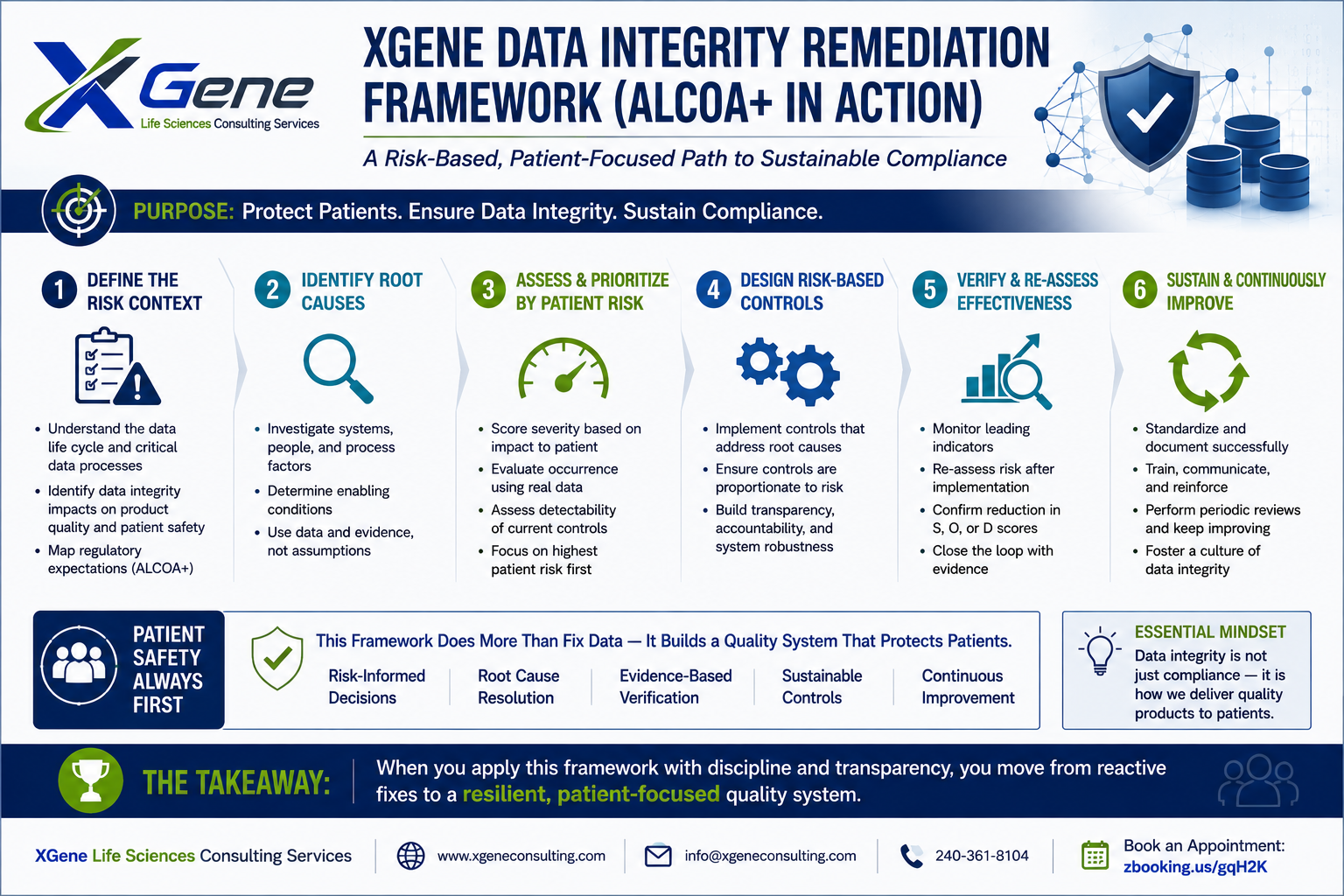
XGene’s approach to GMP remediation risk management applies ICH Q9(R1) tooling within a structured program architecture:
Step 1 — Preliminary Hazard Analysis at program initiation. Before individual findings are assessed, the entire manufacturing system is mapped and hazard categories are identified at the system level. This ensures FMEA resources are concentrated where patient risk is highest.
Step 2 — FMEA for each finding, scored against patient impact. Severity is anchored to patient safety impact under ICH Q9(R1) Clause 3 — not regulatory observation category. Occurrence is drawn from manufacturing data. Detectability reflects actual control system capability, not procedural existence.
Step 3 — RPN calculation and prioritization. RPNs are calculated, documented with assumptions and uncertainty notes, and used directly to sequence remediation investments. Findings at or above RPN 100–125 enter immediate corrective action. Lower-RPN findings enter a planned improvement queue with defined timelines.
Step 4 — Independent risk assessment review. Before the risk assessment is finalized, it is reviewed by a function independent of the remediation team to test the scoring rationale and challenge assumptions. This addresses the subjectivity concern Q9(R1) raised explicitly.
Step 5 — Remediation sequencing based on RPN and resource constraints. The remediation plan maps RPN-prioritized findings against available resources and produces a sequenced timeline that FDA can review and evaluate as a coherent program rather than a list of commitments.
Step 6 — Re-assessment protocol after each milestone. After each significant corrective action is implemented, the relevant FMEA is re-scored with supporting data. Re-assessment outputs feed the next management review and are included in regulatory submissions where relevant.
This framework treats the risk assessment as a living document — not a program deliverable — and produces the re-assessment evidence that demonstrates to FDA that risk reduction was achieved, not just that remediation activity was completed.