
CareFusion 213, LLC (BD) Class I Recall — ChloraPrep Sterile Antiseptic Applicators: The Sterile Manufacturing System Failure Behind the Recall and What Every Aseptic Processing Director Must Address
CareFusion 213, LLC, a subsidiary of Becton, Dickinson and Company (BD), has recalled two configurations of its BD ChloraPrep One-Step and FREPP Clear sterile antiseptic applicators (2% w/v chlorhexidine gluconate…
On this pageArticle overview
CareFusion 213, LLC, a subsidiary of Becton, Dickinson and Company (BD), has recalled two configurations of its BD ChloraPrep One-Step and FREPP Clear sterile antiseptic applicators (2% w/v chlorhexidine gluconate and 70% v/v isopropyl alcohol) under a Class I classification confirmed by FDA on June 25, 2026. The firm initiated the recall on May 28, 2026, covering approximately 371,000 applicators distributed nationwide and internationally, after quality testing detected non-sterility caused by Aspergillus penicillioides in the 1 mL One-Step applicator (Lot 4032183, NDC 54365-400-31) and, in the 1.5 mL FREPP applicator (Lot 4073005, NDC 54365-400-30), the same fungal contamination combined with a second, independent finding: wrinkles in the paper lidding stock that may breach the seal area.
The Manufacturing Failure: Two Distinct Control Points That Had to Fail Simultaneously
ChloraPrep is not a peripheral product category. It is one of the most widely used pre-procedural skin antiseptics in U.S. hospitals and surgical centers, applied to intact or pre-incision skin immediately before venipuncture, catheter insertion, and surgical incision. A sterile antiseptic applicator carrying viable fungal contamination introduces, at the precise moment a skin barrier is being breached, the type of organism the product exists to eliminate. Aspergillus species are not associated with skin-site infection at the rate of common bacterial flora, but in immunocompromised patients, or where a seal breach allows recontamination during storage or use, the theoretical exposure route becomes clinically plausible. FDA’s Class I designation reflects a reasonable probability of serious adverse health consequences under 21 CFR § 7.3(m)(1); it is a prospective risk classification, not a confirmed injury count, and the purpose of this analysis is the manufacturing failure mechanism, not speculation about individual patient outcomes.
Two separate manufacturing control points had to fail for this event to occur, and they appear to be independent of one another. First, the process controlling bioburden and sterility assurance for the applicator solution and pad matrix did not exclude a fungal organism before the unit was sealed and released — a finding that could implicate sterilization validation, upstream bioburden control, or the environmental monitoring program’s sensitivity to fungal excursions in the filling suite ahead of batch disposition. Second, the paper lidding stock used to seal the applicator wrapper reportedly wrinkled in a manner that can breach the seal area — a container-closure integrity issue that sits entirely outside the sterilization step and instead implicates packaging-material specification, incoming inspection, or heat-seal-parameter control. Two distinct failure modes surfacing in the same recall event, at the same facility, in the same classification window, is a stronger systemic signal than either finding would represent alone.
21 CFR § 211.113(b) requires written procedures designed to prevent microbiological contamination of drug products purporting to be sterile, and FDA’s 2004 Guidance for Industry on Sterile Drug Products Produced by Aseptic Processing sets the practical expectation that environmental monitoring is built to detect excursions before a batch disposition decision, not after a complaint surfaces one. A program aligned with that expectation for this product category generally includes routine viable and non-viable particulate monitoring of the filling environment, defined action and alert limits appropriate to the suite’s classification, personnel monitoring tied to aseptic gowning qualification, and a documented investigation trigger whenever a mold or fungal organism — organisms that standard bacterial monitoring media and incubation conditions can under-detect — is recovered anywhere in the facility. Container-closure integrity for a sealed sterile applicator is separately expected to be qualified under a validated seal-strength and inspection program sized to catch a wrinkle-related seal defect before release, rather than depend on a downstream complaint to surface it.
The Warning Letter-to-Recall Sequence: What It Reveals About CAPA Effectiveness
What elevates this event beyond a single-lot quality signal is that CareFusion 213’s El Paso, TX facility received an FDA Warning Letter dated April 30, 2026 (MARCS-CMS 722729), following an FDA inspection conducted October 15–24, 2025. Based on available reporting on that Warning Letter — which should be independently verified against FDA’s Warning Letters index before being relied on for compliance decisions, as the full verbatim text was not part of the source record for this analysis — FDA cited inadequate investigation of sterility test failures and container-closure integrity gaps at this same site: the identical failure-mode pair now named in this recall, roughly six weeks after the Warning Letter published. A Warning Letter communicates significant regulatory violations and requests corrective action; it does not by itself halt production or constitute an import ban, and CGMP compliance is not a status a facility earns permanently by responding to one inspection — it has to be re-demonstrated at every subsequent batch. When the same root-cause family, sterility-investigation adequacy and container-closure integrity, reappears as a Class I recall within roughly two months of a Warning Letter citing that same gap, the object under scrutiny is not the lot; it is the corrective and preventive action’s actual effectiveness. A comparable lesson, at far larger scale, came from the New England Compounding Center fungal meningitis outbreak of 2012, where Exserohilum rostratum contamination in injectable methylprednisolone acetate — traced to environmental monitoring and sterility-assurance failures that were not caught prospectively — caused 64 deaths across 20 states and led to the Drug Quality and Security Act of 2013. The organism, dosage form, and route of administration differ from this event, but the underlying pattern does not: fungal contamination is frequently an environmental-monitoring-program design gap before it becomes a batch-disposition problem.
Actionable Takeaways for Aseptic Processing Sites
Any aseptic processing site operating under an open Warning Letter, or one closed within the past 12 to 18 months, should independently verify — rather than assume — that its environmental monitoring program’s mold and fungal detection capability, including media selection, incubation conditions, and identification workflow, was explicitly addressed in its corrective action, not only its bacterial monitoring sensitivity. Separately, any site using paper, Tyvek, or foil lidding stock on primary or secondary sterile barrier packaging should confirm that incoming-material inspection and heat-seal-parameter qualification include a defined wrinkle- or fold-related seal-integrity acceptance criterion that is trended over time, not evaluated only as a pass/fail check at the point of release.
XGene Sterile Manufacturing CAPA and Environmental Monitoring Framework
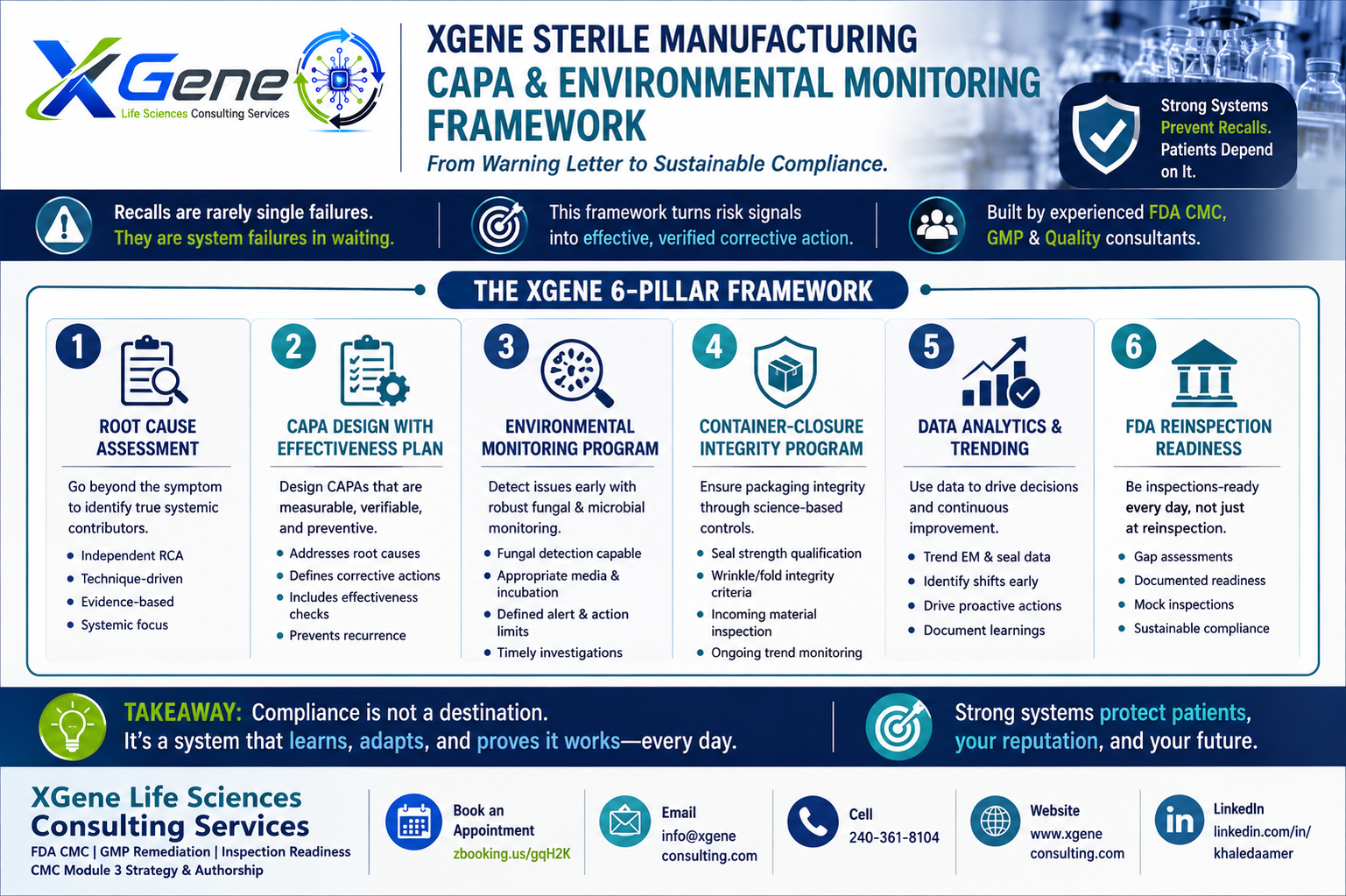
This is the intersection where XGene Consulting works with sterile product manufacturers:
1. Warning Letter and FDA Form 483 Root Cause Assessment: Independent root cause analysis that looks past the cited observation to the underlying system — not just the specific failure mode, but the quality system architecture that allowed it to persist.
2. Corrective and Preventive Action (CAPA) Design with Effectiveness-Check Planning: CAPA design paired with effectiveness-check planning that verifies recurrence prevention rather than training completion. A CAPA is not closed because the procedure was revised; it is closed when the failure mode has not recurred across a defined observation window.
3. Environmental Monitoring Program Development: Environmental monitoring and container-closure integrity program development aligned with current FDA aseptic processing expectations — including fungal detection capability, media selection, incubation conditions, and investigation triggers specific to mold and fungal excursions.
4. Container-Closure Integrity Program Design: Seal-strength qualification and incoming-material inspection programs that include a defined wrinkle- or fold-related seal-integrity acceptance criterion that is trended over time, not evaluated only as a pass/fail check at release.
5. FDA Re-inspection Readiness: Independent technical review of whether your CAPA response addresses the root cause FDA identified — before FDA does at reinspection. If your facility is managing an open Warning Letter citing sterility-investigation or container-closure gaps, XGene Consulting can help you assess that before FDA does at reinspection.