
3.2.P.5.1–5.3 Drug Product Specifications, Analytical Methods, and Validation: The Testing Architecture FDA Reviews Most Critically
The drug product specification is not complete because it passes internal review. It is complete when it addresses every critical quality attribute identified in P.2, when every method is validated…
On this pageArticle overview
The drug product specification is not complete because it passes internal review. It is complete when it addresses every critical quality attribute identified in P.2, when every method is validated to detect what it is intended to detect, and when the combination of release and shelf-life specifications provides the assurance that every unit reaching a patient meets its clinical performance criteria throughout its shelf life.
What makes 3.2.P.5.1–5.3 the most scrutinized section of the drug product module is not its complexity — it is the consequence of its failure. A specification that does not cover a critical quality attribute, a method that cannot distinguish degraded product from intact product, or a dissolution criterion that every manufactured batch can pass regardless of its in vivo behavior are not abstract regulatory deficiencies. They are gaps that allow substandard product to reach patients. FDA reviewers understand this, and the deficiency letters issued against P.5 packages consistently reflect a reviewer who is examining not just whether a specification exists, but whether the specification architecture as a whole provides meaningful quality assurance. The question is not whether your release testing passes — the question is whether it would fail when it should.
The Drug Product Specification Architecture: Appearance, Identity, Assay, Impurities, and Dosage Form-Specific Tests
ICH Q6A establishes the universal architecture for drug product specifications: appearance and description, identification, assay, degradation products, residual solvents if applicable, water content, uniformity of dosage units, and performance tests such as dissolution or disintegration. Each of these is a category of testing, not a single test, and the precision of how each category is populated determines whether the specification provides genuine quality control or merely the appearance of it. The identification section receives the least attention in most CMC packages and the most attention from reviewers who have seen products approved on the basis of a single chromatographic retention time — a property that is entirely non-orthogonal, since any compound eluting at the same retention time under the same conditions will pass. ICH Q6A is explicit: identification testing must use methods of sufficient specificity to distinguish the drug substance from closely related compounds, and where a single test cannot accomplish this, a combination of tests is required.
In practice, this means that UV absorption maximum as a second orthogonal method adds meaningful discriminating power only if the UV spectrum has been demonstrated to be distinct from known related compounds at the concentrations present in the dosage form. HPLC retention time and UV — both of which are outputs of the same HPLC-UV run — are not two orthogonal identification methods; they are two readings from the same chromatographic separation. An IR spectrum compared against a reference standard spectrum, a comparison of HPLC retention time under two different chromatographic conditions, or an HPLC-MS confirmation are examples of genuine orthogonality. Reviewers will issue a deficiency when both identification tests are HPLC-UV without documented justification for why the UV spectrum of the drug substance is distinctly identifiable under the analytical conditions used.
For dosage-unit uniformity, USP <905> uses an Acceptance Value (AV) approach based on the individual unit results, sample mean, and sample standard deviation, with staged criteria. The submission and specification should therefore reference the applicable compendial test and acceptance-value calculation rather than substitute a simplified mean/RSD rule for the compendial decision logic.
ICH Q6A Specification-Setting Applied to Drug Products: The Acceptance Criterion Justification Standard
ICH Q6A distinguishes between universal tests — those applied to all drug products of a given type — and specific tests that apply to a particular dosage form or product. For oral solid dosage forms, dissolution is a specific test that is also the performance test most directly linked to in vivo behavior, and it is the acceptance criterion for dissolution that receives the most sustained scrutiny in review. The FDA Guidance for Industry on Dissolution Testing of Immediate-Release Solid Oral Dosage Forms (1997) articulates the evidentiary standard clearly: a dissolution specification is scientifically meaningful only if it is derived from data linking dissolution performance to in vivo behavior, or at minimum, from data demonstrating that the specified acceptance criterion distinguishes between acceptable and unacceptable manufacturing outcomes.
The phrase “discriminating dissolution method” has specific technical content that is frequently misapplied. A method is not discriminating because multiple commercial batches show consistent results. A method is discriminating when it can detect a meaningful deterioration in product quality — a change in coating thickness, a change in API particle size distribution, a compromise in excipient blend homogeneity — as a change in the dissolution profile that falls outside the acceptance criterion. The failure scenario that generates the deficiency letter “Dissolution Q≥75% at 30 minutes is not discriminating — please provide discriminatory power data” is not a theoretical construct: it reflects actual submissions in which the applicant set Q≥75% at 30 minutes based on passing data from development batches without ever testing a batch that was expected to perform suboptimally. A specification that was never challenged against a failing batch provides no meaningful assurance.
The release-versus-shelf-life specification distinction compounds this issue for assay and degradation products. For oxidation-sensitive compounds, the release assay limit is routinely set tighter than the shelf-life limit because the degradation trajectory over the stability period is predictable from the forced degradation studies and real-time stability data. The release limit must be set with sufficient margin to ensure that all units will remain within the shelf-life limit for the proposed shelf life — a rationale that must be explicitly documented in P.5.1 and supported by stability data. USP <1092> provides procedural guidance for dissolution method development that specifically addresses media selection, apparatus selection, and discriminatory power assessment, and it is a reference FDA reviewers expect to see cited when the dissolution method description is presented in P.5.2.
Analytical Method Description and the Q3B Link Between Specifications and Degradation Products
Section 3.2.P.5.2 requires a description of the analytical procedures used to test each attribute in the specification, and the precision of this description is the foundation on which P.5.3 validation is evaluated. A method description that does not specify mobile phase composition, gradient program, column type and dimensions, detection wavelength, and system suitability requirements cannot be reproduced or validated in a meaningful sense. The specific connection between P.5.2 and P.5.3 that FDA reviewers examine most closely is the relationship between the methods described for related substances and the degradation products whose limits are set in P.5.1 — because ICH Q3B(R2) establishes that identified degradation products above the identification threshold must have limits set in the specification, and the method used to quantify them must be validated to demonstrate that those degradation products are resolved from the API peak and from each other.
A stability-indicating procedure should be challenged with scientifically relevant stressed samples and known degradants or impurities as appropriate. Acid/base hydrolysis, oxidation, light, heat, or other stresses may be used based on degradation chemistry, but Q2(R2) does not prescribe one universal forced-degradation recipe.
The container closure integrity test, where applicable, belongs in P.5.1 as a specific test when the container closure system is a critical control against moisture ingress or oxygen permeation. For moisture-sensitive compounds packaged in HDPE bottles with desiccants, or for products packaged in blister configurations with defined water vapor transmission rates, the specification for container closure integrity is the downstream assurance that the moisture content specification at shelf life is achievable. The method validation for container closure integrity testing — typically by vacuum decay, dye ingress, or headspace analysis — falls under P.5.3 and must include the acceptance criteria that distinguish a sealed from a compromised package at the sensitivity required by the product’s moisture sensitivity profile.
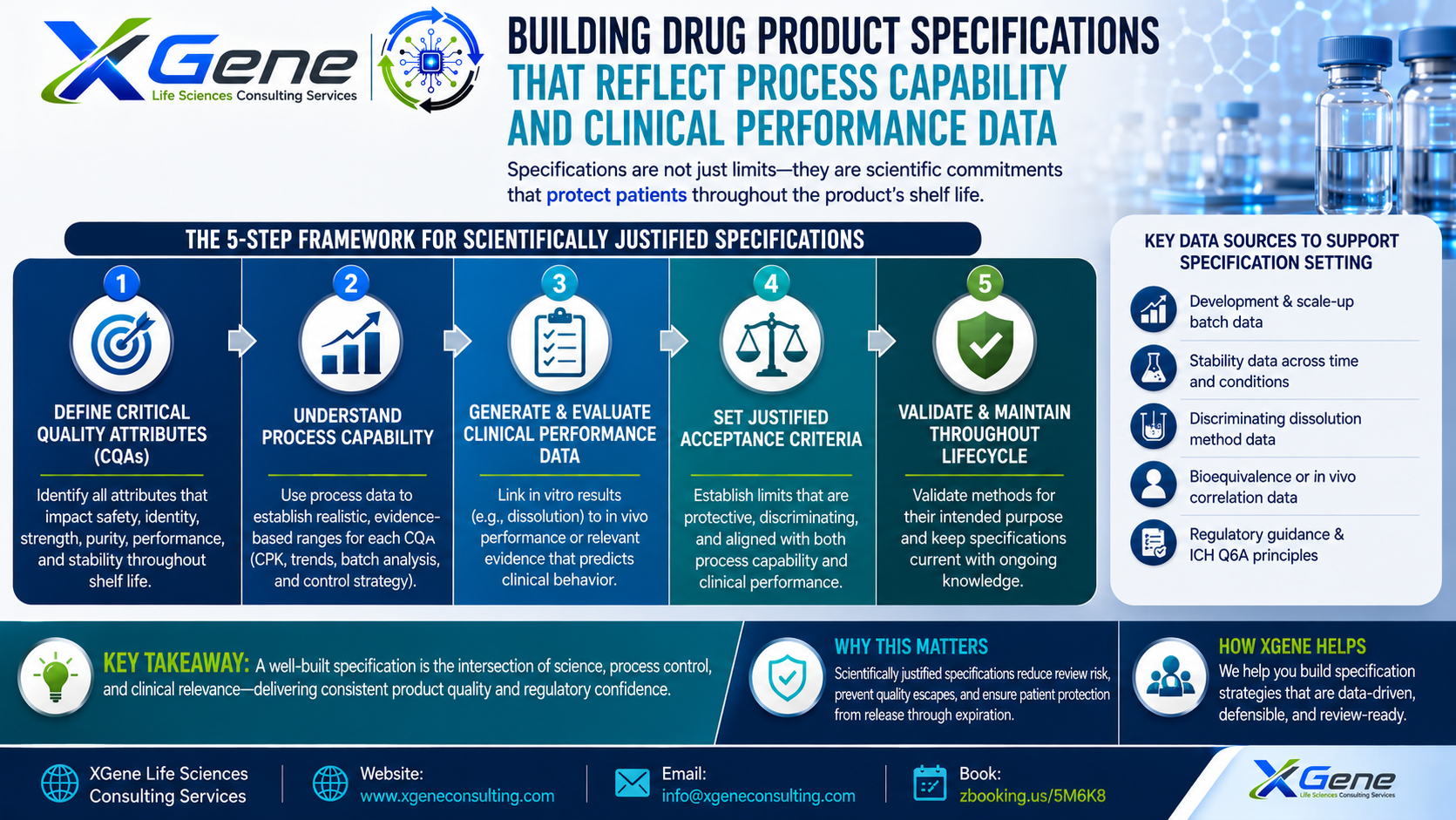
Building Drug Product Specifications That Reflect Process Capability and Clinical Performance Data
The XGene P.5 Specification Design Protocol is a five-step pre-submission specification audit that confirms every component of the P.5 package can withstand the standard of reviewer scrutiny before the submission is filed, not after the deficiency letter is received.
Step 1 — CQA Coverage Check: Map every critical quality attribute identified in 3.2.P.2 against the tested attributes in 3.2.P.5.1 and confirm there are no CQAs that lack a corresponding specification and test method. This step identifies the category of deficiency in which a CQA is documented in P.2 but not controlled in P.5 — the gap that reviewers flag immediately because it demonstrates that the specification does not reflect the product’s quality control framework.
Step 2 — Stability-Indicating Validation Confirmation: Verify that the HPLC assay and all related substances methods have been subjected to forced degradation under all five ICH Q1A/Q1B stress conditions — acid hydrolysis, base hydrolysis, oxidative stress, photolytic stress, and thermal stress — and that the resulting degradation products are resolved from the API peak and from each other, with mass balance confirmed. Without this data, neither P.5.3 nor the stability section (P.8) can demonstrate that the method is measuring what it is intended to measure.
Step 3 — Dissolution Discriminatory Power Assessment: Confirm that at least one batch with known suboptimal performance — whether from accelerated stress conditions, an intentionally modified process parameter, or a reformulated prototype — has been tested against the proposed dissolution method and failed the acceptance criterion. Without this test, the discriminatory power of the method is asserted, not demonstrated, and the assertion will not survive reviewer scrutiny under the FDA’s 1997 guidance standard.
Step 4 — Release-to-Shelf-Life Specification Logic: For every attribute with different release and shelf-life limits, document the quantitative rationale: the predicted degradation rate from stability studies, the margin between the release limit and the shelf-life limit, and the worst-case scenario analysis demonstrating that a batch released at the outer edge of the release specification will remain within the shelf-life specification for the full proposed shelf life.
The LOQ for an impurity or degradation-product method should be scientifically suitable for the specification, reporting threshold, and intended control strategy. Q2(R2) does not define a universal LOQ-to-specification ratio. XGene’s readiness review instead confirms that accuracy, precision, specificity, and quantitation capability are demonstrated over the range needed to make the specification decision reliably.
The output of the XGene P.5 Specification Design Protocol is a pre-submission specification audit report that maps each acceptance criterion to its supporting data source, each method to its validated performance characteristics, and each release-versus-shelf-life distinction to its documented rationale — a package designed to eliminate P.5 deficiency letters before the review clock starts.
A drug product specification that survives internal review but fails under FDA scrutiny does not fail because the science was wrong — it fails because the documentation of the science was insufficient to satisfy the reviewer’s standard of evidence. The cost of a P.5 deficiency letter is not the letter itself; it is the three-to-six month extension of the review clock, the complete reanalysis of retained samples under conditions that should have been designed into the original validation, and the negotiation over acceptance criteria that should have been finalized at development completion. The analytical infrastructure that supports a drug product specification is built during development, not during the review cycle, and the time to confirm that it meets the regulatory standard is before the submission is filed.