
3.2.P.2 Pharmaceutical Development: Writing the QbD Narrative That Justifies Every Formulation and Manufacturing Decision
Section 3.2.P.2 is the section reviewers read when they want to understand why the drug product is designed the way it is — why those excipients, that manufacturing process, that…
On this pageArticle overview
Section 3.2.P.2 is the section reviewers read when they want to understand why the drug product is designed the way it is — why those excipients, that manufacturing process, that particle size specification, that dissolution method. A P.2 that reads as a list of formulation experiments without a clear decision architecture will generate questions about why development decisions were made, even when the decisions were sound.
This is the structural failure that defines the category of deficiency most commonly issued against pharmaceutical development sections: not missing data, but missing logic. A sponsor who conducted thorough formulation screening, a well-designed design of experiments, and a comprehensive excipient compatibility program — and then wrote P.2 as a chronological record of those activities — will receive a deficiency letter asking for the scientific rationale connecting drug substance properties to formulation decisions, even though the rationale was embedded in the work all along. The problem is presentation architecture, and the architecture begins with the Quality Target Product Profile.
The QTPP Foundation: What P.2 Must Establish Before Any Formulation Data Are Presented
The Quality Target Product Profile is not a regulatory checklist appended to the front of section 3.2.P.2. It is the prospective scientific statement that defines what the drug product must achieve for the patient before a single excipient is selected or a process parameter is evaluated. ICH Q8(R2) (2009) defines the QTPP as a prospective summary of the quality characteristics of a drug product that ideally will be achieved to ensure the desired quality, taking into account safety and efficacy of the drug product. The word “prospective” carries technical weight. The QTPP must be established before the design decisions it is intended to justify — not reconstructed from them. When a P.2 section presents a QTPP that is obviously derived from the final formulation rather than the clinical and patient requirements that preceded it, a reviewer recognizes the inversion and the scientific credibility of the entire section is weakened.
A complete QTPP addresses dosage form and route of administration with the patient-facing rationale — not a restatement of the clinical formulation, but the reasoning that connects patient population characteristics, clinical pharmacology data, and intended use to the dosage form decision. An immediate-release tablet for a BCS Class I compound with a wide therapeutic window in a patient population without known swallowing impairment is a different scientific argument from an extended-release capsule for a compound with a narrow therapeutic index and a short biological half-life. The QTPP must articulate that argument, because it is the clinical rationale that then drives every downstream decision about particle size, dissolution target, and manufacturing process.
The FDA Guidance for Industry: Quality Target Product Profile for New Molecular Entities (2020) is explicit that QTPP elements must include dosage form and route of administration, dosage strength and dosing regimen, container closure system, drug product quality attributes including physicochemical attributes such as appearance and identification, strength, assay, uniformity, purity and impurity profile, dissolution and drug release characteristics, and physical characteristics. The guidance specifies that each QTPP element should be accompanied by a clinical or patient justification — a requirement that FDA reviewers apply directly when assessing whether a QTPP element is present as a substantive regulatory commitment or as a label. The most commonly cited QTPP deficiency in FDA information requests and deficiency letters for pharmaceutical development sections is: “The QTPP does not include a target dissolution or drug release specification with clinical justification — please revise.” That language reflects a direct application of the 2020 QTPP guidance, and it is avoidable when the QTPP is built from clinical data forward rather than from the final drug product specification backward.
Target shelf life and storage conditions, assay at release and at the end of shelf life, and target impurity profile at release and at shelf life are QTPP elements that are frequently present only in abbreviated form. A QTPP that specifies “assay: NLT 95.0% at release” without establishing the target assay at shelf life — and the margin between release and shelf life targets that allows for degradation within the proposed specification limits — is incomplete as a design document. ICH Q6A (1999) establishes the specification-setting framework for drug products, and the QTPP must be consistent with it: the target degradation allowance over shelf life, the acceptable impurity levels at the end of shelf life, and the proposed microbiological quality attributes must all appear as QTPP elements supported by clinical and toxicological justification, not just as regulatory conventions.
The relationship between the QTPP and the control strategy in P.3, P.4, and P.5 is the traceability argument that P.2 must make visible. Each QTPP element must ultimately map to a specification attribute in 3.2.P.5, a container closure system element in 3.2.P.7, or a stability commitment in 3.2.P.8. When that mapping is not explicit in P.2, the control strategy in P.5 appears asserted rather than derived, and the reviewer cannot follow the scientific thread from the patient requirement to the regulatory control without requesting the sponsor to reconstruct it.
CQA Identification and Risk Assessment: The Scientific Rationale FDA Expects
The transition from QTPP to Critical Quality Attributes is where ICH Q9(R1) (2023) enters the P.2 architecture. A CQA is defined in ICH Q8(R2) as a physical, chemical, biological, or microbiological property or characteristic that should be within an appropriate limit, range, or distribution to ensure the desired product quality. The operative phrase is “to ensure the desired product quality” — which means a CQA designation must be traceable to a QTPP element and justified by a risk assessment that demonstrates the link between that quality attribute and the patient outcome the QTPP element is intended to protect.
ICH Q9(R1) provides the methodological framework for the risk assessment that produces CQA designations. For pharmaceutical development, the most technically defensible approaches are failure mode and effects analysis (FMEA) and cause-and-effect analysis (fishbone/Ishikawa diagrams), both of which produce a documented, semi-quantitative evaluation of the severity, probability, and detectability of each formulation attribute’s impact on product quality. The FMEA for a solid oral drug product will typically evaluate attributes including dissolution, content uniformity, assay, degradation impurities, particulate matter (for oral liquid forms), and microbiological quality against the severity of the impact on the patient if the attribute is out of specification, the probability that the formulation or process design will fail to control it, and the detectability of the failure through the proposed testing program. Attributes that emerge from this analysis with high risk priority numbers — or with high severity scores regardless of probability — are designated as CQAs.
The deficiency that FDA issues most frequently against CQA identification in P.2 is not the absence of a risk assessment tool — it is the absence of a transparent risk assessment rationale: “CQA identification rationale not provided — no risk assessment methodology shown.” A P.2 section that asserts “dissolution was identified as a CQA because it is critical to bioavailability” is not a risk assessment. It is a conclusion without a methodology. The reviewer expects to see the risk ranking matrix, the FMEA scoring criteria, the attribute-by-attribute evaluation, and the explicit designation logic that separates CQAs from non-CQA quality attributes. When that methodology is presented, the reviewer can evaluate whether it was applied consistently. When it is absent, the reviewer has no basis to accept the CQA designations as scientifically founded, and a deficiency is issued requesting the complete risk assessment.
The drug substance physicochemical properties are the input to the CQA identification process, not a separate section of P.2. Solubility, dissolution rate, particle size distribution, polymorphic form, hygroscopicity, and melting point are not background information — they are the scientific parameters that determine which formulation attributes will be critical to clinical performance and which can be controlled by standard process parameters without CQA designation. A BCS Class II drug substance with a documented solubility-dissolution limitation driving in vivo exposure variability must produce a P.2 where the FMEA assigns high severity to dissolution as a CQA, where the formulation design decisions — particle size reduction, solubilizing excipients, amorphous dispersion — are directly linked to that CQA designation, and where the dissolution method development section demonstrates that the in vitro method can discriminate between formulations that differ in biopharmaceutically relevant ways. The FDA BCS Waiver Guidance (2015) is the counterpoint: a BCS Class I compound for which a waiver of in vivo bioequivalence is sought must meet the dissolution criteria specified in that guidance, and the QTPP target dissolution profile must be built around those criteria, not generically.
Excipient selection and compatibility studies connect the CQA framework to the formulation development narrative. Each excipient in the formulation must be justified for its functional role — binder, disintegrant, lubricant, glidant, film coating polymer — at the level selected, with data supporting that the level is within the established range for the functional category and within the limits of established safety for the route of administration. The compatibility study program must go beyond pass/fail characterization of binary drug-excipient mixtures at a single stress condition. ICH Q8(R2) expects a compatibility program that evaluates potential interactions under stressed conditions representative of manufacturing and shelf life, with analytical methods capable of detecting the degradation products identified in the 3.2.S.3 drug substance stability and forced degradation characterization. An excipient compatibility section that reports “no incompatibility observed” without specifying the stress conditions, the analytical methods, and the sensitivity of those methods relative to the impurity thresholds in the QTPP will generate the deficiency: “Excipient compatibility pass/fail without data.”
The manufacturing process development narrative in P.2 must connect the CQA designations to the critical process parameter identification that will be presented in 3.2.P.3. ICH Q8(R2) defines critical process parameters as those process parameters whose variability has an impact on a CQA and therefore should be monitored or controlled to ensure the process produces the desired quality. The design of experiments data that establishes which process parameters affect dissolution, content uniformity, or other CQAs — and the boundaries of the design space within which the control strategy can maintain CQA compliance — must appear in P.2 with sufficient technical detail that the reviewer can assess whether the design space boundaries are supported by the data or asserted by the sponsor. The deficiency: “Design space claim for mixing time/speed without DoE data linking to dissolution CQA” reflects this expectation precisely. A design space claim is not a process characterization narrative. It is a data-supported argument that process parameters can vary within defined ranges without pushing a CQA outside its acceptable limits.
From Formulation Development to Control Strategy: Making the P.2-to-P.5 Argument Traceable
The dissolution method development subsection of P.2 is the technical bridge between the in vitro control strategy and the in vivo performance commitment the QTPP represents. The dissolution method must be shown to discriminate between formulations that differ in biopharmaceutically meaningful ways — not merely to measure a physical property, but to serve as a surrogate for in vivo behavior. Where an in vitro/in vivo correlation has been established, IVIVC data should be referenced in P.2 and cross-referenced to the dissolution specification in P.5 and the biopharmaceutics data in Module 5. Where a formal IVIVC has not been established, the method development section must present the biorelevant rationale for the dissolution conditions selected — media, pH, apparatus, rotation speed — and demonstrate that the method is capable of distinguishing between lots that perform differently in vivo. The absence of this discriminatory capability argument is one of the most reliable predictors of a P.5 specification deficiency, because a dissolution specification set against a non-discriminatory method cannot be defended as clinically meaningful.
The IVIVC or in vitro/in vivo relationship documentation, where applicable, follows the FDA IVIVC Guidance expectations and should be addressed in P.2 to establish the dissolution method and target before the in vivo data are described. For modified-release formulations, the biopharmaceutics argument in P.2 is foundational to the bioequivalence strategy and the dissolution specification in P.5, and omitting it from P.2 creates a submission architecture where the control strategy in P.5 appears disconnected from the clinical evidence in Module 5.
The FDA Guidance for Industry: Q8/Q9/Q10 Questions and Answers (2012) provides clarification on the practical implementation of ICH Q8(R2) design space concepts that resolves one of the most common P.2 authoring errors: the conflation of a normal operating range with a design space. A design space, as defined in ICH Q8(R2) and clarified in the Q&A guidance, is the multidimensional combination and interaction of input variables (material attributes and process parameters) that has been demonstrated to provide assurance of quality. A normal operating range is a manufacturing specification, not a design space. When a P.2 section presents a single-parameter range as a design space without the multivariate characterization data that demonstrates the interaction effects among parameters on CQAs, the reviewer recognizes the conflation and the design space claim is rejected.
The control strategy documentation requirement — connecting each CQA through the formulation and process design decisions to the specification attribute, in-process control, or release test that will ensure it is met at commercial scale — is the final deliverable of a complete P.2 section, and it is the element that most P.2 sections leave implicit. ICH Q10 describes the pharmaceutical quality system framework within which the control strategy operates, and P.2 is the section of the CTD where the scientific rationale for the control strategy elements is established. A P.2 section that presents formulation development data, identifies CQAs, characterizes the manufacturing process, but does not explicitly trace each CQA to its corresponding control in P.3, P.4, and P.5 has produced a scientific narrative without a regulatory argument. The reviewer cannot connect the formulation science to the specification without the traceability map — and when it is absent, they request it.
Writing a Pharmaceutical Development Section That Demonstrates Scientific Rigor to a Skeptical Reviewer
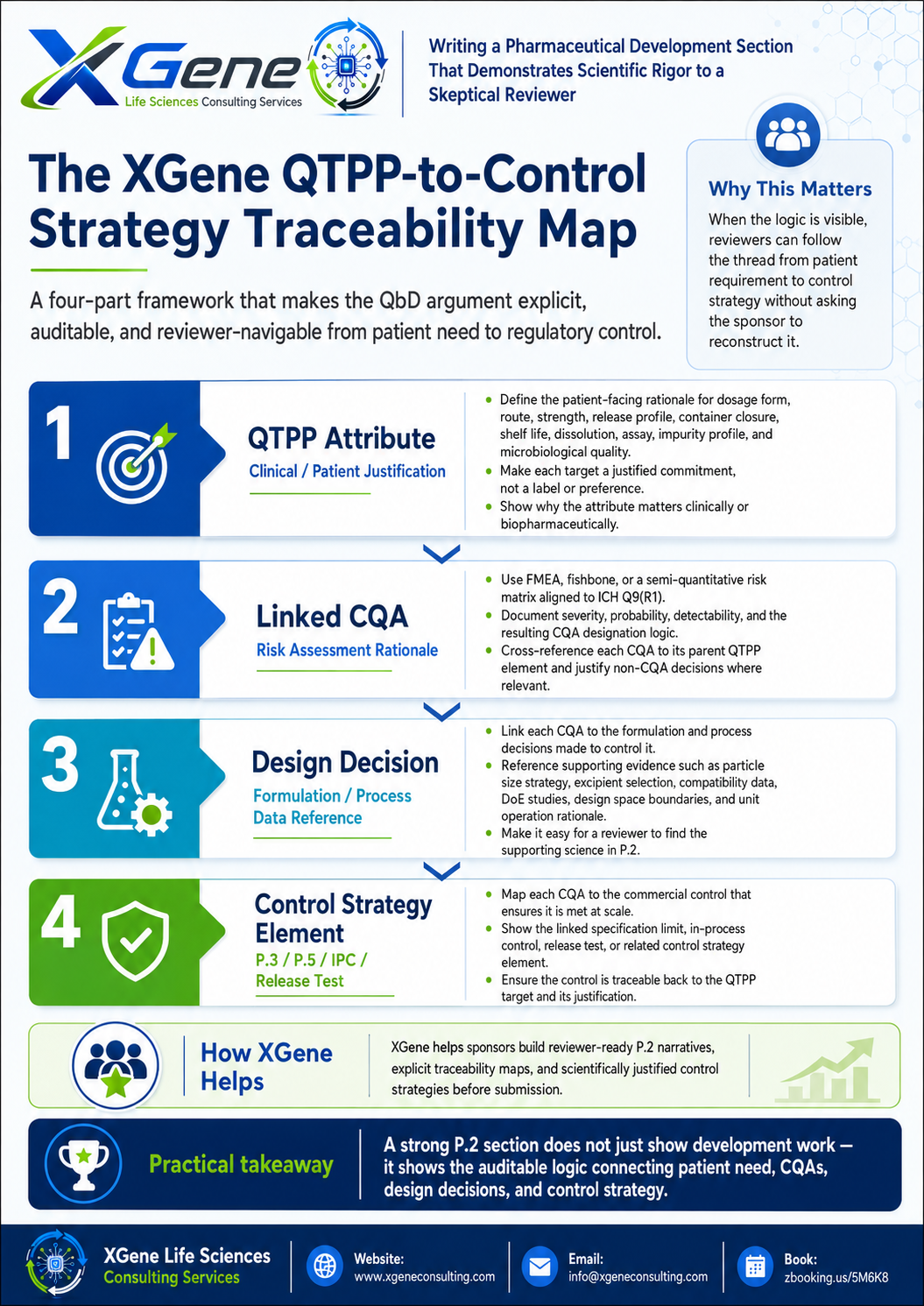
The XGene QTPP-to-Control Strategy Traceability Map is a four-column documentation framework designed to produce a 3.2.P.2 section that makes the QbD argument explicit, auditable, and reviewer-navigable — building the scientific rationale that makes the control strategy in P.3, P.4, and P.5 self-evident rather than asserted.
Column 1 — QTPP Attribute (Clinical/Patient Justification): For each QTPP element — dosage form and route, strength, release mechanism and rate, CCS, assay at release and shelf life, dissolution target, impurity profile at release and shelf life, microbiological quality — document the clinical or patient-facing rationale. “Dissolution: NLT 80% in 30 minutes (Q30)” should be accompanied by the biopharmaceutics rationale connecting this target to the in vivo exposure data from clinical pharmacology studies or, where a BCS waiver is sought, to the BCS Class I criteria in FDA’s 2015 waiver guidance. The patient justification is not a narrative embellishment — it is the technical evidence that establishes why each QTPP element is a commitment rather than a preference.
Column 2 — Linked CQA (Risk Assessment Rationale): For each CQA designation, document the risk assessment methodology (FMEA, fishbone, semi-quantitative risk matrix per ICH Q9(R1) 2023), the severity, probability, and detectability scores applied, and the resulting risk priority number or classification. Cross-reference the CQA to its parent QTPP element. Where a quality attribute was evaluated and not designated as a CQA, document the rationale for non-designation — a reviewer who cannot find a justification for why particle size was not designated as a CQA in a BCS Class II formulation will request it, and the absence of a documented non-CQA justification is as problematic as an undocumented CQA designation.
Column 3 — Formulation/Process Design Decision (Data Reference): For each CQA, document the formulation and process design decisions made to ensure it is met — particle size target and the micronization or milling process selected to achieve it, excipient selection and level with compatibility data reference, DoE study number and conclusion, design space boundaries and the multivariate characterization data that support them, and manufacturing process unit operation selection rationale. Each entry in this column should include a specific reference to the development study report or data section within P.2 where the supporting data appear. The column functions as a navigational index — a reviewer following the traceability map should be able to move from a CQA designation directly to the data that justify the design decision made to control it.
Column 4 — Control Strategy Element in P.3/P.5 (Specification Limit, IPC, Release Test): For each CQA, document the corresponding control in the commercial control strategy — the specification attribute and limit in 3.2.P.5.1, the in-process control in 3.2.P.3.4, the release test in 3.2.P.8.2, or the combination of controls that together ensure CQA compliance at commercial scale. The specification limits in this column must be traceable to the QTPP targets in Column 1 — a dissolution specification of NLT 80% in 30 minutes in Column 4 that is not connected to a QTPP dissolution target in Column 1 with a clinical justification is a specification without a scientific rationale, and it will not survive a deficiency cycle.
The output of the XGene QTPP-to-Control Strategy Traceability Map is a submission-ready four-column table that functions as the organizational backbone of the P.2 section and as the reviewer’s navigational guide through the entire pharmaceutical development narrative — establishing an auditable, documented thread from patient need to regulatory control that makes the QbD argument explicit at the section level and defensible across the CTD.