
PLZ Corp Warning Letter: Component Testing Failure and the CMC Pattern Every Quality Director Must Recognize
On June 2, 2026, FDA issued Warning Letter 320-26-88 to PLZ Corp's Mississauga Personal Care (MPC) facility at 6080 Vipond Drive, Mississauga, Ontario (FEI 3001956890), citing systemic failures in incoming…
On this pageArticle overview
On June 2, 2026, FDA issued Warning Letter 320-26-88 to PLZ Corp’s Mississauga Personal Care (MPC) facility at 6080 Vipond Drive, Mississauga, Ontario (FEI 3001956890), citing systemic failures in incoming component testing — specifically the manufacturer’s inability to demonstrate that talc drug components used in OTC drug product manufacturing had been adequately tested for asbestos contamination. The primary citation was 21 CFR 211.84(d)(1) and 211.84(d)(2), with a secondary finding under 21 CFR 211.22 directed at the quality unit’s failure to exercise its oversight responsibility. What this Warning Letter exposes is not an isolated documentation gap — it is the canonical failure mode of component qualification programs at international OTC and finished drug product sites: substituting supplier certificate-of-analysis reliance for independent verification, without first establishing the scientific reliability of that reliance.
The Core Deficiency: Supplier COA Reliance Without Validation
The factual record is precise and the FDA’s framing is deliberate. PLZ Corp manufactured an OTC drug product containing talc as an inactive ingredient. Both talc and asbestos are naturally occurring minerals that co-occur geologically, and asbestos is a known human carcinogen when inhaled — a fact cited explicitly in FDA’s letter, with the product classified as “higher-risk” due to the inhalation route. PLZ Corp’s initial response to FDA’s 704(a)(4) records request stated that no asbestos testing was performed on incoming talc. A subsequent correspondence reversed that position, claiming prior testing had occurred and the initial response was erroneous — but the supporting data disclosed only that the supplier had tested for asbestos, not PLZ Corp. The distinction is not semantic. Under 21 CFR 211.84(d)(2), COA-based reliance is permissible only if the drug product manufacturer has established the reliability of the supplier’s test results through appropriate validation at appropriate intervals. PLZ Corp had not performed that validation. Beyond the asbestos-specific deficiency, PLZ Corp’s USP identity testing for talc was incomplete: the identity testing conducted did not conform to the current USP talc monograph, lacking Identification B and C components. The quality unit had approved and accepted talc for drug product manufacturing with a specification that omitted the assay and multiple impurity limits required by USP — including any specification for the absence of asbestos.
The COA Validation Framework Under 21 CFR 211.84(d)(2)
The COA reliance validation framework under 21 CFR 211.84(d)(2) is a well-established but routinely underimplemented CGMP requirement. The regulatory standard requires the drug product manufacturer to: (1) identify, at minimum, one specific identity test performed on each incoming component lot regardless of supplier COA status — this is an absolute, non-waivable requirement; (2) establish the reliability of the supplier’s COA data through initial comparative testing of multiple lots against independent in-house methods or a qualified third-party laboratory, prior to committing to COA-only acceptance for non-identity attributes; and (3) revalidate the supplier’s COA reliability at defined intervals, documenting the data package and the statistical comparison against the historical baseline. The PLZ Corp Warning Letter illustrates the consequence of omitting step 2 entirely while also failing step 1 for the asbestos-specific identity attribute: the talc USP monograph requires asbestos testing as part of the current official specification, and PLZ Corp’s specification for talc omitted it. An incomplete specification cannot support adequate component qualification — the quality unit’s sign-off on that specification became the proximate failure point.
The ICH Q3A(R2) framework provides the quantitative structure for understanding why asbestos in talc demands its own specification and testing approach rather than generic impurity coverage. Asbestos is not a trace organic impurity to which ICH Q3A thresholds apply; it is a genotoxic inorganic mineral fiber for which the applicable safety standard is qualitative absence, not a ppm limit derived from maximum daily dose calculation. The applicable characterization framework is the USP talc monograph’s X-ray powder diffraction (XRPD) method for detection of fibrous mineral phases and, as revised in the monograph effective June 2026, updated analytical requirements for asbestos fiber detection. PLZ Corp’s failure to have any asbestos-specific release specification means no asbestos limit existed against which a supplier’s COA could have been validated — validating a supplier’s test results against a non-existent acceptance criterion is analytically impossible. This structural deficiency in the specification preceded and enabled the testing failure.
The Quality Unit’s Failure Under 21 CFR 211.22
The quality unit finding under 21 CFR 211.22 follows directly from the specification failure. FDA’s letter makes the logical connection explicit: the QU approved specifications for talc that were incomplete relative to the current USP monograph and approved incoming talc components for use in drug manufacturing against those deficient specifications. Under 21 CFR 211.22, the QU is responsible for approving or rejecting all procedures, specifications, and standards — not delegating that approval to a supplier’s laboratory data. When a QU approves a specification that omits a required USP attribute, and then accepts a COA from a supplier on the basis of that incomplete specification, the QU has not exercised its authority; it has vacated it. FDA’s response request for the QU finding is correspondingly systemic: a comprehensive assessment and remediation plan that addresses procedural robustness, QU oversight throughout operations, and complete batch record review before disposition for all within-expiry batches.
The PLZ Corp situation reflects a risk category that is highly specific to OTC drug product manufacturers operating at Canadian and other international sites supplying the US market: the intersection of natural-source excipient qualification and USP monograph currency. Talc is a USP article, and under section 501(b) of the FD&C Act, drugs containing USP-recognized articles are generally required to meet the current applicable monograph. When USP revises its talc monograph — as it did with the June 2026 revision incorporating updated asbestos testing requirements — the CGMP obligation to meet the current specification is not prospective; it creates an immediate gap between the manufacturer’s last-approved specification and the current USP standard that the quality unit is responsible for detecting and closing. A systematic USP monograph currency review is not optional process improvement — it is a CGMP obligation under 21 CFR 211.160(b), which requires that laboratory controls include scientifically sound and appropriate specifications and test procedures.
Enforcement Consequences and Remediation Path
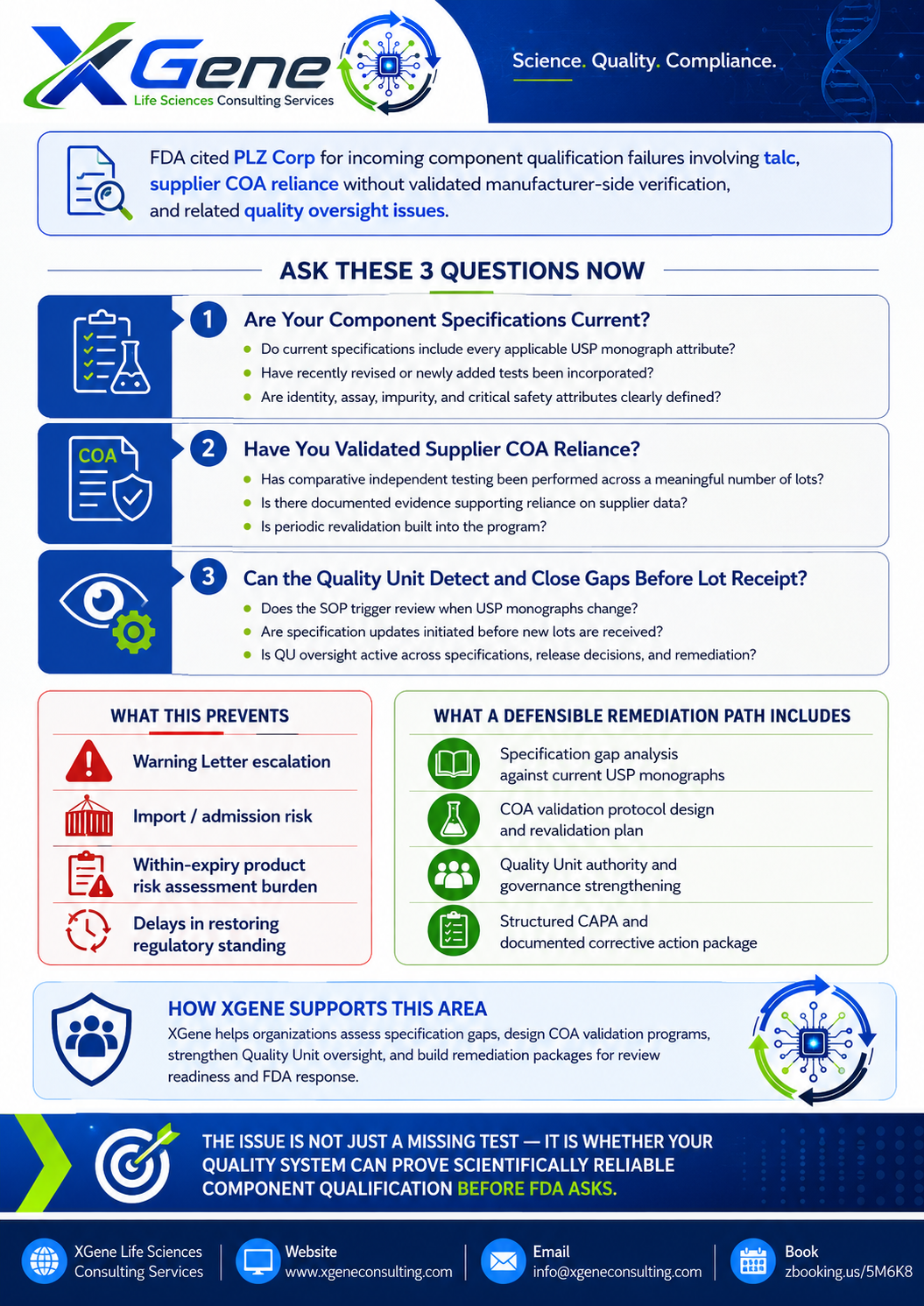
For quality directors managing OTC drug product programs that include natural-source excipients — talc, starch, microcrystalline cellulose from wood pulp, magnesium stearate — the PLZ Corp Warning Letter demands an immediate internal audit on three questions: first, does the current specification for each natural-source excipient include every attribute in the current USP monograph, including any recently revised or newly added tests; second, has the firm performed documented COA validation — comparative independent testing across a statistically meaningful number of lots — for each supplier of each such excipient, with evidence of periodic revalidation; and third, does the quality unit’s specification review SOP include a mechanism to detect USP monograph revisions and trigger specification update requests before the next lot receipt? Companies managing similar component qualification gaps, or preparing Warning Letter remediation responses for FDA’s Office of Manufacturing Quality, benefit most from a structured CMC regulatory assessment that combines specification gap analysis against current USP monographs, COA validation protocol design, and quality unit authority documentation. XGene Consulting provides exactly this type of enforcement remediation support — root cause assessment, CAPA structure that FDA accepts at reinspection, and supplier qualification program design grounded in 21 CFR 211.84 compliance requirements.
The PLZ Corp Warning Letter closes with FDA’s standard enforcement language: refusal of admission of articles manufactured at this facility under section 801(a)(3) of the FD&C Act, and withholding of new application approvals until violations are completely addressed. PLZ Corp’s Plant Manager has already committed in writing that talc is no longer an ingredient in any product manufactured at the MPC facility. That commitment stops the immediate safety exposure but does not address the systemic quality unit authority gap or the COA validation program deficiency — both of which will require documented corrective action and FDA confirmation before the facility’s regulatory standing with CDER is restored. The path forward is not simply stopping talc use; it is demonstrating to FDA that the quality system now possesses the specification governance and independent testing discipline that the Warning Letter found absent.