
Revlon Group Holdings Warning Letter: Component Testing and Laboratory Controls Failures and the CMC Pattern Every OTC Drug Quality Director Must Recognize
On June 2, 2026, FDA issued Warning Letter 320-26-89 to Revlon Group Holdings, LLC at its Oxford, North Carolina facility — a registered OTC drug product manufacturer — citing significant…
On this pageArticle overview
On June 2, 2026, FDA issued Warning Letter 320-26-89 to Revlon Group Holdings, LLC at its Oxford, North Carolina facility — a registered OTC drug product manufacturer — citing significant violations of Current Good Manufacturing Practice regulations under 21 CFR Parts 210 and 211. The central finding: Revlon had not demonstrated that it appropriately tested incoming drug components used in the manufacture of its OTC products for identity, purity, strength, and quality under 21 CFR 211.84(d)(1) and (2). More critically, the uncharacterized component was a known source of carcinogenic contamination in high-risk dosage forms — a patient safety dimension that elevated this from a routine documentation deficiency to a potential public health issue with recall implications.
The Core Failure: COA Reliance Without Validation Under 21 CFR 211.84(d)(2)
The failure pattern FDA described at the Oxford facility is one I have seen across both domestic and international drug product sites over the past two decades: a manufacturer relying on supplier certificates of analysis as a substitute for independent component testing, without first establishing the reliability of those supplier results through validation. Under 21 CFR 211.84(d)(2), reliance on a supplier COA is permissible — but only conditionally. The regulation requires the drug product manufacturer to establish reliability of the supplier’s analyses through appropriate validation at appropriate intervals. When FDA asked Revlon to produce records confirming it tested incoming components at its own facility, what the company produced instead was evidence that the supplier had tested the material, not Revlon. That distinction is not administrative; it is the boundary between a compliant incoming release program and one that has transferred quality responsibility to an unqualified external party without the validation work that would make such transfer defensible.
The identity testing dimension of this finding adds a layer of technical specificity that quality directors should examine closely. Revlon had conducted identity testing against a United States Pharmacopeia method — or so the company believed. FDA’s review found that the testing did not conform to the current USP testing method because it was incomplete, lacking one or more identification steps required by the applicable monograph. This is a distinction that matters precisely because USP identity tests are multi-criteria confirmations: they exist to exclude adulterants that may partially mimic the target compound on a single test parameter while failing on another. A truncated identity test is not a partially compliant identity test — it is a test that has not demonstrated identity, regardless of the passing result it produced. Under 21 CFR 211.84(d)(1), every component must be tested for identity before use. A test that cannot distinguish the target compound from closely related adulterants does not satisfy that requirement.
The Carcinogen Contamination Risk and Quality Unit Failure Under 21 CFR 211.22
What makes this WL particularly instructive is the quality of the carcinogen contamination narrative. FDA documented that one or more inactive ingredients in Revlon’s OTC product line carry the risk of carcinogenic contamination — contamination with a compound recognized as a known human carcinogen — with inadvertent exposure as the primary risk pathway in at least one high-risk dosage form category. This is the same regulatory logic that animated FDA’s enforcement actions against manufacturers of aerosol OTC products when benzene contamination was detected at levels ranging from trace amounts to above 6 parts per million in propellant streams between 2021 and 2022, triggering Valisure’s citizen petitions and a series of voluntary recalls affecting Procter & Gamble’s aerosol dry shampoo lines, Unilever’s Dove aerosol dry shampoo products, and Coppertone and Banana Boat aerosol sunscreens. In each of those cases, manufacturers had validated the safety of their propellant systems under earlier manufacturing conditions and had not revalidated after process changes that introduced contamination-susceptible excipient streams. The Revlon Oxford WL cites an analogous gap: components with known carcinogen contamination risk were not tested at Revlon’s facility; suppliers were relied upon without COA validation; and in a higher-risk dosage form where inadvertent patient exposure is a plausible outcome, that combination of failures converts a specification deficiency into a safety risk assessment requiring immediate attention.
The quality unit findings under 21 CFR 211.22 are equally revealing. FDA’s observation was not that the quality unit had failed to detect the component testing deficiency after the fact — it was that the quality unit had approved component specifications that were scientifically inadequate from the outset. The specifications for the implicated component did not include testing for assay or multiple specified impurities. Microbiological specifications for yeast and mold exceeded the applicable USP maximum — and the COA reports presented to the quality unit showed “CONFORM” without a quantitative value, which is not sufficient information for a disposition decision. The quality unit’s role under 21 CFR 211.22 is precisely to evaluate whether test procedures and specifications are scientifically sound before approving them for use. A quality unit that accepts “CONFORM” as a reportable result for a microbiological test parameter, without a quantitative value against which the USP NMT limit can be verified, has not exercised its review function — it has performed a signature.
Remediation Pathway and the 704(a)(4) Remote Assessment Risk
Mylan Pharmaceuticals received a Warning Letter in 2018 from its Morgantown, West Virginia facility citing the same analytical quality failure mode at a different level: OOS investigation reports that did not consistently identify root cause, alongside inadequate cleaning validation. In United States v. Barr Laboratories, Inc. (D.N.J. 1993), the court held that an OOS result cannot be invalidated without specific, documented evidence of an assignable cause. Both the Mylan finding and the Barr holding establish the same regulatory principle that runs through the Revlon Oxford WL: FDA does not accept assertions of quality as a substitute for demonstrated quality. A manufacturer that says its component meets identity requirements without a complete USP identity test has asserted quality. A manufacturer that says its microbiological specification is met without a quantitative result has asserted quality. FDA’s enforcement posture treats both as failures of the same type: quality claims without adequate evidence.
For OTC drug manufacturers operating under 21 CFR Parts 210 and 211, the Revlon Oxford WL demands a specific self-assessment. Every incoming drug component testing program must be evaluated against three questions: First, does the firm conduct at minimum one specific identity test per incoming lot at its own facility, or has it outsourced identity confirmation to the supplier without COA validation? Second, do the component specifications include the full set of tests — assay, impurities, microbiological — required by the current USP monograph, and are specifications quantitatively defined rather than qualitatively described? Third, where components carry known contamination risks tied to patient safety — carcinogenic impurities, genotoxic degradants, microbiological contaminants in compendial-classified product types — has the firm conducted and documented a formal risk assessment under ICH Q9(R1) that defines the testing approach as risk-commensurate with the patient exposure potential?
The practitioner takeaway from the Revlon Oxford WL is directional: FDA’s use of the 704(a)(4) remote records access pathway — first invoked in September 2025, with the resulting Warning Letter issued June 2, 2026 — demonstrates that in-person inspection is no longer the exclusive enforcement trigger for CGMP findings. Your incoming component testing program and your quality unit’s specification review process are now subject to document-based enforcement review at any time. If your answer to “Can we prove we independently tested every incoming lot for identity?” is qualified by phrases like “the supplier tests it” or “we rely on the COA,” the Revlon Oxford WL is the regulatory outcome you are managing toward. Connect with me on LinkedIn or at xgeneconsulting.com to discuss how a systematic component qualification assessment can convert that risk exposure into a defensible CGMP program before FDA’s next 704(a)(4) request arrives.
XGene Component Qualification and COA Validation Program Framework
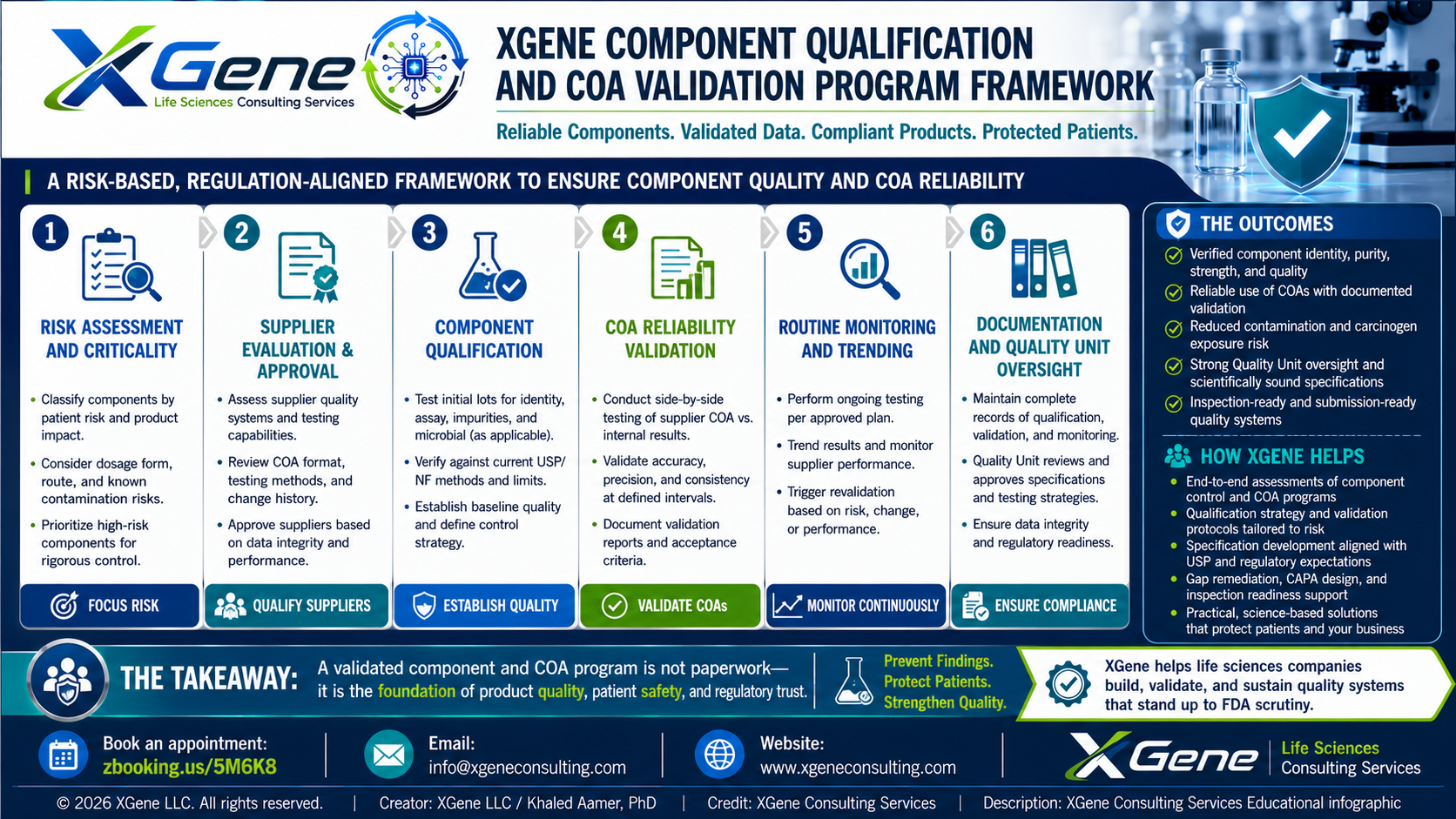
At XGene Consulting, we approach component qualification and COA validation as an integrated analytical and quality system program designed to withstand FDA’s 704(a)(4) document-based enforcement review. The framework is built on five core pillars:
1. COA Validation Program Design: Establish documented reliability of each supplier’s test results through initial comparative testing of a minimum of three lots against independent in-house methods, followed by periodic revalidation at defined intervals — annually for high-risk components, biennially for lower-risk materials — with statistical acceptance criteria that define “equivalent” in operational terms.
2. Method Portfolio Gap Assessment Against Current USP Monographs: Verify that every identity, assay, impurity, and microbiological test method referenced in component specifications aligns with the current USP monograph requirements for that compendial article — not a previous edition, not a truncated version. Identify and remediate any gaps before the next 704(a)(4) request.
3. Quantitative Specification Redesign: Replace qualitative acceptance criteria (“CONFORM,” “passes,” “acceptable”) with quantitatively defined limits — numeric values for assay, ppm or percent limits for impurities, quantitative CFU/g or CFU/mL limits for microbiological testing — so that every disposition decision is traceable to a measurable threshold.
4. Carcinogen Risk Assessment and Testing Strategy: For every component with a known carcinogen contamination risk profile — talc/asbestos, petrochemical-derived excipients/benzene, nitrosamine-susceptible ingredients — conduct a formal ICH Q9(R1) risk assessment and implement a testing strategy with validated methods at detection limits consistent with FDA’s acceptable daily intake limits under ICH M7.
5. Retain Sample Strategy and 30-Day Emergency Testing Protocol: Ensure that retain samples for all incoming component lots are accessible and that the facility can generate and report test results for carcinogenic impurities within a 30-calendar-day window — a scenario that has now become an FDA expectation, not a theoretical risk.
The output of the XGene Component Qualification Framework is a supplier qualification and incoming testing program that can survive a 704(a)(4) records request and demonstrate the operational independence and analytical rigor FDA requires.