
FDA 483 Production and Process Controls — The CMC Risk Map
Production and process controls 483 observations are the category where FDA's regulatory findings intersect most directly with your CMC submission — because the process controls FDA finds inadequate in your…
On this pageArticle overview
Production and process controls 483 observations are the category where FDA’s regulatory findings intersect most directly with your CMC submission — because the process controls FDA finds inadequate in your facility are almost always the same controls that were inadequately justified in your Module 3 package.
That convergence is not coincidental. It is structural. The CMC regulatory submission is, at its core, a promise about the process: these are the critical quality attributes that define acceptable product, these are the critical process parameters that predictably deliver those attributes, and this is the control strategy — embedded in equipment qualification, in-process testing, and manufacturing batch records — that ensures the process reliably performs as described. When FDA investigators walk into a manufacturing facility and begin pulling production records under 21 CFR 211.110, what they are testing is whether that promise is being kept. The 483 observation is issued when it is not. The CMC consequence arrives when the gap between the filed promise and the executed process is wide enough that it can no longer be characterized as minor operational variation.
The most dangerous pattern in production and process controls compliance — the one that most reliably escalates from a 483 observation to a Warning Letter and from a Warning Letter to a complete response letter — is the CPP misalignment pattern: the critical process parameters identified in manufacturing process investigations do not match the critical process parameters justified in the IND or NDA process validation section. When that misalignment exists, the regulatory submission is describing a process the facility is not actually running. FDA does not treat that as a quality event. FDA treats it as a misrepresentation of the manufacturing process in a regulatory filing, and the enforcement response is calibrated accordingly.
The Production Controls Framework: What 21 CFR 211.100 and 211.110 Actually Require
The regulatory architecture for production and process controls under 21 CFR Part 211 is built on two interlocking requirements. The first, under 21 CFR 211.100, requires that written procedures for production and process controls be established that are designed to assure that the drug products have the identity, strength, quality, and purity they purport or are represented to possess. The regulation then requires that those written procedures be followed in the execution of production and process control functions, and that any deviations from written procedures be recorded and justified. The second, under 21 CFR 211.110, requires that in-process controls, tests, or examinations be conducted at appropriate phases of production to monitor output and validate performance of the manufacturing process, and that samples be collected at appropriate intervals using statistically sound methods to assure that any in-process specification will be met.
21 CFR 211.103 extends this framework to the yield dimension: written procedures for each step of a manufacturing process must include the theoretical yield, the calculated yield at appropriate phases of production, and any investigation that must be conducted when a yield falls outside acceptable limits. The apparently procedural nature of these requirements understates the inspection risk they generate. When FDA investigators find that an in-process control result has been trending toward its specification limit over multiple batches without documented investigation, they are citing 211.110 — but what they are recording is evidence that the process is drifting away from the validated state, and the question that immediately follows is whether the approved process validation section in the NDA or BLA reflects the current operating reality.
The FDA 2011 Process Validation Guidance — Process Validation: General Principles and Practices — reframed this regulatory architecture as a three-stage lifecycle model that connects development science directly to commercial manufacturing execution. Stage 1, Process Design, is where the process is defined based on knowledge gained through development and scale-up activities, and where the critical process parameters and their acceptable ranges are identified through Design of Experiment studies and risk assessments documented in the Module 3 CMC package — specifically in the P.3.3 process validation section of the NDA or BLA, and in the development history described under ICH Q8(R2). The CPP ranges established in Stage 1 are not operational suggestions. They are the regulatory representation of the process that FDA approved.
Stage 2, Process Performance Qualification, is where the process design is confirmed as capable of reproducible commercial manufacturing through a formally executed PPQ protocol with statistically justified sampling plans, pre-specified acceptance criteria, and a defined number of validation batches. The PPQ protocol must be approved before the validation runs are executed, and it must address each CPP identified in Stage 1. The acceptance criteria established in the PPQ protocol are tied directly to the CQAs justified in the CMC filing — granule particle size distribution, blend uniformity, tablet hardness, dissolution profile, content uniformity — and the sampling plan must be statistically justifiable for the conclusion it is asked to support. A sampling plan that cannot statistically detect a non-conforming process at a defined confidence level provides no protection against releasing batches that fail that standard.
Stage 3, Continued Process Verification, is where the commercial manufacturing program maintains its validated state through ongoing statistical monitoring of process performance. 21 CFR 211.110 provides the regulatory basis for this monitoring requirement: in-process samples must be collected at appropriate intervals and the results must be used to assure that the in-process specification will be met. The 2011 PV Guidance operationalizes that requirement through statistical process control — control chart methodology, capability indices, trending rules — applied to each CPP and CQA in the commercial process. The Stage 3 program is not satisfied by recording in-process results and filing them. It requires an active, statistically structured monitoring program that triggers investigation when results indicate process drift before a specification is breached, not after.
The connection between the three-stage framework and the CMC filing is not regulatory decoration. Under ICH Q11, which governs development and manufacture of drug substances, and under ICH Q8(R2), which governs pharmaceutical development for drug products, the design space concept provides a formal mechanism for FDA to accept operating ranges that differ from the nominal operating conditions without triggering a post-approval change supplement — but only if the design space was established in the original filing through development data that justified the broader range. CPP ranges that fall outside the approved design space, or that differ from the NDA operating ranges in a product with no established design space, are not just GMP deviations. They are unapproved changes to the manufacturing process, and the regulatory path for correcting them requires either a Prior Approval Supplement, a Changes Being Effected in 30 Days notification, or a CBE-0 notification depending on the risk classification of the change under 21 CFR 314.70.
In-Process Testing Deficiencies and Process Validation Gaps: The Most-Cited Patterns
The in-process testing deficiencies that most frequently generate 483 observations under 21 CFR 211.110 fall into four patterns, and understanding them as a connected system rather than as isolated procedural lapses is essential for building a production controls program that survives an informed inspection.
The first and most frequently cited pattern is IPC results trending toward a specification limit without documented investigation. The practical mechanics of this failure are straightforward: a company’s batch manufacturing records show blend uniformity results, tablet weight variation results, or dissolution sampling results that have moved progressively toward the lower or upper end of the established range over a series of batches. No deviation was opened because no batch failed the specification. But 21 CFR 211.110 and the Stage 3 CPV framework under the 2011 PV Guidance do not require a specification exceedance before investigation is triggered — they require monitoring capable of detecting process drift, and investigation when that drift is detected. A process that is consistently producing blend uniformity results at 85% of the upper specification limit while the approved NDA process produces results at 65% of the upper limit is not merely trending; it is a process whose actual performance has materially diverged from the validated profile documented in the regulatory filing.
The second pattern is CPP range excursions that are not entered into the deviation system. The regulatory expectation under 21 CFR 211.110 is explicit: any in-process control that falls outside established standards must be documented. When a manufacturing batch record shows a granulation endpoint moisture content that exceeded the upper CPP limit by two percentage points, and the batch was released without a deviation investigation, the 483 observation writes itself. But the compliance consequence extends beyond the observation. If that CPP moisture range was established in the NDA P.3.3 section based on development data showing that moisture above the upper limit predictably compromises dissolution behavior, the unreported excursion is not just a GMP failure — it is evidence that a batch potentially released to market had a CQA that may not have met the requirements the CMC filing represented it would meet. The retroactive batch disposition question that follows that conclusion is among the most operationally damaging consequences of production controls failures.
The third pattern is yield deviations that are not tracked against the theoretical yield and investigation thresholds established in the written procedures under 21 CFR 211.103. Yield is not merely an economic metric in pharmaceutical manufacturing. It is a process performance indicator, and systematic yield losses at specific process steps are diagnostic signals about process parameter performance. When a company cannot demonstrate that actual yields are being tracked against theoretical yields with documented investigations at defined alert levels, FDA investigators interpret the absence of that system as evidence that the process has never been statistically characterized well enough to define what normal yield variation looks like — which is, in turn, evidence that the Stage 1 process design described in the CMC filing may not reflect the process actually being run.
The fourth pattern, and the most directly consequential for CMC submissions, is the absence of statistical justification for sampling plans in the PPQ protocol and the commercial manufacturing procedure. The 2011 PV Guidance is explicit that sampling during Stage 2 should be more extensive than during routine production, and that the sampling plan must be justified in the PPQ protocol. When an FDA investigator finds that a PPQ protocol established tablet content uniformity sampling at n=10 without any statistical rationale for why that sample size provides adequate protection against releasing a non-conforming batch at a defined confidence level, the 483 observation is both a process validation finding and a CMC finding. The PPQ protocol is a document submitted in regulatory filings, and its statistical inadequacy is an inadequacy in the regulatory representation of the process validation program.
CPP Monitoring, Batch Record Review, and the Stage 3 CPV Gap
The Stage 3 CPV gap is the most systemically underdeveloped component of the three-stage process validation lifecycle in commercial pharmaceutical manufacturing. The majority of NDA-approved manufacturing programs have Stage 1 documentation — development reports, risk assessments, DoE data — because FDA requires it as a condition of approval. Most have Stage 2 documentation — PPQ protocols, validation batch records, summary reports — because PPQ is a well-understood regulatory milestone. What a significant proportion of commercial programs lack is a functioning Stage 3 statistical monitoring program that ties every CPP and IPC in the commercial batch record to a statistically structured ongoing monitoring protocol with defined control chart methodology, action limits distinct from specification limits, and an investigation trigger that activates before a specification is breached.
The regulatory consequence of this gap is not hypothetical. Under the 2011 PV Guidance, FDA’s expectation is that commercial manufacturing operates in a state of continuous process verification — meaning that the validated state is not a snapshot captured in a PPQ report but an ongoing condition confirmed through statistical monitoring. When a Stage 3 program consists of listing CPP values in a spreadsheet and noting whether they passed or failed without statistical trend analysis, FDA investigators do not treat that as an adequate CPV program. They treat it as the absence of one — and the absence of a CPV program means the company cannot demonstrate that its commercial process is operating in a validated state. That finding, applied to a product with a pending supplemental NDA or with active FDA review of a related application, has direct consequences for review timelines.
The batch record review dimension of CPP monitoring is where the CMC-GMP integration failure is most directly observable. The CPP ranges that appear in the NDA P.3.3 process validation section and in the process description sections of Module 3 are derived from Stage 1 development data. Those ranges are the ranges that FDA reviewed and approved as the operating envelope for the commercial process. When those ranges are carried forward into the commercial manufacturing batch record — as they are required to be — the batch record becomes a real-time verification that the process is running within the approved CMC envelope. A CPP excursion recorded in the batch record is therefore simultaneously a GMP deviation requiring investigation under 21 CFR 211.110 and a potential unapproved change to the manufacturing process requiring assessment under 21 CFR 314.70.
The CPP misalignment pattern that drives the most serious enforcement consequences is subtler than an obvious range excursion. It arises when process investigations — conducted under the deviation system in response to OOS results, atypical batch failures, or yield losses — identify root causes that point to CPPs operating outside their approved ranges, but those investigations never trigger a review of whether the CPP range reflected in the current batch record still matches the CPP range documented in the approved NDA. Over time, this generates a manufacturing program where the process being run is not the process described in the regulatory submission, and neither the quality team nor the regulatory affairs function has a structured mechanism for detecting that divergence. The FDA investigator who asks to see the approved CPP ranges from the NDA and compare them against the current batch record specifications will identify that divergence within minutes.
The continuous manufacturing context adds a dimension that the traditional 211.110 framework was not designed to address. FDA’s Guidance for Industry on Advancement of Emerging Technology Applications, including continuous manufacturing frameworks, recognizes that the real-time release testing and process analytical technology programs that define continuous manufacturing control strategies require CPP monitoring architectures that are fundamentally different from traditional batch process IPC programs. For organizations implementing or submitting CM processes, the Stage 3 CPV program must be designed as an integral element of the real-time control system — not as a retrospective reporting function — and the CPP monitoring methodology described in the CMC filing must match the monitoring methodology executed in manufacturing with exactitude that exceeds what batch processes typically require, because the real-time release decision depends on it.
The regulatory risk map of production and process controls observations is ultimately a map of the gaps between what was promised in the CMC submission and what is being executed in manufacturing. Closing those gaps is not a documentation exercise. It is a process engineering exercise that requires comparing the approved process description against the running process systematically, at every CPP and every IPC, with a change control procedure that prevents the gap from re-opening.
The XGene Process Controls CMC-GMP Integration Framework: Aligning Manufacturing to the Approved Submission
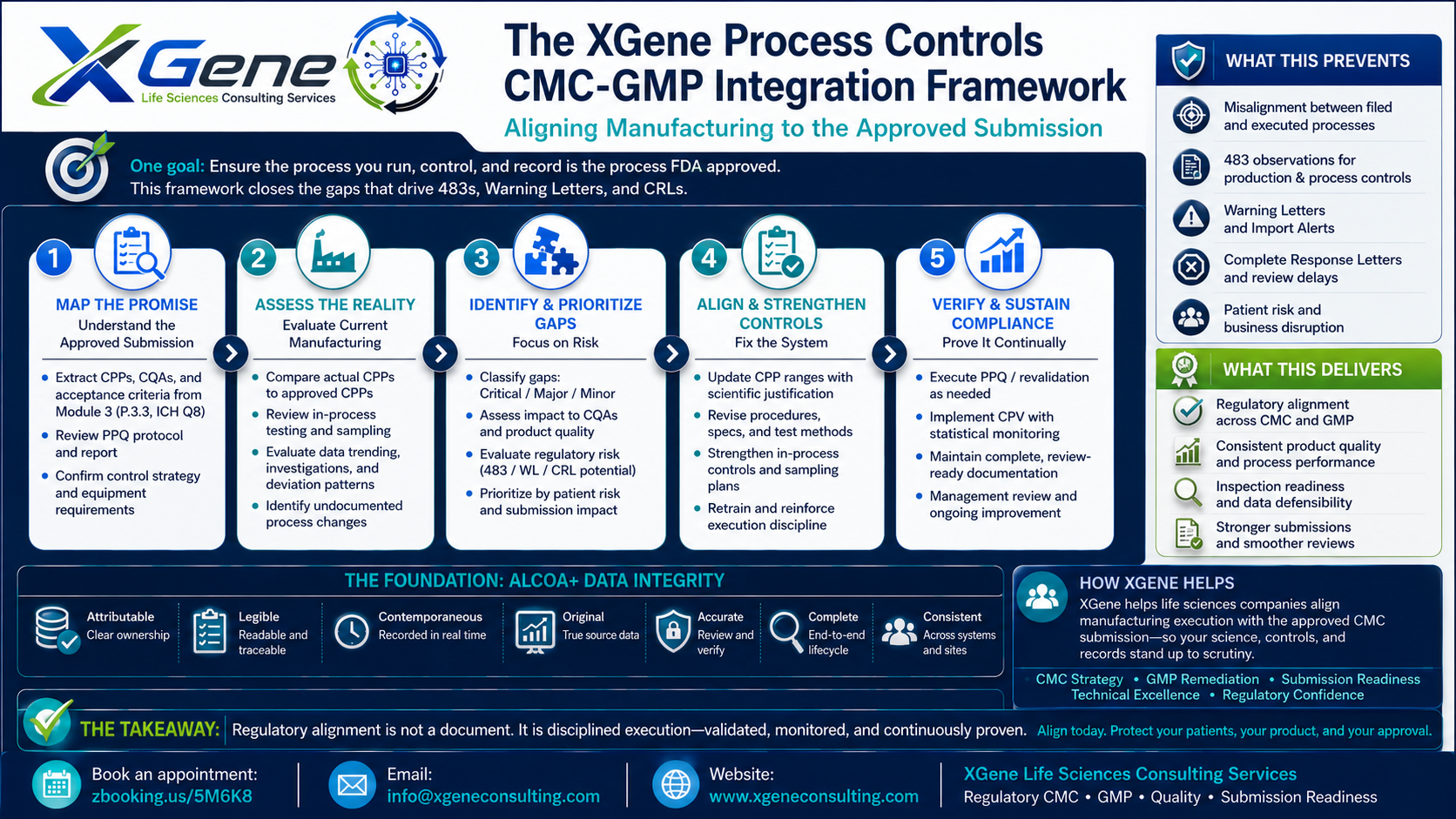
The XGene Process Controls CMC-GMP Integration Framework is a four-component operational architecture designed to eliminate the CPP misalignment pattern — the structural gap between the process described in a regulatory submission and the process being executed in manufacturing — before it is identified by an FDA investigator.
Component 1 — CPP and IPC Traceability Map: For each commercial product, a master traceability map is constructed that links every CPP and every IPC in the current manufacturing batch record against its source justification in the approved CMC regulatory submission. The map identifies the NDA/BLA section, the specific page and table reference, the approved range, the current batch record range, and the date of the most recent post-approval change submission that modified the range (if any). Where no post-approval change submission is on file for a range that differs from the approved NDA range, the map flags a potential unapproved change requiring immediate regulatory affairs review and remediation under 21 CFR 314.70.
Component 2 — Stage 3 CPV Statistical Monitoring Program: For each CPP and CQA in the commercial process, a CPV monitoring protocol is established that specifies the control chart methodology (Individuals and Moving Range, X-bar and R, EWMA, or CUSUM based on the statistical characteristics of the parameter), the data collection frequency, the control limits derived from the validated process dataset (distinct from specification limits), the trending rules that trigger investigation (Western Electric rules or equivalent), and the responsible owner for investigation initiation. The protocol is reviewed and updated annually or following any significant process change.
Component 3 — Deviation System Integration for CPP Excursions: A written procedure establishes that any CPP range excursion recorded in a manufacturing batch record — regardless of whether the finished product CQA passed — automatically generates a deviation record. The deviation investigation protocol cross-references the CPP excursion against the approved NDA CPP range, assesses whether the excursion constitutes an unapproved change, evaluates finished product CQA data for any impact signal, and determines whether a post-approval change submission is required before the process is run again outside the approved range.
Component 4 — CMC Supplement Trigger and Change Control Linkage: A change control procedure is established that prevents any modification to a CPP range in a batch master record without a concurrent regulatory affairs assessment determining whether the change requires a Prior Approval Supplement, CBE-30, or CBE-0 notification under 21 CFR 314.70. The change control record documents the regulatory affairs assessment conclusion and the FDA submission tracking number (if a supplement is filed) before the modified batch record is approved for manufacturing use. This procedure eliminates the pathway by which operational process changes migrate into the batch record without corresponding regulatory action.
The output of the XGene Process Controls CMC-GMP Integration Framework is a commercial manufacturing program in which the process being run is the process described in the regulatory submission — verified at the CPP level, monitored statistically, and protected by a change control architecture that prevents deviation without regulatory documentation.