
Sante Manufacturing Inc. Warning Letter: Raw Material Identity and Supplier Qualification Failures and the CMC Pattern Every OTC Drug Quality Director Must Recognize
On June 5, 2026, FDA issued Warning Letter 320-26-94 to Sante Manufacturing Inc., an over-the-counter drug product manufacturer located at 516 John Street N, Aylmer, Ontario, Canada. The letter, issued…
On this pageArticle overview
On June 5, 2026, FDA issued Warning Letter 320-26-94 to Sante Manufacturing Inc., an over-the-counter drug product manufacturer located at 516 John Street N, Aylmer, Ontario, Canada. The letter, issued by the Center for Drug Evaluation and Research’s Office of Manufacturing Quality under Director Francis Godwin, followed FDA’s review of records submitted in response to a 704(a)(4) records request initiated July 7, 2025. By the time the warning letter was issued, FDA had already placed Sante Manufacturing on Import Alert 66-40 on April 27, 2026 — meaning the enforcement consequence preceded the formal letter. That sequencing matters: it tells you that the records FDA reviewed contained a failure so immediate in its public health risk that agency compliance staff did not wait for the full warning letter cycle to close US market access.
The Primary Observation: Identity Testing Failure and COA Reliance Without Validation
The primary observation is a failure to conduct at least one specific identity test for each component of a drug product, combined with a failure to validate and establish the reliability of the component supplier’s test analyses at appropriate intervals, both under 21 CFR 211.84(d)(1) and 211.84(d)(2). The warning letter references ingredients at high risk for a specific type of contamination — the text is redacted in the public version as (b)(4) — but the agency’s language is unambiguous: “The use of ingredients contaminated with (b)(4) has resulted in various lethal poisoning incidents in humans worldwide.” Any pharmaceutical quality professional reading that sentence knows what it means. The contamination pattern FDA is describing is diethylene glycol, ethylene glycol, or a structurally analogous compound that has historically infiltrated glycerin and propylene glycol supply chains at international manufacturers with inadequate raw material testing programs. The mass poisoning events in Panama (2006), Haiti (1995-96), and Nigeria (2008) — all involving glycerin contaminated with diethylene glycol — resulted in hundreds of deaths and followed the identical supply chain failure pattern FDA is describing here: a manufacturer relying on a supplier’s certificate of analysis without conducting independent identity testing, specifically without performing the wet chemistry identity tests required by the applicable USP monograph.[citation:3][citation:8][citation:12]
Under 21 CFR 211.84(d)(1), a manufacturer must test at least one component of each shipment of each lot for identity using a specific identity test. For high-risk excipients — glycerin, propylene glycol, sorbitol solution, and related polyols — the USP monograph identity tests are not optional enhancements to a COA review program. They are the minimum regulatory floor.
The Ranbaxy Laboratories facility in Toansa, India received a Warning Letter in 2014 under 21 CFR 211.84(d)(2) for an analogous supplier qualification failure for API incoming raw materials, requiring a full audit of all impurity data for API lots released over 36 months before resuming US shipments.[citation:1][citation:10] The parallel to Sante is direct: both cases involve a manufacturer treating the supplier’s COA as a substitute for independent testing, when 21 CFR 211.84(d)(2) is explicit that COA reliance is only permissible after the reliability of the supplier’s test analyses has been established through initial validation and periodic revalidation. In Sante’s case, that establishment never occurred.[citation:4]
The Systemic Failures: Process Validation, Water System Qualification, and Quality Unit Oversight
The second observation — failure under 21 CFR 211.100(a) to establish adequate written procedures for production and process control — reveals the systemic quality infrastructure failure underlying the component testing deficiency. FDA found that Sante had not adequately qualified its water system and had no demonstrated process validation program. For an OTC drug manufacturer using water as a component, this is a compounding failure: the same quality unit that did not require independent identity testing of high-risk incoming components also did not have a validated system to ensure that process water meets USP purified water monograph specifications and appropriate microbial limits. An unmonitored water system feeding a manufacturing process for which no stage 1 process design or stage 2 process qualification data exists means Sante cannot demonstrate, for any batch it has released, that the process consistently produces drug product meeting its predetermined specifications. The FDA 2011 Process Validation Guidance is unambiguous on this point: successful process qualification studies are necessary before commercial distribution, not concurrent with it.[citation:4]
The third observation, under 21 CFR 211.22, is that the quality unit did not exercise its responsibility to ensure products in commerce comply with CGMP and meet established specifications. FDA specifically cited the absence of an appropriate stability program per 21 CFR 211.166(a) and inadequate validation of analytical methods per 21 CFR 211.160(b). A quality unit that cannot ensure incoming components are identity-tested, cannot validate its manufacturing process, and cannot generate validated stability data has fundamentally failed its primary CGMP function — not in one isolated operational area, but systematically across the three pillars of pharmaceutical quality assurance: what goes in, how it is made, and how long the result remains acceptable.[citation:4]
The pattern FDA describes at Sante is one I have seen across multiple small-to-midsize OTC manufacturers, particularly those operating in jurisdictions where domestic regulatory oversight is less intensive than FDA’s enforcement standard. The sequence is consistent: a quality system that was designed at a level adequate for domestic market requirements, supplemented by a supplier COA reliance program that feels administratively sufficient — the COA arrives with each shipment, it says the material passed, and the quality team files it and proceeds. The critical gap is that 21 CFR 211.84(d)(1) does not recognize COA review as identity testing. It requires a specific identity test performed at the receiving facility. For glycerin under the USP monograph, that means performing the specific gravity test, the refractive index test, and for lots at high risk for DEG adulteration, a gas chromatographic identity confirmation. None of these tests can be read off a supplier’s document.[citation:14]
The Remediation Pathway: Import Alert 66-40, 15-Day Response, and What FDA Actually Needs to See
A company in Sante’s current position — Import Alert 66-40 in place, warning letter in hand, FDA requesting 15-working-day response — faces a remediation sequence that requires immediate triage of all in-expiry drug products containing high-risk components, retain sample testing or finished product testing for each implicated lot, and a full written response to FDA that demonstrates not just intent to comply but a documented, executable corrective action plan. The FDA’s explicit recommendation in this letter for engagement of a CGMP consultant qualified under 21 CFR 211.34 is not a suggestion — it is a signal that FDA does not believe the current internal quality infrastructure is capable of designing and executing the remediation without external expert assistance. Firms that respond to warning letters with process improvement plans authored by the same quality team that produced the underlying deficiencies rarely succeed at reinspection. What FDA is looking for, and what actually closes import alerts, is independent verification that the corrective actions are technically sound, that the supplier qualification program has been rebuilt on a validated foundation, and that the quality unit now has both the authority and the resources to sustain what has been put in place.[citation:4]
XGene Raw Material System Remediation Framework
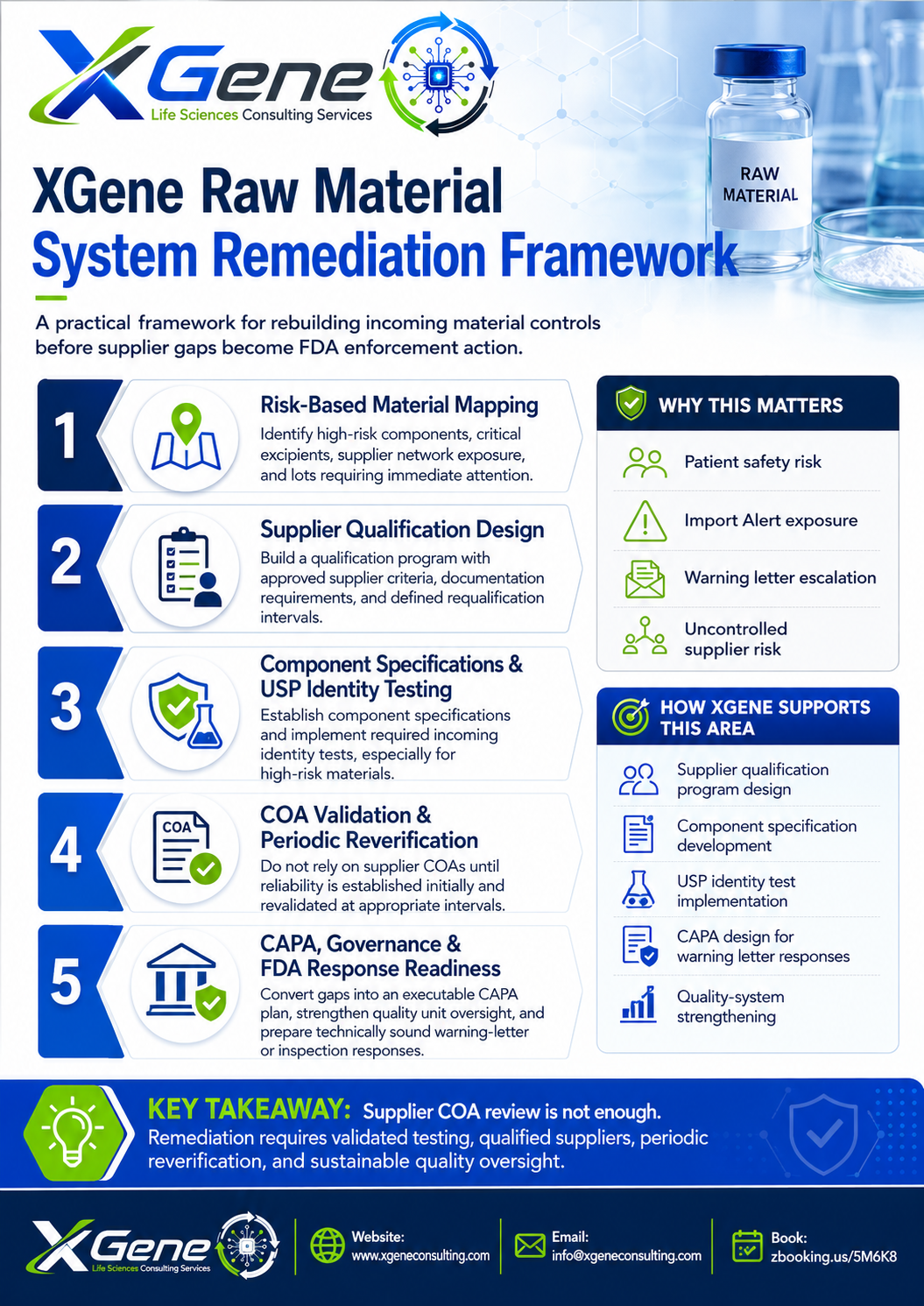
At XGene Consulting, raw material system remediation — including supplier qualification program design, component specification development, USP identity test implementation, and CAPA design for FDA warning letter responses — is among the core services we deliver to manufacturers navigating exactly this type of enforcement action. If your facility’s incoming material control program relies primarily on COA review, and if your supplier qualification records cannot demonstrate the periodic revalidation required by 21 CFR 211.84(d)(2), the Sante warning letter is the pattern you are looking at before it becomes your enforcement action. The time to close that gap is before the 704(a)(4) records request arrives, not after.
Practitioners managing similar supplier qualification, component testing, or OTC manufacturing compliance challenges are welcome to connect with me on LinkedIn or reach XGene Consulting at xgeneconsulting.com to discuss a confidential assessment.