
3.2.P.3 Drug Product Manufacture: Batch Formula, Process Description, and Validation Evidence That Survives FDA Review
The most common manufacturing-related CMC information request FDA issues for drug product applications is not about batch failure — it is about the gap between the process description in the…
On this pageArticle overview
The most common manufacturing-related CMC information request FDA issues for drug product applications is not about batch failure — it is about the gap between the process description in the filing and the actual manufacturing steps, parameter ranges, and in-process controls used in the batch records. When P.3 and the batch record say different things, one of them is wrong. FDA’s inspector will find out which.
Section 3.2.P.3 is the submission’s commitment to the commercial manufacturing process. It is not a summary, a narrative approximation, or a high-level overview. It is the authoritative, quantitative description of how the drug product will be made, in what quantities, under what conditions, and to what in-process acceptance criteria — stated with enough specificity that a reviewer in the Office of Pharmaceutical Quality can assess process adequacy without ever seeing the master batch record, and that a pre-approval inspection investigator from the Office of Regulatory Affairs can verify the filed description against the batch record without finding a single discrepancy that triggers a deficiency. When P.3 is written correctly, the PAI is uneventful. When P.3 is written as a loose narrative, the PAI generates observations, the application receives a complete response requirement, and the approval clock resets.
The Batch Formula Requirement: Quantitative Composition Per Unit and Per Batch
The batch formula is the foundation of P.3, and it is also the source of one of the most durable deficiency patterns in FDA’s review of NDA and ANDA submissions. The information request language is almost always the same: “The batch formula provides composition per unit dose but does not provide composition per batch. Please provide the batch formula for the proposed commercial batch size(s), including the quantity of each component per batch expressed in appropriate units.”
This deficiency exists because applicants conflate the per-unit composition table in 3.2.P.1 with the batch formula requirement in 3.2.P.3. They are not the same. ICH Q8(R2) section 3.2.P.3.1 requires a batch formula that includes a list of all components of the dosage form, with the amount of each component per batch. Under 21 CFR 211.186, the master batch production record must include a complete list of components to be used and the weight or measure of each component to be used. The P.3 batch formula is the submission-equivalent of that record, and it must be numerically consistent with it.
A properly constructed P.3 batch formula contains four elements for each component: the component name (USAN or INN for drug substance, PhEur/NF grade designation for excipients), the quality standard (USP/NF edition, PhEur edition, or internal specification), the quantity per unit dose expressed in mg or mL (as appropriate to dosage form), and the quantity per batch expressed in kg or L at the stated commercial batch size. Where the drug substance or an excipient is added in excess of the labeled quantity to compensate for manufacturing loss — for example, a 5% overage of active ingredient to ensure label claim at end of shelf life — the overage must be stated explicitly, the quantity included in the batch formula must reflect the overage, and the overage must be justified. FDA routinely issues information requests on unjustified overages: “A 3% overage of [drug substance] is included in the batch formula. Please provide the justification for this overage, including data demonstrating that the overage is necessary to achieve the labeled amount at end of shelf life.”
The batch size itself must be the commercial batch size — not the pilot batch size used in bioequivalence or pivotal clinical studies, not a range stated so broadly that it encompasses every scale from development to commercial, but the specific commercial scale at which PPQ batches were manufactured and at which routine production will occur. If the applicant proposes multiple commercial batch sizes — for example, 200,000 and 500,000 tablets — each batch size requires its own batch formula. The FDA’s SUPAC-IR/MR guidance establishes that a change in batch size beyond the scale reported in the application constitutes a post-approval change requiring a prior approval supplement, a Changes Being Effected in 30 Days supplement, or an Annual Report filing, depending on the scale of change. The batch size in P.3 is therefore not merely a technical detail — it defines the post-approval change boundary.
For solid oral dosage forms manufactured by wet granulation, the batch formula must distinguish between granulation-stage components and extra-granular components, because the two are added at different unit operations and at different points in the manufacturing sequence. Mixing a granulation-stage lubricant with an extra-granular lubricant in the same batch formula line item creates a description that cannot be verified against the batch record without finding an inconsistency. For modified-release tablets with a functional coating, the coating formula is a separate batch formula that must enumerate membrane polymer, plasticizer, colorant, and solvent or water, with quantities expressed per kg of tablets coated or per batch.
Volatile components — solvents, water — require particular attention. Water added during wet granulation is not retained in the final product at its added quantity. The batch formula must state the quantity of water added during granulation, acknowledge that the residual water content of the final product is controlled by granule moisture loss-on-drying specification rather than by the added quantity, and cross-reference the in-process control for granule moisture. An omission here generates an information request asking how residual water is controlled in the final product, which in turn requires submission of additional data that could have been in the original filing.
Manufacturing Process Description: The Level of Detail FDA Needs to Assess Process Understanding
ICH Q8(R2) provides the organizing principle for the manufacturing process description: each unit operation should be described with the process parameters and their ranges. The operative phrase is “and their ranges.” A process description that states “blend for approximately 30 minutes” does not satisfy ICH Q8(R2). A process description that states “blend at 15 rpm for 20–30 minutes until blend uniformity is confirmed by in-process sampling” satisfies the ICH requirement, establishes the parameter range, identifies the endpoint determination method, and connects the unit operation to the in-process control.
The flow diagram required by 3.2.P.3.2 must depict every unit operation in manufacturing sequence, with material addition points, sampling points, and hold steps identified. For a wet granulated immediate-release tablet, this means the flow diagram shows dispensing, sieving of drug substance and excipients, dry blending, wet granulation with binder solution addition, wet massing, fluid bed drying or tray drying, dry milling, extra-granular blending with lubricant, compression, and film coating as discrete unit operations. Hold points after granulation, after compression (tablet core hold), and after coating must appear on the flow diagram with maximum hold times. 21 CFR 211.100(a) requires written procedures for production and process controls, and FDA’s PAI investigators verify that hold times stated in the filing do not exceed hold times validated and stated in the batch record.
The process description by unit operation in 3.2.P.3.3 must assign specific parameter ranges to each critical and non-critical step. For blending: blender type (diffusion blender, bin blender, or tumble blender), load capacity as a percentage of blender volume, rotation speed in rpm, blending time or number of rotations, and the in-process test for blend uniformity with its acceptance criterion. For wet granulation: granulator type (high-shear granulator, fluid bed granulator), impeller speed range in rpm, chopper speed range in rpm, binder solution concentration and addition rate, wet massing time range, and the endpoint determination method — whether by power consumption monitoring, granule size assessment, or torque measurement. For fluid bed drying: inlet air temperature range, product temperature range, and the endpoint criterion expressed as loss-on-drying specification with acceptance criterion. For compression: tablet press type, compression force range in kN, pre-compression force range in kN, turret speed in rpm, and the in-process controls for tablet weight, hardness, friability, and thickness with acceptance criteria and sampling frequency.
A compression force range of 5–25 kN is not acceptable without process characterization data. An information request that FDA has issued in this language reads: “The compression force range of 5–25 kN is unusually wide. Please provide process characterization data demonstrating that tablets manufactured across this entire range meet all physical and dissolution specifications, or narrow the range to reflect the validated operating range.” This information request is the direct consequence of reporting a parameter range broader than what the development data and PPQ data support. The validated operating range — the range demonstrated through PPQ to produce product meeting all specifications — is the range that belongs in P.3.
For film coating, the description must include: coating system type (perforated pan coater), pan load and pan speed range in rpm, inlet air temperature range and exhaust air temperature range, spray rate range in g/min or g/min/gun, atomization air pressure range in bar, and target weight gain expressed as a percentage with its acceptance criterion. For aqueous coating systems, the description should state the solids content of the coating dispersion. The weight gain is particularly important for modified-release coatings where release rate is directly dependent on membrane thickness — for extended-release pellets or tablets, the coating weight gain specification is a critical process parameter, and the coating weight gain acceptance criterion in P.3 must be consistent with the dissolution specification in P.5 and the coating weight gain validated range established in PPQ.
For sterile drug products manufactured by aseptic filling, the process description must address bioburden and endotoxin controls at each stage of bulk solution preparation, the bioburden acceptance criterion pre-filtration, the sterilizing filtration conditions (filter type, pore size, pre-use and post-use filter integrity test criteria), the fill volume and fill weight with acceptance criteria, container closure integrity testing, and the environmental monitoring program for the aseptic fill area. For terminally sterilized products, the sterilization cycle parameters — temperature, time, F0 value — must be stated with their operating ranges, and the overkill or bioburden-based validation approach must be identified and cross-referenced to the validation data in P.3.5.
In-process controls are the bridge between the process description and the quality outcome. Every IPC listed in P.3 must carry an acceptance criterion — not a range so wide as to be meaningless, not a criterion stated as “within specification” without defining the specification. Blend uniformity acceptance criteria are most commonly expressed as relative standard deviation — RSD not more than 5.0% or not more than 6.0% — with the number of sampling locations and the sample size stated. An acceptance criterion of “blend uniformity: acceptable” without a numerical criterion generates an immediate information request. Granule moisture by loss-on-drying must state the acceptance criterion in percent. Tablet hardness must state the range in kP or N with minimum and maximum. Weight variation must state the acceptance criterion, typically expressed as percent of target tablet weight or in absolute mass terms consistent with USP <905>.
The critical manufacturing steps identified in P.3 must be consistent with the critical process parameters and critical quality attributes identified in the process development section P.2. If ICH Q8(R2) development studies in P.2 identified wet granulation endpoint as a critical process parameter linked to dissolution as a critical quality attribute, then wet granulation endpoint determination must be described as a critical step in P.3 with the corresponding IPC and acceptance criterion. Inconsistency between the criticality assessment in P.2 and the process description in P.3 is a consistency deficiency — FDA reviewers perform this cross-check explicitly, and ICH Q10 section 3.1’s requirement for a consistent pharmaceutical quality system means that the scientific rationale for criticality in development must be reflected in the commercial process controls.
PPQ Evidence and the PAI Alignment: Connecting Filed Process to Validated Commercial Process
The January 2011 FDA Process Validation Guidance established the three-stage process validation lifecycle model and redefined Stage 2 — process performance qualification — as the demonstration at commercial scale that the process design can produce commercial product meeting all predetermined specifications and quality attributes, consistently. The PPQ data submitted in 3.2.P.3.5 is the documentary evidence that the process described in P.3.3 has been executed at commercial scale and has produced product meeting all specifications.
The PPQ section must state the commercial batch size, the number of PPQ batches (typically a minimum of three consecutive batches, though FDA expects scientific justification for the number), the batch numbers, and the manufacturing dates. The PPQ data must demonstrate that every IPC acceptance criterion stated in P.3.3 was met in every PPQ batch. A blend uniformity acceptance criterion of RSD not more than 5.0% supported by PPQ data showing RSD values of 4.8%, 3.9%, and 4.5% across three batches is adequate. A blend uniformity acceptance criterion of RSD not more than 5.0% with no PPQ data showing the criterion was met at commercial scale generates an information request: “Blend uniformity acceptance criterion is RSD ≤5.0% but no PPQ data demonstrating this criterion was met at commercial scale have been provided. Please provide blend uniformity data from commercial-scale PPQ batches.”
Dissolution data from PPQ batches deserves particular attention. Dissolution profiles from all PPQ batches, at each timepoint, for each stage tested, must be presented and must demonstrate not only that the specification is met but that the process is consistent — that batch-to-batch variability is low and that the dissolution profile is not hovering near the specification limit. An applicant whose PPQ dissolution data shows three batches each just above the dissolution specification limit has technically passed the criterion but has provided FDA with evidence of a process operating near its edge of failure. FDA reviewers note this. PAI investigators will look at batch records for compression force and coating weight gain in the context of those results.
The connection between P.3 and FDA Compliance Program 7346.832 — the PAI program — is direct and consequential. Under CP 7346.832, the PAI investigator is tasked with verifying that the manufacturing process, controls, and specifications described in the application are the same as those actually used in commercial manufacturing. The investigator will compare the P.3 flow diagram to the master batch record process flow. The investigator will compare the parameter ranges in P.3.3 to the operating ranges specified in the master batch record — and if the batch record specifies a compression force range of 10–20 kN while P.3 states 8–22 kN, that discrepancy is a PAI observation, the application is placed on PAI hold, and resolution requires either a field amendment to the NDA or an amendment to the batch record, with associated revalidation considerations.
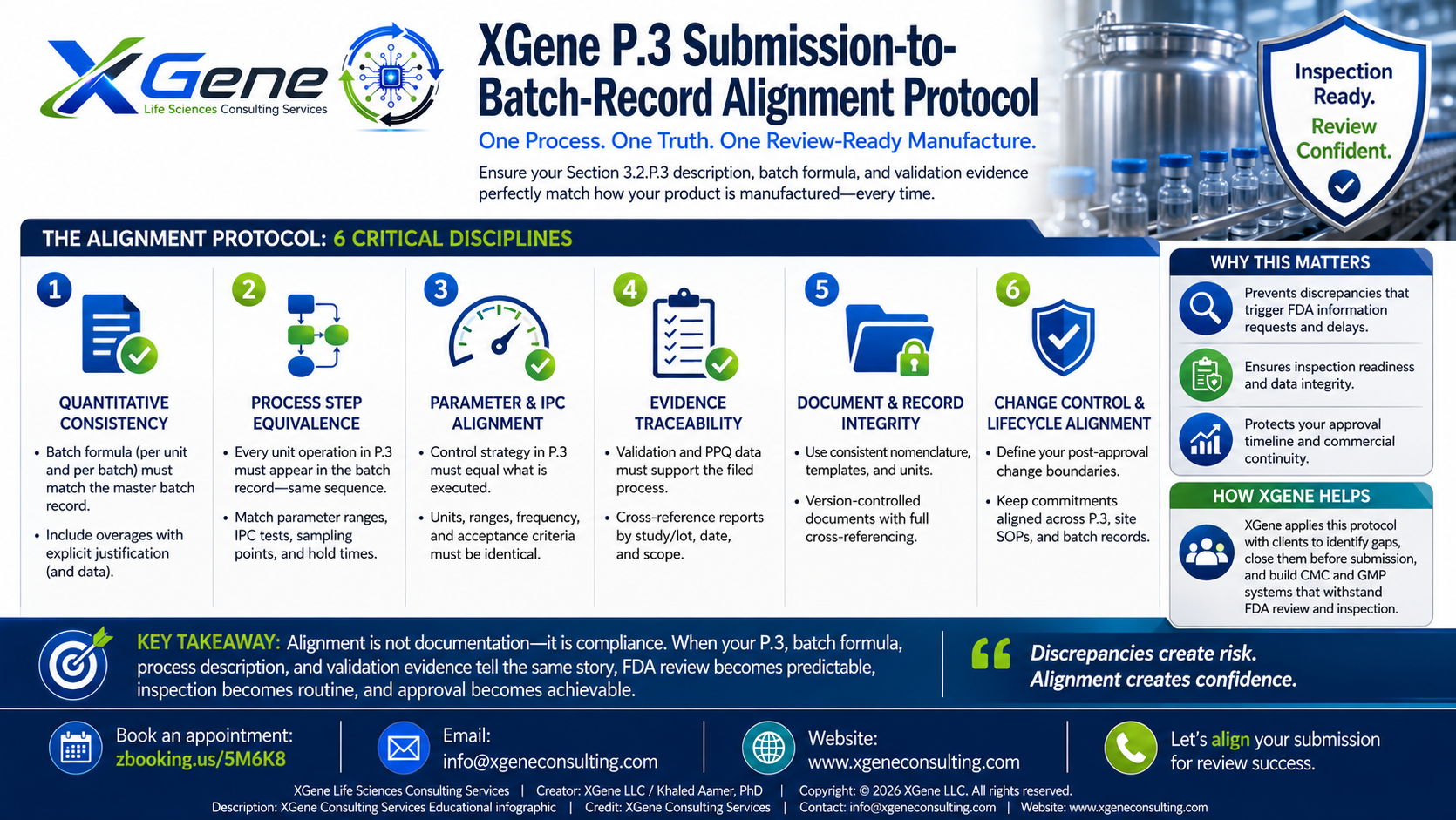
The XGene P.3 Submission-to-Batch-Record Alignment Protocol addresses this risk through three sequential steps before submission. Step one is the Process Description Completeness Audit: the P.3 flow diagram is mapped section by section to the master batch record, verifying that every unit operation in the batch record appears in the P.3 flow diagram, that every material addition point in the batch record corresponds to a material addition point in the flow diagram, and that every hold step in the batch record appears in the flow diagram with a consistent maximum hold time. Step two is the Parameter Range Verification: every process parameter range stated in P.3 is compared against the corresponding range in the master batch record, confirming that the P.3 range is neither narrower than the batch record range (which would create an unreported constraint) nor wider than the validated range (which would claim a range not supported by validation data). Step three is the IPC Acceptance Criteria Cross-Check: every in-process acceptance criterion in P.3 is verified against the corresponding acceptance criterion in the master batch record and against the actual results observed in the PPQ batches — confirming that the criterion is realistic given observed data, consistent between P.3 and the batch record, and not tighter in the batch record than in the filing.
These three steps, executed sequentially and documented before submission, eliminate the category of PAI observations that arise from P.3-to-batch-record discrepancies. They do not eliminate observations arising from GMP deficiencies in the facility, from data integrity findings, or from equipment qualification gaps — those are addressed separately. But they close the specific gap that the hook describes: the gap between what P.3 says and what the batch record says.
XGene P.3 Submission-to-Batch-Record Alignment Protocol
Writing the Drug Product Manufacturing Section That Supports Both Approval and PAI
The XGene P.3 Submission-to-Batch-Record Alignment Protocol is a three-step pre-submission verification procedure designed to eliminate the discrepancy class of PAI observations and information requests. It is applied to the final draft of 3.2.P.3 against the current approved master batch record before the CTD package is assembled for submission.
STEP 1 — Process Description Completeness Audit Map the P.3 flow diagram (3.2.P.3.2) to the master batch record section by section. For each unit operation in the MBR: confirm it appears in the P.3 flow diagram with the same operation name and sequence. For each material addition point in the MBR: confirm it appears on the P.3 flow diagram with the same component and stage. For each hold step in the MBR: confirm it appears in the P.3 flow diagram and that the maximum hold time in P.3 does not exceed the maximum hold time in the MBR or the validated hold time supported by stability or microbial data. Document each mapping as a line-item audit trail.
STEP 2 — Parameter Range Verification Extract every process parameter range from P.3.3 into a verification table. For each parameter: record the P.3 range, the MBR range, and the PPQ demonstrated range (actual min and max observed across PPQ batches). Flag any case where: (a) the P.3 range is wider than the MBR range — indicating P.3 claims parameter space not controlled in the batch record; (b) the P.3 range is narrower than the MBR range — indicating the batch record allows operation outside the filed range; or (c) the PPQ demonstrated range approaches or meets a boundary of the stated range — indicating the process may be operating near its validated limit. Resolve all flags before submission by updating either P.3 or the MBR, and re-running affected PPQ statistical analyses if the range changes.
STEP 3 — IPC Acceptance Criteria Cross-Check Extract every in-process control and acceptance criterion from P.3.3 into a verification table. For each IPC: record the P.3 acceptance criterion, the MBR acceptance criterion, and the actual results from each PPQ batch. Flag any case where: (a) the P.3 criterion and MBR criterion differ; (b) any PPQ batch result fails the stated criterion — indicating a criterion that does not reflect process capability; or (c) any PPQ batch result is within 10% of the acceptance limit — flagging criteria where process capability may be insufficient to sustain consistent compliance. Resolve all flags before submission. Where PPQ results consistently approach a limit, conduct a process capability analysis and either tighten the process parameter range to improve centering or provide explicit process characterization data demonstrating that operation at the limit does not affect product quality.
OUTPUT: A pre-submission alignment report that documents Step 1 map, Step 2 verification table, and Step 3 verification table, with all flags resolved and resolution rationale documented. This report is retained in the CMC authoring file, not submitted to FDA, but is available to support responses to information requests or PAI follow-up questions.
REGULATORY BASIS:
– 3.2.P.3 batch formula completeness: ICH Q8(R2) §3.2.P.3.1 – Master batch record requirement: 21 CFR 211.186 – Production and process control procedures: 21 CFR 211.100(a) – Stage 2 PPQ requirements: FDA Process Validation Guidance, January 2011 – PAI scope and verification mandate: FDA Compliance Program 7346.832 – Pharmaceutical quality system consistency: ICH Q10 §3.1 – Post-approval change thresholds: FDA SUPAC-IR/MR Guidance
COMMON DEFICIENCY LANGUAGE THIS PROTOCOL PREVENTS:
– “Batch formula per unit but not per batch provided. Please provide batch formula for each proposed commercial batch size.” – “Blend uniformity acceptance criterion is RSD ≤5.0% but no PPQ data demonstrating this criterion at commercial scale have been provided.” – “The compression force range of 5–25 kN is unusually wide. Please provide process characterization data or narrow the range to the validated operating range.” – “The commercial-scale PPQ batch size is not stated. Please clarify the batch size for which PPQ data have been generated.” – “Parameter ranges in P.3 are inconsistent with parameter ranges in the master batch record submitted under [reference]. Please reconcile.”