
CMC 2030 Convergence — Where the Regulatory Landscape Is Heading
The CMC regulatory landscape in 2030 will be defined by three converging forces that are already in motion today: structured data submission as the default for all major agencies, AI-assisted…
On this pageArticle overview
The CMC regulatory landscape in 2030 will be defined by three converging forces that are already in motion today: structured data submission as the default for all major agencies, AI-assisted review as standard FDA workflow, and continuous manufacturing as the expected platform for new drug product approvals — and the companies building their CMC infrastructure today will either be positioned for that world or be forced to retrofit.
The Convergence Imperative: Why 2030 Is Already in Motion
I want to be precise about what I mean by “already in motion.” I do not mean that these forces are emerging trends subject to revision. I mean that each of them is the product of active, funded, multi-year regulatory investment by FDA and EMA that is documented in public commitments, finalized guidance, and operational infrastructure deployments that are running now. PDUFA VII commitments include explicit FDA deliverables for structured CMC data and AI-assisted review. ICH Q13 on continuous manufacturing was finalized in 2022. EMA’s 2025+ Regulatory Science Strategy names digital transformation and advanced manufacturing as central pillars. The regulatory agencies are not waiting for 2030. They are building toward it quarter by quarter, and the gap between where they are going and where the average CMC program sits today is growing.
This article maps the five convergence vectors that define the CMC regulatory environment of 2030, explains why they must be understood as an integrated architecture rather than five separate compliance projects, and describes what CMC strategy needs to account for them.
The Five Regulatory Vectors Reshaping CMC Submissions by 2030
The five vectors are structured CMC data and PQ-CMC, global data harmonization through IDMP and eCTD v4, advanced manufacturing through continuous manufacturing and PAT, AI-assisted regulatory review through KASA, and the eCTD evolution toward fully structured submission formats. Each vector is active today. The defining feature of the 2030 environment is not the maturity of any single vector — it is what happens when all five reach operational scale simultaneously.
The first vector is structured CMC data. FDA’s PQ-CMC program is converting Module 3 submission content from narrative documents into machine-readable HL7 FHIR-formatted data submitted alongside the eCTD. Phased implementation has begun. The HL7 Pharmaceutical Quality CMC Implementation Guides are published and updated. For the submission types in current scope, structured data is not optional. For submission types entering scope over the next several years, companies that have not aligned their LIMS, ELN, and document management systems to produce FHIR-formatted output will face deficiencies that editorial revision cannot resolve. The source data must be structured at the point of generation, not retrofitted from a finished narrative document. This is a data architecture decision, and it must be made years before a submission deadline, not weeks.
The second vector is global data harmonization. EMA’s SPOR platform and the ISO IDMP standards — ISO 11615, 11238, 11239, 11240, and 11616 — define how medicinal products, substances, organizations, and packaging are identified and described in structured formats across the EU. IDMP compliance is a current obligation for EU product portfolios, not a future one. eCTD v4, the successor to the current eCTD v3.2.2 structure, introduces XML-based structured metadata and lifecycle management capabilities that represent a significant expansion of the structured data layer in regulatory submissions globally. FDA, EMA, and PMDA are all engaged in the eCTD v4 transition timeline. Companies with submission infrastructure built on eCTD v3.2.2 documents will need to plan that transition deliberately or discover it as a critical path constraint. The ICH PDUFA VII commitments include specific deliverables for FDA’s eCTD evolution progress, which signals that this transition is on a defined schedule, not an indefinite horizon.
The third vector is advanced manufacturing. ICH Q13, finalized in 2022, provides the harmonized regulatory framework for continuous manufacturing of drug substances and drug products. Approved continuous manufacturing products are already on the US market. FDA’s Emerging Technology Program provides a pre-submission engagement pathway for sponsors planning to use novel manufacturing technologies — including continuous manufacturing, advanced process control, and digitally integrated process monitoring — and ETP engagement is the recognized route to building the agency relationship necessary for efficient review of non-traditional manufacturing platforms. Process analytical technology, anchored to the 2004 FDA PAT Guidance and integrated with the quality-by-design principles of ICH Q8, underpins the real-time monitoring capability that makes continuous manufacturing regulatorily defensible. Real-time release testing, or RTRT, replaces traditional end-product batch testing in continuous operations by demonstrating product quality through in-process monitoring data rather than offline finished-product analysis. Companies without PAT capability cannot credibly operate continuous manufacturing at the regulatory interface.
The fourth vector is AI-assisted review. KASA — FDA’s Knowledge-Aided Assessment and Structured Application — is the reviewer-side infrastructure being deployed in CDER to consume PQ-CMC structured submission data, automate cross-referencing of specifications against batch analysis results and stability data, and reduce the manual extraction burden that has historically added weeks of uncertainty to CMC review cycles. KASA is operational. The submission data it is designed to consume is the structured PQ-CMC data that sponsors are expected to provide. A submission that arrives without the required structured data layer does not simply create a deficiency — it means KASA cannot process the package as designed, and the reviewer reverts to fully manual extraction. The efficiency benefit of the AI-assisted review infrastructure flows to sponsors who provide structured data. It does not flow to sponsors who do not.
The fifth vector is eCTD evolution. The current eCTD v3.2.2 structure is a file-and-folder format with document-based content. eCTD v4 introduces a structured XML backbone that carries lifecycle management metadata, submission unit relationships, and content references in a way that is fundamentally different from the current architecture. Transitioning from eCTD v3.2.2 to v4 is not a republishing exercise. It requires publishing system reconfiguration, metadata schema alignment, and validation against the updated DTD specifications maintained by ICH. For companies with high-volume, complex submission programs, the eCTD v4 transition is a multi-year program that needs to begin before the compliance window closes.
The Architecture Decision That Determines Competitive Advantage
The defining strategic insight is that these five vectors share a common foundation: structured, machine-readable data generated consistently from source systems and formatted to agency-defined standards. A company that builds its CMC data architecture around structured outputs — FHIR-formatted CMC data for PQ-CMC, IDMP-compliant substance and product identifiers for SPOR, PAT-derived process data for continuous manufacturing, XML-structured metadata for eCTD v4 — is building a single integrated capability that serves all five vectors simultaneously. A company that treats each vector as a separate compliance project is building five separate remediation programs, each with its own timeline, resource requirement, and risk of intersection with an active submission deadline.
CMC strategy that does not account for this convergence will produce programs with structural disadvantages at the regulatory interfaces of the future. The question is not whether these changes are coming. The regulatory agencies have already committed to them, invested in them, and begun enforcing them in the submission types currently in scope. The question is whether a company’s CMC infrastructure is being built to meet that environment or whether it will need to be rebuilt when the environment arrives in full.
The XGene CMC 2030 Strategic Readiness Assessment
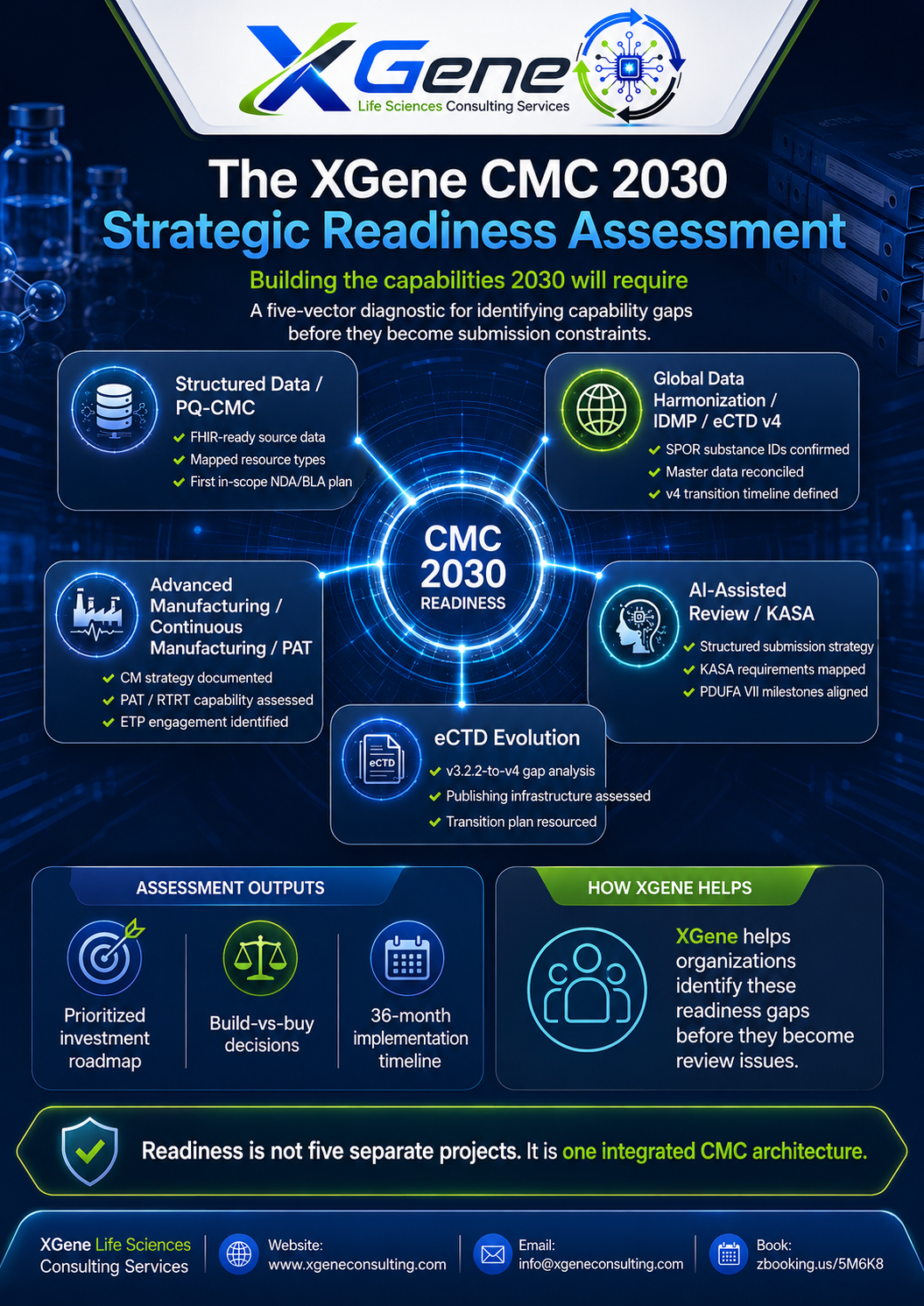
BUILDING THE CAPABILITIES 2030 WILL REQUIRE — THE XGENE CMC TRANSFORMATION ROADMAP
XGene’s CMC 2030 Strategic Readiness Assessment maps a company’s current CMC infrastructure against five converging regulatory vectors and produces a prioritized investment roadmap with identified capability gaps, build-vs-buy decisions, and a 36-month implementation timeline.
VECTOR 1 — Structured Data / PQ-CMC Current state assessment: Can your LIMS, ELN, and document management systems generate HL7 FHIR-formatted output conformant to the current PQ-CMC Implementation Guide? Have you mapped your data models against required FHIR resource types for the eCTD sections in current structured data scope? Is your first in-scope NDA or BLA submission accounted for in your PQ-CMC readiness plan?
VECTOR 2 — Global Data Harmonization / IDMP / eCTD v4 Current state assessment: For EU portfolios, have all active substances been registered in SPOR SMS with confirmed substance IDs? Is your product master data reconciled against SPOR PMS? Have you mapped your publishing infrastructure against the eCTD v4 transition requirements and confirmed the timeline for your first v4-required submission?
VECTOR 3 — Advanced Manufacturing / Continuous Manufacturing / PAT Current state assessment: Does your CMC team have documented capability on continuous manufacturing process design and regulatory submission strategy? Have you assessed which pipeline programs are candidates for continuous manufacturing or advanced PAT implementation? Have you identified whether ETP engagement is appropriate for any programs at the pre-submission stage?
VECTOR 4 — AI-Assisted Review / KASA Current state assessment: Does your regulatory submission strategy account for KASA’s structured data requirements, or is the submission plan built around narrative document packages that KASA cannot process? Has your CMC or regulatory affairs team reviewed the PDUFA VII commitments for AI-assisted review milestones and mapped them to your submission timelines?
VECTOR 5 — eCTD Evolution Current state assessment: Has your regulatory publishing team assessed your current eCTD v3.2.2 infrastructure against the eCTD v4 requirements published by ICH? Is there a documented transition plan with a compliance date and resource allocation, or is the transition on the roadmap as an undated future project?
Primary regulatory references
- https://database.ich.org/sites/default/files/M4Q%28R2%29_Step%202_Slides%20to%20Accompany%20Consultation_2025_0624_SEC.pdf
- https://www.ich.org/page/ich-electronic-common-technical-document-ectd-v40
- https://www.fda.gov/about-fda/artificial-intelligence-drug-development/guiding-principles-good-ai-practice-drug-development