
3.2.P.8 Drug Product Stability: Building the Stability Program That Establishes a Defensible Shelf Life
"The proposed shelf life of 24 months is not supported by the data provided." Three years after ICH Q1E has been in effect, this deficiency continues to appear in CMC…
On this pageArticle overview
“The proposed shelf life of 24 months is not supported by the data provided.” Three years after ICH Q1E has been in effect, this deficiency continues to appear in CMC letters because the difference between a 24-month real-time data package that supports a 24-month shelf life and one that supports only 18 months is a statistical question that many stability programs are not designed to answer.
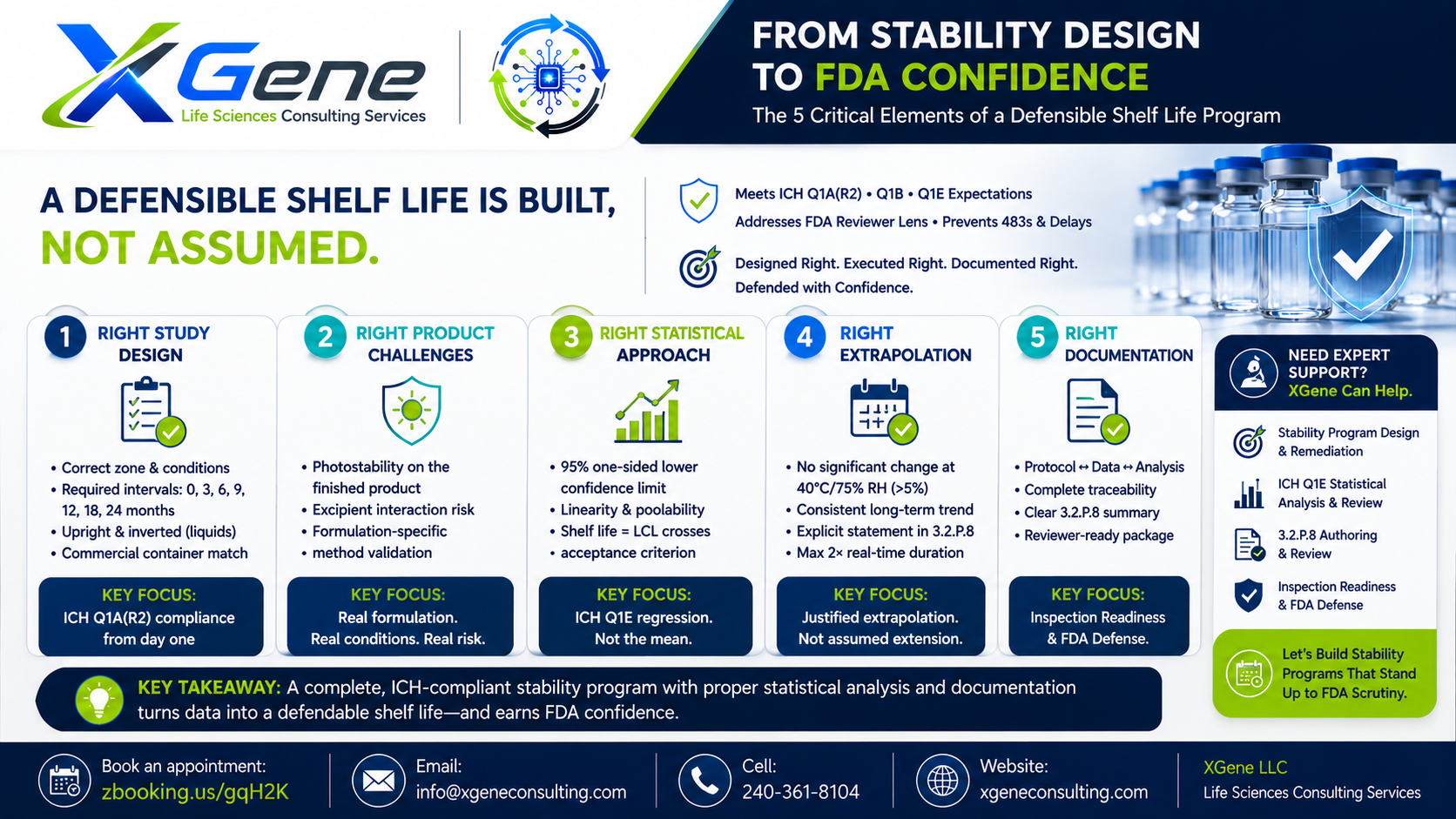
The deficiency is not, at its root, a data gap — it is a design gap. A stability program initiated without pre-specified acceptance criteria, without a validated stability-indicating method suite anchored to forced degradation outcomes, and without a pre-planned ICH Q1E statistical analysis cannot retroactively become defensible by adding time points. The 3.2.P.8 section of an NDA or ANDA is one of the most consequential CMC chapters in the submission because the shelf-life determination is, in regulatory terms, a scientific argument, and FDA reviews it as such.
The ICH Q1A(R2) Study Requirements for Drug Product Stability: Zone Classification, Conditions, Intervals
The architecture of a compliant drug product stability program begins with a decision that is often treated as administrative but carries direct regulatory consequence: which climatic zone governs the intended market. ICH Q1A(R2) (2003) establishes long-term storage conditions at 25°C/60%RH for Zone I and II markets and at 30°C/65%RH for Zone III and IV markets, and the choice of condition is not interchangeable at review. A submission targeting an FDA approval for US distribution — Zone II — using only 30°C/65%RH long-term data will draw a deficiency requesting data at 25°C/60%RH, because the storage conditions under which the shelf life was estimated must correspond to the conditions on the approved label. The intermediate condition at 30°C/65%RH is required for Zone I/II products when there is concern that the product may fail accelerated testing, and the accelerated condition at 40°C/75%RH provides the supportive data context within which the long-term trend is interpreted — but per ICH Q1E (2003), accelerated data alone cannot establish a shelf life. They can only confirm, or fail to confirm, the absence of significant change that permits extrapolation beyond the real-time data set.
Testing frequency is not an area where sponsors have discretion once the study duration is defined. ICH Q1A(R2) Table 2 prescribes the minimum testing intervals: for long-term studies, time points at 0, 3, 6, 9, 12, 18, and 24 months constitute the required data set for a 24-month shelf life claim. Missing a time point is not correctable after the fact — the statistical regression model at the foundation of the ICH Q1E shelf-life estimate requires a complete interval data set, and a gap at, for example, the 18-month time point removes a data anchor that anchors the slope estimate in exactly the range most critical to the shelf-life endpoint. For liquid drug products in primary containers, ICH Q1A(R2) also requires stability samples stored in both upright and inverted orientations, because headspace gas composition and stopper-solution contact are orientation-dependent variables that cannot be inferred from single-orientation data.
Container closure representativeness is a companion requirement that generates its own deficiency pattern. The stability protocol must specify that the containers and closures placed on study are identical in material, geometry, and fill volume to the commercial configuration. A study conducted with laboratory-scale closures where the commercial closure is a different supplier or a different torque specification will not satisfy FDA reviewers because 3.2.P.7 and 3.2.P.8 are linked: the container closure integrity data package must encompass the same configuration placed on stability. When the two sections use different configurations, FDA’s deficiency language is direct: “The stability studies were not conducted in the proposed commercial container closure system — please provide a revised stability protocol or confirmatory data.”
Photostability, Excipient Interaction, and Drug Product-Specific Stability Challenges
Photostability testing under ICH Q1B (1996) has a deceptively simple framing — expose the drug product to defined light intensities and assess for change — but the operational failure that generates the most FDA deficiencies is not insufficient exposure but incorrect test article selection. ICH Q1B is explicit: photostability testing must be performed on the drug product in its final packaging. A photostability dossier that demonstrates the drug substance is photolabile but provides no photostability data for the packaged drug product fails the regulatory requirement in a mechanistic sense: it cannot tell FDA whether the packaging provides adequate protection, because the packaged product was never tested. The deficiency language is exact: “The photostability study was conducted on the drug substance only — please provide photostability data for the drug product in its final container closure system.” The consequence is either a re-test campaign on the drug product or, if the product is photosensitive and data are absent, an inability to justify the absence of a “protect from light” label statement.
ICH Q1B Option 1 (confirmatory testing using ICH light sources at prescribed total illuminance and near-UV energy) and Option 2 (sequential testing with the same total energy delivered in stages to identify the threshold of concern) both serve the same regulatory function, but Option 2 is operationally valuable when the product is expected to be borderline photosensitive, because the staged approach can support a labeling statement that limits secondary packaging exposure rather than requiring light-protective primary packaging. The strategic value of selecting Option 2 under these circumstances is that a well-designed photostability protocol directly informs a specific label storage statement — and a label storage statement built on actual photostability data is far more defensible in a Type A meeting than one derived from drug substance characterization.
Drug product-specific excipient interaction failures are a distinct category of stability challenge. Ester-containing excipients in solid oral dosage forms can participate in transesterification reactions under elevated humidity, generating impurities not present in the drug substance impurity profile and therefore not monitored by methods validated only against the drug substance degradation suite. ICH Q1A(R2) does not prescribe forced degradation for drug products with the same specificity as ICH Q3B addresses degradants, but FDA’s expectation — drawn from its 2003 Stability Guidance — is that the stability-indicating method suite for the drug product be validated under conditions that reflect the actual formulation matrix, not just the drug substance in solvent. A method that resolves all drug substance degradants under stressed conditions but was never challenged against a stressed drug product formulation cannot confirm that excipient-derived impurities eluting near the principal peak are absent from the chromatographic window.
Shelf-Life Estimation From Stability Data: The Statistical Regression Method FDA Accepts
ICH Q1E (2003) is the governing framework for converting a stability data set into a shelf-life estimate, and its core statistical requirement is precise: the shelf life is the time at which the 95% one-sided lower confidence limit of the regression line intersects the acceptance criterion. This is not the time at which the mean value reaches the specification limit. A stability program that reports only mean assay values at each time point without calculating the lower confidence limit will produce a shelf-life estimate that is optimistically biased — the mean may remain within specification at 24 months, but the lower confidence limit may cross the specification boundary at 18 months. That is the exact mechanism behind the deficiency pattern in the hook: the data exist, the mean is acceptable, but the statistical analysis was never designed to answer the question FDA is actually asking.
Regression model selection under ICH Q1E is not arbitrary. The analysis begins with a test for linearity and for poolability of batches — if three or more batches are included in the submission package, FDA expects the ICH Q1E analysis to test whether the slopes and intercepts of the individual batch regression lines can be pooled into a single model. If the poolability test fails, the shelf life is estimated from the batch with the least favorable (shortest) projected shelf life, not from the mean of all batches. A common submission error is to report batch-specific regression results and then propose a shelf life based on a visual average rather than the statistical determination that ICH Q1E requires — FDA’s deficiency in this case states that the poolability analysis was not performed or that the shelf-life determination does not follow from the presented statistical model.
Extrapolation — proposing a shelf life beyond the observed real-time data duration — is permitted under ICH Q1E only when two conditions are met: no significant change at accelerated conditions (40°C/75%RH), and a consistent trend at long-term conditions. The guidance defines significant change at accelerated for assay as a greater than 5% change from initial. ICH Q1E permits extrapolation of up to twice the real-time data duration in some cases, but the explicit compliance statement must appear in the 3.2.P.8 submission — not implied by the shelf-life proposal, but stated: the extrapolation criteria have been evaluated, the accelerated study outcome, the long-term trend determination, and the resulting extrapolation limit. Submissions that propose extrapolated shelf lives without this explicit statement draw a deficiency requesting confirmation that ICH Q1E Section 2.2 criteria were evaluated.
Building a Stability Program That Establishes a Defensible Drug Product Expiry Date
The XGene Shelf-Life Statistical Justification Package is a four-document consulting deliverable built to satisfy ICH Q1E review at the first submission cycle and to withstand the specific deficiency patterns that FDA CMC reviewers issue most frequently in 3.2.P.8.
1. Stability Protocol — Pre-Specified Before Study Initiation. The protocol documents the ICH Q1A(R2)-compliant study design: climatic zone selection with market justification, testing conditions (long-term, intermediate, and accelerated), container closure configuration confirmed as representative of the commercial system, testing frequency per ICH Q1A(R2) Table 2 time points (0, 3, 6, 9, 12, 18, and 24 months), storage orientation for liquid products, and pre-defined acceptance criteria for each attribute. Pre-specification before initiation is not procedural — it is the regulatory basis on which FDA distinguishes a prospective stability program from a post-hoc data set, and deficiency letters requesting “a copy of the stability protocol in effect at study initiation” are a recognized pattern when this document is absent from the 3.2.P.8 package.
using stress conditions selected to generate and understand scientifically relevant degradation pathways in the actual drug-product matrix. Common challenges include hydrolytic, oxidative, photolytic, and thermal stresses where relevant; the objective is to demonstrate specificity and stability-indicating capability, not to satisfy a fixed five-condition checklist.
3. ICH Q1E Statistical Analysis Report — Regression, Poolability, and Confidence Limit Calculation. The report presents the batch-specific regression lines, the poolability test result with the statistical decision rule applied, the selected regression model, the 95% one-sided lower confidence limit calculation, the resulting shelf-life estimate, and an explicit statement evaluating each ICH Q1E extrapolation criterion. The extrapolation compliance statement is written as a discrete, reviewable conclusion — not embedded in narrative — so that FDA’s CMC reviewer can locate the criterion, the data, and the determination in a single document.
4. Storage Condition Justification — Accelerated and Photostability Outcomes Mapped to Label Statement. The document maps the accelerated study outcome (significant change or absence thereof), the ICH Q1B photostability conclusion (photosensitive or not), and the resulting label storage statement, with explicit confirmation that the stated conditions are both necessary — required by the data — and sufficient — no additional precautions are indicated by the evidence. This document is what FDA reviewers look for when evaluating whether the proposed storage statement is supported or whether a “protect from light” or “store below 25°C” condition is required by the data rather than selected by preference.
The output of the XGene Shelf-Life Statistical Justification Package is a pre-submission evidence dossier that maps the proposed shelf life and storage statement to specific statistical results, validated method outputs, and guideline compliance determinations — not a narrative claim, but a structured technical argument that anticipates and closes the four most common 3.2.P.8 deficiency categories before the submission is filed.
A shelf-life deficiency after first-cycle review does not only delay approval — it triggers a clock. The agency’s response timeline for a Complete Response Letter is measured in months, and a stability deficiency requiring additional real-time data is among the longest to resolve because the data cannot be generated retroactively at a faster rate than time permits. The submission that enters review with an ICH Q1E analysis that does not hold under statistical scrutiny will exit review with a request for data that did not exist before submission and cannot exist until real time accumulates. The cost of that deficiency is not a documentation exercise — it is calendar time at the commercial launch boundary, and for programs where patent exclusivity is a factor, it is not recoverable.