
3.2.S.7 Drug Substance Stability: Designing the ICH Q1-Compliant Program That Supports a Defensible Retest Period
"The proposed retest period of 36 months is not supported by the data presented — the available data cover only 18 months of long-term data at the time of submission.…
On this pageArticle overview
“The proposed retest period of 36 months is not supported by the data presented — the available data cover only 18 months of long-term data at the time of submission. Please provide the scientific basis for extrapolation beyond the observed data.” This deficiency, or one identical to it, appears in a significant portion of CMC information requests for drug substance stability. The cause is not inadequate data — it is inadequate understanding of what ICH Q1E permits and requires.
The mechanics of that failure are more precise than they first appear. ICH Q1E (2003) — the ICH guidance on evaluation of stability data — does not prohibit extrapolation of the proposed retest period beyond the observed data range. It establishes specific criteria under which extrapolation is scientifically justifiable. A sponsor who understands those criteria, builds the stability program to satisfy them, and documents the statistical analysis in the submission has a defensible retest period. A sponsor who submits 18 months of long-term data, proposes a 36-month retest period, and cites ICH Q1E as authority without applying its statistical requirements has produced a deficiency letter, not a submission.
A defensible drug substance retest period requires long-term stability data supported by the ICH Q1E statistical analysis framework, a stability-indicating analytical package that detects every relevant degradation pathway, and a clear delineation between the retest period assigned to the drug substance and the shelf-life assigned to the finished drug product — and most programs fail on at least one of these three dimensions.
The ICH Q1A(R2) Study Design Requirements: Conditions, Containers, and Time Points
ICH Q1A(R2) (2003) is the foundational document governing the design of drug substance stability studies. It establishes three study types — long-term, intermediate, and accelerated — and assigns storage conditions, humidity targets, and minimum testing intervals to each. For drug substances intended for the ICH Zone I/II climatic zones (which encompasses the United States and Europe), the long-term condition is 25°C/60% RH, the intermediate condition is 30°C/65% RH, and the accelerated condition is 40°C/75% RH. The testing frequency specified in Table 1 of ICH Q1A(R2) defines the minimum time points at which testing must be performed: 0, 3, 6, 9, 12, 18, and 24 months at the long-term condition, with additional time points at 36 and beyond when a longer shelf-life or retest period is proposed. At the accelerated condition, testing at 0, 3, and 6 months is required. The intermediate condition — which many sponsors treat as optional — becomes obligatory when significant change is observed at accelerated conditions during the first 6 months, and its testing frequency mirrors the long-term schedule.
The significance of this table is not only the testing intervals it mandates. It is the minimum data set it defines for a submission supporting a 24-month retest period. A submission filing at the 18-month point in long-term testing has 0, 3, 6, 9, 12, and 18 months of data — a six-time-point data set that does not include the 24-month time point. A retest period of 24 months proposed on the basis of this data set depends entirely on extrapolation. A retest period of 36 months proposed on the same data set represents extrapolation of 18 months beyond the last time point — double the observed range. ICH Q1E permits extrapolation, but under conditions that must be explicitly demonstrated, and the distance of that extrapolation is bounded.
The design of the long-term stability study must also specify the container closure system used, because ICH Q1A(R2) requires that stability studies be conducted in the commercial or representative packaging. When the container closure system described in 3.2.S.6 does not match the container used for the stability studies in 3.2.S.7, the data package is compromised regardless of its statistical completeness. This reconciliation failure is among the most common cross-section deficiencies in Module 3. The stability study protocol, which should be included in the 3.2.S.7 section, must specify the container closure system, the batch sizes and manufacturing sites represented, and the number of batches enrolled — with a minimum of three pilot- or production-scale batches required to support registration.
Stress testing should be designed to generate scientifically relevant degradation pathways and demonstrate that the analytical procedure is stability indicating. Acid/base hydrolysis, oxidation, heat, humidity, and photolysis are common tools where relevant, but the program should be product- and molecule-specific rather than treated as a fixed five-condition regulatory checklist.
The relationship between ICH Q1B photostability requirements and 3.2.S.7 is frequently misunderstood. ICH Q1B (1996) governs photostability testing as a component of the overall stability program, and it distinguishes between the photostability study conducted under the ICH Q1B-specified light sources — a near-UV fluorescent lamp and a visible lamp, with a combined exposure of at least 1.2 million lux-hours and 200 Wh/m2 UV — and the forced degradation photolytic stress component conducted for method validation purposes. A deficiency pattern that recurs in 3.2.S.7 reviews is the photostability study that does not specify the light source type, confirm the cumulative exposure achieved, or document whether Option 1 (direct exposure) or Option 2 (indirect with comparator) was used. The deficiency language is consistent: “Photostability study does not specify light sources or confirm Q1B Option 1 exposure.” The fix is documentation, not data.
Bracketing and matrixing per ICH Q1D (2002) are design strategies that reduce the total number of samples tested without compromising the validity of the stability data supporting a retest period — provided the design is pre-specified in the stability protocol, the bracketing factors are limited to those permitted by ICH Q1D (strength and container size, not manufacturing site or batch), and the matrixing reduction does not drop below the minimum frequency required to identify statistically significant trends. When bracketing or matrixing is applied without a pre-specified protocol or when the design reduces testing frequency below the minimum time points required by ICH Q1A(R2) Table 1, the data set is not ICH Q1D-compliant and cannot be used to support the retest period proposed.
ICH Q1E Statistical Analysis: How to Calculate a Defensible Retest Period From Your Data
ICH Q1E (2003) — and its FDA implementation guidance, FDA Guidance for Industry: Q1E Evaluation for Stability Data (2004) — establishes the statistical methodology for estimating the retest period from the stability data collected under ICH Q1A(R2). The core requirement is that the retest period be determined as the time point at which the 95% one-sided lower confidence limit of the mean degradation curve intersects the acceptance criterion for the attribute being analyzed. This is not a mathematical nicety — it is the regulatory standard. A retest period calculated as the time point at which the mean degradation curve crosses the acceptance criterion, without inclusion of the confidence limit, systematically overstates the retest period by ignoring the uncertainty in the regression estimate. When an FDA reviewer performs the Q1E analysis on the submitted data and obtains a confidence-limit-based shelf-life that is shorter than the proposed retest period, the deficiency is not a technical disagreement — it is a computational discrepancy with an exact fix.
The regression model used for the Q1E analysis must be pre-specified in the stability protocol and justified by the degradation kinetics expected for the drug substance. A zero-order model (linear decline of assay over time) is appropriate when the degradation rate is approximately constant and the degradation is not concentration-dependent. A first-order model (linear decline of log-assay over time) is more appropriate when the degradation rate is proportional to the remaining drug substance concentration. ICH Q1E states that the linear regression of assay (or log-assay for first-order kinetics) on time is the standard approach, and the 95% one-sided lower confidence bound is calculated from the regression line using the standard error of the slope and intercept estimates. The FDA Q1E Implementation Guidance (2004) provides numerical examples of the calculation and explicitly confirms that the lower confidence bound, not the mean estimate, defines the retest period.
The poolability analysis — combining data from multiple batches into a single regression — is the step most commonly executed incorrectly in 3.2.S.7 statistical packages. ICH Q1E requires testing for batch-to-batch variability before pooling: if the slopes and intercepts of individual batch regression lines are not statistically distinguishable at the 0.25 significance level, the data may be pooled and the retest period estimated from the pooled regression. If significant batch-to-batch differences in slope or intercept are detected, the data may not be pooled and the retest period must be estimated from the worst-case batch. When a sponsor pools batch data without performing — or without reporting — the poolability analysis, the reviewer will request it, and if the analysis reveals non-poolable batches, the retest period estimated from the pooled regression is no longer valid.
The extrapolation provisions of ICH Q1E are the most consequential and most misapplied component of the guidance. ICH Q1E permits the proposed retest period to extend beyond the observed data range — but only if: (1) no significant change is observed at the accelerated condition (40°C/75% RH) through 6 months of testing; (2) the long-term data demonstrate a stable trend consistent with the proposed retest period; and (3) the extrapolation does not exceed 12 months beyond the last real-time data point available at submission. The third criterion is the one that generates the deficiency quoted at the opening of this article. Eighteen months of long-term data at submission supports extrapolation to a maximum of 30 months, not 36 months, regardless of the accelerated condition outcome. A 36-month retest period requires 24 months of real-time long-term data, permitting extrapolation of 12 additional months to 36 months only if the accelerated condition shows no significant change and the statistical analysis of the 24-month data set supports the projection. When these criteria are explicitly documented in the submission — not assumed, but tabulated with the accelerated data outcome, the ICH Q1E analysis output, and the extrapolation basis — the reviewer has everything needed to confirm the retest period is supported.
Out-of-trend (OOT) analysis is a component of the ongoing stability monitoring program that must be described in the stability protocol and applied to each batch enrolled in the program. An OOT result is not the same as an out-of-specification result — it is a result that, while within specification, deviates from the expected trend defined by the regression model in a statistically meaningful way. The absence of an OOT protocol in the 3.2.S.7 submission is not typically a deficiency that blocks approval, but the absence of an OOT investigation for an observed data point that deviates from the regression trend — visible in the stability data tables submitted — frequently generates a deficiency requesting the investigation and its conclusion.
Mass balance at each stability time point is the internal consistency check that confirms the stability-indicating method suite is detecting all degradation products. ICH Q6A establishes the principle that the sum of drug substance assay value and all reported degradation product quantities should approach 100% at each time point. A mass balance of 98% or greater is the generally accepted standard; deviations below 98% that are not attributed to a specific analytical cause — volatilization, insolubility, method sensitivity — represent an unidentified degradation pathway and constitute a deficiency requiring analytical investigation. Mass balance reporting must appear in the stability data summary as a calculated column at each time point, not as a narrative statement that mass balance was acceptable.
Stability-Indicating Method Validation and the Forced Degradation Package FDA Requires
The stability-indicating character of an assay method is not established by declaration — it is established by experimental demonstration that the method resolves the drug substance from each degradation product generated under forced degradation conditions, and that each resolved impurity is quantified independently of the drug substance peak. ICH Q2(R1), which governs analytical method validation, requires that specificity for stability-indicating purposes be demonstrated by analyzing samples subjected to stress conditions and confirming peak purity or resolution. The stress conditions are those defined in ICH Q1A(R2) and elaborated in ICH Q1B: acid hydrolysis, base hydrolysis, oxidative degradation, thermal degradation, and photolytic degradation.
Stress testing should be designed to generate scientifically relevant degradation pathways and demonstrate that the analytical procedure is stability indicating. Acid/base hydrolysis, oxidation, heat, humidity, and photolysis are common tools where relevant, but the program should be product- and molecule-specific rather than treated as a fixed five-condition regulatory checklist.
The mass balance criterion in forced degradation — which is distinct from the mass balance calculation at each long-term stability time point — requires that the sum of the drug substance peak area and all resolved degradation product peak areas in the stressed sample accounts for at least 98% of the original drug substance peak area. When mass balance falls below 98% in forced degradation, the analytical explanation must be documented: the shortfall may be attributable to UV-inactive degradation products not detected by the HPLC-UV method (which a diode array or MS detector would resolve), to insoluble precipitates removed during sample filtration, or to volatile degradants lost during sample preparation. Each explanation requires analytical support. An unexplained mass balance deficit in the forced degradation study is the laboratory signal that an uncharacterized degradation pathway exists — a signal that the submission must address, not conceal.
The HPLC method’s gradient conditions, detection wavelength, column chemistry, and system suitability requirements must be defined with the forced degradation data as the qualification basis. Resolution between the drug substance peak and the nearest eluting degradation product must be confirmed at the system suitability level — not only in the forced degradation chromatograms themselves. A system suitability specification of Rs ≥ 2.0 between the drug substance and its principal impurity under worst-case (e.g., aged sample or spiked mixture) conditions provides the operating assurance that the method will detect and resolve degradation products in real stability samples. When that resolution specification is not included in the method — or when it is specified but the forced degradation chromatograms reveal that the actual resolution under the gradient conditions is below the specification for a specific degradant — the method validation is incomplete and the stability-indicating claim is not defensible.
The retest period versus shelf-life distinction is the conceptual boundary that 3.2.S.7 must make explicit. A retest period is assigned to the drug substance and defines the period within which the DS may be used without re-testing, provided it has been stored under the approved conditions. A shelf-life is assigned to the drug product and applies to the finished dosage form in its final container closure system. The retest period in 3.2.S.7 does not become the shelf-life in 3.2.P.8 by default — the drug product stability data must independently support the proposed shelf-life for the drug product. When a sponsor proposes a drug product shelf-life that exceeds the drug substance retest period without providing a scientifically justified basis for that extension (e.g., a formulation that stabilizes a labile drug substance, or drug product stability data that independently demonstrate the shelf-life is achievable), the reviewer will flag the inconsistency. Conversely, a drug substance retest period that is significantly shorter than the drug product shelf-life is not an error — it is an operationally important constraint, because it means the DS must be retested before use if it has been stored beyond the retest period, and that retesting must be reflected in the batch release procedures.
Building a Stability Program That Establishes a Defensible Retest Period Through NDA/BLA
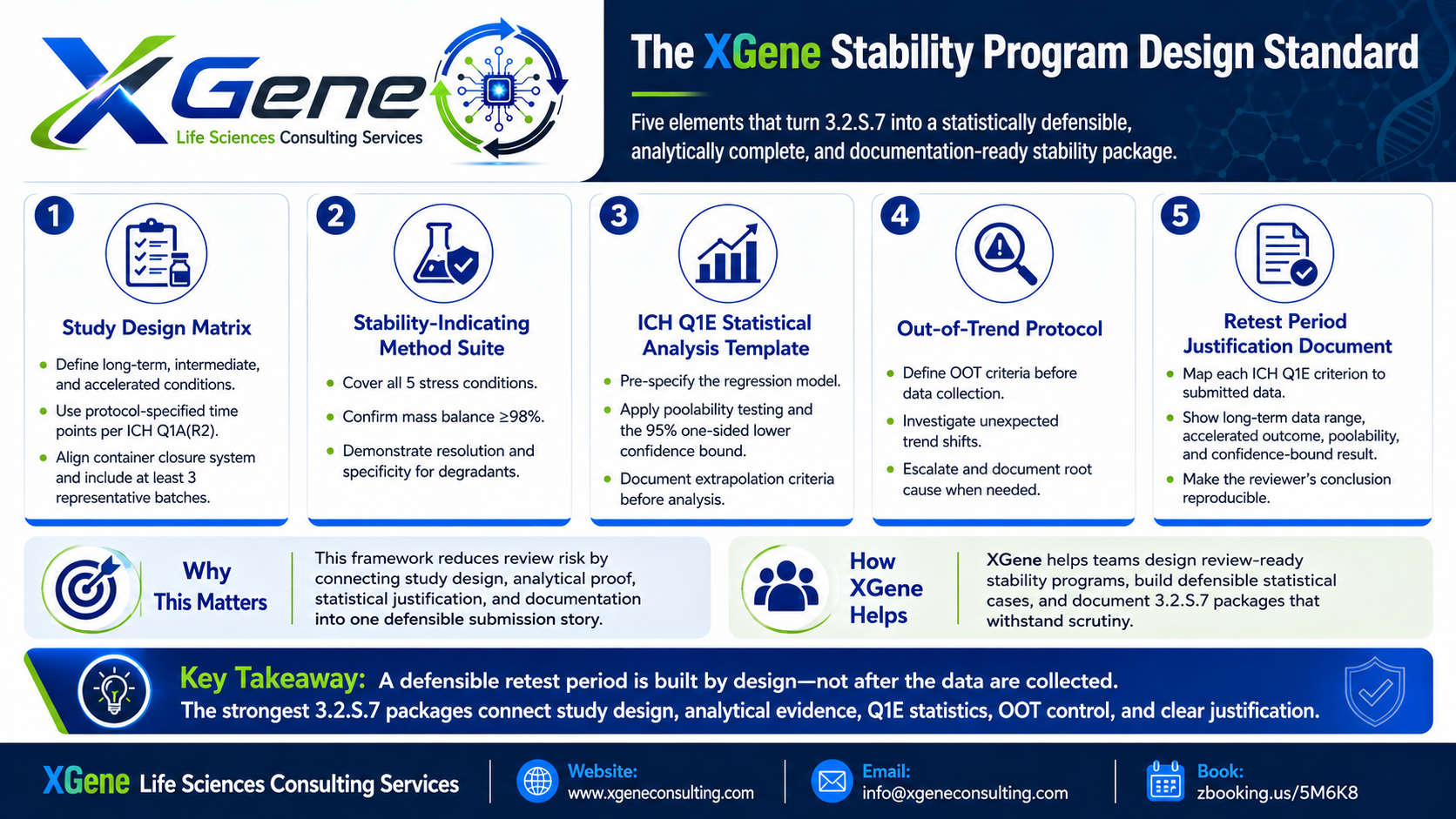
The XGene Stability Program Design Standard is a five-element framework structured to produce a 3.2.S.7 section that is statistically defensible, analytically complete, and documentation-ready at the time of NDA/BLA submission.
Element 1 — Study Design Matrix: Define the full study matrix at program initiation: long-term (25°C/60% RH), intermediate (30°C/65% RH), and accelerated (40°C/75% RH) conditions per ICH Q1A(R2); testing frequency per Table 1 (0, 3, 6, 9, 12, 18, 24 months for long-term; 0, 3, 6 months for accelerated); container closure system identical to commercial or representative packaging; minimum three batches representing the commercial manufacturing process. If bracketing or matrixing per ICH Q1D is applied, the design must be pre-specified in the stability protocol with documented justification and confirmed compliance with ICH Q1D reduction limits. The study design matrix is the document that maps every future data point to a protocol-specified time point, condition, and container — it is not written after the data are collected.
Element 2 — Stability-Indicating Method Suite (5 Stress Conditions, Mass Balance ≥98%): Conduct forced degradation under all five ICH Q1B/Q1A stress conditions. Document the experimental conditions — concentration, reagent, time, and temperature for each stress — and the mass balance outcome for each stressed sample. Confirm that the HPLC method resolves the drug substance peak from each observed degradation product with Rs ≥ 2.0 and that the mass balance calculated as (assay% + sum of all degradation product%) meets the ≥98% criterion. Where mass balance is below 98%, the deficit must be analytically characterized before the method can be declared stability-indicating. The five-condition forced degradation data package is the primary evidentiary basis for the specificity claim in the analytical method validation report that cross-references 3.2.S.7.
Element 3 — ICH Q1E Statistical Analysis Template (Pre-Specified Regression Model, CI Approach, Extrapolation Criteria): At stability protocol initiation, document the pre-specified regression model (zero-order or first-order), the poolability analysis approach (significance level 0.25 per ICH Q1E), the confidence limit calculation method (95% one-sided lower confidence bound on the mean regression line), and the extrapolation criteria (no significant change at accelerated through 6 months; extrapolation not to exceed 12 months beyond last real-time data point at submission). When the submission data set is assembled, apply the pre-specified statistical model and report the Q1E analysis output — including the poolability test result, the individual batch regression parameters, the pooled or worst-case regression, and the 95% lower confidence bound — as a tabulated deliverable in the 3.2.S.7 section. A pre-specified statistical analysis template that produces a negative result (i.e., the confidence bound-based retest period is shorter than proposed) must be reported as such — the analysis is not valid if it is re-run with an alternative model selected post hoc to produce a longer retest period.
Element 4 — Out-of-Trend Protocol: Define the OOT criteria in the stability protocol before any data are collected. OOT is conventionally defined as a result that exceeds a pre-specified statistical threshold relative to the regression trend — for example, a result that falls outside the 3-sigma prediction interval of the regression model fitted to prior time points. The protocol must specify the investigation trigger, the root cause analysis process, and the criteria under which an OOT result is escalated to a regulatory notification. An OOT result that is investigated, attributed to a laboratory or process cause, and resolved with documented evidence does not threaten the retest period. An OOT result that is not investigated, or that appears in the submission data without an associated investigation record, generates a reviewer request that delays the review cycle.
Element 5 — Retest Period Justification Document: Prepare a structured justification document that explicitly maps each ICH Q1E criterion to the submitted data. The document must state: the number of long-term time points available at submission, the outcome of the accelerated condition assessment (significant change or no significant change), the ICH Q1E extrapolation basis and maximum permissible extrapolation from the last real-time data point, the result of the poolability analysis, the 95% lower confidence bound-based retest period estimate, and the proposed retest period and its relationship to the confidence bound estimate. This document is not a narrative — it is a structured table that a reviewer can verify against the raw stability data in a single pass. Its purpose is to make the regulatory conclusion reproducible: if the reviewer performs the Q1E analysis independently using the submitted data, the output should match the sponsor’s calculation exactly, because the pre-specified model, poolability approach, and confidence limit method are documented and applied consistently.
The output of the XGene Stability Program Design Standard is a 3.2.S.7 section that cannot generate the deficiency quoted at the opening of this article — because the extrapolation basis, the confidence limit calculation, and the ICH Q1E criteria are explicitly documented, not assumed. A reviewer who reads it does not need to ask for the scientific basis for extrapolation. It is already there.