AI-Enabled CMC: Where the Technology Actually Works and Where It Does Not (Yet)
Pharmaceutical AI is splitting into two categories: tools that have FDA-recognized regulatory frameworks and tools that do not. Knowing which is which determines whether your AI investment helps or hurts…
On this pageArticle overview
Pharmaceutical AI is splitting into two categories: tools that have FDA-recognized regulatory frameworks and tools that do not. Knowing which is which determines whether your AI investment helps or hurts your next inspection.
The industry conversation about AI in pharmaceutical manufacturing and CMC has outpaced the regulatory infrastructure that governs it. That gap — between AI tools with established validation pathways and AI tools with none — is where inspection findings are being written today. The tier you deploy into determines your regulatory exposure, not the sophistication of the model.
Tier 1 — Regulatory Framework Exists: Deploy with Standard CSA
Process Analytical Technology has had an FDA-recognized regulatory framework since September 2004. The FDA PAT Guidance established the framework for real-time process monitoring and control using NIR spectroscopy, Raman spectroscopy, inline particle size analysis, and multivariate data analysis models in pharmaceutical manufacturing — over twenty years ago. ASTM E3066-16 (standard practice for validating spectroscopic tools in GxP environments) and ICH Q8(R2) Section 2.5 (Design Space) provide the scientific and regulatory basis for model-based process control, enabling MVDA and AI-based control systems to support real-time release testing when properly established in a Module 3 submission.
The barrier to PAT adoption has never been regulatory. It has been organizational: quality systems built around endpoint testing, validated processes resistant to change, and QA organizations that have not internalized the FDA 2004 guidance’s explicit statement that PAT is encouraged, not merely permitted. A manufacturing organization sitting on near-infrared spectroscopy capability and treating it as a developmental tool rather than a validated process analytical system is not being cautious — it is leaving a proven, FDA-supported process control capability unused while citing regulatory uncertainty that does not exist.
Continued Process Verification statistical and machine learning models occupy the same tier. FDA’s January 2011 Process Validation Guidance, Stage 3, defines the regulatory expectation for ongoing statistical monitoring of critical quality attributes and critical process parameters at commercial scale, and multivariate control charts or ML-based batch outcome prediction models deployed in Stage 3 CPV have a defined regulatory home. Under FDA’s September 2022 Computer Software Assurance guidance, the validation effort is driven by risk classification — a CPV model that generates a human-reviewed alert is lower risk than a model autonomously controlling a continuous manufacturing process parameter, and the CSA guidance explicitly replaces prescriptive CSV documentation burden with evidence of testing proportionate to that risk. AI-assisted workflows in configured platforms — Veeva Vault QMS, MasterControl, and similar LIMS and EBR systems — are validated primarily through vendor qualification programs, with site-level CSA assessment determining whether additional testing beyond that package is required.
Tier 2 — Regulatory Pathway Emerging: Proceed with Documented Risk Assessment
AI tools for CMC document authoring and gap analysis are in commercial deployment today and have a partial regulatory home. FDA’s May 2023 Discussion Paper on Artificial Intelligence and Machine Learning in Drug and Biological Products explicitly distinguishes AI tools that inform human review from AI tools that generate regulatory determinations — and that distinction is the precise line that separates Tier 2 from Tier 3. A tool that identifies cross-document inconsistencies in Module 3 — flagging a mismatch between specification acceptance criteria, analytical method validation data, and stability results across submission sections — is informing a human reviewer, not generating a regulatory conclusion, and under FDA’s 2022 CSA guidance the intended use specification must make that distinction explicit before validation begins.
Machine learning models for stability prediction and shelf-life support occupy similar ground. ML-based models that predict degradation kinetics, optimize accelerated stability protocols, or support shelf-life extension applications are commercially emerging, and when the output of such a model is included in a Module 3 stability section to support a shelf-life claim, FDA’s 2023 Discussion Paper principles apply: training data, model assumptions, and validation approach must be documented with sufficient rigor to establish the model’s credibility as the basis for a regulatory position. The validation pathway exists; it requires more documentation than a Tier 1 deployment and more regulatory judgment than a site QMS can reliably provide without hands-on AI implementation experience in a GxP pharmaceutical context.
Tier 3 — No Regulatory Framework Yet: Internal Use Only
Autonomous batch release decision systems have no current FDA regulatory framework. The batch record review requirement under 21 CFR 211.192 implicitly requires human review before release, and FDA has not issued guidance establishing an alternative pathway for AI-autonomous release decisions. This is not a technology limitation — it is a regulatory gap FDA is actively working through, and the appropriate response is to deploy autonomous release capabilities for internal research and decision support only, with enhanced change control if any output reaches a regulated activity.
AI-generated regulatory conclusions fall into the same tier for the same reason. An AI system that writes “the proposed specification limit of NMT 0.15% for impurity X is justified based on the ICH Q3B threshold” is generating a regulatory determination, not assisting a human reviewer in generating one. FDA’s 2023 Discussion Paper is clear that AI/ML tools generating regulatory determinations are on a more demanding and less defined regulatory pathway than tools that support human decision-making, and no AI authoring tool currently available commercially has a defined FDA-accepted validation framework for autonomous regulatory conclusion generation. Digital twin process simulation sits in the same position: ASTM’s working groups are active, FDA has engaged, but guidance on the use of digital twin outputs in regulatory submissions or GxP process control has not been issued — deploy for development and learning, not as primary evidence in a submission.
The XGene AI-CMC Tier Framework
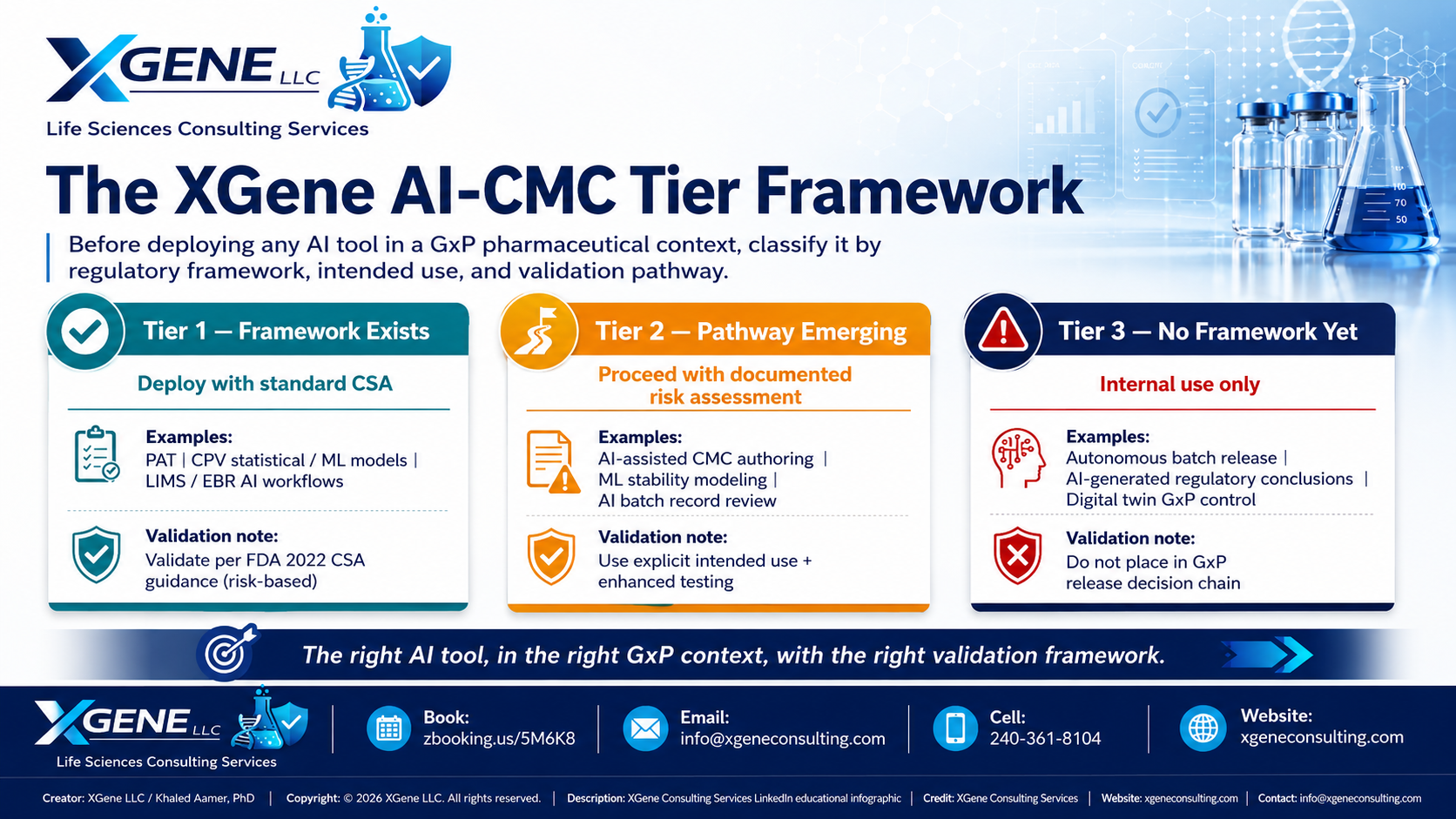
Before your team deploys any AI tool in a GxP context:
TIER 1 — FDA Regulatory Framework Exists. Validate per FDA 2022 CSA guidance (risk-based). Do not apply legacy CSV protocols unless site QMS requires it. Examples: PAT tools (FDA PAT Guidance 2004 + ASTM E3066-16), CPV statistical/ML models (FDA 2011 PV Guidance Stage 3), LIMS/EBR AI-assisted workflows (configured platform qualification).
TIER 2 — Regulatory Pathway Emerging. Validate with documented risk assessment and explicit intended use specification. Apply GAMP 5 Second Edition with enhanced testing for GxP decision-support functions. Examples: AI-assisted CMC authoring and gap analysis, ML-based stability modeling, AI batch record review platforms.
TIER 3 — No Regulatory Framework Yet. Internal use only. Not in GxP decision chain. Document as exploratory. Enhanced change control if outputs inform any regulated activity. Examples: Autonomous batch release, AI-generated regulatory conclusions, digital twin process simulation for GxP control.
For any tier — 5 validation questions to ask every AI vendor:
Is this tool GAMP 5 Category 3, 4, or 5 — and does FDA’s 2022 CSA guidance change that classification?
Does it generate regulatory conclusions or assist a human reviewer in generating them?
Does it maintain a compliant audit trail per 21 CFR Part 11 / EU Annex 11?
Is user access control configurable per 21 CFR Part 11 Section 11.10?
Can it be validated under FDA’s 2022 CSA guidance using a risk-based approach?
The pharma industry is making two opposite mistakes with AI in CMC. Some organizations are deploying machine learning models for process monitoring or OOS prediction without establishing them as validated computer systems under FDA’s 2022 CSA guidance — building sophisticated predictive models in Python or Jupyter notebooks, demonstrating performance on historical data, and deploying them in GxP contexts without a documented intended use specification, audit trail, or change control procedure. When FDA inspects, the model is running and influencing batch release decisions with no evidence of testing against a defined specification — a critical observation on an otherwise functional system. Others are waiting for complete regulatory clarity before deploying anything, and missing PAT tools, CPV statistical models, and LIMS AI features that have had FDA-recognized frameworks for ten to twenty years.
The question is not “is AI compliant in pharma.” The question is: which specific AI tool, for which specific intended use, has which specific regulatory framework — and what does that framework require of your validation program?
Which AI applications in your CMC or manufacturing function fall into Tier 1 (framework exists), Tier 2 (emerging), or Tier 3 (no framework yet)? The answer tells you where your regulatory risk is concentrated — and where your next inspection finding is most likely to come from.