
What FDA’s PQ/CMC Initiative Means for the Future of Structured CMC Submissions
FDA’s PQ/CMC program is developing structured, standardized approaches for selected pharmaceutical-quality information that is currently submitted in CTD Module 3 and Module 2.3. As of August 2026, the HL7 FHIR…
On this pageArticle overview
FDA’s PQ/CMC program is developing structured, standardized approaches for selected pharmaceutical-quality information that is currently submitted in CTD Module 3 and Module 2.3. As of August 2026, the HL7 FHIR implementation guide remains a standards-development effort: Stage 1 is published as STU1, later stages are progressing through testing and ballot/publication steps, and FDA expressly states that those activities do not themselves constitute policy, guidance, or an announcement that FDA accepts or requires the format. The strategic implication is therefore readiness, not premature compliance claims: companies that build governed, reusable CMC data now will be better positioned as structured submission standards mature.
The distinction matters operationally. A pharmaceutical company that responds to PQ-CMC by improving its regulatory writing is solving the wrong problem. A company that responds by rebuilding its CMC data architecture is making an investment that will determine its regulatory review velocity for the next decade.
What PQ-CMC Actually Is — and What It Is Not
PQ-CMC is a structured data standard, not a new content requirement. The science FDA requires for a drug application does not change — specifications, analytical methods, stability data, manufacturing process descriptions remain exactly what they have always been. What changes is the encoding: structured data fields with defined terminologies and FHIR value sets replace free-text narrative in specific Module 3 sections.
A firm submitting a PQ-CMC-compliant drug substance specification section (3.2.S.4) is not submitting different science. It is submitting the same acceptance criteria and test methods in HL7 FHIR R4 format rather than in a PDF table. The regulatory review expectation is identical. The machine-readability of what FDA receives is fundamentally different.
This distinction has a practical consequence that most regulatory affairs teams miss: PQ-CMC implementation is not a regulatory writing project. It is a data architecture project that happens to have a regulatory submission deadline at the end.
Why KASA Changes the Review Equation
KASA — FDA CDER’s Knowledge-Aided Assessment and Structured Application platform — is the reason PQ-CMC matters beyond format compliance. KASA uses structured CMC data from PQ-CMC submissions to run automated consistency checks before a human reviewer opens the file: comparing proposed specifications to historically approved products in the KASA database, flagging acceptance criteria that fall outside established ranges, identifying missing validation data elements, and surfacing cross-section inconsistencies that human reviewers miss in large Module 3 packages.
KASA processes structured data. When a firm submits unstructured PDFs, KASA’s automated checks either cannot run or run on extracted text with materially lower reliability. The review clock starts at the same point for both submission types — but the information available to the reviewer at day one is not the same.
The practical consequence: a KASA-aligned structured submission enters a review workflow where automated pre-screening has already identified gaps and inconsistencies before the human reviewer begins. An unstructured PDF submission does not. The information request that structured pre-screening would have caught before submission surfaces during the review cycle instead.
The Implementation Gap Most Pharmaceutical Companies Have
Implementing PQ-CMC requires three organizational capabilities most pharmaceutical companies do not currently have.
First: a CMC data model that maps internal data fields to the PQ-CMC FHIR R4 value sets and profiles for each published implementation guide section — drug substance (3.2.S), drug product (3.2.P), and co-packaging. Firms that have not aligned their internal CMC data model to ICH Q6A terminology will encounter data mapping failures before they submit a single FHIR resource.
Second: a data authoring workflow that populates structured data fields at the source — not by converting finished PDFs to structured data after the fact. Post-hoc PDF-to-FHIR conversion inherits every data quality problem that exists in the source documents: non-standard terminology, inconsistent value formats, acceptance criteria stated in different units across sections. The PQ-CMC FHIR profiles require controlled vocabularies — NCI Thesaurus, UNII codes, EDQM Standard Terms — and a PDF table formatted for human readability cannot resolve to those vocabularies without a controlled terminology mapping exercise.
Third: technical staff who are fluent in both dimensions simultaneously — the regulatory content requirements (ICH Q6A, Q2(R2), Q1A) and the FHIR implementation specifications well enough to validate the structured output. This dual competency does not currently exist in most pharmaceutical regulatory affairs or CMC functions. It must be built or acquired, and building it takes time that most organizations have not allocated.
The Timeline Reality
FDA’s PQ-CMC pilot phase began accepting voluntary structured submissions in 2020. The voluntary phase has extended as FDA develops remaining implementation guides and builds KASA’s structured data processing capabilities. The implementation guides for drug substance and drug product sections are published at FDA.gov and define the specific FHIR profiles, value sets, and technical requirements for each section with enough specificity that implementation can begin now, without waiting for mandatory requirements.
The transition from voluntary to mandatory structured submission for new NDAs and BLAs — in sections where implementation guides are finalized — is not a speculative regulatory event. It is the direction FDA has set with five years of investment in PQ-CMC infrastructure and KASA development. The parallel eCTD v4.0 transition under ICH M8 will integrate structured PQ-CMC data with the eCTD backbone, making the current eCTD v3.2.2 infrastructure a transitional state, not the endpoint.
The lead time for implementing a CMC data model and FHIR-compliant authoring workflow at a commercial pharmaceutical company is 18–24 months for organizations starting from no structured data foundation. Firms that begin during the voluntary phase arrive at the mandatory transition with a working infrastructure and accumulated pilot submission experience. Firms that wait arrive with a compliance deadline and an 18-month implementation backlog.
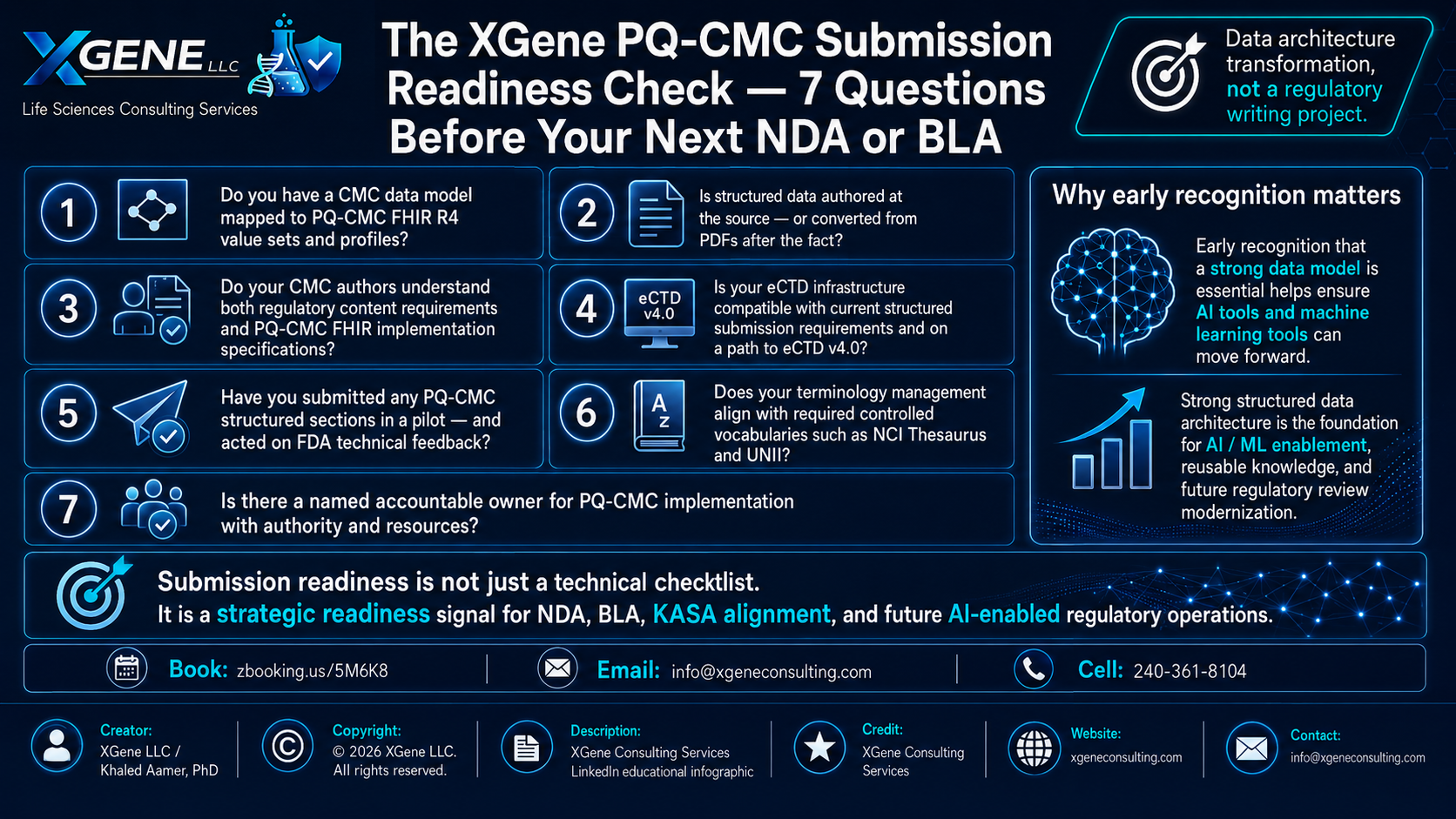
The XGene PQ-CMC Submission Readiness Check — 7 questions before your next NDA or BLA:
Does your organization have a CMC data model that maps internal data fields to PQ-CMC FHIR R4 value sets and profiles for the sections covered by published implementation guides?
Is your data authoring workflow designed to populate structured data fields at the source — or does it produce PDFs that are converted to structured data after the fact?
Do your CMC authors understand both the regulatory content requirements (ICH Q6A, Q2(R2), Q1A) and the PQ-CMC FHIR implementation specifications well enough to validate structured output?
Is your eCTD infrastructure compatible with current eCTD v3.2.2 structured submission requirements and on a defined path toward eCTD v4.0?
Have you submitted any PQ-CMC structured data sections in a pilot submission — and if so, have you documented and acted on FDA’s technical feedback?
Does your terminology and value set management align with the controlled vocabularies required by published PQ-CMC FHIR profiles (NCI Thesaurus, UNII codes)?
Is there a named individual in your CMC or regulatory affairs organization accountable for PQ-CMC implementation — not a project team, but a person with defined authority and resources?
The firms investing in PQ-CMC infrastructure during the voluntary phase are not doing it for regulatory compliance credit. They are doing it because a KASA-aligned submission is a faster, more predictable review — fewer information requests, automated consistency checks that surface problems before the reviewer sees them, and a submission that enters the review workflow with a known quality baseline. The return on investment is not compliance. It is review cycle time, and for a product approaching NDA or BLA filing, review cycle time translates directly to time-to-approval and time-to-revenue.
Regulatory compliance is the floor, not the ceiling. The ceiling is submitting in a format that FDA’s review system was specifically built to process efficiently — and arriving at that mandatory transition having already done it once.
When your regulatory affairs team reviews the published PQ-CMC implementation guides, are they reading them as future compliance requirements — or as the current specification for what your next NDA submission infrastructure should look like? The answer determines whether your organization is 18 months ahead of the transition or 18 months behind it.