
Data Integrity Warning Letter Remediation: Rebuilding Credibility After a GMP Finding
A data integrity Warning Letter is not a documentation problem — it is a credibility crisis, and the difference between companies that recover in 18 months and those that face…
On this pageArticle overview
A data integrity Warning Letter is not a documentation problem — it is a credibility crisis, and the difference between companies that recover in 18 months and those that face import alerts is whether their remediation program rebuilds the evidentiary foundation of their quality system or just fixes the records FDA cited.
That distinction is not rhetorical. It is the operational difference between a remediation program FDA closes out and one that triggers an import alert under FDA’s section 801(a) authority because the agency concluded — on re-inspection or through a desk review of the site’s written response — that the root cause analysis addressed the symptoms visible in the cited observations rather than the governance and cultural conditions that allowed those observations to exist in the first place. Every data integrity Warning Letter I have reviewed in twenty-five years of pharmaceutical GMP and regulatory practice has one structural feature in common: the investigator found not an isolated falsification event but a systemic absence of the controls that would have detected falsification before it became a pattern. The remediation program that responds only to the cited finding has misread the document entirely.
The FDA Data Integrity Guidance Framework: What Constitutes a Data Integrity Finding
FDA’s 2018 Guidance for Industry on Data Integrity and Compliance with Drug CGMP establishes the regulatory expectations that govern what an investigator is evaluating when they issue a data integrity observation. The guidance defines data integrity as the completeness, consistency, and accuracy of data — and it anchors those requirements in the ALCOA+ framework: data must be Attributable, Legible, Contemporaneous, Original, and Accurate, with the “+” attributes of Complete, Consistent, Enduring, and Available. What is critical to understand about this framework is that it is not a documentation standard alone. It is a quality governance standard. When FDA cites 21 CFR 211.68 — the regulation requiring that automatic, mechanical, and electronic equipment be maintained, calibrated, and checked according to a written program — in the context of a data integrity finding, the citation is not about the equipment. It is about the absence of a functioning system that would detect whether the equipment was being used to generate, store, and retrieve authentic, unadulterated records.
The 2018 guidance is explicit that data integrity failures occur along a spectrum ranging from unintentional error to deliberate falsification, and that FDA’s remediation expectations differ accordingly. For sites where the investigation determines that data manipulation was intentional — audit trail backdating, peak integration manipulation in chromatography data systems, selective deletion of out-of-specification results — the agency’s close-out criteria are substantially more demanding than for sites where the failure was a governance gap that permitted error without detection. The MHRA GMP Data Integrity Definitions and Guidance (2018) reinforces this framework and is instructive for sites that supply both US and EU markets: the MHRA explicitly states that the absence of data integrity controls, rather than confirmed manipulation, is itself a GMP failure. That framing matters for scope determination. A remediation program that addresses only confirmed manipulation events has already underscoped the required corrective action.
The regulatory citations in a data integrity Warning Letter almost always cluster around three CFR provisions in addition to 211.68: 21 CFR Part 11 (electronic records and electronic signatures), 21 CFR 211.68 (automated systems controls), and 21 CFR 211.180 and 211.192 (records requirements and laboratory controls). When all three appear together, the investigator is communicating something specific: the site lacks the technical infrastructure to ensure that electronic records are authentic and unaltered, lacks the operational controls to ensure that laboratory results reflect actual testing outcomes, and lacks the governance framework to ensure that management would have known if either condition had been compromised. A Warning Letter carrying that citation cluster requires a remediation response that addresses all three dimensions simultaneously. Addressing any one in isolation will not satisfy the agency’s close-out criteria.
Audit Trails, LIMS, and the Paper Backup: Where Integrity Failures Hide
The most common structural vulnerability in pharmaceutical data systems is not the system that an investigator can see — it is the shadow system that exists alongside it. Paper backup logs maintained outside the LIMS. Standalone spreadsheets used for in-process calculations before data entry into the validated system. Chromatography workstations with user-level access to integration parameters after peak acquisition. Secondary accounts with administrative privileges not reflected in the access control matrix. These shadow systems emerge not from deliberate fraud planning but from operational pressure: an analyst who finds the validated system too slow, a supervisor who needs a summary report the LIMS does not generate, a method that requires manual calculation steps the system was not configured to automate. The existence of the shadow system is a governance failure even before a single data point is altered. And FDA investigators, particularly those trained on the agency’s post-2012 data integrity enforcement campaign, know exactly where to look for them.
The WHO Technical Report Series No. 996 Annex 5 (2016) provides the clearest guidance on the technical controls that constitute a functioning data integrity architecture: unique user identification and authentication, time-stamped audit trails that cannot be disabled by operators, controlled access to raw data with read-only permissions for completed runs, validated backup and recovery procedures, and documented periodic review of audit trail records by qualified supervisors. A site that has implemented all five of these controls for its primary analytical systems has materially reduced its data integrity risk. The sites that receive Warning Letters have typically implemented most of them, but with gaps: audit trails enabled but not reviewed, backup procedures validated but not tested for recovery completeness, access controls documented in policy but not enforced at the system configuration level. FDA’s investigators test the gaps between documented policy and operational reality. The retrospective data review that a remediating site must conduct is designed to determine how long those gaps were open and what passed through them.
The retrospective data review is the technical heart of a data integrity remediation program and the component most frequently executed inadequately. A credible retrospective review must be risk-stratified across a defined lookback period — typically six to eighteen months from the date of the cited observation, extended further if the investigation determines that the control failure predates the observation window. It must cover all data systems within the scope of the Warning Letter, not only the systems specifically named in the cited observations. And it must be executed by personnel who are independent of the data creation activity under review — a requirement that cannot be satisfied by having the same laboratory team review its own chromatography records. Sites that conduct retrospective reviews using internal staff who generated the records under review have produced a document FDA will not accept as an independent verification, regardless of how thoroughly the review was conducted.
Why Data Integrity Remediation Requires a Quality Culture Intervention, Not Just Technical Controls
The failure mode that converts a manageable Warning Letter response into an import alert situation is not technical inadequacy — it is the organizational assumption that data integrity remediation is a compliance project rather than a quality culture intervention. FDA has been explicit about this in guidance and in public communications from CDER and CDRH leadership: when an agency investigator returns to a site that received a data integrity Warning Letter and finds that the audit trails are now functioning and the access controls are now documented but the same management team is in place with no structural changes to oversight, accountability, or quality culture, the re-inspection finding is predictable. Technical controls that are implemented without the organizational accountability structure to sustain them do not survive the next operational pressure event. The original shadow system was created because a process pressure existed. If the process pressure is still there, the shadow system will be recreated.
The cultural indicators FDA evaluates on a data integrity re-inspection are documented in the agency’s own guidance and in the body of enforcement actions following Warning Letters: Does management conduct and document periodic review of audit trail records, or are those reviews delegated entirely to analysts? Is there a documented escalation pathway for data anomalies that bypasses the supervisor who may have been aware of the original failure? Has the site changed the organizational reporting structure for quality oversight — or did the same quality director who was present during the observation period sign the remediation CAPA? Has training moved beyond procedure-reading acknowledgment to demonstrated competency verification, including scenario-based exercises in which analysts are presented with actual audit trail anomalies and asked to identify them? Training that consists only of procedure sign-off is the single most consistently cited inadequacy in FDA’s assessment of data integrity remediation programs. The agency does not credit it as a cultural remediation measure because it is not one.
The import alert trigger — inadequate response within approximately twelve months of the Warning Letter issuance — is not a mechanical deadline. It is FDA’s assessment that a site has failed to demonstrate credible progress toward a state of control. Sites that receive import alerts following data integrity Warning Letters have almost uniformly made the same set of errors: they submitted a remediation plan that committed to system implementation timelines that were not met, they conducted a retrospective data review that was not independent, and they did not establish the quality management infrastructure — dedicated data integrity oversight function, audit trail review schedule, periodic data review by senior quality leadership — that the agency expects to see as a permanent operational feature of the quality system. Recovery from that point requires, in most cases, a voluntary recall evaluation, an FDA meeting request, and a substantially more intensive engagement than the original Warning Letter response required.
The XGene Data Integrity Restoration Program: Six-Pillar Methodology from Finding to Sustainable Compliance
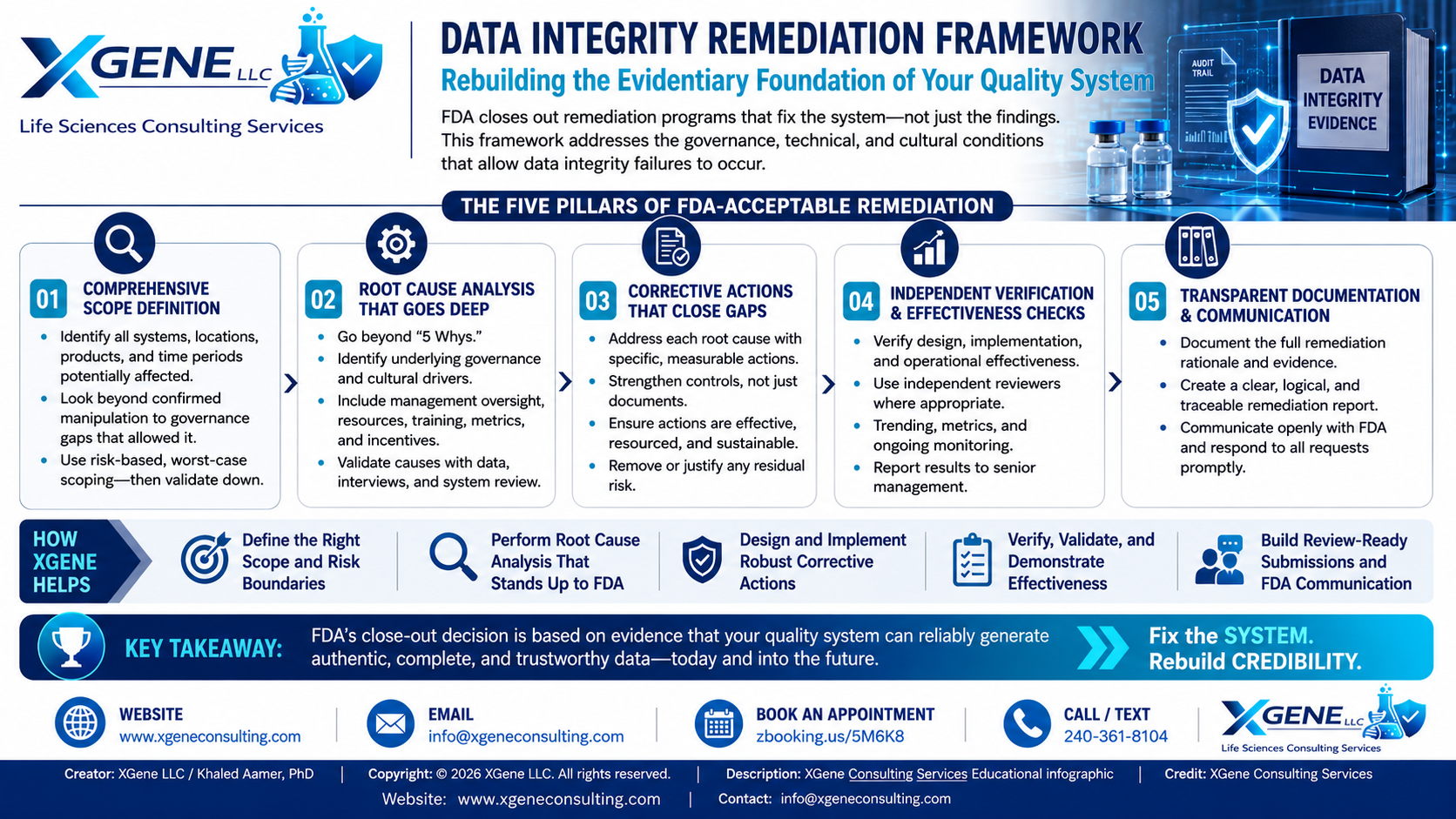
The XGene Data Integrity Restoration Program is a structured six-pillar methodology for pharmaceutical sites navigating data integrity Warning Letter remediation. It is designed to satisfy FDA’s close-out criteria within eighteen months while building the quality system infrastructure that prevents recurrence.
1. Organizational Accountability Restructuring: Within thirty days of Warning Letter receipt, establish a dedicated Data Integrity Remediation Committee with direct executive sponsorship, independent reporting to the Board or CEO function, and a charter that explicitly separates quality oversight authority from the operational management chain implicated in the original finding. This is not a procedural requirement — it is a governance signal FDA reads at re-inspection.
2. Technical Controls Implementation and Validation: Audit and remediate all electronic data systems within the Warning Letter scope against the WHO TRS 996 Annex 5 technical control checklist: unique user authentication, tamper-evident audit trails with supervisor review, read-only access to completed raw data, validated backup and recovery, and periodic audit trail review documentation. All technical remediations must be validated and the validation records must be available for FDA review.
3. Procedural Redesign: Rewrite all data management SOPs from the ALCOA+ framework down — not as updates to existing procedures but as fresh documents that reflect how data is actually generated, reviewed, and stored in the current operational environment. A procedural document that describes a process the laboratory does not actually follow is a data integrity observation waiting to be written on the next inspection.
4. Risk-Stratified Retrospective Data Review: Conduct a retrospective review covering a minimum of twelve months prior to the cited observation for all data systems and product families within the Warning Letter scope. Use a defined, documented risk stratification methodology to identify which records require full re-review versus statistical sampling review. All review activities must be conducted by personnel independent of the original data creation. The output is a written summary that either confirms data integrity across the review period or identifies the scope of affected records requiring regulatory notification.
5. Independent Verification: Engage a qualified third party — not affiliated with the site’s current quality or regulatory leadership — to independently verify the technical control implementation, the retrospective data review methodology, and the procedural redesign outputs before the formal FDA response or re-inspection. Independent verification is not optional. It is the single most credible signal a site can provide to FDA that the remediation was conducted with the rigor the agency’s close-out criteria require.
6. FDA Communication Strategy: From the initial written response through each subsequent communication, maintain a posture of proactive transparency: acknowledge the systemic nature of the failure explicitly, provide milestone updates without being asked, and do not commit to timelines the site cannot verify are executable. Overpromising on remediation timelines and then missing them is the most common single factor in Warning Letter escalations to import alerts.
Data integrity remediation is the most consequential regulatory recovery exercise a pharmaceutical site can undertake — not because the technical fixes are uniquely difficult, but because the agency’s evaluation of the response is holistic. FDA is not checking whether your audit trails are enabled. It is evaluating whether the organization that allowed those audit trails to be disabled, ignored, or manipulated has fundamentally changed the governance conditions that permitted that situation to exist. The sites that recover in eighteen months are the ones that understood that distinction on the first day after the Warning Letter arrived and built their remediation program accordingly.