
FDA 483 Equipment and Facilities — What Inspectors Actually Document
FDA equipment and facilities 483 observations are rarely about whether the equipment works — they are almost always about whether the documentation demonstrates that the equipment has been qualified, maintained,…
On this pageArticle overview
FDA equipment and facilities 483 observations are rarely about whether the equipment works — they are almost always about whether the documentation demonstrates that the equipment has been qualified, maintained, and cleaned in a manner that ensures it cannot be a source of contamination, cross-contamination, or product quality variability.
That sentence captures the consistent pattern across FDA’s equipment and facilities inspection observations under 21 CFR 211.63 through 211.68, and it points directly to the structural problem most pharmaceutical manufacturers carry into every inspection cycle: equipment qualification programs that were designed for the installation event and were never architected to manage the ongoing qualification lifecycle. The qualification package that cleared the FDA pre-approval inspection five years ago has not been updated for the process changes, maintenance events, and calibration variances that have accumulated since. The cleaning validation that was filed with the original application calculates MACO for the original product suite but has never been extended to the two additional products introduced in subsequent supplements. The facility’s HVAC systems were qualified at commissioning under a cleanroom certification that has not been formally requalified in three annual cycles. When an FDA investigator walks the floor, they are not testing whether the equipment produces the right output. They are auditing whether the documented qualification status accurately represents the current state of the equipment and the current risk to product quality. In most facilities, that audit finds a gap — sometimes several of them — that has been accumulating invisibly for years.
What FDA Investigators Look for in Equipment and Facility Inspections
The operative regulatory framework for equipment and facilities inspections is built around three interlocked requirements. 21 CFR 211.63 requires that equipment used in the manufacture, processing, packing, or holding of a drug product be of appropriate design, adequate size, and suitably located to facilitate operations for its intended use and for its cleaning and maintenance. 21 CFR 211.65 adds the material construction requirement — equipment surfaces that contact components, in-process materials, or drug products must not be reactive, additive, or absorptive in a way that alters the safety, identity, strength, quality, or purity of the product. And 21 CFR 211.67 establishes the cleaning and maintenance requirement: written procedures for cleaning and maintenance, records of the cleaning and maintenance performed on each piece of equipment, and a validation basis for the cleaning procedures used on equipment shared between different products.
What investigators document under these regulations is not failure of the equipment itself. It is failure of the paper trail that should exist if these requirements have been continuously satisfied. The inspection pattern begins with the equipment master list — a facility document that most quality organizations maintain with inconsistent fidelity. An investigator working through an equipment and facilities inspection will typically request the equipment master list, cross-reference it against the equipment physically present on the manufacturing floor, and then begin pulling qualification documentation for the highest-risk systems: coating pans, fluid bed dryers, granulation equipment, HVAC systems supporting controlled environments, and any equipment shared between product lines or with direct product contact in sterile or highly potent manufacturing contexts. The first observation pattern that emerges in this review is not missing qualification documentation. It is qualification documentation that has not been updated to reflect the current state of the equipment — qualification packages that describe original installation parameters while the equipment has been relocated, repaired, modified, or operated under process conditions that were not part of the original qualification scope.
The ISPE Baseline Guide Vol. 5: Commissioning and Qualification (C&Q) describes the equipment qualification lifecycle as a continuous management discipline, not a one-time installation event. The lifecycle begins at Design Qualification, where the user requirements specification and design criteria are reviewed against intended use. Installation Qualification documents that the equipment was installed correctly against those specifications. Operational Qualification confirms that the equipment operates within defined limits across its intended operating range. Performance Qualification demonstrates that the equipment performs consistently under actual process conditions. And then — the step that most facilities execute poorly — Requalification confirms that the equipment continues to perform at the original qualification standard following any change to the equipment, the process, the facility, or the operating environment that could affect that performance. FDA investigators are trained to identify the gap between the last PQ and the current operating state. That gap is where most equipment and facilities 483 observations originate.
The requalification trigger framework is where systemic failures concentrate. Under a risk-based approach consistent with ICH Q9(R1), requalification is triggered by equipment relocation, major repair or replacement of a qualified component, calibration failure outside the established acceptance criteria, a process change that alters the equipment’s operating range, and the passage of time beyond the established requalification interval — typically evaluated on an annual basis for critical process equipment. Most facilities have a written requalification trigger procedure. Most of those procedures are not consistently enforced. Maintenance departments log repairs without consulting the qualification status owner. Process changes go through change control that does not systematically assess requalification scope. Calibration out-of-tolerance results are addressed through recalibration without triggering a formal assessment of whether results generated during the out-of-tolerance period are affected. When an investigator pulls the change control records, the maintenance logs, and the calibration history for a piece of critical equipment and compares them against the requalification record, the gaps are almost always evident.
Cleaning Validation Deficiencies: The Specific Evidence Gaps That Generate 483 Observations
Cleaning validation under 21 CFR 211.67 is one of the most technically demanding and consistently mismanaged components of the equipment lifecycle program. The regulation requires written procedures for the cleaning and maintenance of equipment, and FDA’s 1993 Guidance on Equipment Cleaning Validation operationalizes that requirement into a framework that most facilities have partially implemented — enough to pass a first approval inspection — and then failed to maintain as the product portfolio and manufacturing operations evolved.
The foundational technical requirement is the Maximum Allowable Carryover calculation: for every equipment-product combination used in shared equipment manufacturing, the MACO must be calculated to demonstrate that residual active pharmaceutical ingredient from a prior product cannot contaminate the subsequent product at a level that presents a safety or quality risk to the patient. The MACO calculation is based on the therapeutic daily dose of the prior product, the minimum batch size of the subsequent product, and a safety factor — typically 1/1000 of the No Observed Effect Level — that reflects the toxicological margin between a therapeutic dose and an unacceptable residue level. FDA’s 1993 guidance establishes the conceptual framework; the specific calculation method and the acceptance criterion basis must be documented in the validation protocol and justified scientifically. The observation that FDA investigators write most frequently in this area is not that the MACO was calculated incorrectly. It is that the MACO was calculated for the original product suite at validation and has never been extended to products added to the shared equipment train after the initial validation was completed. A facility that introduces a new product with a lower therapeutic daily dose or a narrower safety margin than the original validation products has silently invalidated the cleaning validation basis for every equipment item in the shared train — without a single change control record to show that the gap was identified or assessed.
The second cleaning validation failure pattern that generates 483 observations is the “visually clean” standard used as a surrogate for analytical verification. The 1993 FDA guidance is explicit: visual inspection alone is not an adequate demonstration of cleaning effectiveness for product contact equipment. Analytical methods — typically HPLC or TOC analysis for API residues — must be capable of detecting residues at the MACO acceptance criterion level, and the detection limit of the analytical method must be demonstrated to be at or below the acceptance criterion. When facilities use swab sampling and visual inspection without an analytical method validated to detect residues at the relevant concentration, the cleaning validation does not demonstrate what it claims to demonstrate. Investigators who pull cleaning validation protocols and find acceptance criteria documented as “visually clean” or analytical methods with detection limits above the MACO threshold write observations that are difficult to close without complete remediation of the validation basis.
The third pattern is equipment use log deficiencies. 21 CFR 211.67 requires records of the cleaning and maintenance of equipment, and the equipment use log is the document that connects the batch manufacturing record to the cleaning execution record. When equipment use logs are incomplete — missing batch numbers, missing cleaning dates, missing cleaning agent lot numbers, or unsigned by the operator who performed the cleaning — the chain of evidence connecting the validated cleaning procedure to the specific equipment preparation for a specific batch is broken. An investigator reviewing batch records for a product manufactured on shared equipment will cross-reference the equipment use log as a matter of standard practice. Gaps in that log create ambiguity about whether the validated cleaning procedure was executed before the batch in question was manufactured — and ambiguity about product protection from cross-contamination is the exact concern the regulation was written to address.
HVAC qualification and cleanroom environmental monitoring represent the facility-side complement to the equipment-side qualification gaps. ISO 14644-1 establishes the classification criteria for cleanrooms and clean zones, and FDA expects periodic requalification of cleanroom classification — typically annually — along with continuous monitoring of the environmental parameters (pressure differentials, viable and non-viable particle counts, temperature, and humidity) that determine whether the classified environment is maintained throughout manufacturing operations. When environmental monitoring data shows pressure differential excursions that were recorded and not investigated, or when the annual cleanroom classification requalification has lapsed without a documented risk assessment explaining the extension, the investigator’s observation writes itself.
Equipment Qualification and Maintenance Programs: Where Documentation Fails
The documentation failure that links equipment qualification observations to Warning Letter escalation is not a single missing document. It is the accumulated evidence, visible in the qualification record set as a whole, that the facility’s equipment qualification program operates as a series of independent installation events rather than as a managed lifecycle discipline. An investigator reviewing the qualification history for a fluid bed dryer over a five-year period will notice that three major filter replacement events appear in the maintenance log, none of which triggered a requalification assessment. They will find a change control record authorizing a process change from wet granulation to a higher inlet air temperature range, with no documented assessment of whether the existing PQ scope covered the new operating parameters. They will find two calibration out-of-tolerance events for the inlet air temperature sensor — both resolved by recalibration without any assessment of whether batches manufactured during the out-of-tolerance period require additional review. And they will find a requalification document dated four years prior, at initial installation, that has never been updated.
Under 21 CFR 211.68, automatic, mechanical, and electronic equipment used in manufacturing and processing must be routinely calibrated, inspected, or checked according to a written program designed to assure proper performance, and records of those activities must be maintained. The maintenance integration requirement is the point where most equipment programs fall structurally short. Qualification and maintenance operate as separate management disciplines in most facilities — qualification owned by quality or validation, maintenance owned by engineering or facilities — with change control as the theoretical bridge between them. When that bridge is not actively managed, maintenance events that should trigger requalification assessments go unassessed, and the documented qualification status diverges progressively from the actual operating state of the equipment. The qualification document says the equipment is qualified. The maintenance log says the equipment has been significantly modified. Neither document acknowledges the other. An experienced FDA investigator finds both documents in the same inspection and writes an observation that neither department can independently defend.
USP <1058> provides the analytical instrument qualification framework that governs laboratory equipment within the same lifecycle model, and the consequences of instrument qualification gaps in the laboratory context mirror those in the manufacturing context: every analytical result generated on an instrument during a qualification gap is potentially suspect, and the batch disposition decisions made on the basis of those results may require retrospective review. The connection between laboratory instrument qualification and manufacturing equipment qualification in the same inspection creates a compounding observation pattern — one in which the investigator can demonstrate that qualification lifecycle management has failed both in the manufacturing environment and in the analytical environment supporting it.
Building an Equipment and Facility Qualification Program That Survives PAI
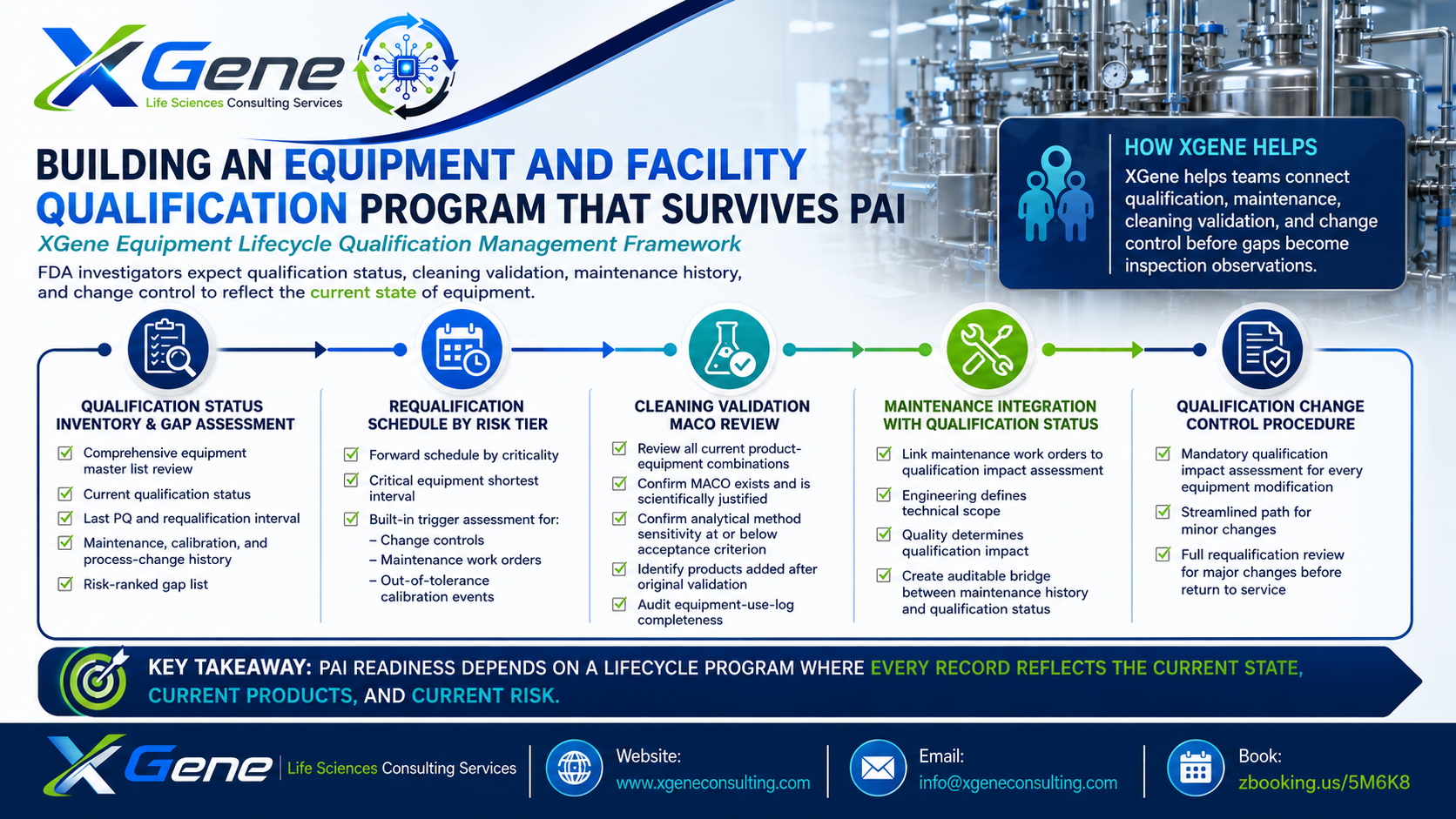
The XGene Equipment Lifecycle Qualification Management Framework is a structured qualification status management program built against the specific observation patterns that FDA investigators document under 21 CFR 211.63 through 211.68. It operates across five integrated workstreams designed to close the gap between documentation of qualification status and the actual current state of equipment in the facility.
Workstream 1 — Qualification Status Inventory and Gap Assessment: The framework begins with a comprehensive equipment master list review that captures, for every piece of equipment in the manufacturing and laboratory environment, the current qualification status, the date of the most recent completed PQ, the documented requalification interval, and any maintenance events, calibration events, or process changes that have occurred since the last requalification. The gap assessment identifies equipment where the documented qualification status does not accurately reflect the current operating state — equipment that has been modified, relocated, or operated outside its qualified parameters without a requalification on record. The inventory output is a risk-ranked gap list that prioritizes remediation by product contact criticality, sterility risk, and proximity to the next planned regulatory inspection.
Workstream 2 — Requalification Schedule by Risk Tier: Based on the gap assessment, a forward requalification schedule is established that assigns requalification intervals by risk tier — critical manufacturing equipment with direct product contact at the shortest interval, non-critical ancillary equipment at extended intervals supported by documented risk justification. The schedule is managed as a living document with built-in requalification trigger assessment workflow: every change control record, every maintenance work order above a defined complexity threshold, and every calibration out-of-tolerance result routes automatically to a requalification scope assessment before the event is closed.
Workstream 3 — Cleaning Validation MACO Review for All Product-Equipment Combinations: The cleaning validation component of the framework conducts a matrix review of all product-equipment combinations currently in use against the existing cleaning validation documentation. For each combination, the review confirms that a MACO calculation exists, that the MACO was calculated using the correct therapeutic daily dose and batch size parameters for the current product formulations, and that the analytical method used for residue monitoring has a validated detection limit at or below the MACO acceptance criterion. Products added to the shared equipment train after the original cleaning validation are identified and scheduled for cleaning validation extension before the next manufacturing campaign. Equipment use log completeness is audited against the written procedure, and gaps are corrected through a structured back-review and SOP enforcement program.
Workstream 4 — Maintenance Integration with Qualification Status: The maintenance integration workstream restructures the interface between the maintenance work order system and the qualification status record so that maintenance events triggering a requalification assessment cannot be closed without documented qualification scope determination. Engineering and quality hold shared accountability for the assessment — engineering defines the technical scope of the repair or modification, quality determines whether the change affects the parameters documented in the existing qualification record. The outcome of every assessment is documented in the change control record and the equipment qualification file, creating an auditable bridge between maintenance history and qualification status.
Workstream 5 — Qualification Change Control Procedure: The change control procedure governing equipment modifications is revised to include a mandatory qualification impact assessment step that cannot be bypassed regardless of the magnitude of the change. Minor changes receive a streamlined impact assessment with a documented conclusion of no requalification required or requalification required with defined scope. Major changes trigger a full requalification protocol review and approval before the modified equipment is returned to service. The procedure maps directly to the 483 observation types most commonly generated in equipment and facilities inspections — ensuring that no maintenance event, process change, or environmental excursion advances past the change control system without a documented qualification status determination.
The output of the XGene Equipment Lifecycle Qualification Management Framework is a qualification record set in which every document accurately represents the current state of the equipment it describes, every cleaning validation covers every product-equipment combination in current use, and every maintenance and calibration event has a documented qualification status assessment on record. That is the standard FDA investigators expect to find when they walk the floor — and it is the standard that determines whether the inspection closes as a voluntary action indicated or advances to regulatory action.
The thesis that runs through every equipment and facilities 483 observation is the one stated at the outset: the equipment usually works. The documentation that should demonstrate it works consistently, cleanly, and under qualified conditions is what fails the inspection. Qualification programs designed for a single installation event and never managed as a lifecycle discipline will accumulate the observable gaps — in requalification records, in cleaning validation matrices, in maintenance logs, in environmental monitoring data — that an experienced FDA investigator is specifically trained to find. The cost of those gaps is not a single 483 observation. It is the retroactive review of every batch manufactured on out-of-qualification equipment, the cleaning validation remediation that delays the next manufacturing campaign, and the qualification program rebuild that consumes six to twelve months of resource before the next inspection can proceed with confidence.