
Inspection Readiness — The 90-Day CMC Preparation Framework
The companies that perform best in FDA inspections are not the ones that scramble in the two weeks before the investigator arrives — they are the ones that maintain inspection-ready…
On this pageArticle overview
The companies that perform best in FDA inspections are not the ones that scramble in the two weeks before the investigator arrives — they are the ones that maintain inspection-ready documentation every day of the year, and treat the 90 days before an anticipated inspection as a verification exercise, not a remediation sprint.
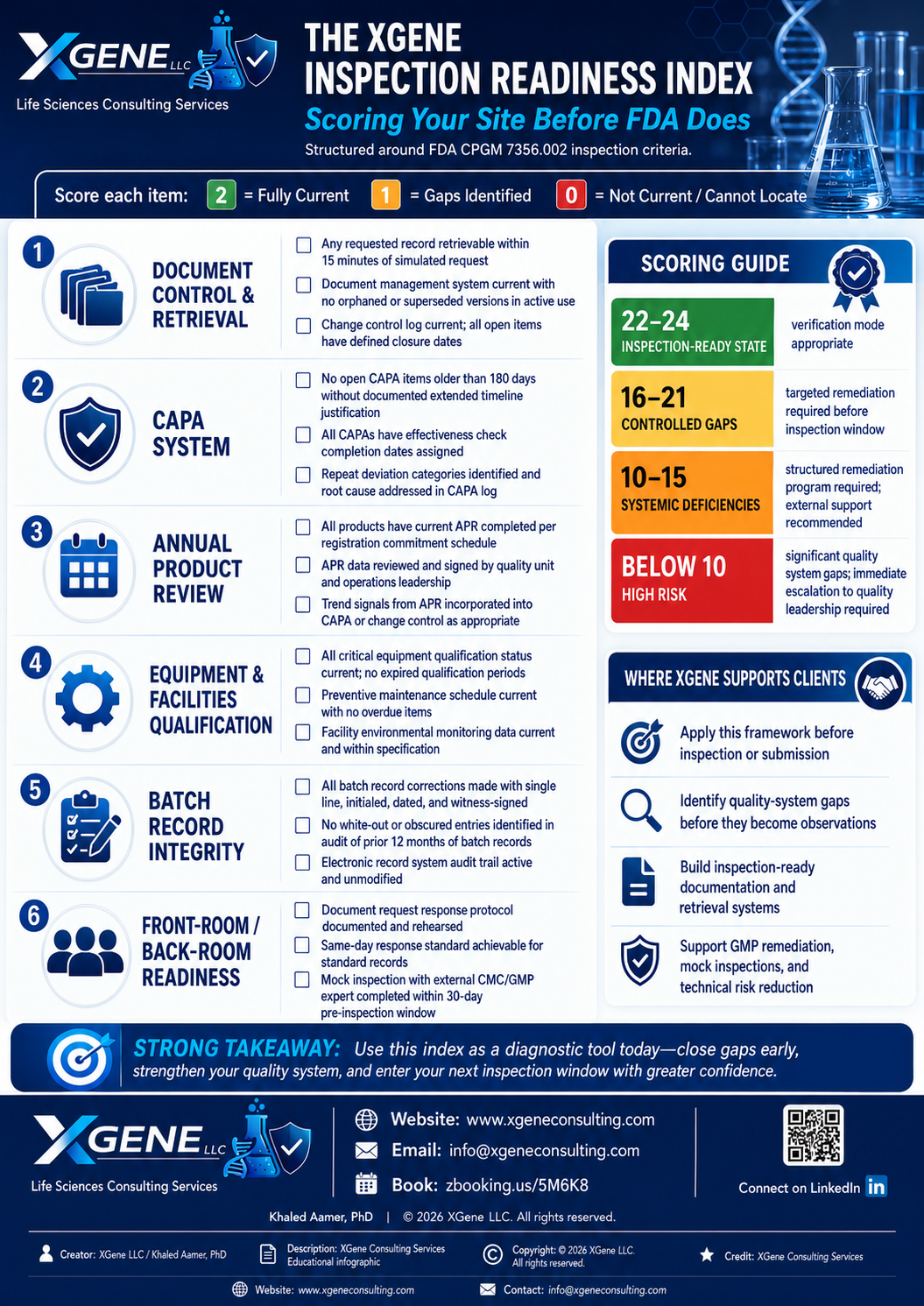
That distinction sounds simple. In practice, it separates sites that routinely achieve Voluntary Action Indicated status from sites that accumulate 483 observations that were entirely preventable and entirely predictable.
Inspection readiness is not an event — it is a quality system state. The companies that achieve the best inspection outcomes treat their 90-day pre-inspection window as a structured verification program against the exact criteria FDA investigators use, not a document-gathering exercise driven by anxiety about what might be found.
What FDA Investigators Are Trained to Find in the First 90 Minutes of an Inspection
Before a single batch record is opened, a trained FDA investigator executing a Drug Manufacturing Inspection under CPGM 7356.002 is already forming a systems-level assessment of your site. The opening conference is not a courtesy — it is an intelligence-gathering exercise. The investigator is listening for how leadership describes the quality system, watching whether the quality unit and operations personnel tell the same story, and calibrating how long the inspection will need to run. Standard drug manufacturing inspections run two to five days, but sites that communicate poorly in the first 90 minutes often find themselves on the longer end of that window, with progressively deeper document requests following.
What the FDA’s New One‐Day Inspectional Assessments Mean for Your Site
In May 2026, the FDA announced a pilot program for one‐day inspectional assessments – shorter, focused screening visits designed to complement, not replace, the standard 2‐5 day drug manufacturing inspections. The agency has already completed approximately 46 such assessments, with most resulting in No Action Indicated (NAI) outcomes. This pilot does not change enforcement policy, nor does it apply to higher‐risk or more complex facilities that require comprehensive inspectional coverage. Investigators retain the authority to extend the assessment beyond one day if significant observations are identified.
For CMC and quality leaders, the announcement answers a critical question: does the 90‐day preparation framework still apply? The answer is yes – for the facilities that will continue to receive standard 2‐5 day inspections, the full 90‐day verification program remains the gold standard. For sites that may be selected for a one‐day screening assessment, the same foundational readiness principles apply: document retrieval within 15 minutes, a current CAPA log with justified timelines, an up‐to‐date annual product review, and a front‐room team that understands how to respond to investigator requests without volunteering unintended scope.
The difference is not what to prepare, but how quickly . A one‐day assessment may arrive with less notice; the preparation window could be compressed from 90 days to a matter of weeks or days. The FDA is using risk‐based criteria – product type, prior inspection outcomes, operational characteristics – to select facilities. That means a site with a clean VAI history and stable operations could be chosen for a one‐day screening at any time. The only reliable defense is to maintain inspection‐ready documentation every day of the year , exactly as the article’s opening paragraph states.
Importantly, the pilot does not weaken the agency’s scrutiny. The same CAPA log, batch record corrections, and electronic audit trail reviews that trigger 483 observations in a full inspection will trigger findings in a one‐day assessment. The difference is the scope and duration, not the evidentiary standard. Facilities that rely on a 90‐day “sprint” to fix known gaps will remain vulnerable; facilities that embed readiness into their quality system will pass both a 5‐day inspection and a 1‐day assessment with equal confidence.
For now, the 90‐day framework below remains the appropriate planning tool for standard inspections. But the FDA’s pilot is a signal: the agency is increasing its surveillance footprint, and sites should expect more frequent, shorter assessments – not fewer. The question is not whether your site will be visited, but whether your documentation room can answer every request within 15 minutes on any given day.
The first document requests almost always target the same categories: the annual product review status, the CAPA log, and any deviations opened in the prior six months. This is not coincidental. These three categories are the diagnostic pulse of a quality system operating under 21 CFR Part 211. An annual product review that is overdue tells the investigator immediately that management review of quality data is not functioning as designed. A CAPA log with open items older than 180 days, with no documented extended timeline justification, communicates that the organization does not have effective management oversight of its own corrective action commitments — which is precisely the language FDA uses when escalating from observations to Warning Letters. A deviation log populated with repeat event categories tells the investigator where to drill.
The most dangerous moment in any inspection occurs when an investigator requests a specific document — a qualification record, a change control package, a stability protocol amendment — and the back room cannot locate it within 30 minutes. At that point, the inspection dynamic shifts. The investigator’s hypothesis changes from “this is a site with typical gaps” to “this is a site that may have a document control problem,” and everything that follows is evaluated through that lens. Under ICH Q10, the pharmaceutical quality system is explicitly required to ensure the availability and retrievability of data that supports product knowledge and process understanding. A retrieval failure is not a filing problem. It is a quality system problem.
The 90-Day CMC Preparation Window: What to Build, Sequence, and Evidence
The XGene 90-Day Inspection Readiness Verification Program structures pre-inspection activity into three sequential phases, each aligned to what FDA investigators actually examine under CPGM 7356.002 rather than to internal assumptions about what will be reviewed.
Phase 1 runs from Day 90 to Day 61 and is entirely diagnostic. The objective is a complete document inventory gap assessment across every inspection zone: manufacturing, laboratory controls, quality systems, facilities and equipment, and materials. This phase does not produce polished packages — it produces an honest map of what exists, what is current, what is overdue, and what cannot be located at all. Sites that skip this phase and move directly to evidence assembly are the sites that encounter retrieval failures under investigation. The document retrieval standard that should be applied during Phase 1 is strict: if any requested record cannot be produced within 15 minutes of a simulated request, the retrieval system has a gap that must be addressed before FDA arrives.
Phase 2 runs from Day 60 to Day 31 and shifts from diagnosis to evidence assembly. Each inspection zone identified in Phase 1 is built into a structured package: not a binder of documents, but a coherent evidentiary narrative that connects quality data to quality system effectiveness. Equipment qualification records are confirmed current. The CAPA log is reviewed item by item, and every open item older than 90 days — not 180, because 90 days is where the risk accumulates — must carry a documented extended timeline justification that demonstrates management review and awareness. (While FDA guidance often flags items beyond 180 days as a regulatory red flag, an internally disciplined quality system uses a 90‐day alert threshold to intervene earlier – before the problem becomes a 483 observation.) The annual product review schedule is confirmed against product registration commitments and ICH Q10 requirements. Batch record corrections are audited for the presence of witness signatures, because this is one of the most consistent observations issued during pre-approval and surveillance inspections alike.
Phase 3 runs from Day 30 to Day 1 and is operationally focused. This is the phase where the work done in Phases 1 and 2 is stress-tested against actual investigator behavior. A mock FDA inspection conducted by an external CMC and GMP expert — someone who has sat across the table from investigators, not someone reading from an internal checklist — is the single highest-value activity a site can execute in this window. The mock inspection must replicate the pressure and sequencing of a real inspection: opening conference, systems-based document requests, back-room retrieval testing, and a formal closeout with an honest 483-equivalent observation list. FDA guidance under the cGMPs for the 21st Century — A Risk-Based Approach (2004) established explicitly that FDA would conduct risk-based inspections focused on systems, not products. Sites whose mock inspections focus only on product-specific documentation routinely underperform in real inspections that open with quality system queries.
Front-room personnel — typically the quality director and whoever accompanies the investigator — must be trained not just on content but on protocol. The standard for responding to document requests is same-day delivery for standard records and next-morning delivery for complex regulatory packages. Every minute beyond those benchmarks increases investigator suspicion and the probability of additional document requests in adjacent areas.
The Back Room and Front Room Dynamic: Why Preparation Fails in Execution
The most common failure mode in inspection preparation is not inadequate documentation. It is the disconnect between what the back room has assembled and what the front room communicates. Sites routinely invest significant effort in building inspection packages and then lose inspection outcomes because the front-room representative answers a question in a way that triggers a follow-on request the back room was not prepared to support.
Under FDA’s established Manual of Policies and Procedures (MAPP) framework, the agency has formalized guidance on inspection conduct and communications. The implication for sites is clear: the investigator is operating within a defined framework, and sites that understand that framework can navigate it effectively. Sites that treat the inspection as an adversarial encounter — withholding context, providing minimal answers, escalating to legal counsel prematurely — routinely generate the very suspicion they are attempting to avoid.
The front-room and back-room protocol must be designed, documented, and rehearsed. The back room needs a real-time communication channel with the front room, a document tracking log that records every request and response time, and a clear escalation protocol for requests that cannot be answered from existing packages. The front room needs to understand the difference between answering the question asked and volunteering information that opens new inquiry lines.
This is not a compliance exercise. It is a strategic discipline, and the sites that execute it consistently — not just in the 30 days before an inspection, but as an embedded quality system practice — are the sites that walk out of inspections with No Action Indicated or Voluntary Action Indicated classifications and maintain the regulatory standing that makes everything else in pharmaceutical operations possible.
Pull your CAPA log today and identify every open item older than 90 days — does each have a documented extended timeline justification that FDA would accept as evidence of management oversight rather than neglect?