
Post-Approval CMC Changes: Why ICH Q12 Is Not an Administrative Framework — It Is a Commercial Strategy
The approval of a new drug application is not the end of CMC regulatory work — it is the beginning of a decades-long change management challenge. The most expensive regulatory…
On this pageArticle overview
The approval of a new drug application is not the end of CMC regulatory work — it is the beginning of a decades-long change management challenge. The most expensive regulatory decisions in pharmaceutical product lifecycles are made post-approval, when manufacturing changes, site transfers, process improvements, and analytical method updates must be classified, justified, and reported. ICH Q12, finalized in 2019, provides the framework. Most organizations are not using it.
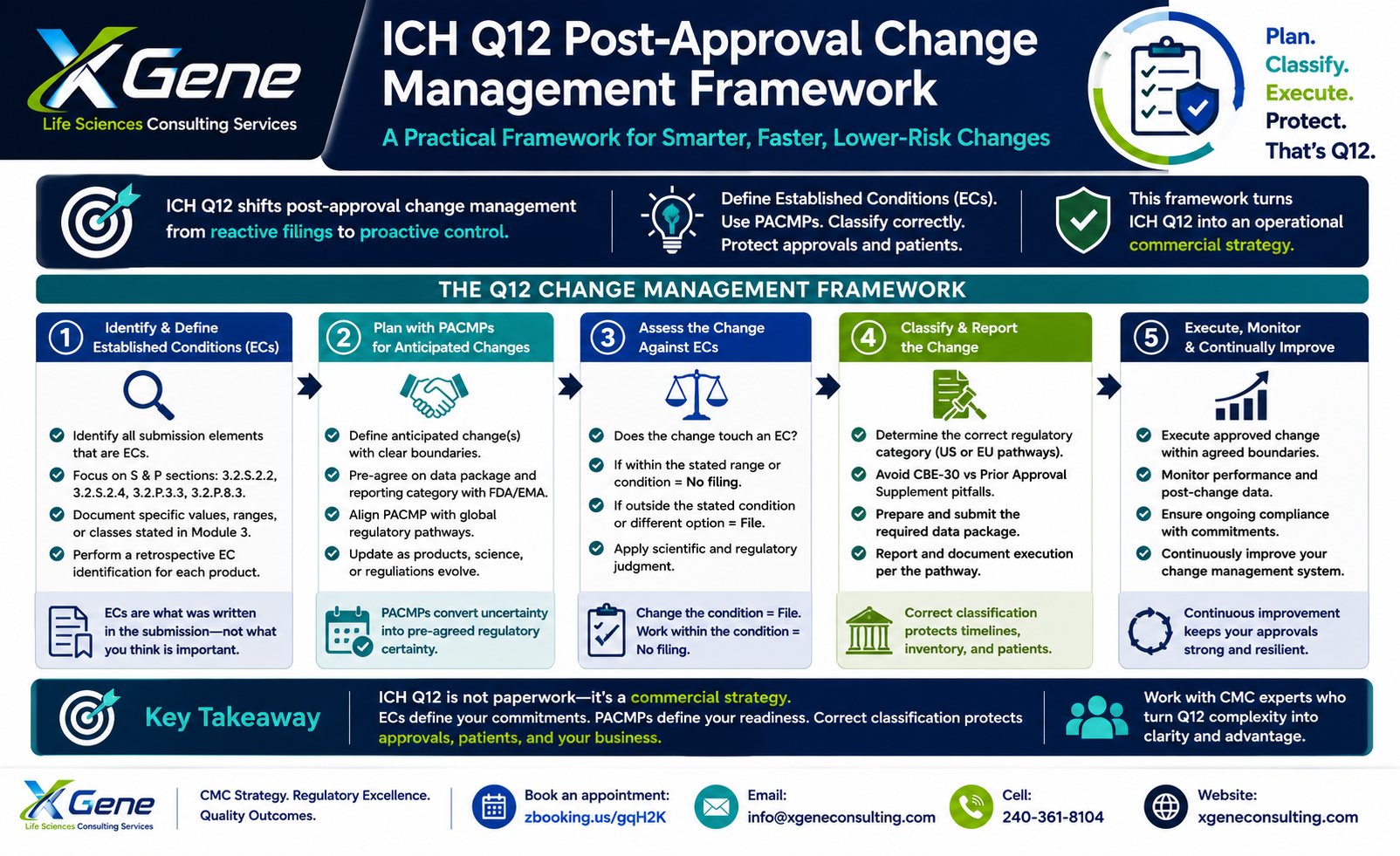
misclassification can create significant compliance and supply risk if a change is implemented under an incorrect reporting category. The regulatory consequence depends on the specific application, change, legal status, and whether prior approval was required; it should not be described as an automatic ‘clinical hold on distribution.’
What ICH Q12 Changes From the Pre-Existing Change Management Framework
Before ICH Q12 was finalized, post-approval change management operated almost entirely within the framework of 21 CFR 314.70 and its companion FDA guidance documents — most notably the SUPAC-IR, SUPAC-MR, and SUPAC-SS guidance documents for solid oral dosage forms and the 2004 FDA Guidance for Industry on CMC Post-Approval Manufacturing Changes. That framework was workable for uncomplicated changes to well-characterized products, but it was fundamentally reactive: you implemented or planned a change, you classified it against the CFR criteria and the applicable SUPAC tier, and you filed. There was no mechanism to pre-agree with the agency on what data package would satisfy a future change before you had either the data or the urgency driving the timeline.
ICH Q12 restructures this logic. The guideline introduces two prospective tools that did not exist in 21 CFR 314.70: the Established Conditions (EC) framework, which explicitly delineates at the time of original submission which elements of the approved filing require a regulatory submission upon change, and the Post-Approval Change Management Protocol (PACMP), which allows a company to pre-agree with FDA or EMA on the data package and reporting category for a defined anticipated change before that change is needed. The EMA Reflection Paper on ICH Q12 (2020) confirmed that the guideline’s PACMP mechanism is compatible with the EU Variations Regulation framework under EC No. 1234/2008, and that agreed PACMPs can reduce Type II variations — the highest-burden EU change category — to Type IB or Type IA notifications upon execution. That reduction in regulatory category is not a procedural convenience. It is a timeline compression of months to years for a manufacturing change that cannot wait.
The structural shift ICH Q12 demands is from a change management system that asks “what CFR category does this change fall into?” to one that asks “what did we designate as an EC at submission, and does this change touch it?” These are different questions with different answers, and organizations that have not performed a retrospective EC identification exercise on their approved NDAs are operating on the pre-Q12 logic even when they believe they are implementing ICH Q12 principles.
Established Conditions and Their Role in Determining Change Classification
An Established Condition, as defined in ICH Q12 and elaborated in the FDA Draft Guidance for Industry: Established Conditions (2021), is a legally binding element of the approved regulatory submission — any information described in the submission that, if changed, requires a regulatory submission regardless of the company’s internal risk classification. The critical operational implication is that EC status is determined by what was stated in the submission, not by what the company considers scientifically significant. A manufacturing process parameter whose range was stated explicitly in 3.2.P.3.3 is an EC. The same parameter, had it been described only in a batch record referenced by 3.2.P.3.3, may not be. This distinction — what was written into the submission versus what was merely relied upon operationally — is the source of the most consequential classification errors in post-approval CMC.
FDA’s ICH Q12 implementation landscape now includes OPQ MAPP 5018.3, effective November 29, 2024, which describes how OPQ staff assess proposed Established Conditions and associated reporting categories. The separate May 2021 FDA implementation guidance remains draft. EC identification and reporting categories should therefore be justified against the approved application, ICH Q12, applicable U.S. regulations and guidance, and current OPQ implementation practice rather than treated as an automatic section-by-section list.
The practical failure pattern this generates is predictable: at the time of first post-approval manufacturing change, the organization discovers that an element it treated as a non-EC — perhaps a drying time range, an in-process filtration pressure parameter, or a granulation endpoint described narratively — was explicitly stated in the original submission and therefore constitutes an EC. The change that was planned as an Annual Report filing is reclassified as a CBE-30 or, worse, a Prior Approval Supplement under 21 CFR 314.70(b). If the change was already implemented under the Annual Report logic, the product has been distributed under an unapproved manufacturing change. The remediation path from that position — retrospective filing, field alert assessment, possible recall evaluation — is the most expensive regulatory crisis a commercial CMC function can face.
PACMP, PIPs, and the Lifecycle Management Tools ICH Q12 Introduces
The Post-Approval Change Management Protocol is the most underutilized mechanism in the ICH Q12 toolkit, and its underuse stems from a misunderstanding of what it is. A PACMP is not a notification to the agency that a change is planned — it is a pre-agreed document, submitted and reviewed by FDA or EMA before the change occurs, that specifies the analytical and non-clinical data package the company commits to generating, the acceptance criteria against which that data will be evaluated, and the reporting category (PAS, CBE-30, or Annual Report under US framework; Type II, IB, or IA under EU framework) that the agency agrees will apply when the change is executed according to the protocol. The distinction between these two framings — notification versus pre-agreement — is decisive, because a PACMP that was submitted but not agreed is not a PACMP under ICH Q12; it is a unilateral statement of intent, and it carries none of the regulatory benefit.
The PACMP mechanism works best for changes that are anticipated but not yet needed — a site transfer being planned two years before the primary site reaches capacity, an analytical method modernization from HPLC-UV to UHPLC-DAD that the company knows it will need as the reference standard ages, or a process change from batch to continuous manufacturing that requires phased regulatory agreement. For each of these change types, the PACMP allows the company to conduct the pre-change studies during a period of low urgency, submit the protocol for FDA agreement during a routine review cycle, and then execute the change with a pre-agreed data package and pre-agreed reporting category when the operational need arrives. The alternative — facing a major manufacturing change with a six-to-twelve month Prior Approval Supplement review on the critical path of a supply chain disruption — is the scenario PACMP was designed to prevent. Under the EU framework, the EMA Reflection Paper on ICH Q12 (2020) clarified that a PACMP agreed through the Variations Regulation under EC No. 1234/2008 can prospectively downgrade a Type II variation to a Type IB notification, achieving a regulatory timeline reduction that no amount of post-change scientific justification can replicate.
The Product Information Profile (PIP), another ICH Q12 tool, complements PACMP by providing a summary document — agreed with the agency — that describes the ECs for the product and the design space within which the company may operate without a regulatory submission. Organizations that invest in PIP development at the time of NDA submission, or at the first post-approval review opportunity, build a register of their change flexibility that can be shared with manufacturing site teams, CMOs, and acquirers in business development diligence. That document has commercial value that extends well beyond its regulatory function.
Building a Post-Approval Change Control Program That Uses ICH Q12’s Regulatory Flexibility
The XGene Post-Approval Change Classification Decision Tree is a six-branch classification system applied at the point of change initiation — before any regulatory filing decision is made and before internal change control is closed.
Branch 1 — EC Impact Determination: Identify every element of the approved submission (3.2.S.2.2, 3.2.S.2.4, 3.2.P.3.3, 3.2.P.8.3, and associated analytical sections) that was stated with a specific value, range, or defined condition, and map the proposed change against each element to determine whether the change modifies an EC. If the answer is yes, a regulatory submission is mandatory — internal risk classification cannot override EC status.
Branch 2 — Design Space Impact Assessment: Determine whether the proposed change moves any process parameter outside the approved design space described in the original submission. Under ICH Q12 §4.2, any operation outside the approved design space constitutes a change to an EC and triggers a Prior Approval Supplement under 21 CFR 314.70(b) regardless of the company’s judgment about the magnitude of the change.
Branch 3 — CQA Impact Assessment: For changes that do not directly modify an EC but may affect a Critical Quality Attribute — dissolution rate, assay, related substances, microbiological quality — determine whether a comparability exercise, validated test comparison, or in-process data package is required as part of the regulatory submission data package.
Branch 4 — SUPAC Tier Assessment (solid oral products): For changes to solid oral drug products, apply SUPAC-IR, SUPAC-MR, or SUPAC-SS tier classification to confirm the change category identified in Branch 1 and Branch 2 is consistent with SUPAC guidance thresholds, which remain the operative guidance for FDA review of solid oral post-approval changes.
Branch 5 — Validated State Impact: Assess whether the change triggers revalidation of the manufacturing process, an analytical method revalidation under ICH Q2(R1), or a computer system revalidation — and incorporate the validation timeline into the regulatory submission strategy, as an incomplete revalidation at time of CBE-30 filing is a routine source of agency information requests.
Branch 6 — PACMP Eligibility Review: Determine whether the change type is covered by an existing FDA-agreed PACMP. If yes, execute the PACMP protocol and file under the pre-agreed reporting category. If no, assess whether the change is a candidate for prospective PACMP development — particularly for changes with long development timelines or high commercial consequence if delayed.
The output of the XGene Post-Approval Change Classification Decision Tree is a regulatory filing strategy document that specifies the submission category, the data package required, the estimated agency review timeline, and the PACMP development recommendation for each anticipated change — a change management register that can be maintained across the product lifecycle, audited at pre-approval inspection, and used to brief manufacturing leadership on the regulatory timeline implications of operational decisions before those decisions are made.
The organizations that will absorb the highest regulatory cost over a product’s lifecycle are those that treat post-approval change management as an administrative function rather than a strategic one — identifying change categories reactively, filing without pre-agreement, and discovering EC status errors at the worst possible moment. ICH Q12’s EC framework and PACMP mechanism exist precisely to prevent those discoveries, but they require investment at the time of original submission and at the first post-approval planning horizon, not after the change is already in progress. The gap between what ICH Q12 enables and what most commercial CMC programs actually implement is not a knowledge gap — it is a prioritization gap, and the companies that close it first will build a measurable regulatory velocity advantage over their competitors in every supply chain change and technology transfer they execute for the life of the product.