
OOS Investigation Protocol — The CMC Framework FDA Expects
The most dangerous statement in pharmaceutical quality is "the result was retested and passed" — because that sentence, without the three-phase investigation framework that FDA requires before any retest is…
On this pageArticle overview
The most dangerous statement in pharmaceutical quality is “the result was retested and passed” — because that sentence, without the three-phase investigation framework that FDA requires before any retest is scientifically valid, is the foundation of the most common laboratory data integrity Warning Letter FDA issues.
That sentence appears in FDA Warning Letters with remarkable regularity, and every time it does, the story is the same: an analyst runs a test, the result falls outside specification, and someone in the QC laboratory — sometimes the analyst, sometimes the supervisor — initiates a retest before a single piece of documentary evidence about the original failure has been reviewed, recorded, or evaluated. The retest passes. The batch is released. The OOS event is documented as “retested, result confirmed within specification.” Then FDA arrives. Under 21 CFR 211.192, laboratory records must include a complete record of all data obtained during testing of each component, drug product container, closure, in-process material, and drug product — and that requirement carries a corollary obligation that has been FDA’s enforcement position since its 2006 OOS guidance made it explicit: the decision to retest must follow documented investigation, not precede it.
The companies that survive OOS scrutiny during inspection are not the ones with the fewest OOS results. They are the ones whose investigation protocol mirrors the three-phase framework FDA articulated in its Guidance for Industry: Investigating Out-of-Specification (OOS) Test Results for Pharmaceutical Production (2006), and whose SOPs define each phase with enough operational specificity that any investigator can walk through an OOS file and confirm that the investigation was conducted before any retest decision was made.
The FDA OOS Guidance Framework: Phase I, Phase II, and When to Extend the Investigation
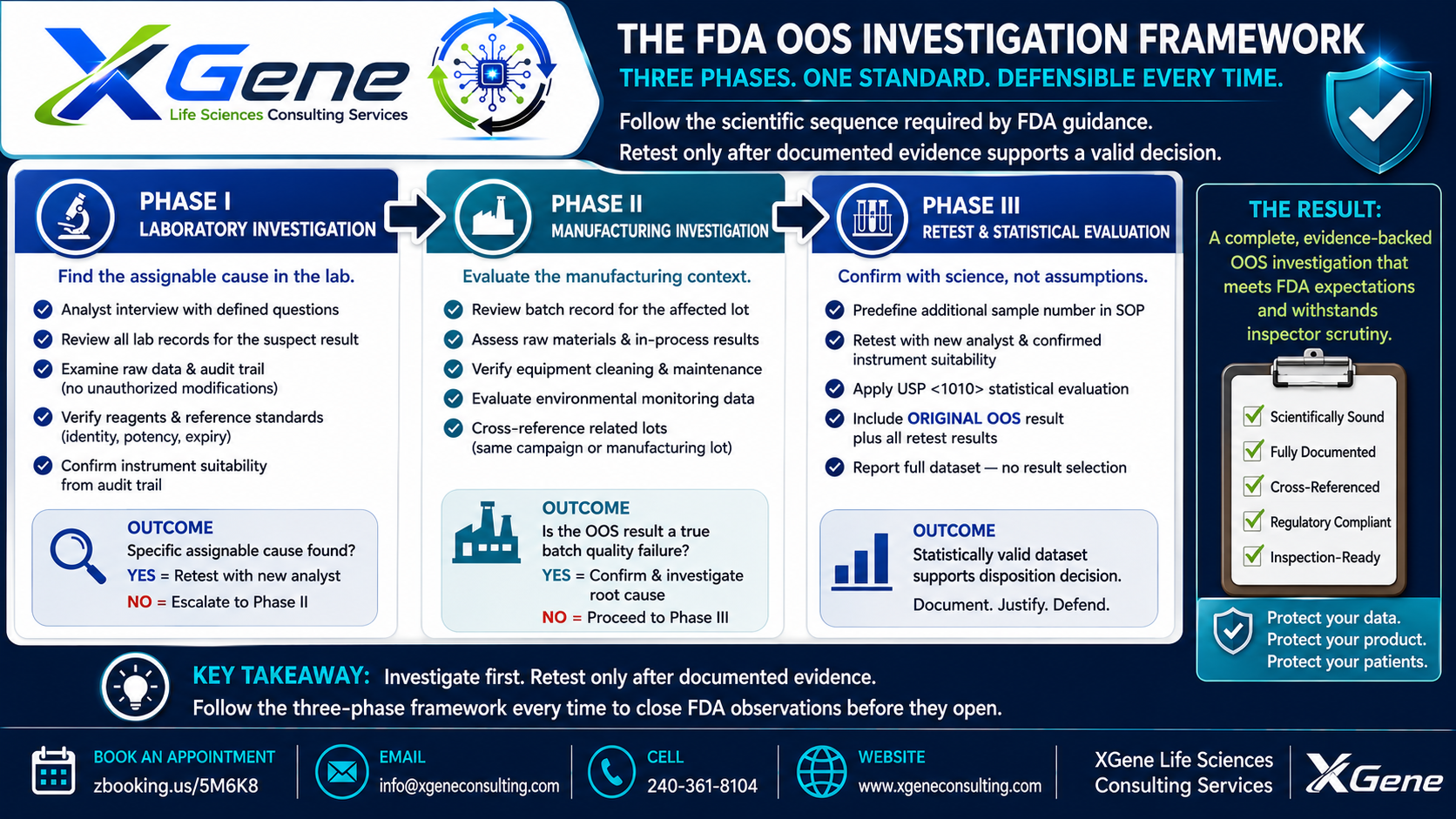
FDA’s May 2022 Level 2 revised OOS guidance is not a menu from which laboratories select the phases they find convenient. It is a sequential framework, and the sequencing is not incidental — it is the scientific logic that makes any subsequent retest result valid or invalid. Phase I is the laboratory investigation, and it must be completed before Phase II is considered and before any retest sample is prepared. The Phase I scope is specific: the analyst who performed the original test must be interviewed; all laboratory records for the suspect result must be reviewed, including sample preparation, standard preparation, instrument performance, and calculation steps; electronic raw data and the audit trail associated with the analysis must be examined to confirm no unauthorized modifications occurred; reagents and reference standards used in the original analysis must be verified for identity, potency, and expiry; and the instrument must be confirmed to have been suitable for its purpose at the time of the analysis. Each of these is a discrete investigative step, not a checklist box to be initialed without evidence. The 2006 guidance is explicit that an assignable cause must be a specific identified error — a particular step in the analytical procedure where a documented mistake occurred — not an assumption, not a general category of human error, and not a conclusion supported only by the fact that a retest passed.
If Phase I yields a documented, specific assignable cause — a calculation error at a defined step, a confirmed reference standard that was outside its validity period, an instrument malfunction captured in the audit trail — then the original result may be invalidated and a retest conducted with a new analyst using the same validated method. If Phase I does not yield a specific assignable cause, the investigation does not close. It expands. This is the most consequential inflection point in the entire OOS framework, and it is where the majority of investigation failures occur: the Phase I investigation is closed with a vague “analyst error” conclusion, the retest is initiated, the file is archived, and no one escalates to Phase II until an FDA investigator asks why the manufacturing investigation was never opened.
Phase II is the full manufacturing investigation, and 21 CFR 211.192 compels it when no laboratory assignable cause is found. The Phase II scope reaches across the batch record for the affected lot — raw material testing results, in-process controls, equipment cleaning and maintenance records, environmental monitoring data from the manufacturing campaign, and cross-reference to other batches from the same manufacturing lot or campaign period. The purpose is to determine whether the OOS result reflects a true batch quality failure rather than a laboratory anomaly, and that determination requires documentary evidence from outside the laboratory. Phase II is not a literature search or a theoretical discussion. It is a documented cross-reference of specific production records against the analytical finding.
The Most-Cited OOS Investigation Failures: What FDA Investigators Document
The single most frequently cited OOS investigation deficiency in FDA Warning Letters is the retest initiated before Phase I documentation is complete. The scenario is operationally predictable: a QC analyst obtains an OOS result late in the afternoon, the batch release deadline is approaching, and a supervisor authorizes a same-day retest with a different analyst on the basis that “something must have gone wrong” with the original analysis. The retest passes. The original analyst’s interview is documented the following day, after the retest result is known. The review of electronic raw data and audit trail, if it occurs at all, finds nothing because the conclusion — that it was analyst error — has already been reached. Under 21 CFR 211.160(b), which requires that laboratory controls include scientifically sound and appropriate specifications, standards, sampling plans, and test procedures, the retroactive documentation of a Phase I investigation that was never actually conducted is a data integrity failure, not just an investigation deficiency.
The second most predictable failure is the retest plan that is not predefined. FDA’s May 2022 Level 2 revised OOS guidance is unambiguous: the number of retest samples must be predetermined in the SOP or investigation protocol, not determined after the OOS result is known. When the retest sample number is decided after the original OOS result has been received, the selection of that number is vulnerable to — and will be characterized by FDA as evidence of — cherry-picking. The investigation report that documents a retest of three additional samples when the SOP specifies no number, or when the SOP was amended between the OOS event and the retest, is precisely the type of record that generates a 483 observation under 21 CFR 211.192 and, if the pattern recurs, a Warning Letter.
The third failure pattern, less frequently cited but more operationally dangerous, is the OOS investigation for a stability failure that is closed as a stability chamber anomaly without a manufacturing investigation. When a product fails its stability specification at an intermediate or terminal time point, and the investigation concludes that the chamber experienced a temperature excursion — without a documented Phase II evaluation of whether the batch quality itself was compromised prior to stability entry — the batch quality conclusion is not supported by the investigation record. USP <1010> provides the analytical framework for interpreting stability data, and its guidance on evaluating whether a result represents a real trend or a testing anomaly reinforces why the investigation must address batch quality, not only analytical performance.
Assignable Cause, Analyst Error, and the Invalidation Standard FDA Actually Applies
The phrase “analyst error” is the most dangerous two-word conclusion in pharmaceutical QC documentation, not because analyst errors do not occur, but because the term has been systematically misused as a catch-all justification for invalidating any OOS result that the laboratory cannot immediately explain. FDA’s May 2022 Level 2 revised OOS guidance defines the invalidation standard with precision: a result may be invalidated only when a specific, documentable error has been identified — a specific calculation mistake at a defined step, a confirmed volumetric error in a specific pipetting operation, an instrument malfunction captured in the instrument’s electronic record. “Analyst error” without a named error type, a named procedural step, and documentary evidence supporting the conclusion does not meet the 2006 guidance’s invalidation standard. An investigation that invalidates a result on the basis of a passing retest alone — without an identified specific error — is the investigation pattern that drives FDA’s most serious OOS Warning Letter language.
This standard has direct implications for the ICH Q2(R2) Analytical Procedure Development and Revision guidance (2023), which establishes the scientific basis for method robustness and intermediate precision. When a laboratory’s analytical method has been validated in accordance with ICH Q2(R2) and still produces OOS results that cannot be attributed to a specific identified error in Phase I, the investigation logic leads inescapably to Phase II — because the method’s validated performance characteristics preclude the method itself as the source of the failure. The ICH Q2(R2) validation data in the company’s analytical dossier is not separate from the OOS investigation: it is the evidentiary baseline against which Phase I is evaluated.
The invalidation standard also governs what is reported at the conclusion of Phase III. When the Phase III retest protocol is executed — only after Phases I and II are complete, with a predefined sample number, using a new analyst and confirmed instrument suitability — all results must be reported and evaluated together with the original result. The statistical evaluation under USP <1010> applies to all valid data in the dataset. A company that reports only the passing retest results and excludes the original OOS result from the statistical evaluation is not conducting an OOS investigation — it is conducting result selection, and FDA’s investigators are trained to identify the difference between the two.
Building an OOS Investigation Procedure That Closes FDA Observations Before They Open
The XGene Three-Phase OOS Investigation Protocol is a structured OOS investigation SOP and documentation system built directly from FDA’s May 2022 Level 2 revised OOS guidance, designed to produce investigation records that meet the FDA review standard on the first pass — not after a 483 observation has been issued.
Step 1 — Phase I Laboratory Investigation Checklist with Electronic Audit Trail Verification. The Phase I checklist defines each investigative step as a documented action with an evidence reference: analyst interview documented on the day of the OOS event with a defined question set; review of all laboratory records for the suspect analysis cross-referenced to the raw data system; electronic audit trail export and review completed before any retest preparation begins; reagent and reference standard verification recorded against the lot-specific certificate of analysis and expiry log; and instrument suitability confirmation from the instrument’s audit trail, not from memory or verbal attestation. The checklist is designed so that the Phase I record can be reviewed by an FDA investigator without oral explanation — the evidence path from observation to conclusion is visible in the document.
Step 2 — Phase II Manufacturing Investigation Template with Batch Record Cross-Reference. The Phase II template is activated automatically when Phase I closes without a specific assignable cause — not as a discretionary decision by the QC supervisor, but as a procedural requirement triggered by the Phase I conclusion field. The template maps each manufacturing variable — raw material lot, in-process result by step, equipment identifier and maintenance status, environmental monitoring data for the campaign — to the specific batch record section where the supporting data lives, producing a cross-referenced investigation record that demonstrates the manufacturing scope was actually evaluated.
Step 3 — Phase III Retest Protocol with Predefined Sample Number and Statistical Evaluation Framework. The retest protocol specifies the number of additional samples to be tested before any OOS event occurs — removing the post-hoc sample number determination that creates cherry-picking risk. The statistical evaluation method is defined in the SOP, referencing USP <1010> as the analytical framework, and requires that all results — original OOS result and all retest results — be included in the dataset reported in the investigation record.
Step 4 — OOS Investigation Report Template Meeting the FDA Documentation Standard. The report template structures the investigation conclusion around the four elements FDA evaluates: the specific assignable cause identified (or the documented basis for the Phase II expansion); the evidence that supports the cause conclusion; the disposition recommendation and its scientific justification; and the CAPA commitment with a defined completion date. The report template does not permit the phrase “analyst error” as a standalone conclusion — the cause field requires a named error type and a named procedural step.
The output of the XGene Three-Phase OOS Investigation Protocol is an investigation SOP and documentation package that an FDA investigator can follow from OOS event through batch disposition decision without asking a single clarifying question — because every decision point is defined, every evidence reference is specific, and every conclusion is supported by documentary evidence already in the file.
The cost of an inadequate OOS investigation protocol is not a single 483 observation — it is a pattern finding that follows a site across inspection cycles, escalates from observation to Warning Letter when it recurs, and ultimately raises the data integrity question that is the most operationally damaging conclusion an FDA investigator can reach about a laboratory. A laboratory that cannot demonstrate a documented, sequential, evidence-based investigation for every OOS result has not simply failed to follow the 2006 guidance — it has created a documentary record that undermines the validity of every batch release decision that preceded a contested OOS result. The companies that understand this are the ones that build their OOS SOPs from the guidance forward, not from the SOP backward.