
Small Molecule CMC from Phase 1 to NDA: The Phase-Appropriate Development Strategy That Avoids Late-Stage CMC Failure
"CMC is holding up the NDA." This sentence is spoken in development teams every year — about programs where clinical and non-clinical development proceeded at the expected pace, but the…
On this pageArticle overview
“CMC is holding up the NDA.” This sentence is spoken in development teams every year — about programs where clinical and non-clinical development proceeded at the expected pace, but the CMC package was developed reactively rather than strategically, leaving critical gaps in process validation, reference standard qualification, or stability data that were not identified until the submission was being assembled.
The sentence lands differently depending on where you sit in an organization. To a clinical team that has already completed a Phase 3 trial with statistically significant endpoints, it registers as inexplicable — the drug works, the patients responded, the data are clean. To a regulatory affairs director assembling the NDA filing timeline, it means months of delay while PPQ batches are manufactured, stability timepoints accumulate, or impurity qualification studies are completed. To a CFO tracking a product launch date, it represents a direct revenue impact that was entirely avoidable. The thesis of this article — and of this entire 24-article series on small molecule eCTD Module 2/3 — is that late-stage CMC failure is not a technical problem. It is a project management problem caused by treating CMC development as a series of discrete activities rather than a staged, data-dependent program with defined readiness gates at each clinical phase transition.
Understanding why this happens requires understanding how FDA thinks about CMC development across the IND lifecycle.
The Phase-Appropriate CMC Development Framework: What FDA Expects at Each IND Stage
FDA’s 2003 guidance, “INDs for Phase 2 and 3 Studies — Chemistry, Manufacturing, and Controls Information,” remains the foundational document for understanding phase-appropriate CMC expectations. Its core principle is straightforward: the depth and rigor of CMC information required to support an IND increases as the program advances and as the risk of drug exposure to patients grows. This principle is not bureaucratic scaffolding — it reflects a genuine risk-benefit analysis about what is known and what is not known about a drug substance and drug product at each stage of development.
At the Phase 1 IND stage, FDA expects enough CMC information to assure the identity, quality, and purity of the investigational product at the scale and duration of the proposed study. The drug substance section (eCTD 3.2.S) at this stage requires a synthesis route that has been executed at a scale sufficient to produce the material being used in the study — typically greater than 100 grams for most small molecule programs — along with preliminary specifications covering identity, assay, and the key impurities generated by the synthetic route. Stability data are expected to cover at minimum a three-month accelerated stability timepoint, providing enough information to assign a tentative retest date or expiry for the clinical material. The drug product section (eCTD 3.2.P) requires a description of the formulation, the manufacturing process at the scale used to produce clinical supplies, and container closure system information sufficient to demonstrate that the packaging is appropriate for the dosage form and route of administration.
What FDA explicitly does not expect at Phase 1 is a complete characterization of critical quality attributes, a validated analytical method suite, or a process validated to commercial scale. This is appropriate. At Phase 1, the primary CMC obligation is assurance that patients are receiving what they are intended to receive — that the material is the correct compound, at the correct purity, in the correct dose. Detailed process understanding and commercial-scale validation are not yet feasible or necessary.
The critical misstep in many development programs is treating Phase 1 CMC expectations as a ceiling rather than a floor. Teams that do only what is explicitly required at Phase 1 — and do not begin building the informational foundation for Phase 2 and Phase 3 CMC development in parallel with the Phase 1 clinical study — arrive at Phase 2 without the structural data needed to accelerate process characterization and analytical development. ICH Q11, “Development and Manufacture of Drug Substances,” is instructive here: it describes a development continuum in which process understanding is built incrementally, with studies at each stage informing the design space and control strategy that will ultimately support the commercial process. This continuum cannot be compressed at the end. It must be initiated at the beginning.
As a program transitions to Phase 2, FDA’s expectations shift materially. The 2003 guidance notes that by Phase 2, the manufacturing process should be better defined, specifications should be based on data rather than preliminary judgment, and analytical methods should be under validation. ICH Q8(R2), “Pharmaceutical Development,” describes the Phase 2 window as the appropriate period for formal identification of critical quality attributes — those physical, chemical, biological, or microbiological properties or characteristics that should be within an appropriate limit, range, or distribution to ensure the desired product quality. CQA identification is not a retrospective exercise performed at Phase 3. It is an analytical activity that must be completed with Phase 2 data to allow the process characterization studies that follow to be appropriately designed.
The Phase 2 CMC Build: CQA Identification, Reference Standards, and Stability Programs
The Phase 2 CMC build also encompasses the initiation of formal stability programs. At Phase 1, three-month accelerated data are sufficient. By Phase 2, programs should have formal stability protocols in place on representative batches, with long-term stability data accumulating under ICH Q1A(R2) conditions. Six-month long-term data should be available at Phase 2 start at minimum. This is not merely a regulatory compliance issue — it is a programmatic risk management issue. Stability OOS findings identified for the first time during NDA assembly, when 24-month data are required, represent one of the most timeline-damaging CMC findings a program can encounter, because there is no regulatory shortcut to generating stability data. Time must elapse.
The reference standard qualification requirement is another area where Phase 2 preparation determines Phase 3 outcomes. The primary reference standard for the drug substance (eCTD 3.2.S.5) must be fully characterized and qualified before it can anchor the validated analytical methods required for NDA submission. Reference standard qualification is a multi-step process involving synthesis, purification, full structural characterization, quantitative analysis, and assignment of a certified content value. Programs that initiate reference standard qualification late — at Phase 3 start rather than Phase 2 — frequently find that the timeline for qualification, combined with the subsequent analytical method validation cycle, extends past the NDA submission target date.
By Phase 3, the CMC development program enters what should be its final defined phase before NDA submission. The commercial manufacturing process should be defined and locked — meaning that the synthesis route, reaction conditions, workup, and purification at commercial scale are established and are not expected to change. Critical process parameters should be characterized through formal process characterization studies, generating the data that will populate eCTD Section 3.2.S.2.6 and form the basis of the drug substance control strategy. ICH Q1A(R2) stability protocols should be running on representative batches manufactured at or close to commercial scale, with a stability data package targeted at 12 to 24 months of long-term data available at NDA submission.
Phase 3 to NDA: PPQ, Method Validation, and the Complete Module 3 Package
Process Performance Qualification — the execution of PPQ batches at commercial scale under the FDA’s 2011 Process Validation Guidance framework — must be initiated with sufficient lead time that the scientifically justified PPQ campaign is planned, manufactured, tested, and analytically characterized on a timeline appropriate to the submission and commercial-readiness strategy. PPQ batches take time to manufacture and considerably more time to test. A program targeting an NDA submission date of Q4 in a given year that has not initiated PPQ manufacturing by Q1 of that same year is carrying significant timeline risk.
The NDA Module 3 package itself — organized per ICH M4Q(R1), “The CTD — Quality” — requires complete analytical method validation reports for all methods used to generate specification-supporting data, a full drug substance and drug product stability data package, a container closure system report inclusive of extractables and leachables data for any non-aqueous or inhalation product, and a complete manufacturing section with batch analysis data from representative commercial-scale batches. The FDA’s PDUFA VII commitments to meeting management goals for NDA review underscore the Agency’s expectation that submissions arrive complete. An NDA with significant Module 3 gaps will either receive a Refuse to File action or generate a major CMC deficiency letter during review — both outcomes that add six to twelve months to the approval timeline and represent a direct cost to the program. The FDA 21st Century Cures Act reinforced the expectation of submission quality through provisions enabling more efficient review processes, but efficient review requires a complete and well-organized submission to work from.
Understanding what is required at each phase is necessary but not sufficient. What distinguishes programs that arrive at NDA submission with a complete CMC package from those that do not is not technical capability — it is the use of a structured stage-gate framework that defines minimum data requirements at each clinical phase transition and treats those gates as mandatory checkpoints rather than advisory guidelines.
The XGene CMC Development Stage Gate Standard
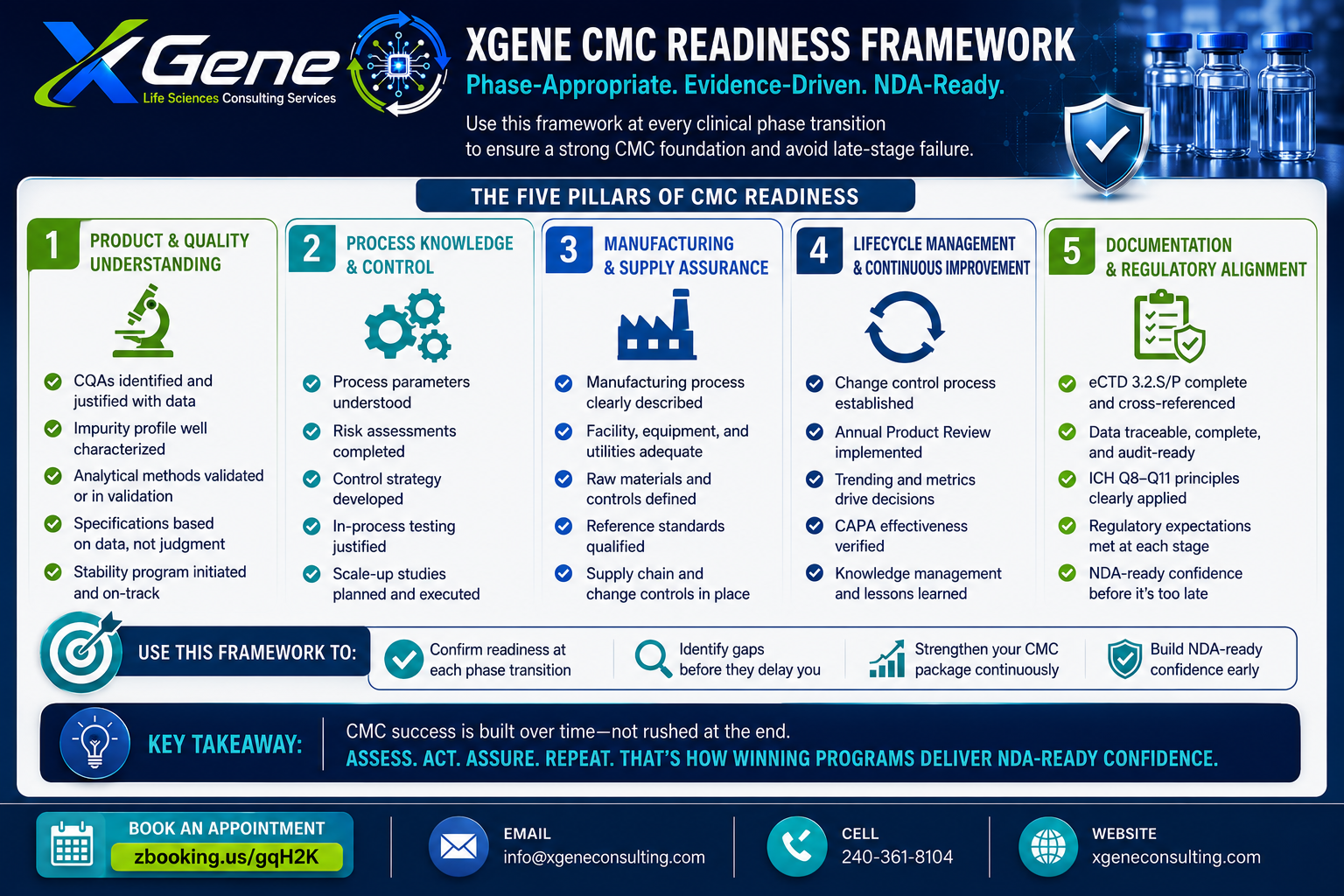
GATE 1 — PHASE 1 IND Minimum Data Required: – Drug substance synthesis route executed at >100g scale – Preliminary specification covering identity, assay, known impurities – 3-month accelerated stability data; tentative retest/expiry assigned – Drug product: formulation description, manufacturing process at clinical supply scale, container closure system characterization – eCTD Sections: 3.2.S.1–3.2.S.7 (abbreviated); 3.2.P.1–3.2.P.8 (abbreviated)
GATE 2 — PHASE 2 START Minimum Data Required: – Critical quality attributes (CQAs) identified for drug substance and drug product – Critical process parameters (CPPs) under active development – Analytical methods for all specification tests in validation (ICH Q2(R1) validation initiation) – Reference standard qualification initiated – 6-month long-term stability data on representative batches; formal ICH Q1A(R2) protocols active – Drug substance: scale-up characterization initiated; impurity profile at Phase 2 scale defined – eCTD Sections: 3.2.S.2.2–3.2.S.2.6 (in development); 3.2.S.4.3 (validation in progress)
GATE 3 — PHASE 3 START Minimum Data Required: – Commercial manufacturing process defined and locked (synthesis route, CPPs, workup, purification) – Formal process characterization studies completed or actively running – Reference standard fully qualified; primary RS certificate issued – ICH Q1A(R2) stability protocols running on batches representative of commercial process – Analytical method validation substantially complete for drug substance and drug product critical methods – Drug product: container closure system fully characterized; E&L assessment completed or in progress for relevant dosage forms – 12-month long-term stability data available or on track for NDA target date – eCTD Sections: 3.2.S.2.6 (design space/control strategy defined); 3.2.S.5 (RS qualified); 3.2.P.7 (container closure complete)
GATE 4 — NDA SUBMISSION Minimum Data Required: – PPQ executed at commercial scale (minimum 3 consecutive batches per FDA Process Validation Guidance 2011) – Full ICH Q2(R1) analytical method validation complete for all specification-supporting methods – 12–24 months long-term stability data (drug substance and drug product) on PPQ-representative batches – Complete batch analysis data from commercial-scale batches – Container closure E&L data complete for any non-aqueous or inhalation product – All Module 3 sections complete per ICH M4Q(R1) organization – 2.3 QOS narrative complete and internally consistent with Module 3 data – eCTD Sections: 3.2.S and 3.2.P — all subsections complete; 3.2.A and 3.2.R as applicable