
3.2.S.5 Reference Standards: The Metrological Foundation Your Entire Analytical Package Depends On
The phrase "reference standard" appears dozens of times in a typical drug substance CTD module — in assay method descriptions, in system suitability requirements, in impurity identification thresholds, in residual…
On this pageArticle overview
What a Reference Standard Is and Why Its Qualification Program Determines Your Entire Analytical Package’s Validity
The phrase “reference standard” appears dozens of times in a typical drug substance CTD module — in assay method descriptions, in system suitability requirements, in impurity identification thresholds, in residual solvent quantitation procedures. In every one of those appearances, a numerical result is anchored to the assigned purity of a physical material. That material — whether it is a USP Reference Standard procured from Rockville, an EDQM Chemical Reference Substance obtained from Strasbourg, or an in-house primary standard painstakingly characterized in your own laboratory — is the metrological foundation upon which your entire analytical package rests. Section 3.2.S.5 of the eCTD, defined under ICH Q6A §3.2.S.5, exists specifically to establish that this foundation is sound. What FDA reviewers consistently find is that sponsors treat it as a box to check rather than a scientific narrative to construct.
Understanding what a reference standard actually is, at the level of metrological rigor demanded by a BLA or NDA submission, begins with distinguishing between the primary reference standard and the working reference standard — a distinction that ICH Q6A makes implicitly but that USP <11> (Reference Standards) and the PhRMA Principles and Practices for Establishing Reference Standards (2013) make explicit in the pharmaceutical analytical context. The primary reference standard is the highest-order material in your traceability chain. It is characterized by multiple orthogonal analytical methods to assign its purity as an absolute value, not as a relative chromatographic ratio. It is stored under defined conditions that have been validated to preserve its integrity over the interval for which it is used. It serves as the anchor against which every subsequent working standard lot is qualified. The working reference standard, by contrast, is the material actually consumed during routine analysis — the standard dissolved in HPLC mobile phase day after day, compared against sample responses, used to generate the assay and impurity results that populate your batch release and stability reports. The working standard’s legitimacy depends entirely on its demonstrated equivalence to the primary standard. If that equivalence has not been established by a validated method with specified acceptance criteria, then the working standard’s assigned purity is an assertion, not a measurement.
This architecture matters because of what FDA’s Office of Pharmaceutical Quality is actually asking when it reviews Section 3.2.S.5. Reviewers are not simply confirming that you have a reference standard. They are tracing the evidentiary chain backward from every quantitative result in your Section 3.2.S.4 methods through the system suitability requirements of those methods, to the assigned purity value used to calculate sample concentration, to the characterization data that established that assigned purity value, to the stability data demonstrating the assigned purity has not changed since characterization. A break anywhere in that chain — a purity assigned by HPLC area normalization without correction for non-UV-absorbing species; a retest interval asserted without supporting stability data; a working standard qualified by a comparison protocol that lacks defined acceptance criteria — is a break in the evidentiary chain for every result that depends on that standard. That is not a minor documentation deficiency. It is a fundamental question about whether the analytical data in your submission is quantitatively reliable.
The regulatory framework governing this section draws on multiple interlocking documents. ICH Q6A §3.2.S.5 specifies that information on reference standards or reference materials used for testing of the drug substance should be provided. That language is brief, but it is interpreted by FDA in light of the more detailed expectations articulated in the 2015 FDA Guidance for Industry: Analytical Procedures and Methods Validation for Human and Animal Drugs (§C), which addresses the qualification of reference materials as a precondition for valid analytical procedures. USP <11> Reference Standards provides the official framework for USP RS procurement and use, while USP <11> and the broader USP general chapter framework address the principles of reference standard establishment and assignment. ICH Q2(R2), the guideline governing analytical procedure validation, creates the link between reference standard quality and method validation integrity — a validated method’s accuracy and precision parameters are meaningless if the reference material used to establish those parameters has an uncertain purity assignment. The EDQM Chemical Reference Substances catalogue provides specifications for European Pharmacopoeial standards, whose use in global submissions requires documentation of lot-specific assigned values, which change between lots and must be tracked. Together, these documents define an expectation of metrological rigor that goes considerably beyond simply noting the lot number of the USP standard used in testing.
The practical significance of this rigor is most visible when things go wrong. Consider what happens when a manufacturer discovers, during a stability investigation, that the primary reference standard used for three years of assay testing was stored at the wrong temperature — that thermal cycling events degraded it by approximately 0.3% over that period. Every assay result derived from that standard during that period is now uncertain by at least that margin. Batch release specifications were met or failed based on calculated assay values that were systematically biased. Regulatory submissions containing those results contain inaccurate data. The corrective action required — re-analysis of retained samples, re-assessment of batch disposition decisions, potential field alert reporting — is enormously costly. That scenario is not hypothetical. It represents exactly the class of finding that emerges from GMP inspections of analytical laboratories and that drives FDA deficiency letters in pending applications.
The lesson for CMC strategy is that Section 3.2.S.5 is not peripheral documentation. It is the metrological certification of your entire quantitative analytical program. The XGene Reference Standard Program Architecture, which I will describe in the framework box, is built on this understanding: every reference standard used in a drug substance submission must be traceable to a primary standard of absolutely documented purity, and that documentation must appear in Section 3.2.S.5 in a form that an FDA reviewer can follow from first principles to final result without encountering an undocumented assumption or an unverified assertion. That is the standard of evidence your submission must meet, and the sections that follow describe in precise technical terms what that standard requires.
Primary Reference Standard Characterization: The Full Analytical Package Required
The characterization of a primary reference standard for a small molecule drug substance is a multi-method analytical program, not a single analytical procedure. ICH Q6A §3.2.S.5, read in conjunction with FDA’s 2015 Methods Validation Guidance §C and the PhRMA Reference Standards Principles (2013), establishes a clear evidentiary requirement: the purity of the primary RS must be assigned by a method — or combination of methods — that accounts for all impurity classes that could affect the absolute purity value. For a small molecule API, the purity assignment methodology must address organic impurities, inorganic impurities, moisture content, and residual solvents. Structure confirmation must precede purity assignment, demonstrating that the material being characterized is in fact the drug substance. The combination of these components yields the mass balance purity: assigned purity = 100% − water (Karl Fischer) − residual solvents (headspace GC) − inorganic/ash (sulfated ash or ICP-MS) − organic impurities (HPLC-UV or HPLC-DAD, with response factor correction for non-UV-absorbing species, or by qNMR with a certified traceable internal standard).
Structure confirmation for the primary RS requires at minimum a proton NMR spectrum, a carbon-13 NMR spectrum, a high-resolution mass spectrum confirming the molecular formula, and where relevant to the pharmacopoeial or regulatory identity definition, an IR spectrum and optical rotation measurement. These data establish that the material is the correct compound and identify any structural anomalies — polymorph misidentification, salt form discrepancy, hydrate versus anhydrous form — that would undermine the purity assignment. ICH Q2(R2) ties analytical procedure validation directly to the identity of the material characterized, meaning that a primary RS characterized as the monohydrate cannot serve as the traceability anchor for methods validated against the anhydrous form without documented correction for the molecular weight difference.
Moisture content determination by Karl Fischer titration is non-negotiable for any hygroscopic compound and strongly recommended as a standard component regardless of hygroscopicity, because water content that is unmeasured is water content that is uncontrolled. A primary RS with a nominal purity of 99.5% that contains 0.8% water and 0.3% residual solvents has a corrected assigned purity of approximately 98.4%. If the water and solvents are not subtracted, the purity is overstated by more than 1% and every assay calculated against that standard is biased low by the same proportion. In a specification with a 98.0–102.0% assay limit, that bias is not trivial.
Residual solvent determination by headspace gas chromatography, conducted under validated conditions with appropriate response factors, is equally required. The solvents present in the primary RS are known from the synthesis route described in Section 3.2.S.2.2 — every Class 1, Class 2, and Class 3 solvent used in the final synthetic steps and purification operations must be tested. For in-house primary standards, where the material often comes directly from the final isolation step of the drug substance synthesis, this is especially important because the same solvents that form the basis for Class 2 residual solvent limits in routine batch release testing may be present at elevated levels in the reference material if it was isolated under non-optimized conditions.
Inorganic impurity content — determined by sulfated ash per Ph. Eur. 2.4.14 or by ICP-MS for more sensitive and specific quantitation — completes the four-component mass balance. For many small molecule APIs synthesized via transition metal-catalyzed reactions (palladium-catalyzed cross-coupling, for example), the inorganic component is not trivial and its measurement and subtraction from the mass balance is required to assign a defensible purity.
Organic impurity quantitation for primary RS characterization faces a methodological challenge that FDA deficiency letters address with notable frequency: HPLC area normalization as the sole basis for purity assignment is not sufficient for primary RS characterization. Area normalization assumes equal detector response for all species — an assumption that holds only for chromophore-matched compounds under UV detection. The 2015 FDA Methods Validation Guidance is explicit that for reference standard purity assignment, the method must account for non-UV-absorbing impurities. The alternatives are: use of qNMR with a certified internal standard (maleic acid or DMSO-d6 referenced to a certified standard of known absolute purity is a common approach); use of HPLC with charged aerosol detection or evaporative light scattering detection, which provide less chromophore-dependent response; or use of mass balance as the primary purity assignment with HPLC-UV providing quantitation of known UV-absorbing impurities as an additive correction within the mass balance framework. Each approach has technical strengths and limitations that must be documented, and the chosen approach must be scientifically justified in Section 3.2.S.5.
The primary RS characterization data package as documented in 3.2.S.5 must include: the full NMR spectra (1H and 13C at minimum) with interpretation; the HRMS spectrum with measured vs. theoretical mass comparison; IR spectrum; Karl Fischer result with standard deviation across replicates; headspace GC residual solvent results with response factor documentation; sulfated ash or ICP-MS result; HPLC purity profile with specification of the method used and response factor corrections; the mass balance calculation table with all four component contributions explicitly stated; the resulting assigned purity with uncertainty estimate; the Certificate of Analysis; the storage condition specification; and the retest interval with supporting stability data. This is not a list that can be abbreviated for submission without inviting a deficiency letter.
When a compendial reference standard — USP, EP, or BP — is used as the primary RS, the characterization burden shifts partly to the pharmacopoeial authority. USP Reference Standards are characterized by USP’s analytical laboratories under documented protocols, and the assigned purity or potency is certified for the specific lot. The sponsor’s documentation obligation in this case is to record the lot number, the lot-specific Certificate of Analysis from USP (or EDQM for EP Chemical Reference Substances), the assigned purity value for that specific lot, and the expiry or retest date. USP lots expire and purity values differ between lots — the 2013 PhRMA Principles document emphasizes that using an expired USP lot, or using a purity value from a previous lot for the current lot, are equally problematic errors. EDQM Chemical Reference Substances are assigned as “assigned content” values in mg/ampoule, not as percent purity, and the correct use of these standards requires understanding the distinction between the assigned content and the calculated purity on a dry, solvent-free basis. Sponsors who import EDQM standards and treat the assigned content directly as a percent purity without correction for moisture and residual solvent content are making a systematic error that will generate an assay bias in their batch data.
The primary RS storage specification must be based on analytical evidence, not assumption. Stability data supporting the retest interval must be provided — typically data from an accelerated stability evaluation (40°C/75% RH for six months) and real-time data at the proposed storage condition (typically −20°C or 2–8°C). The stability-indicating method used for monitoring must be the same HPLC method used for impurity quantitation in routine testing, ensuring that any degradation captured under stress conditions is relevant to the real-world degradation chemistry of the compound. The retest interval specified in the CoA and in the method procedure must be supported by the real-time stability data — if real-time data covers 18 months and the proposed retest interval is 24 months, an extrapolation justification is required, analogous to shelf life extrapolation under ICH Q1E.
Working Standard Qualification, Potency Assignment, and the Traceability Chain to Primary
The working reference standard is the operational unit of analytical traceability. While the primary RS is characterized once (per lot) through an extensive multi-method program and is used sparingly to preserve its integrity, the working RS is the material that analytical chemists weigh, dissolve, and inject into HPLC systems during every routine analytical sequence. Its qualification protocol and ongoing stability monitoring program form the operational backbone of the reference standard program, and Section 3.2.S.5 must document both the initial qualification protocol and the lifecycle management framework that governs ongoing use.
Working RS qualification is fundamentally a method-based comparison to the primary RS. ICH Q6A and the PhRMA Principles both describe this as a head-to-head assay comparison — the working RS candidate is tested against the primary RS using the drug substance assay method, typically by the two-preparation comparison approach in which multiple independent preparations of each standard are assayed and the ratio of working RS result to primary RS result, corrected for purity, is calculated. The acceptance criterion for this ratio — which FDA deficiency letters consistently cite as missing when it is not specified in the qualification protocol — is generally ±0.5% relative to the primary RS assigned purity, though some sponsors apply ±1.0% for less potent materials or for drug substances with known hygroscopicity challenges that introduce weighing variability. Whatever criterion is specified, it must be scientifically justified and documented in the qualification protocol, not added post hoc after the qualification data is generated.
The working RS potency assignment resulting from qualification is not simply the primary RS purity value. It is the primary RS purity value multiplied by the qualification ratio from the head-to-head comparison. If the primary RS has an assigned purity of 99.6% and the working RS qualification comparison yields a mean ratio of 0.998, the assigned potency of the working RS is 99.4% — and that 99.4% value is what appears in the analytical method procedure and is used in the assay calculation for every batch release and stability result. The traceability chain is therefore: batch assay result → working RS potency (99.4%) → primary RS assigned purity (99.6%) → primary RS characterization data in 3.2.S.5. That chain must be explicit in the submission, and every link must be documented.
Ongoing stability monitoring of the working RS is as important as initial qualification. A working RS that qualified at 99.4% at time zero but has been stored under sub-optimal conditions for eighteen months may have degraded to 99.0% or lower — a shift that would cause assay results to be systematically elevated by 0.4%, potentially allowing batches that should fail the assay specification to release against a 98.0–102.0% limit. The stability monitoring protocol for the working RS must specify: the testing frequency (quarterly comparison against primary RS is the standard recommended by the PhRMA Principles); the acceptance criterion for continued use (typically ±0.5% of the initial assigned potency); the storage condition and monitoring temperature log requirement; and the action plan when the working RS fails the retest criterion, including the process for qualifying a new working RS lot and bridging the historical potency data.
Impurity reference standards represent the third tier of the reference standard program and receive separate documentation within Section 3.2.S.5. For each specified impurity identified in Section 3.2.S.4.1 and quantified in the related substances method described in Section 3.2.S.4.2, an impurity RS must be characterized. The characterization requirements for impurity RS materials are analogous to those for the primary drug substance RS — structure confirmation by NMR and HRMS, purity assignment by mass balance or qNMR, Certificate of Analysis, storage specification, and retest interval with stability data. A common deficiency pattern seen in FDA review correspondence is the use of an impurity RS in the related substances method without any characterization data in 3.2.S.5 — the impurity standard is referenced in the method procedure but its purity assignment, characterization data, and stability information are absent from the submission. This creates the same evidentiary gap as an uncharacterized primary RS: the quantitative result for the impurity is calculated against a standard of uncertain purity, making the result scientifically unreliable as a basis for safety-based impurity control.
XGene Reference Standard Program Architecture — Three-Tier Hierarchy
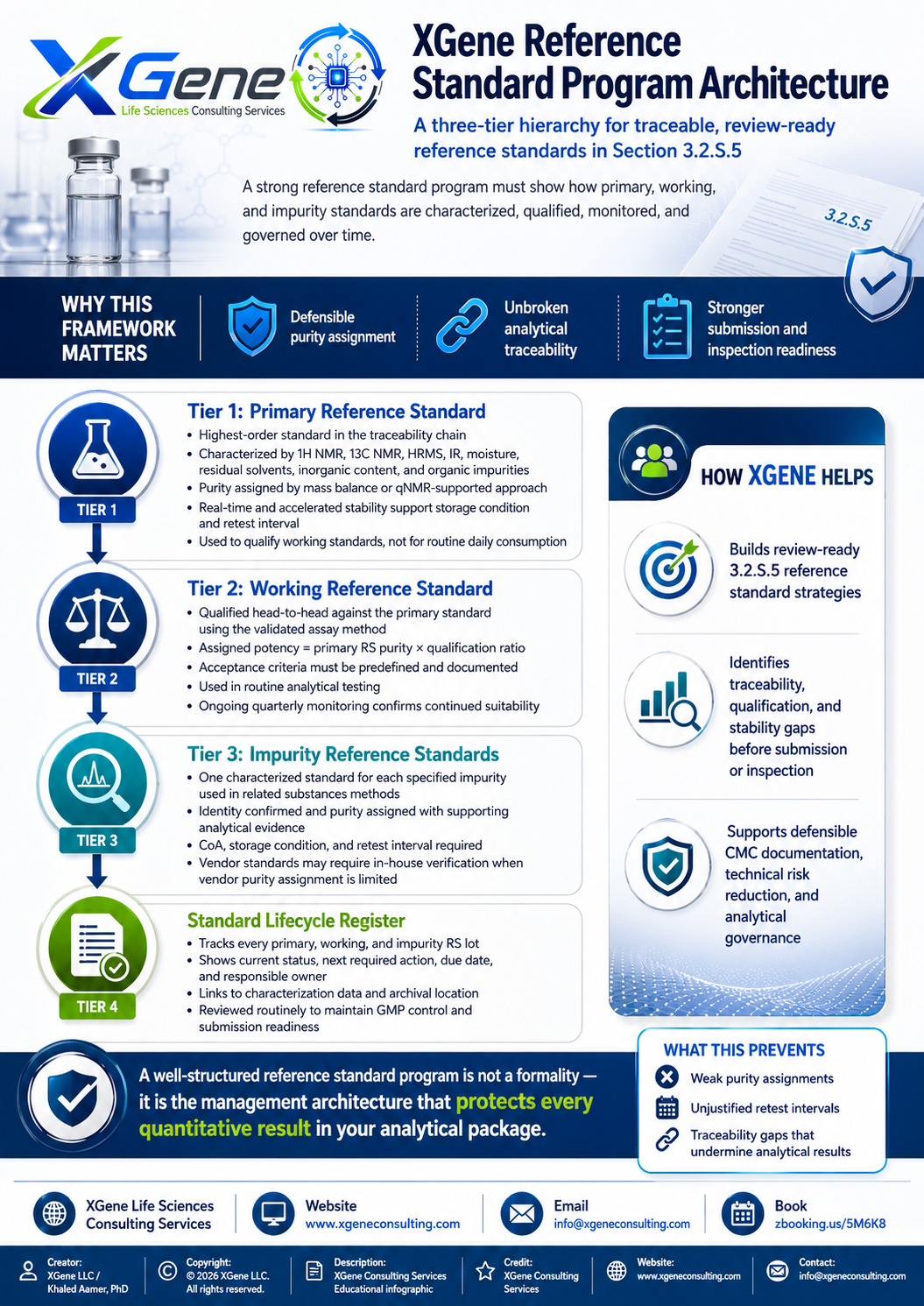
TIER 1 — PRIMARY REFERENCE STANDARD The primary RS is characterized by five orthogonal methods before purity assignment: (1) structure confirmation by 1H NMR, 13C NMR, HRMS, and IR; (2) HPLC organic impurity profile with response factor correction or qNMR with certified internal standard; (3) Karl Fischer moisture determination (triplicate); (4) headspace GC residual solvent determination for all synthesis-route solvents; (5) ICP-MS or sulfated ash for inorganic content. Mass balance purity is calculated as: Assigned Purity = 100% − KF water % − RS solvents % − inorganic % − HPLC organic impurities %. Retest interval is established by real-time stability data at the proposed storage condition (typically −20°C), supported by accelerated stability data at 25°C/60% RH and 40°C/75% RH, tested at 0, 3, 6, 12, 18, and 24 months using the stability-indicating HPLC assay method. The primary RS CoA documents lot number, source, structure confirmed, assigned purity with mass balance table, retest date, and storage condition. Primary RS use is restricted to working RS qualification — it is not routinely consumed in analytical testing sequences.
TIER 2 — WORKING REFERENCE STANDARD Working RS qualification is performed by head-to-head comparison against the primary RS using the validated drug substance assay method, with six independent preparation pairs and an acceptance criterion of assigned potency within ±0.5% of primary RS assigned purity. The assigned working RS potency = primary RS purity × qualification ratio (corrected for moisture at time of weighing). Ongoing stability monitoring is performed quarterly: six-preparation comparison to primary RS with ±0.5% drift acceptance criterion and temperature log verification. Failure of quarterly retest triggers immediate hold on working RS lot, qualification of replacement lot, and retrospective review of batch and stability data generated since the previous passing retest. The working RS stability register documents: lot number, qualification date, assigned potency, each quarterly retest result, storage temperature log summary, and projected retest date.
TIER 3 — IMPURITY REFERENCE STANDARDS Each specified impurity in the related substances method has a dedicated impurity RS with: structure confirmation by 1H NMR and HRMS; purity assignment by mass balance (KF + RS solvents + ICP-MS + HPLC normalization with response factor); Certificate of Analysis; storage condition (typically −20°C, sealed under nitrogen); and retest interval supported by stability data under the proposed storage condition. For commercially sourced impurity RS materials (Sigma-Aldrich, TCI, Cayman Chemical), the vendor CoA is supplemented with in-house structure confirmation and, if the vendor purity assignment is based on HPLC area normalization only, an in-house Karl Fischer and NMR purity verification. The impurity RS traceability register lists each impurity by name and CAS number, the purity assignment method and value, the source lot, the retest date, and the method(s) in which it is used as a system suitability standard or quantitation standard.
STANDARD LIFECYCLE REGISTER The lifecycle register is the operational document that bridges the program architecture to day-to-day GMP compliance. It lists every reference standard lot in the program — primary, working, and impurity — with current status (active, approaching retest, under requalification, retired), the next required action and due date, the person responsible, and the archival location of the characterization data. The lifecycle register is reviewed quarterly as part of the analytical laboratory quality review and is included in regulatory submissions (3.2.S.5) as the documentary evidence that the reference standard program has management infrastructure, not just initial characterization data.