
3.2.S.6 Drug Substance Container Closure System: Meeting the Material Suitability and Protection Requirements
The container closure system for a drug substance is rarely the primary focus of CMC review — until it is. When extractables from a high-density polyethylene drum interact with a…
On this pageArticle overview
The container closure system for a drug substance is rarely the primary focus of CMC review — until it is. When extractables from a high-density polyethylene drum interact with a moisture-sensitive compound, or when the closure system fails to demonstrate adequate protection against the degradation pathway documented in stability data, section 3.2.S.6 moves to the front of the deficiency queue.
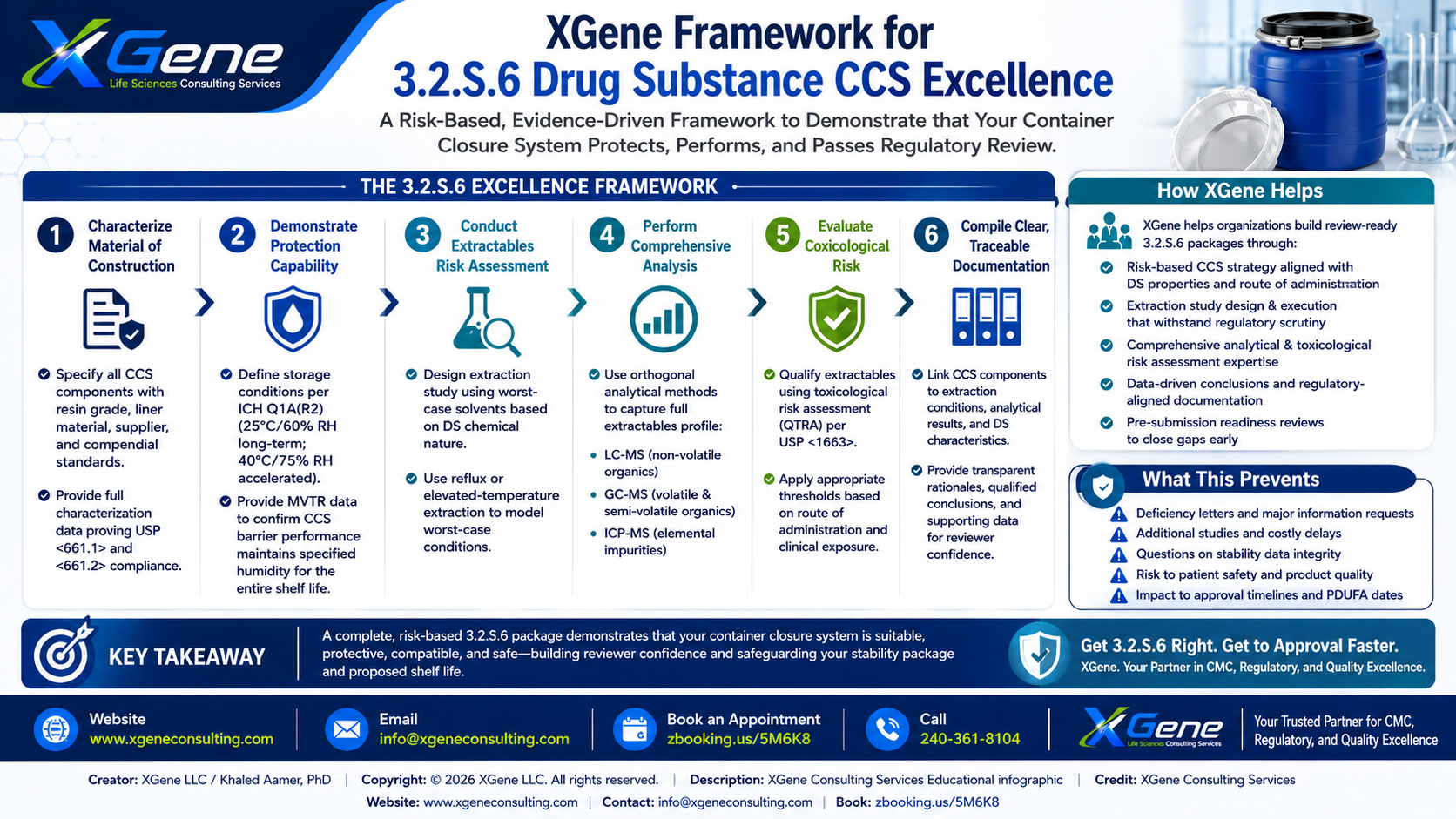
At that point, the conversation shifts from chemistry to consequences. A reviewer who cannot reconcile the CCS description in 3.2.S.6 with the packaging actually used on stability has grounds to question the integrity of every stability data point in 3.2.S.7. What began as a documentation gap in a single section has now implicated the entire stability package — and, by extension, the proposed shelf-life. Section 3.2.S.6 is not a procedural formality. It is the evidentiary record demonstrating that the material housing the drug substance during storage, shipment, and hold does not degrade the molecule or contaminate it with compounds of toxicological concern.
What 3.2.S.6 Must Demonstrate: Material Suitability, Protection, and Compatibility
The regulatory framework for 3.2.S.6 is anchored in the FDA Guidance for Industry: Container Closure Systems for Packaging Human Drugs and Biologics (1999), which establishes that the CCS must be shown to protect the dosage form from environmental factors, be compatible with the drug substance, and not contribute safety concerns from interactions between the packaging and the drug. For drug substances, the guidance draws a direct line between the route of administration of the eventual drug product and the scrutiny applied to the DS packaging — a high-risk designation that triggers a full extractables assessment applies when the DS will be used in a parenterally administered product, but even solid oral DS in hygroscopic form requires a documented protection capability argument. The 1999 guidance is not a checklist; it is a risk-stratification document, and applying it mechanically without matching the risk tier to the drug substance’s physicochemical properties is the first category of error that generates deficiency letters.
Material of construction documentation must go beyond naming the primary container. A CCS description that states “HDPE drum with liner” without specifying the HDPE resin grade, the liner material, the supplier, and the applicable compendial standard is substantively incomplete. Under USP <661.1> Plastic Materials of Construction and USP <661.2> Plastic Packaging Systems, an HDPE drum intended for pharmaceutical use must meet compliance with USP <661.1> and <661.2> requirements with full characterization data confirming compliance — this is the evidentiary standard, not the naming of the standard. FDA reviewers have issued deficiency letters citing exactly this gap: “The container closure system description does not specify the grade and supplier of the HDPE drum liner — please provide complete material specification.” When that language arrives after an NDA filing, the clock on your PDUFA date does not pause.
Compatibility with the drug substance’s physical and chemical properties is the third dimension that separates a complete 3.2.S.6 from an adequate one. A hygroscopic drug substance requiring storage at ≤30% relative humidity cannot be defended by a CCS description alone — the submission must include moisture vapor transmission rate (MVTR) data for the primary container confirming that the barrier performance of the HDPE drum and its liner system is sufficient to maintain the storage condition across the proposed shelf life. The ICH Q1A(R2) stability protocol assigns the accelerated and long-term storage conditions that the CCS must maintain, and those conditions — 25°C/60% RH long-term, 40°C/75% RH accelerated — define the minimum barrier performance requirement the CCS must satisfy.
The Extractables and Leachables Risk Assessment for Drug Substance Packaging
USP <1663> Assessment of Extractables Associated with Pharmaceutical Packaging/Delivery Systems defines the scientific framework for characterizing compounds that migrate out of packaging materials under controlled extraction conditions. For drug substance containers — particularly plastic drums, polyethylene liners, and elastomeric closures — the extraction study design must employ solvents that represent worst-case conditions relative to the chemical nature of the drug substance. An aqueous drug substance stored in an HDPE drum should be assessed using solvents covering a range of polarities, and a reflux or elevated-temperature extraction protocol should be specified to represent worst-case contact conditions. The analytical platform for characterizing extracts must cover non-volatile organics (LC-MS), volatile and semi-volatile organics (GC-MS), and elemental impurities (ICP-MS) — three orthogonal techniques because no single method covers the full chemical space of potential extractables from polyolefin or elastomeric components.
The failure mode in extraction study design that generates the most technically damaging deficiency responses is a mismatch between the extraction solvent and the drug substance’s actual contact conditions. A sponsor who conducts an aqueous-only extraction of an elastomeric closure used with a non-aqueous or hygroscopic DS has not conducted a worst-case study — the reviewer will note this, request a supplemental study, and require a complete assessment under USP <1663> before the section can be closed. The practical consequence is a response cycle that delays the submission timeline by the time required to design, execute, and analytically characterize a new extraction study — a minimum of several months for a well-resourced organization. The 1999 FDA Container Closure Guidance explicitly requires that the extraction study design reflect the conditions of use, not a generic protocol applied across all container types.
The threshold of toxicological concern framework is the analytical bridge between an extractable identified at a specific concentration and a regulatory decision about whether that extractable warrants further leachables characterization. USP <1663> applies the TTC concept to set a practical threshold below which individual extractables identified at trace levels do not require further safety evaluation, provided no structural alert for genotoxicity or high-potency activity is present. For a DS that will be used in a parenterally administered drug product, the TTC threshold is more restrictive than for solid oral dose, and the extractables risk tier assigned under the FDA Container Closure Guidance must be consistent with the drug product route. A submission where the DS CCS extractables assessment applies solid oral dose TTC thresholds for a parenteral DS will generate a deficiency requesting reclassification.
Qualification of Container Closure Systems: The Testing Program FDA Expects
The FDA Guidance for Industry: Stability Testing of Drug Substances and Drug Products (2003) reinforces the requirement established in ICH Q1A(R2) that stability studies be conducted in the container closure system that is representative of, or identical to, the commercial packaging. This is not a general expectation — it is the specific basis for one of the most common CCS-related deficiency patterns: the reconciliation failure. A submission where the 3.2.S.6 description specifies a 50L HDPE drum with a low-density polyethylene liner but the stability program was conducted using drums from a different supplier or with a different liner specification will receive a deficiency requesting that the discrepancy be resolved and the impact on stability data assessed. When that discrepancy is identified during review, the sponsor must either demonstrate that the two CCS configurations are equivalent in material specification and performance characteristics, or initiate a bridging stability study.
Qualification of the CCS for extreme conditions — shipping stress, temperature excursions, and humidity excursions during transit — is a component of 3.2.S.6 that is frequently deferred and equally frequently questioned in pre-NDA meetings. The 1999 FDA Container Closure Guidance addresses the requirement to demonstrate CCS integrity under conditions that simulate the distribution environment. For a drug substance requiring ≤30% RH storage, the qualification program must include data confirming that the sealed container maintains the specified humidity condition after simulated shipping stress — vibration, stacking, and temperature cycling that represents the actual distribution profile. A CCS that performs adequately under static laboratory conditions but fails after simulated shipping stress creates a shelf-life commitment that cannot be honored across the supply chain.
Re-use and re-qualification of returned or refurbished containers is a section of the CCS qualification program that most 3.2.S.6 packages address incompletely. Under cGMP requirements for containers (21 CFR 211.80–211.94), containers must be clean, non-reactive, and non-additive with respect to the drug substance. For drums that are returned and reconditioned for re-use, the qualification program must establish the criteria under which a returned container is accepted for re-use and the analytical testing required to confirm that residual contamination from prior use does not compromise the drug substance’s purity or stability profile. The absence of a re-use and re-qualification policy — or its presence as a procedural statement without supporting analytical criteria — is a gap that GMP inspectors identify with equal frequency as regulatory reviewers.
Writing a Container Closure Section That Connects to Stability Data and Storage Conditions
The XGene DS Container Closure Suitability Assessment is a four-domain evaluation framework designed to produce a 3.2.S.6 package that is defensible at review, consistent with the stability program in 3.2.S.7, and structured to close deficiencies before they are issued.
Step 1 — Material Compliance Audit: For each component of the CCS — primary container, liner, closure, secondary packaging — confirm USP/EP compendial designation and obtain current supplier Certificates of Conformance. For an HDPE drum, this means confirming compliance with USP <661.1> and <661.2> requirements with supporting extraction data from the supplier, not a general statement of compliance. A CoC that cites the standard without providing the characterization data is insufficient for submission purposes.
Step 2 — Extractables Risk Tier Classification: Apply the FDA Container Closure Guidance (1999) risk criteria to each component in contact with the DS. The classification is driven by three variables: the intended route of administration of the drug product, the duration of contact between the packaging component and the DS, and the physicochemical nature of the DS. The output of this step is a documented risk tier for each component that drives the extractables assessment requirement — high risk triggers a full USP <1663> extraction study; lower risk supports a literature- or supplier-data-based justification.
Step 3 — Protection Capability Cross-Reference: Obtain MVTR and, where oxidative degradation has been identified in forced degradation studies, OTR data for the primary container. Map these data points directly to the degradation pathways documented in 3.2.S.7 forced degradation and stability data. A hygroscopic DS with a documented moisture-dependent hydrolytic degradation pathway requires MVTR performance data that demonstrates the container maintains ≤30% RH under the worst-case storage condition specified in the ICH Q1A(R2) protocol. The cross-reference must appear explicitly in the submission — not as an implied connection, but as a documented technical justification.
Step 4 — Extractables Study Design (if triggered by Step 2): Define the solvent selection rationale based on the DS contact conditions, specify the extraction time and temperature parameters representing worst-case use, identify the three-platform analytical approach (LC-MS, GC-MS, ICP-MS), and establish the TTC-based evaluation criteria consistent with the drug product route of administration under USP <1663>. The analytical method sensitivity must be confirmed at concentrations below the applicable TTC threshold to ensure that a negative result is scientifically meaningful and not an artifact of insufficient method sensitivity.
The output of the XGene DS Container Closure Suitability Assessment is a structured technical memorandum that maps each CCS component to its compendial compliance record, its extractables risk tier, its protection performance data, and — where applicable — its extraction study design or data package, producing a submission-ready 3.2.S.6 section that anticipates and preempts the four deficiency patterns most frequently issued in this section.
The drug substance container closure system is the first physical defense the molecule has against the degradation environment — and it is the last element of the CMC package that most development teams treat with submission-level rigor. When 3.2.S.6 is built as an afterthought, the consequences appear in the stability data: an unexplained degradation impurity trending upward at accelerated conditions, a moisture content creep that the formulation team attributes to process variability, a failed hold-time study that the manufacturing group attributes to equipment. In each case, the investigation eventually arrives at the container. Building the evidentiary record in 3.2.S.6 before the submission — not after the deficiency — is the operational decision that separates a complete CMC package from one that generates a second review cycle.