
FDA 483 Laboratory Controls — Deep Dive for CMC Scientists
Laboratory controls 483 observations are the most frequently issued citation category in FDA drug manufacturing inspections — and they are almost always rooted in the same two failures: OOS investigation…
On this pageArticle overview
Laboratory controls 483 observations are the most frequently issued citation category in FDA drug manufacturing inspections — and they are almost always rooted in the same two failures: OOS investigation protocols that stop short of identifying a genuine root cause, and analytical data systems that cannot demonstrate the integrity of the result FDA is being asked to trust.
That sentence has been true for fourteen consecutive years of FDA inspection data, and it will remain true until quality organizations accept the structural reality behind it: the laboratory controls observation is not, at its core, a technical failure of analytical chemistry. It is a failure of the quality system to ensure that every test result reported against a batch specification represents the true quality of that batch — and that any result falling outside expectation is investigated to a genuine scientific conclusion. The financial and regulatory stakes could not be higher. A Warning Letter citing laboratory controls failures triggers FDA’s authority to refuse to accept regulatory submissions from the affected facility, and in a filing-dependent development program, that consequence lands faster than any CAPA timeline.
Why Laboratory Controls Is the Most-Cited 483 Category for 14 Consecutive Years
The operative regulatory language that generates the greatest inspection friction lives in 21 CFR 211.192, which requires that laboratory records include the results of all tests performed and, critically, that any test result that falls outside specifications or established standards be investigated. The regulation does not say “investigated when convenient” or “investigated unless a retest passes.” It requires investigation of every out-of-specification result, and FDA’s 2006 Guidance for Industry on Investigating Out-of-Specification (OOS) Test Results for Pharmaceutical Production operationalizes that requirement into a three-phase structure that most laboratory programs claim to follow but fail to execute with the specificity the guidance demands. The gap between claiming compliance and demonstrating compliance is precisely where investigators write their observations.
The reason this category has dominated inspection data for fourteen consecutive years is not that analytical chemists have become less competent. It is that the fundamental design of most laboratory investigation programs creates a structural incentive to close OOS investigations quickly and favorably rather than rigorously. When an investigation can be closed by attributing the OOS result to “analyst error” — an attribution that is nearly impossible to disprove after the fact — the path of least operational resistance is to document that attribution, retest, obtain a passing result, and release the batch. FDA’s 2006 OOS Guidance explicitly prohibits this practice: an OOS result cannot be invalidated based solely on the fact that a subsequent retest passes. Invalidation requires a specifically identified, documented assignable cause — the specific procedural error, the specific step at which it occurred, and the specific evidence confirming it was an error and not a true OOS signal.
The companion regulation, 21 CFR 211.160, establishes the general requirements for laboratory controls and mandates that laboratory controls include the establishment of scientifically sound and appropriate specifications, standards, sampling plans, and test procedures. When FDA investigators walk into a laboratory and begin pulling OOS investigation files, they are not conducting a technical audit of method chemistry. They are auditing whether the quality system enforces a standard of scientific rigor that ensures every batch released to market has been evaluated against specifications in a manner that can withstand forensic review. The distinction matters enormously for how you prepare.
The Four Laboratory Control Failures That Most Frequently Escalate to Warning Letters
The first failure pattern — and the one most reliably associated with Warning Letter escalation rather than a single 483 observation — is invalidating an OOS result based on a passing retest without a documented, specifically identified assignable cause. FDA’s 2006 OOS Guidance is unambiguous: if Phase 1 laboratory investigation cannot identify a specific error in analyst technique, instrument performance, sample preparation, standard preparation, or calculation, the result cannot be invalidated. The investigation must advance to Phase 2, which expands to the manufacturing process, batch records, and raw material testing history. Programs that terminate investigation at Phase 1 the moment a retest passes — without identifying what went wrong in the original analysis — are doing exactly what the guidance prohibits, and experienced investigators recognize the pattern within the first file they review.
The second failure is retest design that introduces systematic bias. FDA’s 2006 guidance addresses this directly: the analyst who generated the original OOS result should not be the analyst performing the retest, because the ability to identify whether the original error was real depends on eliminating analyst-specific variables through independent execution. Phase 3 retesting calls for six additional determinations, and all results must be considered — they cannot be selectively averaged or stratified to report a favorable mean while suppressing the outliers. Quality programs that allow selective averaging of OOS with passing retest results to produce a reportable mean in specification are invalidating data through arithmetic rather than through scientific investigation, and FDA’s enforcement record on this specific practice is unambiguous.
The third and fourth failure patterns are analytically related: stability OOS results treated as isolated chamber anomalies rather than escalated for manufacturing investigation under Phase 2, and OOS results for degradation products investigated using analytical methods not validated for those specific degradants. Under ICH Q2(R2), adopted by ICH in 2023 and issued as final FDA guidance in March 2024, replacing the earlier Q2(R1) framework, the specificity of an analytical procedure must be demonstrated against all potential interferents — including degradation products arising from the storage conditions that produced the OOS result. When the method was never validated to resolve or quantify the specific degradant generating the OOS signal, the root cause of the assay interference is analytically undetectable, and no amount of retesting will produce a scientifically defensible investigation closure.
OOS Investigations, Audit Trails, and Reference Standards: The Three Linked Failure Systems
The connection between OOS investigation failures and data integrity observations in the same inspection is not coincidental — it is mechanistic. When an investigator reviews an OOS investigation file and finds that the Phase 1 laboratory investigation relied on a paper logbook review without electronic raw data examination, the next document request is predictable: the audit trail from the analytical instrument. 21 CFR 211.68 requires that automatic, mechanical, and electronic equipment used in the manufacture, processing, packing, or holding of a drug product — which includes laboratory analytical systems — be routinely calibrated, inspected, or checked according to a written program, and that backup data be maintained. The audit trail is not optional documentation; it is the evidentiary record of whether the result FDA is being asked to trust was generated under controlled conditions and has not been altered after the fact.
The instrument qualification dimension of laboratory controls failures is systematically underweighted in most preparation programs. USP <1058> establishes a four-level qualification hierarchy — Design Qualification, Installation Qualification, Operational Qualification, and Performance Qualification — and the regulatory consequence of an instrument operating outside the bounds of its current IQ, OQ, or PQ is that every result generated on that instrument during the out-of-qualification period is analytically suspect. This is not a theoretical regulatory position. When an investigator finds an HPLC system with an expired or lapsed performance qualification, every OOS investigation that relied on data from that instrument during the qualification gap becomes simultaneously a data integrity question and a potential basis for batch disposition review. The failure multiplier from a single qualification gap can render years of batch release data questionable in a single inspection day.
The thesis that runs through all of these failure patterns is the one stated at the outset: laboratory controls observations are not about whether your analytical methods are technically sound. They are about whether your quality system ensures that every result reported for a batch release, every OOS investigation closed in your records, and every instrument generating data on your laboratory floor can survive the specific, document-level scrutiny that an experienced FDA investigator applies. The technical quality of your methods is almost never the variable that generates the Warning Letter. The integrity of the investigation, the completeness of the audit trail, and the specificity of the documented root cause are the variables that determine whether a 483 observation closes as a VAI or escalates to enforcement action.
Building Laboratory Controls That Survive Forensic FDA Review
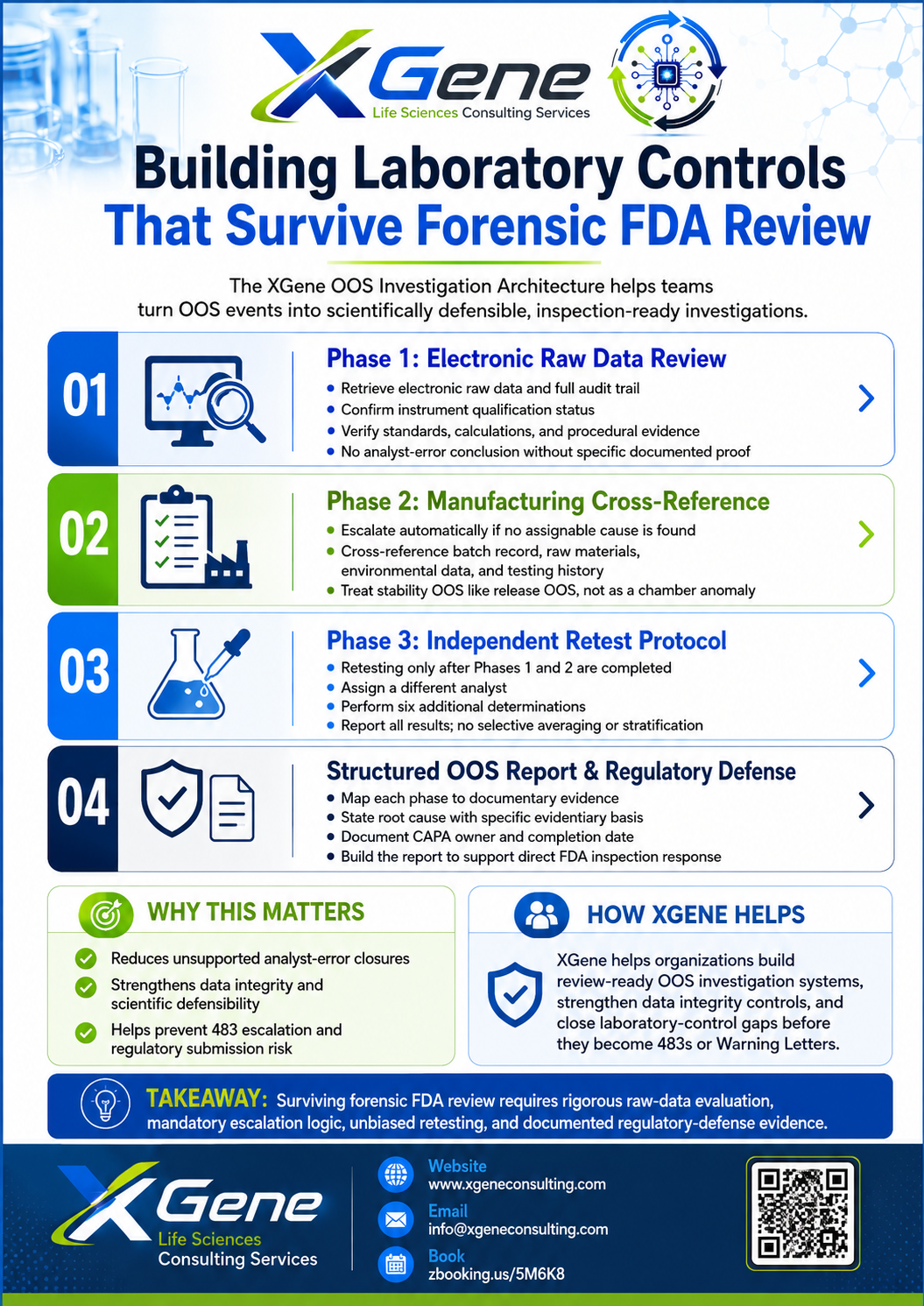
The XGene OOS Investigation Architecture is a structured three-phase protocol built directly against FDA’s 2006 OOS Guidance and designed to eliminate the investigation closure practices that most frequently generate Warning Letter language.
Step 1 — Phase 1 Electronic Raw Data Investigation: Before any assignable cause determination is documented, the Phase 1 checklist requires retrieval and review of the electronic raw data and complete audit trail from the analytical instrument — not just the paper logbook entry. The reviewer confirms instrument qualification status, verifies standard preparation against the weighing records, and traces the calculation from raw instrument output to reported result. No “analyst error” assignable cause is permissible without identifying the specific step, the specific deviation from the written procedure, and the specific evidentiary basis in the raw data record that confirms the error occurred.
Step 2 — Phase 2 Manufacturing Cross-Reference Investigation: If Phase 1 produces no documented assignable cause, the investigation advances automatically and without optional escalation to a manufacturing process review. The Phase 2 protocol cross-references the OOS result against the batch manufacturing record, the raw material release records for the lot in question, any environmental monitoring data from the manufacturing period, and the full testing history for the product and the analytical method. Stability OOS results receive the same Phase 2 protocol as release OOS results — they are not treated as chamber anomalies.
Step 3 — Phase 3 Retest Protocol with Independent Analyst Assignment and Statistical Framework: Retesting proceeds only after Phase 1 and Phase 2 are complete and documented. The retest is assigned to an analyst who did not generate the original OOS result. Six additional determinations are performed. All results — including any that do not conform to specification — are reported in the investigation summary and considered in the final disposition determination. No selective averaging. No stratification. The statistical framework documents the full distribution of results and the basis for the batch disposition decision.
Step 4 — OOS Investigation Report with Regulatory Defense Mapping: The investigation closes with a structured OOS investigation report that maps each investigation phase to its documentary evidence, states the root cause finding with its specific evidentiary basis, and identifies any CAPA commitments with owner and completion date. The report is formatted to serve as the direct response document to a 483 observation — not as an internal quality record that must be translated under pressure during an inspection.
The output of the XGene OOS Investigation Architecture is an investigation report that eliminates unsubstantiated analyst error conclusions and produces the specific, document-level evidence trail that FDA investigators expect to find when they pull an OOS file during an active inspection.
The cost of laboratory controls failures is never limited to the observation itself. A single Warning Letter citing OOS investigation deficiencies suspends FDA’s review of pending applications from the affected facility, stops commercial distribution conversations, and triggers the kind of media and investor attention that no quality organization can absorb quietly. More damaging than any single enforcement action is the institutional pattern it reveals: a quality system that has been releasing batches on the basis of test results it cannot scientifically defend. That pattern does not disappear when the CAPA is closed. It persists in every OOS investigation file from the previous three years that FDA is now entitled to review during the next inspection. Correcting the program means building the investigation architecture correctly from the first OOS forward — not retrofitting closed files after the observation is issued.