
Huons Co. Warning Letter: Data Integrity and the CMC Pattern Every Sterile Products Quality Director Must Recognize
On June 15, 2026, FDA issued Warning Letter 320-26-95 to Huons Co., Ltd., a drug manufacturing facility located at 100 Bio Valley-ro, Jecheon, Chungcheongbuk, South Korea, citing systemic data integrity…
On this pageArticle overview
On June 15, 2026, FDA issued Warning Letter 320-26-95 to Huons Co., Ltd., a drug manufacturing facility located at 100 Bio Valley-ro, Jecheon, Chungcheongbuk, South Korea, citing systemic data integrity violations following an inspection conducted November 12–21, 2025. The primary finding was not a laboratory anomaly or an isolated documentation error — it was a coordinated, deliberate destruction and fabrication of microbiological testing records, executed by a team leader who instructed staff to discard bioburden plates with significant growth, manipulated camera timestamps to create backdated documentation, and used a knife to physically remove completed pages from logbooks, replacing them with fabricated entries that omitted failing results. FDA also found 1,897 blank, uncontrolled CGMP-related forms in the microbiology laboratory — a finding that, by itself, signals the infrastructure for large-scale pre-signed record falsification. The facility has since suspended all drug production for the U.S. market, committed to a voluntary recall of all distributed product within expiry, and been placed on Import Alert 66-40 as of April 3, 2026.
For practitioners managing sterile product manufacturing operations, this warning letter demands a specific reading: data integrity failures in aseptic processing environments are not just record-keeping violations. They are product safety events. When bioburden results indicating significant microbial contamination are discarded rather than investigated, the batches those results were meant to protect have been released without adequate microbiological characterization. The downstream consequence is not a CAPA form — it is a voluntary recall and import alert affecting every product in distribution.
The Core Pattern: Physical Record Destruction and the ALCOA+ Collapse
The pattern FDA documented at Huons fits one of the most destructive forms of data integrity failure in pharmaceutical manufacturing: physical record destruction combined with fabricated replacement documentation. This is categorically different from a shared login credential issue or a missing audit trail entry. Under ALCOA+, every data record must be Attributable, Legible, Contemporaneous, Original, Accurate, Complete, Consistent, Enduring, and Available. The moment a team leader instructs analysts to discard physical test samples and replace logbook pages with backdated fabrications, every one of those nine attributes is simultaneously violated. The regulatory precedent for this failure pattern is unambiguous. Ranbaxy Laboratories’ Paonta Sahib facility, placed under Import Alert 66-40 in 2008, documented a nearly identical failure mechanism: analysts selectively reporting passing chromatographic results while discarding failing runs, with the systematic nature of the behavior confirmed only when FDA investigators recovered deleted audit trail data. Ranbaxy’s import alert covered more than 30 marketed drug products and ultimately led to criminal charges under the Federal Food, Drug, and Cosmetic Act in 2013. The Huons situation adds an aseptic processing dimension that amplifies the patient safety stakes beyond what a pure analytical laboratory integrity case would imply.
FDA’s second observation — the inadequate OOS investigation — reinforces the systemic quality unit failure. When a batch failed initial testing due to unknown impurities, Huons’ investigative approach involved preparing a second sample using glassware marked for disposal to simulate contaminated glassware as the root cause hypothesis, then using the passing hypothesis test result to invalidate the original OOS. This is not an investigative approach that satisfies 21 CFR 211.192 or FDA’s 2006 Out-of-Specification Guidance, which — building on FDA v. Barr Laboratories (D.N.J. 1993) — requires identification and documentation of a specific, scientifically assignable laboratory error before an OOS result can be invalidated. Constructing a simulation using already-condemned materials to generate a passing outcome, and then using that simulated outcome as retrospective justification for invalidation, inverts the entire purpose of an OOS investigation. FDA’s finding here is not that the hypothesis was implausible — it is that the hypothesis was never validated with the original materials and conditions, rendering the invalidation scientifically insupportable.
Aseptic Processing Deficiencies and the Enforcement Precedents
The third and fourth observations shift to aseptic processing deficiencies: smoke studies demonstrating turbulent airflow in ISO 5 critical areas during ampoule filling, operators with their heads and upper bodies fully inside Grade A areas and blocking first air over critical filling surfaces, and inadequate glove monitoring and disinfection procedures for the restricted-access barrier system (RABS). These findings are directly consequential to the data integrity picture. If bioburden results from the compounding tank and transfer line were being falsified — with plates showing significant growth discarded and records backdated — then the environmental monitoring data on which those aseptic processing operations were premised may similarly not represent the true microbiological state of the facility. FDA’s requirement for a comprehensive, independent contamination hazards risk assessment, dynamic smoke studies under worst-case conditions, and a remediated media fill program is not a standalone remediation exercise; it must be understood in the context of a facility where the microbiological data infrastructure has been compromised.
Sun Pharmaceutical Industries’ Halol facility, which received a Warning Letter in 2014 for audit trail manipulation and backdated laboratory records in its Empower chromatography data system, illustrates the remediation trajectory that follows systemic data integrity findings. Sun Pharma’s corrective action required a complete data integrity audit of all marketed product batches, re-evaluation of more than 40 stability studies, and an 18-month FDA reinspection cycle before the Halol facility was released from heightened scrutiny. The Huons remediation path is likely to be at least as demanding, and in several respects more complex: the violations span microbiology, physical chemistry (the warning letter notes recurring data integrity issues with total organic carbon testing in the physical chemistry lab), and aseptic processing controls simultaneously.
The Corrective Action Demands and Actionable Takeaways
FDA’s treatment of the third-party assessment report deserves specific attention from quality and legal teams at any facility currently managing a post-inspection investigation. Huons initially committed to providing the interim and final reports from an independent third-party assessment initiated in response to FDA inspectional findings. The company subsequently reclassified the assessment as an “internal audit” and declined to provide the reports. FDA explicitly rejected this characterization, stating that an investigative assessment initiated in response to FDA inspectional findings — rather than as part of a routine written quality assurance program — is subject to routine FDA review under 21 CFR 211.192 and 211.22. This is a significant enforcement posture: companies should not assume that third-party assessments commissioned as a direct response to FDA inspectional findings fall within the protections applicable to voluntary internal quality audits. Legal and regulatory teams need to be aligned on this distinction before any post-inspection investigation is initiated.
The corrective action demand in this warning letter is among the most comprehensive FDA has issued in recent years for a sterile manufacturing site. It includes a detailed investigation protocol covering all laboratories and manufacturing operations, interviews of current and former employees, a current patient risk assessment for all distributed product, a management strategy covering both interim and long-term remediation, a commitment to annual audits by a qualified consultant for at least two years, and a requirement to contract a third party to be physically present in the microbiology laboratory to oversee sampling and analysis of all U.S. market drug products. That last requirement — a third-party observer present for every microbiological analysis — reflects FDA’s determination that internal oversight at this facility cannot be trusted to produce reliable data without external verification.
For quality directors and CMC teams managing sterile product manufacturing, the actionable read from this warning letter is as follows. Data integrity in aseptic processing is not separable from product sterility assurance. If environmental monitoring and bioburden data are unreliable, no process validation study or media fill result can be interpreted with confidence, because the underlying microbiological state of the facility is unknown. The audit trail, the logbook, and the culture plate are all part of the same evidentiary chain that supports batch release decisions. Compromising any link in that chain compromises the disposition decision for every batch that depended on it.
XGene Data Integrity Remediation Framework for Sterile Product Manufacturers
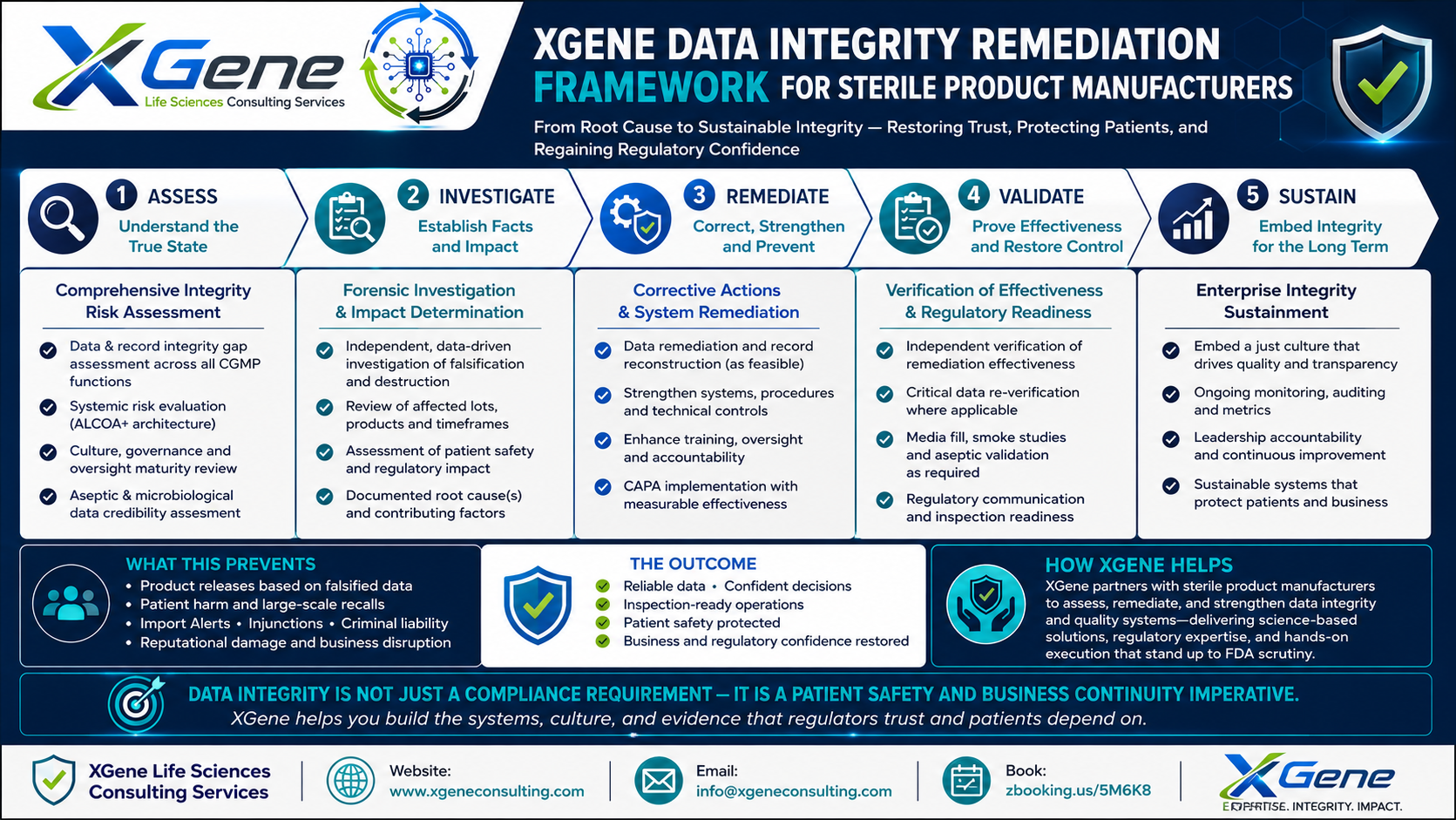
Companies facing similar quality system exposure — whether in microbiological testing, OOS investigation practices, or aseptic processing controls — need a structured remediation approach that addresses root causes at the management and cultural level, not just the procedural level. XGene Consulting provides Warning Letter and FDA 483 remediation support, including root cause assessment, CAPA design, data integrity remediation, ALCOA+ implementation per ICH Q9(R1), and reinspection preparation for sterile and aseptic manufacturing operations.
Key pillars of the XGene approach:
1. Forensic-Level Data Integrity Audit: Conduct a comprehensive review of all laboratory and manufacturing data systems — including logbooks, audit trails, and blank form inventories — to identify the full scope of potential fabrication or deletion.
2. Cultural Root Cause Assessment: Go beyond procedural gaps to identify the management culture that permitted deliberate record manipulation to occur without detection or intervention.
3. Aseptic Processing Revalidation: In sterile product environments, data integrity failures require full revalidation of contamination control strategies — including smoke studies, media fills, and environmental monitoring programs.
4. Third-Party Observer Program: For facilities with compromised internal oversight, implement an independent third-party observer program to verify data integrity in real time during microbiological analysis.
5. FDA Communication Protocol: Establish a proactive, transparent FDA communication strategy that avoids the “internal audit” trap and positions the remediation program for reinspection clearance.
The Huons enforcement action will be studied in the industry for years; the companies that learn the most from it are the ones that treat it as a mirror before FDA arrives at their facility.