
ALCOA+ Attributability — Why Shared Logins Become Warning Letters
The shared laboratory login is one of the most common data integrity violations FDA finds during inspections — and it is also one of the most dangerous, because a shared…
On this pageArticle overview
The shared laboratory login is one of the most common data integrity violations FDA finds during inspections — and it is also one of the most dangerous, because a shared login means that no result in that system can be attributed to a specific analyst, which means FDA cannot determine whether any result in that system is trustworthy.
That sentence is not regulatory hyperbole. It is the operational logic of attribution enforcement, and it explains why shared credentials appear not as footnotes in FDA Warning Letters but as anchor citations — foundational findings that call into question every other piece of data the facility has ever submitted. The shared login is not a configuration error. It is an evidentiary collapse.
The Regulatory Requirement: Why Attributability Is the Foundation of ALCOA+
Attributability is the first letter in ALCOA+ for a structural reason: every other element of the data integrity framework depends on it. Contemporaneous documentation requires that a timestamp be attached to an identified individual. Accuracy requires that if a result is challenged, the person who generated it can be identified, interviewed, and their training record evaluated. Completeness requires that every entry in a sequence — including voided runs, failed injections, and aborted analyses — be traceable to the person who made the decision to exclude or include them. When attribution breaks down, every downstream data integrity assurance breaks with it. FDA’s 2018 Guidance for Industry: Data Integrity and Compliance with Drug CGMP states this directly: data must be attributable to the person generating it, meaning records must be created in a way that identifies who recorded the result, when, and on what basis.
The regulatory architecture beneath attributability spans several interlocking requirements. Under 21 CFR Part 11.10(d), closed computer systems used to create, modify, maintain, archive, retrieve, or transmit electronic records must use authority checks to ensure that only authorized individuals can use the system, access operation or computer input or output devices, alter a record, or perform operations. That language does more than mandate password protection — it requires that the system know, at the moment of every transaction, which individual is acting. A shared credential cannot satisfy this requirement because the system has no mechanism to distinguish which of the multiple persons holding that credential initiated any given action. The authorization check passes at login; the attribution requirement fails with every subsequent keystroke.
Under 21 CFR 211.68(b), backup data are to be exact and complete, and the security and integrity of backup data are to be maintained through appropriate controls including limited access to computer systems. The access limitation requirement presupposes that access is individualized — that granting or revoking access to a specific person has operational meaning. In a shared-login environment, revoking one person’s access means revoking everyone’s access, which means access controls are effectively unenforceable. The regulatory requirement for limited access collapses into incoherence when the credential is not individual.
Under 21 CFR Part 11.50, electronic signatures must contain the printed name of the signer, the date and time of signing, and the meaning — such as review, approval, responsibility, or authorship — associated with the signature. An electronic signature executed under a shared credential cannot satisfy the printed name requirement in any meaningful sense, because the name displayed is that of the account, not necessarily the individual currently at the keyboard. When an analyst uses a supervisor’s login to approve a batch result because the supervisor is unavailable and the release timeline is pressing, the electronic signature on that record is not the supervisor’s signature — it is a fabrication that satisfies the display requirement while violating the attribution requirement in full.
The consequence of these overlapping failures is not limited to the observations they generate in isolation. Under 21 CFR 211.192, all laboratory records must include complete data derived from all tests necessary to assure compliance with specifications and standards, and any test result falling outside specifications must be investigated. That investigation requires identifying who performed the analysis, when, and under what conditions. If the login record shows a shared credential, the investigation cannot establish that the analyst who performed the analysis was the analyst logged in — and it cannot eliminate the possibility that the result was generated, modified, or reviewed by any of the people sharing that credential. The OOS investigation is compromised before it begins.
This is the structural argument for why attributability is not simply one element among nine in the ALCOA+ framework. It is the precondition for every other element’s enforceability. MHRA’s GMP Data Integrity Definitions and Guidance for Industry (2018) reinforces this: data should be attributable to the person generating it, and where data is generated automatically by equipment, the equipment itself should be identified. The requirement for equipment identification in automated systems exists precisely because equipment attribution — serial number, calibration record, qualification status — is the surrogate for individual attribution where human action is absent. In a human-operated system, individual attribution has no substitute.
Shared Logins in Practice: Chromatography Software and the Generic User Problem
The most frequently observed shared-login scenario in FDA inspections is not the deliberate circumvention of access controls — it is the historical accumulation of convenience decisions made by people who did not consider data integrity consequences at the time. A laboratory installs a chromatography data system with a default account called “labuser” or “admin.” Analysts use that account because it is the path of least resistance during system commissioning. The account never gets replaced with individual credentials because no one writes a procedure requiring the replacement, and the software validation did not include user account architecture as a validation requirement. Five years later, an FDA investigator sits down at the HPLC workstation during an inspection and pulls the audit trail. Every injection sequence, every calibration run, every integration parameter adjustment for five years of GMP data is attributed to “labuser.” Every batch released on the basis of data generated on that instrument is now a data integrity problem.
The chromatography data system is the most common site of this failure because the software categories most widely deployed in pharmaceutical laboratories — including legacy versions of platforms that were not designed with individual attribution as an architectural requirement — permitted generic accounts as a default. Firms that validated these systems a decade ago frequently validated the instrument performance without validating the user account architecture, because Part 11 compliance was treated as a separate workstream from instrument qualification rather than as an integrated component of the validated state. The result is a generation of validated systems whose validation documentation is technically complete but whose attribution architecture is fundamentally non-compliant.
Generic account names are only one variant of the shared-login problem. The second variant is individual accounts with shared passwords — an arrangement that satisfies the display requirement for named accounts while completely defeating the attribution requirement, because anyone who knows the password can log in under any name. FDA investigators are trained to identify this pattern not through the account name but through behavioral forensics: simultaneous logins from the same account on different workstations, logins at times inconsistent with the registered user’s shift schedule, logins by an account associated with a terminated employee whose access was never revoked. The 2018 FDA guidance explicitly addresses the investigative technique of cross-referencing login times with timesheets, badge access records, and batch production schedules. When an account shows a login at 02:30 on a Saturday for a facility that operates Monday through Friday day shift, the investigator does not need a confession — the metadata has already provided the attribution failure.
The third variant, and the one with the most serious segregation-of-duties implication, is the supervisor or manager login used by an analyst. This scenario typically arises from operational necessity: an analyst needs to approve a result or advance a workflow step that requires supervisor-level permissions, the supervisor is unavailable, and the shared credential is used to complete the task. Under 21 CFR 211.192 and the FDA 2018 guidance, the person who performs a test must be identified in the record, and the person who reviews and approves the result must be separately identified. When the analyst and supervisor share a credential, those two identities collapse into one account, and the segregation of duties that the approval workflow was designed to enforce becomes unenforceable. FDA’s investigation of this failure is straightforward: if the supervisor’s account shows a login and approval action during a period when badge access records place the supervisor in a different building or off-site entirely, the attribution is demonstrably false.
The LIMS presents a related but distinct set of attribution risks. Unlike chromatography data systems, which may have been deployed before robust user management was a standard feature, modern LIMS platforms are generally capable of enforcing individual authentication. The failure mode in LIMS is therefore less often architectural and more often procedural: account sharing by analysts covering for absent colleagues, training accounts used in production environments, test accounts left active after qualification, and departed employees whose accounts remain enabled in the live system. Each of these creates a population of records in the LIMS that cannot be definitively attributed to an identified individual at the time of the data entry — and under the FDA 2018 guidance, a record that cannot be attributed is a record that cannot serve as reliable evidence of compliance.
How FDA Investigators Identify Attributability Failures Without Informant Tips
The attribution investigation that FDA investigators conduct during a data integrity inspection is a structured forensic methodology, not a document review. Understanding its mechanics is essential for any quality organization that intends to identify and remediate attributability failures before they are found during an inspection rather than after.
The primary investigative tool is metadata cross-referencing. An FDA investigator reviewing a chromatography data system will pull the complete audit trail for a representative sample of batch release data — typically spanning at least twelve to eighteen months — and construct a timeline of login events, data creation timestamps, modification records, and approval actions attributed to each user account. That timeline is then cross-referenced against three independent data sources: the facility’s timekeeping records for each analyst, the building access control system’s badge-in and badge-out records, and the batch production schedule showing when specific products were manufactured and what the testing window was. The intersection of these four data streams produces a forensic attribution map that does not depend on any person’s account of events.
When the map reveals a login attributed to an analyst who was not badged into the building at the time — or who was badged into a building on a different campus — the investigator has documented an attribution failure without asking a single question. When the map shows simultaneous active sessions under the same credential on two different workstations, the shared-login inference is available without any admission. When the map shows a pattern of logins on weekends or outside normal working hours that is inconsistent with the facility’s operating schedule and the analyst’s timesheet, the investigator begins building a case that someone with access to the credential was logging in without authorization — or that the credential was shared among individuals whose schedules do not overlap.
The second investigative technique is statistical pattern analysis of user-level behavior. Experienced FDA investigators will tabulate, by user account, the distribution of actions that affect data: the frequency of integration parameter adjustments, the rate of injection voids, the number of result modifications made between initial data entry and final approval, and the time elapsed between those actions. When one account shows a statistically anomalous rate of result modifications — or when modifications consistently occur during a period that the metadata associates with another analyst’s login session — the investigator has identified a potential attribution irregularity that will generate additional document requests. This technique does not require catching anyone in the act. It requires only that the audit trail contain enough entries to produce a distribution, and that the distribution contain enough anomalies to be distinguishable from random variation.
The third technique, and the one that most frequently produces the connecting evidence that converts a 483 observation into a Warning Letter referral, is the comparison of electronic data system records against paper batch records for the same analytical events. When a paper batch record entry shows an analyst’s initials and a result reported at 10:45, and the chromatography data system audit trail shows that the result was generated — or modified — under a different user account at 14:32, the internal chronological inconsistency is an evidentiary conflict that the facility cannot resolve in its favor. The paper record and the electronic record cannot both be correct. One of them is wrong, and the investigator’s default interpretive posture is that neither can be trusted.
This is the evidentiary foundation for the Warning Letter language that follows shared-login findings: FDA does not merely cite the shared credential as a technical Part 11 gap. FDA characterizes the entire dataset generated under that credential as non-attributable — which means non-reliable — which means every regulatory submission, every batch release record, and every OOS investigation that relied on data from that system is now the subject of a retroactive credibility question. The scope of exposure from a single shared-login finding is not bounded by the finding itself. It is bounded only by how far back the shared credential was in use and how much GMP data was generated under it.
The XGene User Access Control and Attribution Assurance Framework
Eliminating Non-Attributable Data Before FDA Finds It
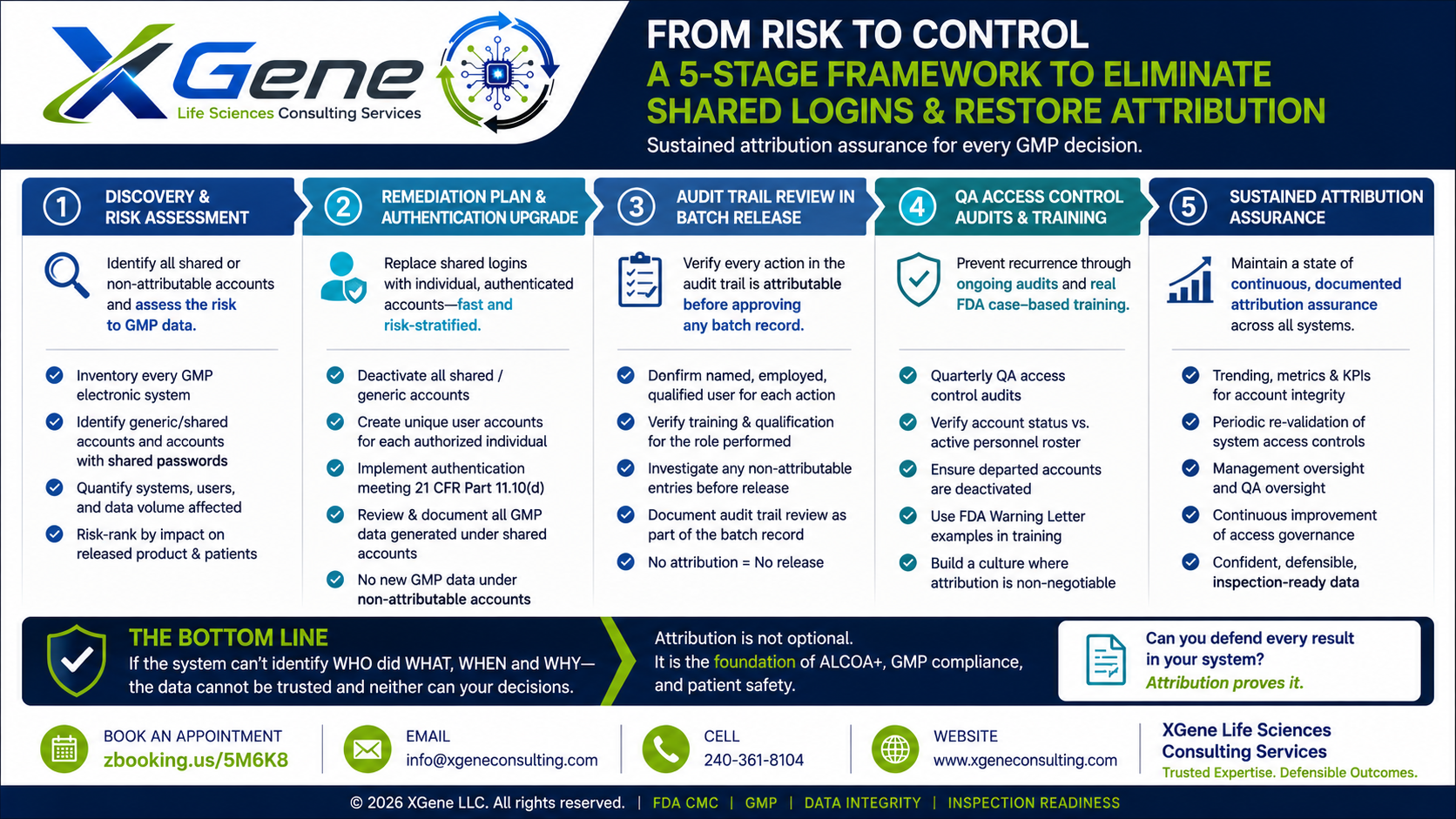
The XGene User Access Control and Attribution Assurance Framework is a structured four-stage program designed to identify every attributability gap in a GMP electronic data environment, remediate the configuration and procedural failures that created those gaps, and establish ongoing controls that prevent recurrence.
Stage 1 — Individual Account Audit and Shared Login Identification: A systematic inventory of every GMP electronic system — chromatography data systems, LIMS, ELN, balance data systems, environmental monitoring systems, manufacturing execution systems, and any other system that generates, modifies, or approves GMP records — is conducted to enumerate every active user account, every inactive account, every generic or system account (including accounts named “admin,” “labuser,” “process,” “test,” or any non-personal designation), and every account associated with departed personnel. Each account is classified as individual-attributed, potentially shared, or definitively non-attributable. The output of Stage 1 is a User Account Attribution Risk Register that identifies every account type, its current status, the volume of GMP data generated under it, and the date range of that data.
Stage 2 — Remediation Plan: Account Segregation and Authentication Upgrade: For every account identified as shared or non-attributable, a time-bounded remediation plan is developed that includes deactivation of the shared account, creation of individually authenticated accounts for each authorized user, authentication upgrade to meet the requirements of 21 CFR Part 11.10(d), and — where technically feasible — audit trail review to identify and document all GMP data generated under the non-attributable account during its period of active use. Remediation timelines are risk-stratified: systems associated with released commercial batches receive immediate priority; systems associated with development or non-GMP activities receive secondary priority. No new GMP data may be generated under a shared or generic account after remediation plan execution begins.
Stage 3 — Audit Trail Review as Part of Batch Record Release: Following remediation, a retrospective audit trail review protocol is implemented as a standing component of batch record review for all affected systems. The review checklist requires that the reviewer confirm, for each batch record reviewed, that every login, data entry, result generation, modification, and approval action in the electronic system audit trail is attributed to a named, currently employed individual whose training record confirms qualification for the action performed. Any entry that cannot be so attributed is escalated for quality investigation before the batch record is approved for release. This review is documented and retained as part of the batch record.
Stage 4 — Periodic QA Access Control Audit and Training Using FDA Warning Letter Case Examples: A quarterly QA access control audit reviews each GMP electronic system’s current user account list against the active personnel roster, verifies that departed personnel accounts have been deactivated, confirms that no generic or shared accounts have been reactivated, and documents the review. The training program for laboratory personnel and QA reviewers is built around specific FDA Warning Letter case examples demonstrating the evidentiary consequences of shared logins — specifically, how FDA investigators used metadata cross-referencing to identify attribution failures and how those findings were translated into Warning Letter language characterizing entire datasets as non-attributable. Using actual enforcement language in training produces a more durable behavioral change than abstract compliance instruction, because it demonstrates to analysts and supervisors alike the precise mechanism by which a shared password becomes a facility-wide data integrity finding.
The output of the framework is not a completed remediation project. It is a sustained attribution assurance program that produces, at every batch release decision, a documented confirmation that the data supporting that decision can be attributed to specific, identified, qualified individuals — the evidentiary standard FDA applies when it opens your data system during an inspection.