
Chiral Drug Substances: Stereospecific Synthesis, Enantiomeric Purity, and the ICH Q6A Specification Strategy
More than half of the small molecule drugs approved by FDA in any given year contain at least one stereocenter. For most of those programs, the enantiomeric impurity is not…
On this pageArticle overview
More than half of the small molecule drugs approved by FDA in any given year contain at least one stereocenter. For most of those programs, the enantiomeric impurity is not just a quality parameter — it is a safety and efficacy variable that FDA reviewers evaluate in depth. The question is not whether to specify enantiomeric purity. The question is whether your specification, your analytical method, and your racemization risk assessment form a coherent, scientifically defensible argument — or whether they were assembled independently and reveal their disconnection only under reviewer scrutiny.
For a CMC or regulatory affairs leader evaluating a chiral API program, this disconnect rarely surfaces until an FDA information request lands mid-review, adding months to an approval timeline. The fix costs far less before submission than after a deficiency letter, and it starts with treating chirality as one integrated regulatory argument rather than three deliverables assigned to three functions.
The ICH Q6A Decision Tree for Chiral Impurities: What It Actually Requires and Where Submissions Diverge
ICH Q6A Specifications: Test Procedures and Acceptance Criteria for New Drug Substances and New Drug Products: Chemical Substances (1999) resolves this through Decision Tree #5, and its logic is more precise than most CMC teams treat it. Step 1 asks whether the drug substance is a single enantiomer; if yes, Step 2 asks whether racemization is possible during synthesis or drug product manufacture; if racemization is possible, Step 3 asks whether the other enantiomer carries significantly different pharmacological or toxicological activity. A “yes” at Step 3 mandates a separate specification for the enantiomeric impurity — not an identity test, a quantitative acceptance criterion tied to activity data.
Where submissions diverge from this logic is at Step 3’s third branch: unknown activity difference. FDA does not accept “not evaluated” as a stopping point — the agency expects pharmacological characterization of the enantiomer before the specification is finalized, a position rooted in the FDA Guidance for Industry: Development of New Stereoisomeric Drugs (1992), which established that both enantiomers’ activities must be characterized rather than assumed. The regulatory record traces this obligation directly to thalidomide, where the (R)-enantiomer is the sedative and the (S)-enantiomer is the teratogen — the paradigm case FDA guidance cites for why chiral impurity control is a safety variable, not a quality nicety.
Racemization Risk Assessment and In-Process Control: Linking Synthesis Mechanism to CMC Evidence
Racemization risk assessment lives in 3.2.S.2, and its credibility depends on naming the mechanism, not describing the conditions. Four pathways account for essentially all racemization risk in small molecule synthetic routes: alpha-proton abstraction at a labile stereocenter under basic conditions, carbanion or enolate intermediate formation during coupling reactions, an SN1 pathway at benzylic or allylic stereocenters under acidic conditions, and thermal racemization at high-temperature steps. Each mechanism maps to specific unit operations in the route of synthesis, and each demands a different in-process control strategy.
Published pharmaceutical sciences literature — Testa and Mayer’s Hydrolysis in Drug and Prodrug Metabolism (2003) — documents alpha-proton abstraction as the dominant racemization pathway in synthetic drug substance routes, with alpha-amino acid derivatives (pKa 20–25 in DMSO) showing measurable racemization above pH 8. A route with a basic coupling or deprotection step adjacent to a labile stereocenter in that pKa range is not a hypothetical risk; it is a quantifiable one, and the risk assessment should say so with the pKa value attached to the specific step.
The recurring FDA deficiency pattern here is a risk assessment that calls reaction conditions “mild” without identifying the mechanistic pathway or the step evaluated — the reviewer cannot judge whether the in-process control sits in the right place. The correct architecture places an IPC test immediately downstream of any high-racemization-risk operation, with an acceptance criterion connected to the drug substance specification through a mass balance calculation rather than an independently set number, so the reviewer can trace control back to consequence.
Chiral HPLC Method Development, Validation, and Specification Justification for FDA Review
Chiral HPLC method development for polysaccharide-based phases has a defined toolkit: Chiralpak IA/IB (immobilized amylose/cellulose, compatible with THF, DCM, and ethyl acetate), Chiralpak IC (immobilized cellulose 3,5-dichlorophenylcarbamate, high loading capacity), and Chiralcel OD-H (coated cellulose 3,5-dimethylphenylcarbamate, normal phase) — each screened for baseline resolution, Rs ≥ 1.5, between enantiomers at the specification concentration. Published benchmarks show SFC-MS has displaced reverse-phase HPLC as the primary screening platform since roughly 2018, screening 48 column/modifier combinations in 8 hours versus 2–3 days by HPLC — a throughput gap that matters when method development compresses against filing dates.
ICH Q2(R2) Validation of Analytical Procedures (final FDA guidance, March 2024) requires the method demonstrate specificity for the enantiomeric impurity in the presence of synthetic impurities, process-related impurities, and degradation products — not merely resolution in a spiked racemic mixture. This is precisely where 3.2.S.4.2 packages draw FDA requests: a chiral HPLC method validated only against a racemic standard cannot demonstrate it resolves the enantiomeric impurity from structurally similar diastereomers or synthesis byproducts co-eluting near the specification limit, and CDER chemistry reviewers ask for that demonstration directly.
Specification justification requires three arguments working together, not one: traceability to the enantiomer ratio used in clinical studies, pharmacological activity measured against the ICH Q3A(R2) identification threshold (0.10% for a drug substance with maximum daily dose ≤2 g/day) and qualification threshold (0.15%), and manufacturing capability — an acceptance criterion of ≤0.10% requires a validated method with a limit of quantitation ≤0.03% to provide adequate headroom. Optical rotation, per ICH Q6A, can serve as an identity test confirming chiral integrity, but it cannot quantify impurities below roughly 1% and cannot stand alone as the release specification’s chiral purity test — a substitution FDA routinely rejects.
The XGene Chiral API CMC Architecture
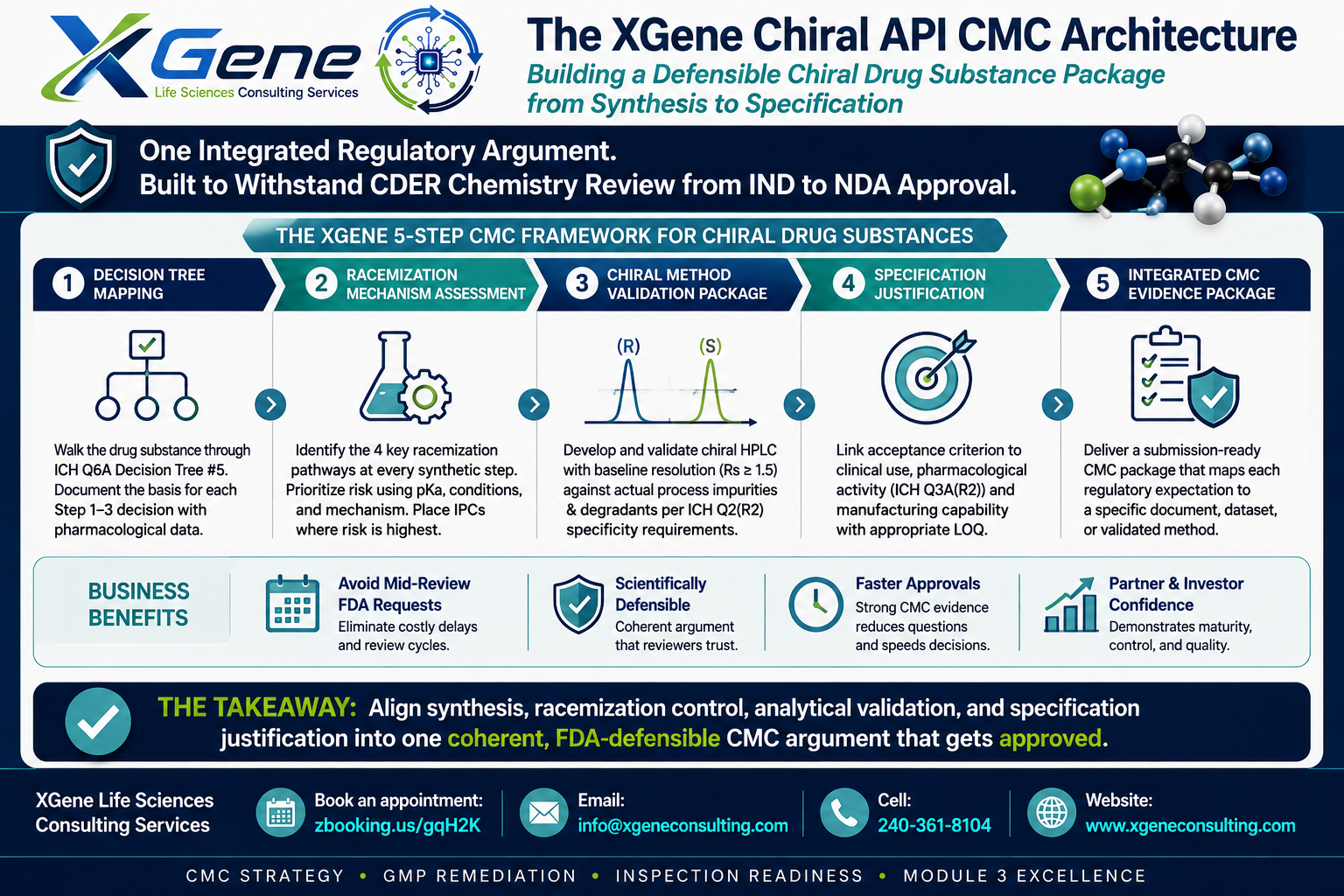
Building a Defensible Chiral Drug Substance Package from Synthesis to Specification
The XGene Chiral API CMC Architecture converts these three domains into a single integrated regulatory argument, built to withstand CDER chemistry review from IND through NDA approval.
Decision Tree Mapping — walks the drug substance explicitly through ICH Q6A Decision Tree #5, documenting the basis for each Step 1–3 determination and the pharmacological data supporting the Step 3 outcome, so the specification’s origin is traceable rather than asserted.
Racemization Mechanism Assessment — classifies every synthetic step against the four known racemization pathways, assigns pKa and reaction condition data to each labile stereocenter, and positions in-process controls at the steps the mechanism identifies as highest risk.
Chiral Method Validation Package — screens polysaccharide column chemistries for baseline resolution against the actual process impurity profile, not just the racemic mixture, and builds the ICH Q2(R2) specificity package CDER reviewers expect to see in 3.2.S.4.2.
Specification Justification Narrative — integrates the clinical pharmacology, pharmacological activity, and manufacturing capability arguments into a single Module 2.3 Quality Overall Summary narrative that links the acceptance criterion to its evidentiary basis.
The output is a submission-ready CMC evidence package that maps each regulatory expectation to a specific document, dataset, or validated method — not a gap list, but a close-out package.
Left unaddressed, this disconnect doesn’t surface as a chemistry failure — it surfaces as a filing delay measured in review cycles, at the point in an NDA timeline where delay is most expensive. Licensing partners and investors read the same gap a reviewer does: a specification, a method, and a risk assessment that were never built to support each other. Closing that gap before submission costs a fraction of closing it after a deficiency letter.