
Regulatory Record
FDA Warning Letter
On May 27, 2026, FDA issued Warning Letter 320-26-80 to Pharmathen International S.A., a sterile drug product manufacturer located in Sapes, Rodopi Prefecture, Greece (Facility Establishment Identifier — FEI 3009961173). Following an…
Pharmathen International Warning Letter: Aseptic Processing Failures and the CMC Pattern Every Sterile Products Quality Director Must Recognize
Source Context
On this recordRecord overview
Regulatory Event
On May 27, 2026, FDA issued Warning Letter 320-26-80 to Pharmathen International S.A., a sterile drug product manufacturer located in Sapes, Rodopi Prefecture, Greece (Facility Establishment Identifier — FEI 3009961173). Following an inspection conducted November 10–21, 2025, FDA cited four CGMP violations covering aseptic process control, contamination investigation, facility design, and microbiological laboratory documentation. The outcome was severe: voluntary recalls of injectable and suspension drug products distributed in the U.S. market, a complete suspension of manufacturing for all U.S.-destined products, placement on Import Alert 66-40 effective April 23, 2026, and a formal FDA recommendation to engage an independent CGMP consultant before resuming any U.S. manufacturing activities. This is not a Warning Letter about a single process lapse. It is a comprehensive failure of the systems that keep sterile injectable products safe.
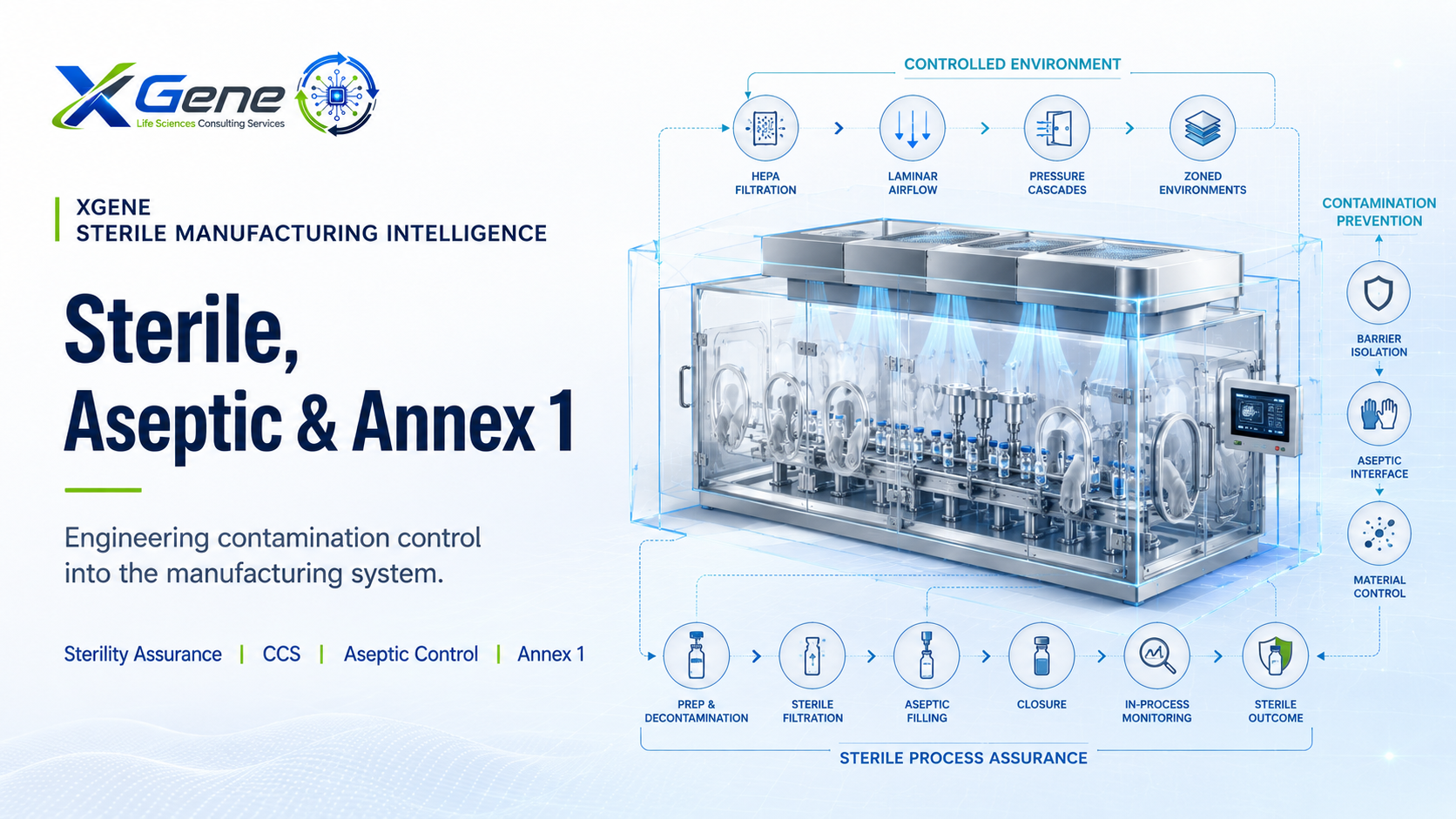
The first and most technically significant observation addresses the airflow visualization program on the RABS-housed aseptic vial filling line used for sterile powder drug products intended for the U.S. market. FDA cited 21 CFR 211.113(b) — the requirement for written procedures preventing microbiological contamination, including validation of all aseptic and sterilization processes. What investigators observed during smoke study simulations was not ambiguous: airflow exiting the filling zone, bouncing off an operator’s chest, and re-entering the critical ISO 5 area. This is a foundational unidirectional airflow failure in the RABS design or qualification. Restricted Access Barrier Systems are engineered specifically to create a positive-pressure, unidirectional airflow curtain that prevents ambient air and personnel-associated bioburden from reaching open product. When that airflow pattern reverses or eddies back across a first-air zone, the RABS is not functioning as a contamination barrier — it is functioning as a recirculation mechanism for the most contamination-prone source in the cleanroom: the operator. FDA also observed that the smoke studies themselves were inadequate in scope, failing to evaluate critical aseptic manipulation scenarios such as fallen vial removal. Operators were observed blocking first air when removing fallen vials, and exposed vials were not discarded — a deviation from basic aseptic technique that should be captured, documented, and investigated within the batch record. None of this was documented in the batch record at all.
What the Record Documents
The severity of the airflow failure is compounded by what was found in the environmental monitoring data: multiple instances of gram-negative organisms identified in ISO 5 air samples. This finding cannot be overstated. Gram-negative bacteria are water-associated, environmentally fragile organisms that are not expected to survive in a well-controlled ISO 5 environment. Their presence in active air samples from the critical zone is not a nuisance EM result — it is a signal that the contamination control strategy has a fundamental gap. Ben Venue Laboratories in Bedford, Ohio reached a similar point in 2011: their environmental monitoring program had been observing a pattern of Brevundimonas vesicularis — a Gram-negative water-associated organism — in 23 of 36 consecutive monitoring events without triggering a formal investigation, because the alert and action level system was not statistically derived from facility performance data and therefore never signaled meaningful trend changes. Ben Venue ultimately invested more than $350 million in remediation efforts but was never able to return the facility to sustainable production, and the site permanently ceased operations in 2013. Pharmathen’s attribution of Gram-negative contamination to room disinfection practices and unspecified contamination sources, without a rigorous root cause analysis, follows the same investigative failure pattern that FDA has cited consistently in sterile manufacturing enforcement actions over the past fifteen years.
The facility design finding under 21 CFR 211.42(c)(10) adds a structural dimension to what might otherwise be read as a procedural breakdown. FDA found that pressure differentials in the aseptic manufacturing rooms were inverted: the aseptic filling rooms were at lower pressure than adjacent rooms. Positive-pressure cascades — from the highest-classification ISO 5 zones outward through ISO 7 and ISO 8 support corridors — are a non-negotiable engineering control in sterile manufacturing facility design. Their purpose is to ensure that any pressure-driven airflow across a boundary moves outward from the cleaner zone to the less-clean zone, never the reverse. An inverted pressure differential means that every door opening event, every material transfer, and every personnel transition creates a potential route for microorganisms from uncontrolled spaces to migrate directly into the aseptic processing environment. Critically, Pharmathen’s monitoring infrastructure could not have detected this condition in real time because the facility’s monitoring devices displayed only live readings with no data storage capability. There was no alarm history, no trend record, and no ability to reconstruct whether or when pressure differentials had crossed into the inverted state. FDA’s Aseptic Processing Guidance (2004) and EU GMP Annex 1 (2023 revision) both require that differential pressure, temperature, and humidity be continuously monitored, recorded, and alarm-trended as part of the facility monitoring system. Operating a sterile manufacturing facility with display-only instrumentation is not a documentation oversight — it is the absence of a monitoring system entirely.
Technical and Quality Context
The fourth observation, cited under 21 CFR 211.160(a), addresses microbiological laboratory records. Incubating microbial plates for sterility, environmental monitoring, and water samples lacked documentation: no raw data, no sample preparation records, no batch or sample identification numbers on the plates themselves, and no contemporaneous recording of results. When FDA investigators identified this during the November 2025 inspection, Pharmathen’s internal review found 14 additional batches with missing sterility testing documentation beyond those observed by investigators — for a total of 16 batches with compromised sterility testing records, all subsequently invalidated. The contemporaneous documentation requirement is the “C” in the ALCOA framework — data that is not recorded at the time of performance cannot be reconstructed with scientific validity, and sterility testing that cannot be attributed to a documented sample preparation, incubation condition, and read-out event has no evidentiary value for batch release. FDA’s characterization of the response as inadequate — because it was limited to addressing sterility tests conducted during the inspection window — reflects the agency’s expectation that a systemic laboratory documentation failure requires a systemic, retrospective, and forward-looking remediation, not a targeted correction of the events FDA happened to observe.
The enforcement posture in this Warning Letter places it among the most consequential sterile manufacturing actions of the recent enforcement cycle. The combination of Import Alert 66-40 placement, voluntary recalls, production suspension across all U.S. products (including injectable, suspension, and capsule dosage forms), and an FDA recommendation for a six-system CGMP audit signals that FDA does not regard this as a remediable gap in an otherwise functional quality system. It is the consequence of compounding failures across contamination control design, aseptic technique oversight, facility engineering, and laboratory data governance — each one a discrete finding and, taken together, a representation of a quality system that was not structured to detect or prevent sterility assurance failures before they reached the product.
Decision Relevance
Companies in analogous sterile manufacturing situations — whether they are remediating Warning Letters, preparing for reinspections after FDA 483 observations, or conducting pre-submission readiness assessments of aseptic processing lines — need to work through each of these failure modes at the root cause level, not at the corrective action surface. Remediating an inverted pressure differential requires an engineering assessment of the HVAC design, valve sequencing, and cleanroom cascade architecture, not just a pressure setpoint adjustment. Remediating deficient smoke studies in a RABS requires dynamic airflow visualization under production-simulated conditions including all operator interventions, not a repeat of a simplified installation qualification study. These are resource-intensive technical programs, and the CAPA plans that FDA is now requiring — independent risk assessment of all contamination hazards, third-party review of five years of sterility and media fill failures, retrospective OOS review covering three years of U.S. products, and installation of a compliant facility monitoring system — reflect that scope accurately. This is where the difference between surface-level remediation and root-cause remediation becomes visible in the reinspection outcome. XGene Consulting supports sterile product manufacturers through aseptic processing assessments, RABS/isolator qualification gap analyses, contamination control strategy development under EU GMP Annex 1 and the FDA 2004 Aseptic Processing Guidance, and end-to-end Warning Letter remediation from root cause analysis through reinspection preparation. If you are managing a contamination control finding or preparing an aseptic site for FDA scrutiny, I welcome the conversation at xgeneconsulting.com or via LinkedIn.
Primary regulatory references
Connected intelligence
Continue through the evidence graph.
Article
OOS Root Cause Analysis — Moving Beyond ‘Analyst Error’
"Analyst error" is not a root cause — it is a conclusion in search of evidence, and FDA’s May 2022 Level 2 revised OOS guidance is…Article
Chiral Drug Substances: Stereospecific Synthesis, Enantiomeric Purity, and the ICH Q6A Specification Strategy
More than half of the small molecule drugs approved by FDA in any given year contain at least one stereocenter. For most of those programs, the…Article
CAPA Effectiveness Verification — Closing the Loop FDA Actually Closes
An FDA investigator reviewing your CAPA system is not interested in how many CAPAs you have opened — they are interested in how many you have…Article
CareFusion 213, LLC (BD) Class I Recall — ChloraPrep Sterile Antiseptic Applicators: The Sterile Manufacturing System Failure Behind the Recall and What Every Aseptic Processing Director Must Address
CareFusion 213, LLC, a subsidiary of Becton, Dickinson and Company (BD), has recalled two configurations of its BD ChloraPrep One-Step and FREPP Clear sterile antiseptic applicators…From record to action
Use the evidence in context.
Continue into related XGene analysis or discuss the technical implication when the issue needs action.