The CMC Function in 2030 Why the Firms Investing in Regulatory Data Architecture Now Will Win
The regulatory submission of 2030 will not be a PDF with a table of contents. It will be structured data with narrative context — machine-readable, agency-queryable, and continuously maintained. The…
On this pageArticle overview
The regulatory submission of 2030 will not be a PDF with a table of contents. It will be structured data with narrative context — machine-readable, agency-queryable, and continuously maintained. The firms building their CMC data infrastructure today are not preparing for a future requirement. They are building their current competitive advantage.
Four parallel regulatory initiatives — FDA’s PQ-CMC, the EU’s IDMP/SPOR program, ICH M8’s eCTD v4.0, and the Accumulus Synergy platform — are converging into a single infrastructure shift from document-based submission to structured data exchange. Most pharmaceutical organizations are treating them as four separate compliance programs. The firms that will define competitive advantage in CMC for the next decade are treating them as one.
The Convergence: Four Initiatives, One Infrastructure
FDA’s PQ-CMC initiative establishes the structured CMC data standard for CDER submissions, built on HL7 FHIR R4 with implementation guides already published for drug substance (3.2.S) and drug product (3.2.P) sections. ISO IDMP’s five-standard suite — 11615, 11616, 11238, 11239, and 11240 — provides the product identification and attribute data standard already mandatory for EU marketing authorization holders through EMA’s SPOR program. eCTD v4.0, under active ICH M8 expert working group development, will provide the structured submission backbone that carries both PQ-CMC and IDMP-aligned data.
Accumulus Synergy completes the picture. The industry-funded nonprofit platform is in live pilots with PMDA in Japan and EMA in Europe, with FDA engagement ongoing, enabling bidirectional structured data exchange that replaces the current asynchronous PDF workflow with machine-readable submissions and structured information requests. Firms that build for one of these and not the others are investing four times and producing nothing interoperable.
Why Structured Data Changes the Review Equation
The shift from PDF to structured data changes what health authorities can do with regulatory information after they receive it. An FDA reviewer receiving a PQ-CMC-structured drug substance specification can query it: which impurities have proposed limits above the ICH Q3A 0.10% identification threshold, and how does each compare to approved limits for similar compounds in KASA’s historical database? That query runs in seconds on structured data; on unstructured PDFs it requires manual extraction across multiple tables.
FDA’s KASA (Knowledge-Aided Assessment and Structured Application) is already in active development and deployment for structured submission review at CDER. The combination of PQ-CMC structured input and KASA AI-assisted analysis produces a review workflow that is qualitatively different from PDF review. The practical consequence is that structured submissions surface cross-document inconsistencies before the reviewer asks about them — or they surface them faster and more reliably than the manufacturer’s internal review did.
Either way, the quality standard for structured submissions is higher than the quality standard for PDFs, because the reviewer’s ability to detect inconsistencies is higher. Firms preparing structured submissions on a foundation of PDF-era data quality will not pass that review unchanged. The data must be right at the source.
The ICH Q12 Multiplier
The relationship between ICH Q12 (2019) Established Conditions and structured CMC data infrastructure is one of the most underappreciated dynamics in pharmaceutical regulatory modernization. ICH Q12 allows firms to designate certain manufacturing elements as Established Conditions — changes to ECs require prior approval, while changes to non-ECs can move through reduced reporting categories or PACMPs. Implementing that strategy effectively requires knowing with precision what is in the approved submission for every product in the portfolio.
Every specification parameter, every manufacturing process parameter, every analytical method characteristic that was submitted and approved must be queryable, not searchable through PDF archives. Firms with structured CMC data systems can query their portfolio for EC-relevant data instantly. Firms with legacy document-based systems must manually review regulatory files to determine what was approved — which is why most ICH Q12 implementation efforts stall in scoping.
The former category can execute ICH Q12 lifecycle management systematically across the portfolio. The latter category cannot. That is not a process gap; it is an infrastructure gap.
The 2030 Scenario: Same Company, Two Futures
Consider a mid-sized pharmaceutical company submitting a new NDA in 2030.
With structured data infrastructure: The submission is generated from a CMC data platform where specification parameters, analytical methods, and stability data are maintained as structured data objects aligned to PQ-CMC FHIR profiles. The submission includes PQ-CMC sections that are KASA-ready on receipt, and the same underlying data generates EMA-compliant IDMP product registration data and PMDA submission components. When FDA sends a structured information request via Accumulus, the response is generated by querying the data platform and returning structured data — not by manually compiling a PDF response package.
Without structured data infrastructure: The same submission is a PDF package generated from regulatory writing templates. When PQ-CMC becomes mandatory, the firm converts existing content to FHIR-compliant structured data post-hoc, from PDFs, with the data quality problems that conversion produces — typically 6–12 months of added effort per application. Meanwhile, IDMP compliance runs as a parallel remediation project mapping product data from SAP and legacy regulatory systems to SPOR-compatible formats, with no shared infrastructure benefit across initiatives.
Same company. Same products. Two entirely different operating models, with the first compounding advantage every cycle and the second compounding cost.
The XGene CMC Digital Readiness Scorecard
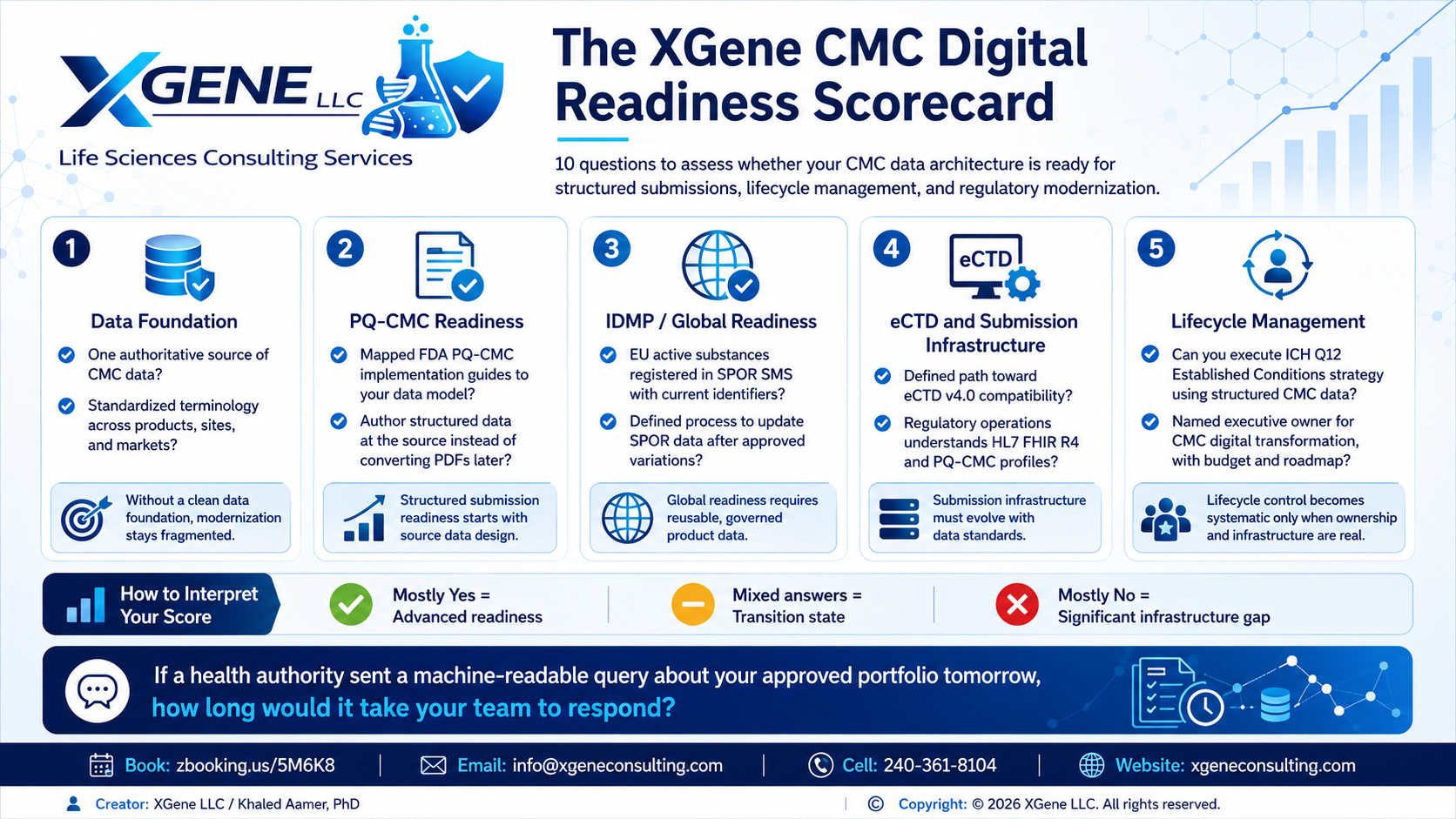
Ten questions to assess your regulatory data architecture today:
Data Foundation
Do you have a single authoritative source of CMC data for your product portfolio — or is it distributed across SAP, Veeva, regulatory files, and departmental spreadsheets?
Is your CMC terminology standardized across products, sites, and markets — or does the same dose form have different names in different systems?
PQ-CMC Readiness
Have you reviewed the published FDA PQ-CMC implementation guides for drug substance (3.2.S) and drug product (3.2.P) against your current CMC data model?
Is your data authoring workflow designed to produce structured data at the source — or to convert finished PDFs to structured data after the fact?
IDMP / Global Readiness
Are all active substances in your EU portfolio registered in SPOR SMS, with current cross-references to UNII and other international identifiers?
Do you have a defined process for updating SPOR product data within EMA’s required timeframe following approved variations?
eCTD and Submission Infrastructure
Is your eCTD infrastructure on a defined path toward eCTD v4.0 compatibility — and do you have a timeline for that transition?
Does your regulatory operations team have working knowledge of HL7 FHIR R4 and the PQ-CMC FHIR profiles?
Lifecycle Management
Have you implemented an ICH Q12 Established Conditions strategy for your approved products — and can you execute variation filings using structured CMC data?
Is there a named executive owner for CMC digital transformation in your organization — with budget, authority, and a defined 3-year roadmap?
The pharmaceutical CMC function of 2030 is a structured data management discipline that produces regulatory documents as an output — not a regulatory writing function that produces documents as the primary work product. The organizational capability shift required to get there is not a technology investment. It is a change in how pharmaceutical companies define what CMC expertise means, how they staff CMC functions, and what systems they require CMC professionals to be fluent in.
The firms building that capability now are not planning ahead. They are responding to an infrastructure transition that is already underway.
If a health authority sent your organization a structured data query about your approved portfolio tomorrow — a machine-readable request for all specification parameters for impurities across your solid oral dose products — how long would it take your CMC team to respond? The answer tells you exactly where your regulatory data architecture stands relative to 2030.