
3.2.P.6 Drug Product Reference Standards: Why the Same Program That Works for Drug Substance Often Falls Short for Drug Product
The cross-reference to 3.2.S.5 is not wrong. For the assay reference standard — the characterized primary standard used to quantify drug substance content in finished tablets, capsules, or solutions —…
On this pageArticle overview
Why Drug Product Reference Standards Require a Different Program Than Drug Substance Standards
The cross-reference to 3.2.S.5 is not wrong. For the assay reference standard — the characterized primary standard used to quantify drug substance content in finished tablets, capsules, or solutions — the drug substance program documented in 3.2.S.5 is, in fact, the correct and authoritative source. ICH Q6A §3.2.P.6 specifies that information on reference standards or reference materials used for testing of the drug product should be provided, and for the assay standard, the characterization data, purity assignment, lot-to-lot qualification protocol, and stability monitoring program are already fully documented in the drug substance section. A clean cross-reference with documentation that the same USP Reference Standard or in-house primary RS is used for both drug substance and drug product assay testing is not a deficiency — it is the correct regulatory approach for that specific reference material.
The deficiency arises from what the cross-reference does not cover. A drug product analytical package in Section 3.2.P.5 does not consist solely of a drug substance assay. It comprises a related substances method that detects and quantifies degradation products specific to the drug product degradation pathway; a dissolution test with apparatus-specific calibration requirements that may invoke USP <711> dissolution apparatus calibration procedures; a content uniformity test calibrated against the same assay standard; and, for products in glass or plastic containers with identified leachable compounds, a leachables analytical method requiring reference standards for the identified container-related extractable species. Each of these methods requires reference materials. None of those reference materials — with the exception of the assay standard and any drug substance process-related impurities that survive into the drug product — are documented in 3.2.S.5. They are the exclusive documentary responsibility of 3.2.P.6, and they are the section that FDA reviewers find absent, incomplete, or inadequately characterized in a significant proportion of drug product submissions.
Understanding why the drug product degradation profile generates reference standard requirements that are categorically distinct from the drug substance impurity profile requires understanding the chemistry of solid-state and solution-state drug product degradation. A drug substance in bulk API form degrades under stress conditions through pathways that are largely determined by its own chemical reactivity — oxidation of susceptible functional groups, hydrolysis of esters or amides at elevated temperatures and humidity, photolytic bond cleavage at UV-absorbing chromophores. These pathways are characterized during drug substance development, and the resulting impurities are identified, named, and provided with individual acceptance limits in the drug substance specification in 3.2.S.4.1. The reference standards for these degradants are documented in 3.2.S.5.
The drug product changes this chemistry in ways that are not predictable from the drug substance degradation profile alone. Excipients introduce reactive species: residual peroxides in polyethylene glycols and polysorbates oxidize susceptible API functional groups via pathways that are quantitatively different from bulk API oxidation in the absence of the excipient matrix. Reducing sugars — lactose in immediate-release tablets, mannitol in lyophilized formulations — react with primary and secondary amines on the API through Maillard condensation reactions, generating glycation adducts and Amadori rearrangement products that are structurally unique to the drug product formulation and are not present in the drug substance at any meaningful level. Tablet film coatings contribute plasticizers, pigments, and coating solvents that can migrate into the core and react with the API over the shelf life. Excipient-derived aldehydes — formaldehyde released from polyvinylpyrrolidone degradation, acetaldehyde from ethylene oxide sterilization residues — form condensation products with API amines that are both structurally novel and toxicologically significant. Each of these product-specific degradation pathways generates a unique degradant that may qualify for an individual limit under ICH Q3B(R2) — and each such specified degradant requires a characterized, purity-assigned reference standard that exists nowhere in 3.2.S.5.
ICH Q3B(R2), “Impurities in New Drug Products,” is the primary regulatory framework governing the identification and qualification thresholds for drug product degradation products. The 0.1% reporting threshold (for daily doses up to 1 g) and the thresholds scaled to daily dose above that level establish the point at which a degradant must be reported in the batch analysis. At or above the identification threshold — 0.10% or 1.0 mg/day TDI (whichever is lower) for products with a maximum daily dose (TDI) of 1 g or less, and 0.05% for TDI greater than 1 g — a degradant must be identified by structure, reported with an individual limit, and controlled by a validated specific method. A validated specific method requires a reference standard. A reference standard requires characterization. That characterization must be documented in 3.2.P.6. This is not an interpretive position — it is the direct regulatory consequence of meeting ICH Q3B(R2) identification and qualification requirements through an HPLC method with individual degradant acceptance criteria. If you have a named, individually limited degradant in your drug product related substances specification, you have a reference standard requirement in 3.2.P.6 that cannot be satisfied by a cross-reference to 3.2.S.5 unless that degradant is also a drug substance process-related impurity with an individual limit in the drug substance specification — a coincidence that occurs occasionally but cannot be assumed.
The 2015 FDA Guidance for Industry on Analytical Procedures and Methods Validation creates additional precision in this requirement. The guidance establishes that for quantitative impurity methods, the reference material used for calibration or system suitability must have a documented purity assignment, and that the method’s demonstrated accuracy is contingent on the accuracy of that purity assignment. A degradant reference standard procured from a commercial vendor with a Certificate of Analysis showing “HPLC purity: 95.0% (area normalization)” and no further characterization data does not satisfy this requirement. Area normalization does not account for moisture, residual solvents, or non-UV-absorbing species. A degradant RS with a nominal area-normalization purity of 95.0% that contains 2.5% water and 1.0% residual solvents has an actual mass-based purity of approximately 91.5%. Calibrating an HPLC method against a 91.5%-purity degradant standard while treating it as 95.0% introduces a systematic positive bias in every degradant quantitation result — meaning that calculated degradant levels are understated relative to the actual content in the sample. That bias propagates to every stability time point, every specification compliance decision, and every ICH Q3B(R2) qualification determination.
The dissolution method introduces reference standard requirements of a distinct character. USP <711> “Dissolution” governs apparatus calibration requirements for USP Apparatus 1 (basket) and Apparatus 2 (paddle). The mechanical calibration of dissolution apparatus — shaft wobble, vessel dimensions, temperature uniformity — can be verified by hydrodynamic calibration using Performance Verification Test (PVT) tablets. While the USP revision to <711> moved away from mandatory chemical calibrator tablet testing as a routine QC requirement between 2007 and 2010, the calibrator tablets themselves remain official USP Reference Standards and are used in some laboratories as part of new apparatus qualification and troubleshooting protocols. Where calibrator tablets are used and referenced in the dissolution method description in P.5.2, they constitute reference standards for purposes of Section 3.2.P.6 and must be identified, with the applicable USP Reference Standard lot documented. This is a narrow but real requirement that is routinely omitted from P.6 sections because dissolution calibrator tablets are not intuitively associated with the reference standard concept in the way that assay standards and impurity standards are.
Container closure system-related reference standards represent the final category requiring explicit documentation in 3.2.P.6. Where the drug product specification in P.5.1 includes acceptance criteria for leachable compounds — as required when the container closure system extractables/leachables assessment in P.2 identifies extractable compounds at levels above the analytical evaluation threshold — the leachables analytical method must be calibrated against reference standards for those specific compounds. Leachable compounds commonly include plasticizer degradation products (bis(2-ethylhexyl) phthalate, di-n-butyl sebacate residues from PVC or PVDC film coatings), antioxidants from polymer formulations (BHT, Irganox 1010), and oligomeric compounds from rubber stoppers or plastic closures. Commercial reference standards exist for many of these compounds, but their characterization data — purity by GC or HPLC, confirmed identity by NMR and MS, storage condition and retest date — must be documented in P.6. Where commercial standards are used, the vendor Certificate of Analysis must be supplemented with in-house identity confirmation, and if the vendor purity assignment is based solely on chromatographic area normalization, an independent moisture and purity verification is required to support a defensible calibration.
The cumulative picture is of a section — 3.2.P.6 — that has a structural complexity equal to or exceeding 3.2.S.5, despite being treated in many CMC submissions as a brief addendum. The analytical methods in P.5.2 create the reference standard requirements, and the completeness of P.6 is only as good as the completeness of the P.5 method inventory that precedes it. When P.6 is assembled without systematically mapping every method in P.5.2 to its reference materials, the result is a section that covers the assay standard, cross-references S.5 for impurities, and provides nothing for the degradation-product-specific methods that form the core of the drug product related substances analytical control strategy. That gap is exactly what FDA information request letters target.
The Additional Characterization Requirements for Drug Product-Specific Reference Materials
The characterization requirements for drug product-specific degradant reference standards — those that exist in 3.2.P.6 without any parallel in 3.2.S.5 — are substantively identical to the characterization requirements for drug substance impurity reference standards, as governed by the combined framework of ICH Q6A §3.2.P.6, the 2015 FDA Methods Validation Guidance, and the PhRMA Principles and Practices for Reference Standards (2013). Structure confirmation must precede purity assignment. The characterization data package must include proton NMR, carbon-13 NMR, and high-resolution mass spectrometry at minimum — confirming that the material is the expected degradant compound and not a structural isomer, co-eluting impurity, or incorrect synthetic product. For complex degradants such as Maillard condensation products or excipient-API adducts, where the degradant may exist as a mixture of diastereomers or as a chemically labile species, additional structural characterization by 2D NMR (COSY, HSQC, HMBC) and tandem MS fragmentation may be required to establish unambiguous structural identity. That structural identity, once confirmed, is what justifies the specific threshold under ICH Q3B(R2) — whether the degradant is known or novel, and what its qualification status is relative to the administered dose of the finished drug product.
Purity assignment for the degradant RS must be performed by mass balance methodology, not by HPLC area normalization. This requirement — which the 2015 FDA Methods Validation Guidance makes explicit for reference material qualification — is particularly important for degradant standards, which are often synthesized in small quantities, isolated by preparative HPLC or column chromatography, and may carry residual solvents at levels that are substantial relative to the degradant mass. A degradant RS that was isolated by preparative RP-HPLC in a methanol/water/acetonitrile gradient and lyophilized may contain multiple percent residual solvent even after lyophilization, and its water content under ambient storage conditions may drift significantly depending on the hygroscopicity of the specific compound. The mass balance purity assignment — Karl Fischer moisture plus headspace GC residual solvents plus HPLC organic impurity profile, subtracted from 100% — is the only approach that yields an accurate absolute purity value for such materials, and that value is what determines the accuracy of every quantitative result obtained when the degradant is used as a calibration standard in the HPLC method.
Lot-to-lot qualification is required for degradant reference standards for the same reasons it is required for drug substance primary RS materials — and the qualification frequency must be defined, justified, and documented in P.6. Where degradant RS materials are sourced from commercial suppliers (Sigma-Aldrich, TRC, Cayman Chemical), the lot-specific Certificate of Analysis must be evaluated against the characterization data on file from the initially characterized lot. If the structure has been confirmed only for one lot and is assumed constant across subsequent lots, that is a documentable assumption that FDA reviewers will flag if the analytical method has changed the degradant RS lot without a bridging qualification. The lot-to-lot qualification protocol for degradant RS materials must specify the identity test (NMR or HRMS confirmation that the compound is correctly identified), the purity comparison (mass balance purity within defined acceptance limits of the originally characterized lot), and the acceptance criterion for continued use in the analytical method. A new lot of degradant RS whose mass balance purity is 92.0% when the previously characterized lot was 99.2% is not interchangeable without investigation — but that investigation can only be recognized as necessary if the purity of both lots is measured by mass balance and compared against a specified acceptance criterion.
Stability of degradant reference standards under proposed storage conditions is among the most frequently incomplete elements of 3.2.P.6. Many degradant RS materials are chemically labile — their instability under pharmaceutical stress conditions is, after all, what makes them degradants rather than stable impurities. A degradant derived from hydrolysis of the drug substance ester bond may itself be susceptible to further hydrolysis under ambient conditions. A photo-oxidation product may be light-sensitive and degrade further under fluorescent laboratory lighting. A Maillard adduct may undergo retro-condensation at elevated temperature. These stability characteristics are not hypothetical concerns — they are the scientifically predictable consequences of the degradant’s chemical structure, and they mean that the retest interval for the degradant RS must be established by actual stability data at the proposed storage condition (typically −20°C or 2–8°C in the dark), not assumed to be the same as the drug substance primary RS. Where the degradant RS is known to be labile, a shorter retest interval — six months, three months, or even single-use preparation from a neat standard — may be appropriate, and that decision must be documented with supporting analytical data in P.6.
The connection between degradant RS characterization quality and drug product shelf life determination deserves explicit articulation. The drug product related substances method is used to generate the stability data presented in Section 3.2.P.8. The ICH Q1A(R2) stability study data — the individual degradant levels at each time point across all ICH conditions and storage orientations — are the primary basis for the proposed shelf life. If the degradant RS used to calibrate that method has an uncertain or inflated purity assignment, the calculated degradant levels in the stability samples are systematically biased, and the shelf life derived from those biased results is scientifically unreliable. That is not a minor analytical chemistry point. It is a regulatory submission integrity issue — and it is the reason that ICH Q3B(R2) identification and qualification requirements, the 2015 Methods Validation Guidance reference material requirements, and ICH Q6A §3.2.P.6 documentation requirements must be understood as an integrated framework, not as independent regulatory boxes to check.
Stability of Reference Standards and the Requalification Program
The stability monitoring program for reference standards used in drug product testing occupies a distinctive regulatory space that is more operationally complex than its drug substance counterpart. In the drug substance context, the primary RS is a small number of materials with well-characterized long-term stability under standard cryogenic storage, and the working RS undergoes a quarterly comparison protocol against that stable anchor. In the drug product context, the population of reference standards is larger, chemically more diverse, and often less stable — and the management of the requalification lifecycle for that population is a program design challenge that P.6 must address systematically.
The shared reference standard — the drug substance assay RS cross-referenced from S.5 — requires no additional stability documentation in P.6 beyond the cross-reference itself. Its retest interval, storage condition, and requalification protocol are documented in S.5 and apply identically to its use in drug product assay testing. Any changes to the assay RS lot that trigger a requalification event in the drug substance program automatically apply to drug product testing as well, and the P.6 documentation should explicitly state this by confirming that the lot management protocol in S.5 governs drug product assay RS lifecycle without modification.
For drug product-specific degradant reference standards, the stability program must establish a retest interval that is supported by real-time stability data at the proposed storage condition. The stability-indicating test for a degradant RS requalification is the same HPLC method used in the drug product related substances method — the degradant RS is subjected to HPLC analysis at defined intervals, and the area response is compared to the initial characterized response after correction for the purity-assigned value. A defined acceptance criterion — typically ±1.0–2.0% relative change from the initial assigned purity — determines whether the RS remains qualified for continued use. For labile degradants where the stability data supports only a short retest interval, the requalification procedure must describe the bridging protocol: when a new lot of degradant RS is needed before the active lot expires, the new lot must be characterized, the purity assigned by mass balance, and a head-to-head system suitability comparison against the expiring lot performed to confirm equivalent system response before the new lot is placed into service. Any gap in RS availability — a period during which no qualified lot is in service — creates a gap in the analytical method’s scientific foundation and must be documented as an analytical deviation with assessment of impact on any stability data generated during that period.
The requalification frequency for degradant RS materials is not a matter that can be left to default assumptions. The PhRMA Principles and Practices for Reference Standards (2013) recommends establishing retest intervals based on the demonstrated chemical stability of the specific material, the storage conditions, and the precision of the stability-indicating analytical method. For well-characterized, chemically stable degradants stored at −20°C under nitrogen, annual requalification is often defensible. For labile degradants, photosensitive materials, or hygroscopic compounds, quarterly or semi-annual requalification may be required. The P.6 narrative must specify the requalification frequency for each degradant RS, the acceptance criterion for continued use, and the action taken when a RS fails requalification — immediate removal from use, retrospective review of analytical results generated since the last passing qualification, and assessment of whether stability data or batch release data derived from the failing RS lot requires correction or re-analysis.
For dissolution calibrator tablets — where their use is documented in the dissolution method — the reference standard lifecycle management is governed by USP Reference Standard lot management practices as described in USP <11>. Each lot of Prednisone or Salicylic Acid Calibrator Tablets USP has a specific assigned range for the dissolution apparatus calibration acceptance criterion, and that range is lot-specific. Substituting a new USP lot without verifying that the new lot’s assigned range is consistent with the instrument calibration history can introduce an apparent instrument calibration failure that reflects the lot change rather than an instrument performance problem. P.6 must specify the USP RS lot management procedure for calibrator tablets, including the protocol for transitioning between lots and the bridging documentation required when the assigned range changes between lots.
Container-related extractable and leachable reference standards present a stability management challenge that is specific to the typically organic compound class involved. Many plasticizer derivatives, antioxidants, and rubber vulcanization products are volatile under ambient conditions, and their reference standards may degrade not only through chemical reaction but through evaporation losses if stored in improperly sealed containers. The storage specification for extractable/leachable RS materials must address container headspace management — sealed amber vials under nitrogen, for example — and the stability monitoring protocol must verify that the assigned purity has not changed through either degradation or evaporative loss between qualification events. For GC-based leachables methods, the RS stability program must demonstrate that the GC response factor — the ratio of detector signal to mass injected — is constant across the RS retest interval, because a drift in GC response factor arising from RS concentration change (due to evaporation) would be analytically indistinguishable from a matrix effect change in the test method itself.
The aggregated stability monitoring program for all drug product reference standards — DS assay RS (governed by S.5), degradant RS materials, dissolution calibrator tablets, and extractable/leachable standards — constitutes the reference standard lifecycle management program that must be described in P.6. The description must be specific: not “reference standards are requalified periodically” but “each reference standard lot used in drug product testing is assigned a retest date at the time of initial qualification, based on the stability data summarized in the characterization report referenced in Table P.6-1, and is requalified by the procedure specified in Appendix P.6-A before the retest date expires, using the acceptance criteria defined in that procedure.” That level of specificity is what distinguishes a P.6 section that will survive FDA review from one that will generate a request for additional information within the first review cycle.
Building a P.6 Reference Standard Program That Closes Every Analytical Method in P.5.2
XGene P.6 Reference Standard Completeness Matrix
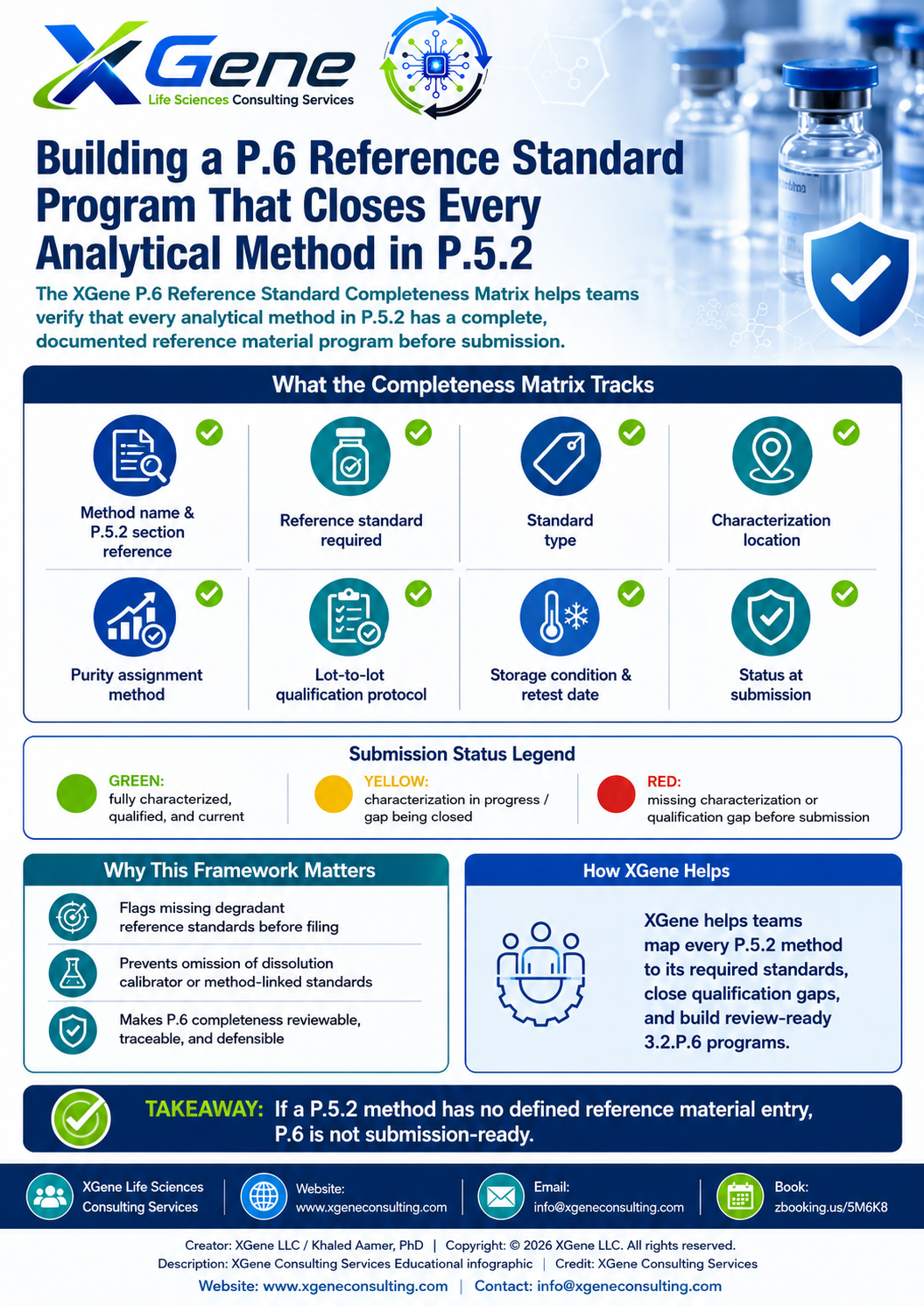
The fundamental diagnostic tool for evaluating whether a 3.2.P.6 section is complete is a cross-reference matrix that maps every analytical method described in Section 3.2.P.5.2 to its required reference materials, confirms the characterization status of each material, and identifies any method whose reference material program has gaps before submission. The XGene P.6 Reference Standard Completeness Matrix is that tool, structured as a method-by-method inventory that makes the completeness of the reference standard program verifiable at the submission review stage.
The matrix is organized with the following columns for each entry:
Method Name and P.5.2 Section Reference — the exact method name as it appears in P.5.2 (e.g., “Related Substances — HPLC-UV Method,” “Dissolution — USP Apparatus 2, 900 mL 0.1N HCl, 75 rpm,” “Assay — HPLC-UV”), with the specific P.5.2 subsection cross-reference.
Reference Standard Required — for each method, every reference material required: the assay RS, each individually specified degradant RS, each individually specified process-related impurity RS, dissolution calibrator tablets (if used), extractable/leachable compound RS (if applicable). Each RS is listed individually; no method row in the matrix has a blank RS entry.
Standard Type — classified as one of five types: (1) DS Assay Standard — shared with S.5; (2) DP Degradant RS — product-specific, documented in P.6 only; (3) DS Process Impurity RS — shared with S.5, with cross-reference confirmed; (4) Dissolution Calibrator Tablets — USP RS, lot-specific; (5) Container Extractable RS — product-specific, documented in P.6.
Characterization Location — either “3.2.S.5 [specify subsection]” for shared RS materials or “3.2.P.6 [specify subsection]” for product-specific materials. Any RS whose characterization data exists in neither section is flagged in red as “CHARACTERIZATION REQUIRED BEFORE SUBMISSION.”
Purity Assignment Method — the specific method used for absolute purity assignment: Mass Balance (KF + headspace GC + ICP-MS + HPLC impurity profiling), qNMR with certified internal standard, Compendial (USP RS lot-specific CoA), or Vendor CoA with in-house confirmation. Any entry where the purity assignment method is “HPLC area normalization only” is flagged as requiring supplementary mass balance confirmation.
Lot-to-Lot Qualification Protocol — document reference for the qualification protocol, the acceptance criterion (e.g., ±0.5% relative to primary or ±1.0% relative to prior lot), and the frequency (annual, semi-annual, quarterly, per-lot).
Storage Condition and Retest Date — the specified storage condition (e.g., −20°C, sealed under nitrogen; 2–8°C in the dark; ambient per USP RS CoA) and the current lot retest date, with a flag if the retest date is within 60 days of the submission target date.
Status at Submission — one of three designations: GREEN (fully characterized, purity assigned by mass balance or compendial, lot current, qualification protocol documented); YELLOW (characterization in progress, expected completion date specified, gap acceptable for initial submission with commitment); RED (no characterization data, no qualification protocol, gap must be closed before submission).
The matrix is populated by the CMC authoring team in parallel with the finalization of Section P.5.2 — specifically, as each method description is written and the list of analytical standards required for system suitability and calibration is defined. Any method that references a standard not yet in the matrix immediately creates a P.6 action item that is tracked to resolution before the submission package is assembled.
The practical impact of this tool is most visible in two scenarios that occur consistently in drug product CMC development. The first is the late-stage discovery that a specified degradant lacks a reference standard: the related substances method development team synthesized a reference material for use during development, the material was never formally characterized for submission, and the purity assigned for development work was based on area normalization. The matrix flags this at the P.5.2 drafting stage — not at the submission review stage — allowing time for formal characterization and purity assignment before the filing deadline. The second is the dissolution calibrator tablet entry: the dissolution method procedure references Prednisone Calibrator Tablets USP for apparatus qualification during annual recalibration, this reference is included in the matrix, the current USP lot is confirmed to be within retest date, and the lot number and assigned range are documented in P.6 — preventing the omission that would otherwise generate a deficiency letter noting that the calibrator reference material is referenced in the method but not documented in P.6.
The Completeness Matrix does not replace the P.6 narrative — it supplements it as a structured summary that allows FDA reviewers to verify at a glance that every method in P.5.2 has a documented reference material program. The narrative provides the scientific justification for each element; the matrix provides the organizational accountability. Together, they constitute a P.6 section that is both scientifically rigorous and administratively traceable — two requirements that FDA’s Office of Pharmaceutical Quality applies with equal weight when reviewing new drug applications.