
3.2.S.2.4–2.6 Critical Steps, Process Validation, and Manufacturing Process Development: Building the Process Understanding Evidence Package
A recurring CMC review issue is not the absence of process information, but the absence of a coherent evidentiary bridge between critical-step controls, process validation or evaluation, and the development…
On this pageArticle overview
A recurring CMC review issue is not the absence of process information, but the absence of a coherent evidentiary bridge between critical-step controls, process validation or evaluation, and the development knowledge used to justify the commercial process. For NDA submissions, the strategic question is not simply whether PPQ has occurred; it is whether the application demonstrates sufficient process understanding, scale awareness, and control to support the proposed commercial manufacturing strategy.
Sections 3.2.S.2.4 through 3.2.S.2.6 should operate as a connected argument. Section 3.2.S.2.4 identifies and justifies controls for critical steps and intermediates. Section 3.2.S.2.5 presents process validation and/or evaluation information appropriate to the drug substance and its stage of development. Section 3.2.S.2.6 explains how manufacturing-process knowledge was generated, how significant process changes were evaluated, and how that knowledge supports the final control strategy described across the relevant Module 3 sections. ICH Q11 explicitly treats 3.2.S.2.2 through 3.2.S.2.6 as an integrated body of drug-substance manufacturing information.
Critical Steps and Intermediates: What Belongs in 3.2.S.2.4
Section 3.2.S.2.4 is not merely a list of in-process tests. It should identify controls applied to critical steps and intermediates and provide the scientific rationale for those controls. The underlying logic should trace from drug-substance quality attributes and process understanding to the parameters, material attributes, or intermediate controls that materially affect quality. ICH Q11 emphasizes that the control strategy should be derived from product and process understanding and that detailed process controls should be presented in the appropriate CTD sections.
Acceptance criteria and operating ranges should be supported by development knowledge rather than historical habit alone. Depending on the process and risk, the evidence base may include designed experiments, mechanistic studies, univariate studies, scale-down models, prior knowledge, platform knowledge, batch data, or justified combinations of these. Formal DOE can be particularly valuable where parameter interactions are important, but DOE is not itself a universal regulatory requirement. What matters is whether the selected evidence is sufficient to explain the relationship between process variables and relevant quality outcomes.
Intermediate hold times are another area where the control strategy must be evidence based. Where an intermediate is held before the next unit operation, the sponsor should understand whether time, temperature, atmosphere, moisture, bioburden, or other conditions can affect its suitability for further processing. The supporting studies should be placed or cross-referenced in the CTD sections where they best explain the manufacturing process, critical controls, process development, and validation strategy. The regulatory issue is not the existence of a particular hold-time table; it is whether the proposed hold condition is scientifically justified and consistently controlled.
Manufacturing Process Development: What 3.2.S.2.6 Must Demonstrate
Section 3.2.S.2.6 should explain why the commercial manufacturing process has the design that it does. ICH Q11, finalized in 2012, describes approaches to developing and understanding drug-substance manufacturing processes and the information expected in CTD sections 3.2.S.2.2 through 3.2.S.2.6. FDA’s final ICH Q11 Questions and Answers guidance, issued in February 2018, provides additional implementation clarification.
The development narrative should document the major scientific decisions that shaped the commercial process: route selection, reagent and solvent choices, order of addition, reaction endpoint strategy, work-up and isolation conditions, impurity purge, crystallization and solid-form control, and any other decisions that materially affect quality. Where a development-stage process change is significant, the application should explain its impact on process understanding and on the drug-substance quality profile. ICH Q10 treats change as an inherent part of pharmaceutical development and places change management in Section 3.2.3 of the pharmaceutical quality system model.
Designed experiments can be powerful when used to establish parameter interactions, characterize sources of variability, support a design space, or justify a normal operating range. But the scientific narrative should not become a collection of DOE plots. The dossier should show how the experimental evidence was converted into a control strategy: which variables matter, which do not, what range is supported, what quality attribute is protected, and where the corresponding control appears in the commercial process.
Scale, Robustness, and Commercial Process Qualification
FDA’s January 2011 Process Validation guidance established the lifecycle framework of Stage 1 Process Design, Stage 2 Process Qualification, and Stage 3 Continued Process Verification. Within Stage 2, Process Performance Qualification (PPQ) combines the qualified facility, utilities, equipment, trained personnel, commercial manufacturing process, control procedures, and components to demonstrate that the commercial process performs as expected.
The guidance states that a manufacturer should successfully complete PPQ before commencing commercial distribution of the drug product and that the decision to begin commercial distribution should be supported by data from commercial-scale batches. At the same time, FDA also states that the PPQ approach should reflect the manufacturer’s level of product and process understanding and should use cumulative knowledge from relevant studies, including laboratory, pilot, and commercial experience. Scale therefore matters, but not every element of process characterization must be repeated across the entire operating range at full commercial scale if the development data provide adequate assurance.
A robust scale-comparability assessment does not ask only whether batch size changed. It asks whether scale-sensitive engineering and physicochemical variables remain controlled: mixing regime, heat transfer, mass transfer, gas-liquid contacting, addition rates, residence time, supersaturation, filtration flux, drying behavior, and other process-specific variables. The correct evidentiary bridge is built from ICH Q11 process understanding, scientifically justified scale-up principles, development and characterization data, and the commercial PPQ strategy.
For submission authors, the practical standard is consistency across the evidence chain. A critical step identified in S.2.4 should be explainable from development knowledge in S.2.6; the associated controls should appear in the process description and control strategy; and the validation or evaluation strategy in S.2.5 should confirm that the proposed commercial process performs within the justified state of control. Where these sections are written independently, the resulting gaps are visible to reviewers.
XGene Process Understanding Evidence Matrix
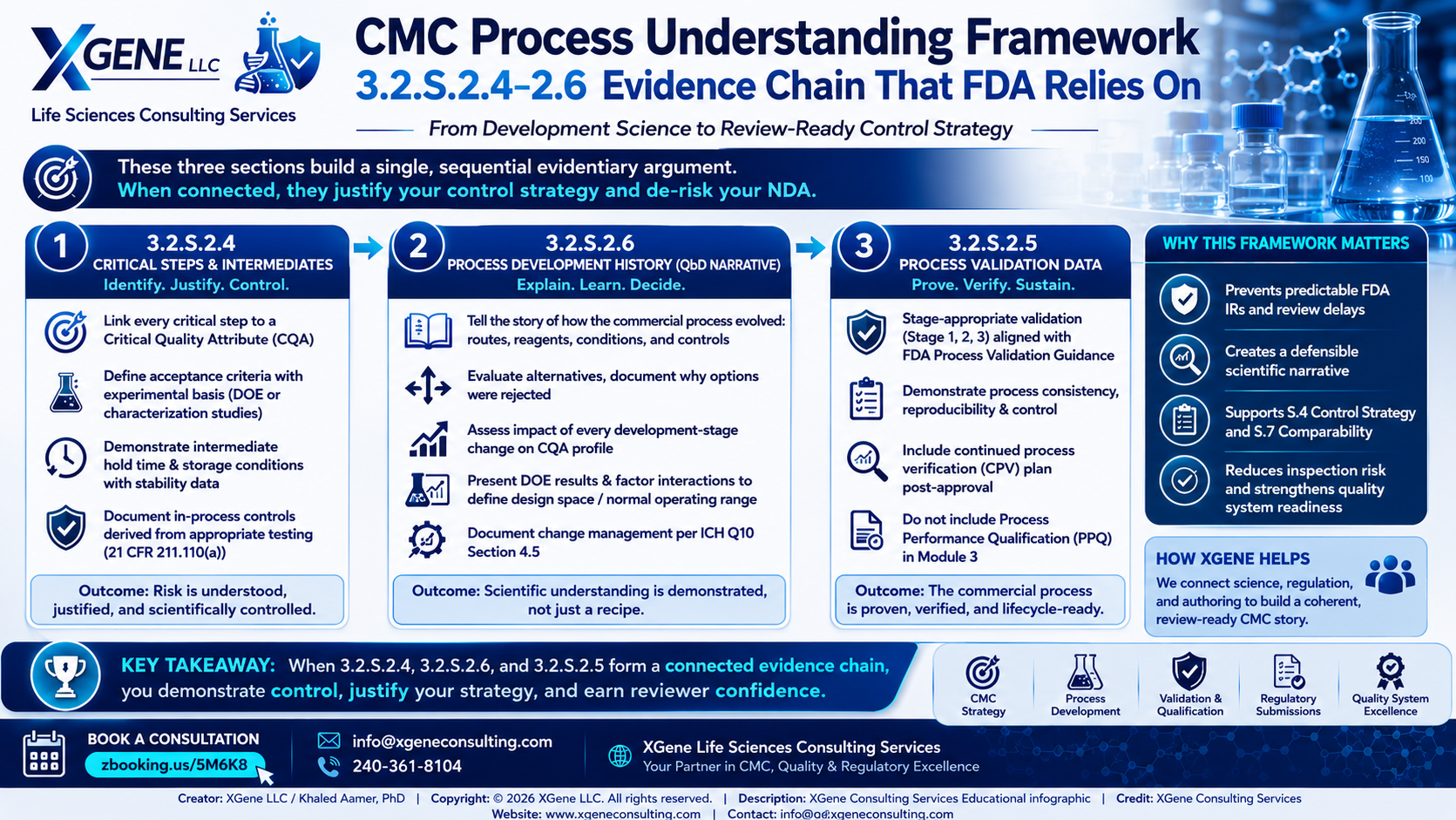
Tier 1 — Risk-Based Criticality and Control Logic: Identify the process steps, parameters, material attributes, and intermediates that can materially affect drug-substance quality. Use documented quality-risk management and process knowledge to justify why a parameter or control is critical, key, or otherwise necessary. FMEA can be useful, but the regulatory objective is traceable scientific reasoning rather than use of one mandatory risk tool.
Tier 2 — Scale and Process-Knowledge Bridge: For meaningful scale or process changes, document the engineering and product-quality basis for comparability. Demonstrate which scale-sensitive variables were assessed, what evidence supports transfer of development knowledge, and which aspects require confirmation at commercial scale.
Tier 3 — Commercial Qualification and Lifecycle Verification: Define the PPQ strategy using process understanding, risk, commercial-scale data, sampling plans, acceptance criteria, and statistical or scientific rationale appropriate to the process. After successful qualification, maintain the state of control through continued process verification and lifecycle knowledge management.
When Tier 1 feeds Tier 2 and Tier 2 feeds Tier 3, the reviewer encounters one coherent argument: the process risks are scientifically identified, the ranges and controls are justified by development knowledge, scale-up is understood, and commercial qualification confirms that the manufacturing process performs as intended.
Primary Regulatory and Technical References