
3.2.S.3.2 Drug Substance Impurities: Writing the ICH Q3A-Compliant Impurity Profile FDA Will Accept
"ICH Q3A(R2) sets reporting, identification, and qualification thresholds for drug substance impurities that have been in force since 2006. Nearly two decades later, the most common impurity-related deficiency FDA issues…
On this pageArticle overview
“ICH Q3A(R2) sets reporting, identification, and qualification thresholds for drug substance impurities that have been in force since 2006. Nearly two decades later, the most common impurity-related deficiency FDA issues is not a failure to identify impurities — it is a failure to qualify them with the correct methodology at the correct threshold, or a failure to control genotoxic impurities under the separately applicable ICH M7(R1) framework.”
A defensible drug substance impurity profile requires explicit documentation of three distinct control regimens — ordinary organic impurities under ICH Q3A(R2), genotoxic impurities under ICH M7(R1), and elemental impurities under ICH Q3D(R1) — with evidence that each impurity above its respective threshold is either identified by structure or qualified by appropriate toxicological assessment. When any one of these three regimens is missing, underspecified, or applied at the wrong threshold, the deficiency letter is predictable and the remediation cost is significant.
THE ICH Q3A FRAMEWORK: IDENTIFICATION, QUALIFICATION, AND REPORTING THRESHOLDS FOR DRUG SUBSTANCE IMPURITIES
The regulatory architecture for drug substance impurities begins with the tiered threshold system in ICH Q3A(R2), finalized in 2006, which establishes three distinct decision points that apply sequentially to every organic impurity observed in the drug substance: the reporting threshold, the identification threshold, and the qualification threshold. Each threshold carries a different regulatory obligation, and the failure to distinguish them — or to apply the wrong tier to an observed impurity — is the source of a significant proportion of CMC deficiency letters in this section.
The reporting threshold under ICH Q3A(R2) is 0.05% for drug substances with a maximum daily dose of 2 g/day or less. For drug substances where the maximum daily dose exceeds 2 g/day, the reporting threshold is 0.03%. At this threshold, an impurity must appear in the impurity profile discussion and, if specified, must have a limit in the 3.2.S.4 specification. The obligation at the reporting level is disclosure and control — not identification. This is the floor of the impurity control program, and it exists because regulatory agencies need to know that the manufacturer has analytical methods capable of detecting and quantifying impurities at these concentrations across multiple representative batches.
The identification threshold moves the obligation from detection to structural characterization. Under ICH Q3A(R2), for drug substances administered at a maximum daily dose of 2 g/day or less, an impurity observed at or above 0.10% — or above 1.0 mg/day intake, whichever is lower — must be identified by structure. For drug substances where the maximum daily dose exceeds 2 g/day, this threshold is 0.05%. The phrase “identified by structure” is not satisfied by a retention time comparison to a reference standard under reversed-phase HPLC. It requires structural elucidation, typically by LC-MS/MS with mass fragmentation pattern analysis, and in many cases by NMR when the mass data alone are insufficient to distinguish structural isomers. The deficiency language that invokes this threshold is precise: “Impurity X at [reported level] exceeds the ICH Q3A(R2) identification threshold and has not been identified by structure.” There is no ambiguity in that sentence, and no response to it that does not involve either generating the structural data or demonstrating analytically that the impurity does not in fact exceed the applicable threshold.
The qualification threshold triggers the highest level of regulatory obligation. For drug substances with a maximum daily dose of 2 g/day or less, this threshold is 0.15% or 1.0 mg/day intake, whichever is lower. For maximum daily doses exceeding 2 g/day, the threshold is 0.05%. At or above the qualification threshold, an impurity must be qualified — meaning its safety must be demonstrated — either by toxicological studies conducted with the impurity itself, by reference to published literature demonstrating the safety of a structurally equivalent compound, or by a formal structural analogue justification that the agency may or may not accept. The deficiency language in this domain reflects the specificity of the requirement: “Qualification of impurity at 0.18% based on structural analogue — provide study or justification” is a direct statement that a structural analogue argument alone was found insufficient. Whether it is sufficient depends on how defensible the analogy is, how closely the toxicological profile of the analogue tracks the compound in question, and whether the impurity has any structural features — electrophilicity, DNA-reactive moieties, known pharmacological activity at the impurity level — that undermine the analogy argument.
The FDA Guidance for Industry: Q3A Implementation (2008) reinforces the Q3A(R2) thresholds and clarifies that the agency’s expectation for qualification studies is toxicological data that is adequate to assess the safety of the impurity at the level at which it appears in the drug substance. What “adequate” means in practice depends on the specific impurity and the clinical context — a genotoxicity study such as an in vitro Ames assay is often the minimum acceptable demonstration, supplemented by a 14-day or 90-day repeat-dose toxicology study in rodents when the impurity exceeds 0.15% and the structural features do not permit a clean analogue argument. The 2008 FDA implementation guidance also addresses the important practical question of actual versus potential impurities: potential impurities — those that could theoretically form based on synthetic chemistry but are not observed in representative batches — do not trigger the identification or qualification obligations under Q3A(R2) unless and until they are observed above threshold. However, they must be discussed in 3.2.S.3.2 as potential impurities with a scientific rationale for their non-appearance or for their expected absence. Omitting potential impurities from the profile on the basis that they were not detected is a common authoring error that generates a straightforward deficiency.
The European regulatory landscape parallels the FDA position. EMA’s adoption of ICH Q3A(R2) through the CHMP guideline process makes the same thresholds operative in EU marketing authorization applications, with the same identification and qualification obligations. A submission that is fully Q3A(R2)-compliant for FDA purposes should not require structural modification for EMA purposes, provided that the same batch data and analytical methods are presented consistently across the dossier.
Residual solvents constitute a parallel impurity category governed not by ICH Q3A(R2) but by ICH Q3C, which classifies solvents into Class 1 (avoid), Class 2 (limit), and Class 3 (low toxic potential) with permitted daily exposure limits defined for each Class 2 solvent. The 3.2.S.3.2 section should address residual solvents explicitly by identifying every solvent used in the synthesis and workup, classifying each by ICH Q3C class, and demonstrating that the residual levels in the drug substance meet the applicable PDE limits. When the synthesis involves Class 1 solvents — benzene, carbon tetrachloride, 1,2-dichloroethane — the regulatory expectation is not merely that limits are met but that their use is technically unavoidable, which requires justification in the manufacturing description and confirmation in the residual solvent specification at S.4.
The impurity profile discussion in 3.2.S.3.2 must present batch data across a sufficient number of representative batches to establish the realistic impurity profile — not the worst-case theoretical profile from every possible side reaction, but the observed profile from development and, where available, commercial-scale batches. ICH Q3A(R2) does not specify a minimum number of batches for this purpose, but FDA reviewers apply an implicit standard: three to six batches from the proposed commercial-scale process or the process stage used in pivotal clinical studies is generally the minimum that will be viewed as sufficient to characterize the profile. When the batch numbers are insufficient, the deficiency is typically framed around process variability uncertainty rather than threshold compliance, but the consequence is the same: a request for additional batch data before the profile can be assessed.
PROCESS IMPURITIES, DEGRADATION PRODUCTS, AND MUTAGENIC IMPURITIES: THREE CATEGORIES WITH DIFFERENT REGULATORY EXPECTATIONS
The classification of impurities by origin is not merely a taxonomic exercise — it determines which regulatory framework applies to each impurity and what the control strategy must demonstrate. ICH Q3A(R2) defines two primary categories: process-related impurities, which include synthetic intermediates, by-products, reagents, catalysts, and ligands that are carried through from the synthesis; and degradation products, which arise from the chemical instability of the drug substance itself during manufacturing, storage, or formulation.
Process-related impurities are, in principle, predictable from the synthetic chemistry. A thorough 3.2.S.3.2 section enumerates the theoretically possible by-products at each step — over-reaction products, under-reaction products, coupling regioisomers, epimerization products at stereocenters, and residues from protecting group chemistry — and provides the observed batch data to show which of these potential impurities are actually present above the reporting threshold. The ones that are not observed are characterized as potential impurities with a brief scientific rationale (e.g., “the reaction is highly selective under the defined temperature range, and no regioisomeric by-product has been detected in any development batch by HPLC at 0.05% sensitivity”). The ones that are observed above threshold are the actual impurity profile, and these are what the Q3A(R2) threshold obligations attach to.
Degradation products require a different analytical approach. They are characterized through forced degradation studies conducted under ICH Q1A(R2) conditions — acid hydrolysis, base hydrolysis, thermal stress, photodegradation, and oxidative stress — and through real-time and accelerated stability studies. The purpose of forced degradation in the context of 3.2.S.3.2 is to identify what degradation products are chemically possible, to confirm that the analytical method in S.4 resolves them from the drug substance peak and from each other, and to establish which of them need to appear in the specification as individually controlled degradants. When a degradation product observed in forced degradation or in long-term stability batches reaches or approaches the qualification threshold, the same Q3A(R2) qualification obligations apply as for process impurities. The regulatory failure mode here is to treat degradation products as outside the scope of ICH Q3A qualification — they are not. ICH Q3A(R2) Section 1 explicitly applies to both process impurities and degradation products in new drug substances.
Genotoxic impurities constitute the third category and the one with the most distinct — and most demanding — regulatory control framework. ICH M7(R1), finalized in 2017, applies to mutagenic impurities specifically: compounds that test positive in a bacterial reverse mutation (Ames) assay or that are predicted to test positive based on computational structural alert analysis. The threshold concept for genotoxic impurities is the Threshold of Toxicological Concern (TTC), set at 1.5 μg/day for a compound without compound-specific carcinogenicity data, based on a lifetime daily intake risk model of 1 in 100,000 excess cancer risk. This 1.5 μg/day TTC is the numerical basis for acceptable daily intake limits for Class 2 and Class 3 mutagenic impurities under ICH M7(R1) and, notably, it is an absolute daily intake limit — not a percentage of the drug substance dose. The conversion from a daily intake limit to a specification limit in the drug substance requires knowledge of the maximum daily dose, which is why the ICH M7(R1) framework requires that the acceptable limit calculation be documented explicitly with the maximum daily dose as an input parameter.
The ICH M7(R1) classification system divides mutagenic impurities into five classes based on the available mutagenicity and carcinogenicity evidence. Class 1 impurities are known mutagenic carcinogens with compound-specific acceptable intake limits typically far below the 1.5 μg/day TTC. Class 2 impurities are known mutagens without sufficient carcinogenicity data, controlled at the TTC unless compound-specific data support a higher limit. Class 3 impurities are those with structural alerts but no mutagenicity data — pending testing, they are treated as Class 2. Class 4 impurities have structural alerts that are predicted to be negative in the Ames assay based on mechanism, and Class 5 impurities have no structural alerts. Only Classes 4 and 5 can be controlled under the ICH Q3A(R2) framework rather than the M7(R1) TTC framework. The deficiency pattern in this domain is specific: “Genotoxic risk assessment does not include in silico screening for [intermediate].” This deficiency arises when the applicant screens the final drug substance and known impurities but does not extend the screening to synthetic intermediates that could be carried through — in degraded or residual form — into the final drug substance.
GENOTOXIC IMPURITY CONTROL UNDER ICH M7: TTC, PDEs, AND THE ANALYTICAL CONTROL STRATEGY
The implementation of ICH M7(R1) in 3.2.S.3.2 requires a documented workflow that begins with computational screening and ends with an analytically validated control strategy. The ICH M7(R1) Q&A document published in 2020 clarifies several implementation ambiguities that were sources of inconsistent industry practice after the 2017 finalization, including the scope of the in silico screening obligation and the conditions under which a purge factor approach can be used in lieu of a validated analytical method to demonstrate control.
In silico screening under ICH M7(R1) requires the use of two complementary computational methodologies to assess structural alert activity: an expert rule-based system and a statistical quantitative structure-activity relationship (QSAR) model. In practice, Derek Nexus (Lhasa Limited) and CASE Ultra (MultiCASE Inc.) are the two systems most commonly used and most explicitly recognized by FDA and EMA as satisfying the complementary methodology requirement. The output of each system — a list of structural alerts with associated confidence levels and reasoning — must be documented and interpreted by a qualified toxicologist. An in silico “negative” result from both systems is sufficient to classify an impurity as Class 5 (no structural alert), provided the two systems are run independently and the output is preserved in the submission dossier. An in silico “positive” result from either system — a structural alert identified — moves the impurity to Class 3 pending Ames test data, and triggers the TTC-based control obligation in the interim.
The analytical control strategy under ICH M7(R1) must demonstrate that each Class 1, 2, or 3 impurity is controlled in the drug substance at or below its acceptable intake limit. For a drug substance with a 2 g/day maximum daily dose, the 1.5 μg/day TTC corresponds to a specification limit of 0.75 ppm (parts per million, w/w). This is a trace-level analytical challenge that requires validated specific analytical methods — typically LC-MS/MS with selected reaction monitoring or HPLC with appropriate UV sensitivity — rather than the non-specific HPLC methods used for ICH Q3A reporting. The deficiency pattern is direct: “Elemental impurity limits not in spec despite Pd catalyst in Step 4.” The same logic applies to genotoxic organic impurities: if a structurally alerting reagent or intermediate is present in the synthesis, its absence or control below the TTC limit must be demonstrated analytically, and that analytical method must appear in the S.4 specification or in a documented purge justification.
The purge factor approach, recognized by ICH M7(R1) and elaborated in the 2020 Q&A, allows a sponsor to demonstrate through documented process chemistry that a genotoxic impurity introduced at an early synthetic step is removed to acceptable levels by subsequent processing — crystallization, aqueous workup, distillation, or other unit operations — without requiring a validated specific analytical method for the final drug substance. The purge calculation must be documented step by step, showing the fate of the impurity through each processing operation with conservative estimates of removal efficiency. When the calculated purge factor is sufficient to reduce a worst-case introduction level to below the TTC limit with a safety margin, the purge justification supports removing the impurity from the drug substance specification while maintaining appropriate controls in the process. The ICH M7(R1) Q&A (2020) specifies that purge factor calculations must be experimentally supported where feasible, and that conservative assumptions must be applied where experimental data are absent. A purge justification based solely on theoretical removal without any experimental confirmation at any process step will receive scrutiny in an FDA review.
Elemental impurities are governed by ICH Q3D(R1) (2019) and USP <232> and <233>. The risk assessment required under ICH Q3D(R1) must consider all potential sources of elemental contamination: the drug substance synthetic route (catalysts, reagents, equipment contact surfaces), the drug product manufacturing process, and the container-closure system. Palladium, a catalyst used in a wide range of coupling reactions including Suzuki, Heck, and Buchwald-Hartwig reactions, has an oral permitted daily exposure (PDE) under ICH Q3D(R1) of 100 μg/day. When a Pd catalyst is used in any step of the drug substance synthesis, the elemental impurity risk assessment must address Pd explicitly, and the drug substance specification must include a Pd limit unless the risk assessment and batch data together demonstrate that Pd is consistently reduced below a level that would contribute meaningfully to the daily exposure from the drug product. The deficiency pattern “Elemental impurity limits not in spec despite Pd catalyst in Step 4” reflects a direct failure to follow through from the risk assessment to the specification — the assessment acknowledges the Pd source, but the specification table at S.4 does not carry a Pd limit or a justified rationale for its absence.
XGene Impurity Control Strategy Triage A Four-Lane Strategy for 3.2.S.3.2 Authoring
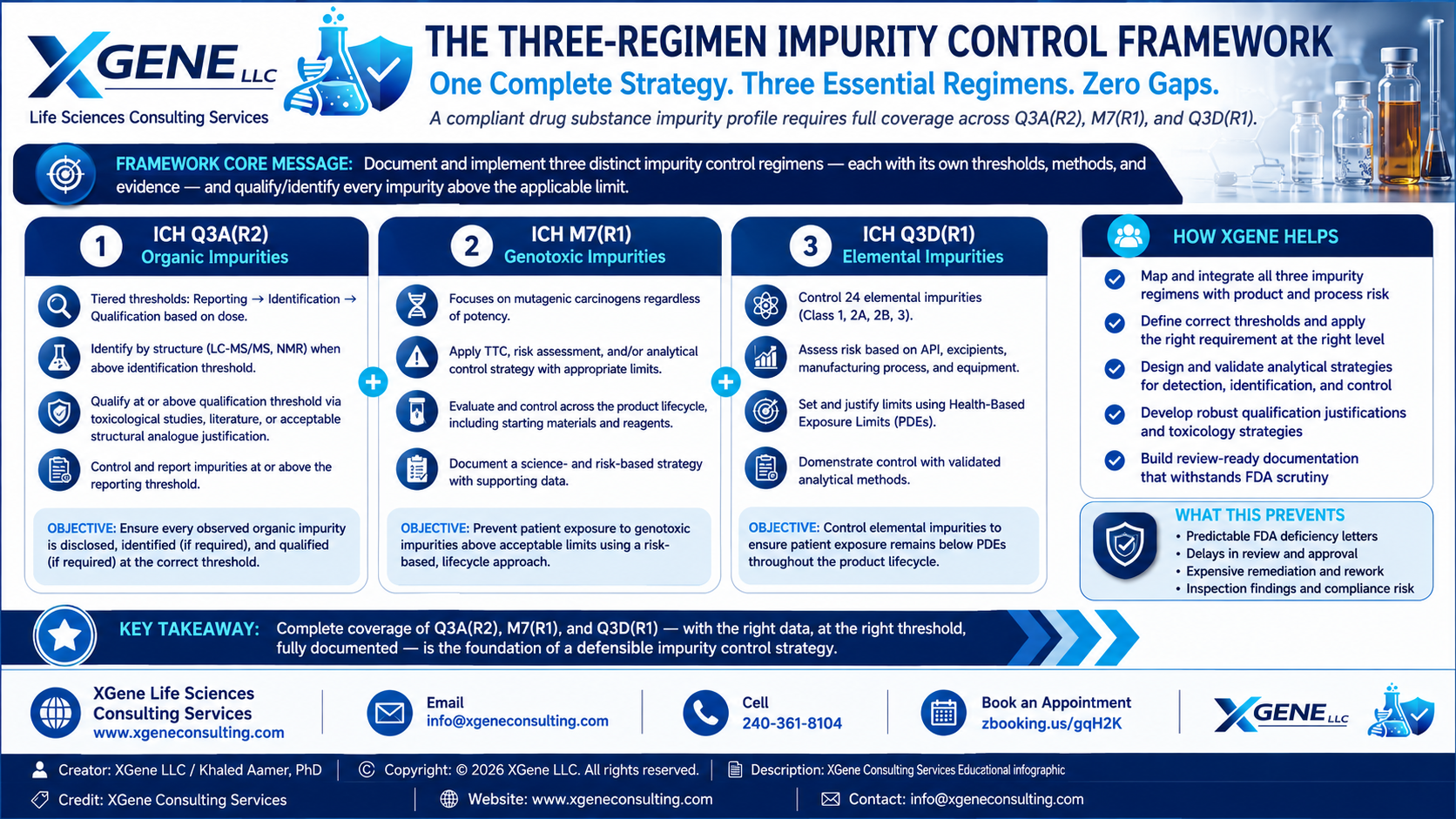
Before any 3.2.S.3.2 section is finalized for submission, XGene structures the impurity control narrative around four parallel lanes, each with its own regulatory framework, threshold system, analytical methodology requirement, and cross-reference to the S.4 specification.
Lane 1 — ICH Q3A(R2) Ordinary Organic Impurities: Document all process-related impurities and degradation products observed above the 0.05%/0.03% reporting threshold across representative batch data. For each impurity at or above the identification threshold (0.10% for MDD ≤ 2 g/day; 0.05% for MDD > 2 g/day), confirm structural identification with supporting analytical data. For each impurity at or above the qualification threshold (0.15% for MDD ≤ 2 g/day; 0.05% for MDD > 2 g/day), confirm that a qualification study exists or that a defensible structural analogue justification is documented. Cross-reference every identified and qualified impurity to its individual limit in the S.4 specification table. Separately enumerate potential impurities with scientific rationale for expected non-appearance above threshold.
Lane 2 — ICH M7(R1) Genotoxic Impurities: Document in silico screening results from two complementary computational systems (Derek Nexus and CASE Ultra) for every reagent, intermediate, and known impurity in the synthetic route. Classify each assessed structure into the ICH M7(R1) Class 1–5 scheme with documented rationale. For Class 1, 2, and 3 impurities, calculate the acceptable daily intake limit using the TTC (1.5 μg/day for compounds without compound-specific carcinogenicity data) and the maximum daily dose of the drug substance, then convert to a ppm specification limit. Where a purge factor approach is used instead of a validated analytical method, document the step-by-step purge calculation with experimental support. Cross-reference the control strategy to the S.4 specification or to the validated purge justification.
Lane 3 — ICH Q3D(R1) Elemental Impurities: Conduct a risk assessment covering all four potential contamination sources: synthetic route (catalysts, reagents), manufacturing equipment, excipients (for drug product purposes), and container-closure. For any catalyst metal used in the synthesis — Pd, Pt, Ir, Rh, Ru, or other — compare observed batch levels measured by ICP-MS (USP <233> method) against the ICH Q3D(R1) oral PDEs. Include elemental impurity limits for all metals above the 30% PDE threshold in the S.4 specification or document a justified exemption. Document the ICH Q3D(R1) risk assessment in full as a supporting document cross-referenced from 3.2.S.3.2.
Lane 4 — ICH Q3C Residual Solvents: List every solvent used in the synthesis, workup, and recrystallization steps. Classify each by ICH Q3C class (Class 1, 2, or 3). For Class 1 solvents, justify their use as technically unavoidable. For Class 2 solvents, confirm that residual levels in representative drug substance batches meet the applicable PDE limits. Include Class 2 residual solvent limits in the S.4 specification. Cross-reference the residual solvent data to the manufacturing process description in 3.2.S.2.2 where the solvents are listed.
All four lanes converge at the S.4 specification table: every impurity, elemental limit, and residual solvent limit that emerges from the four-lane triage must appear as a controlled attribute in S.4 with a scientifically justified acceptance criterion. A 3.2.S.3.2 section that passes all four lanes of this triage is an impurity profile that gives FDA reviewers what the guidance frameworks require — not a document that gives them an occasion to write a deficiency.
If you cannot answer both questions with an immediate yes, the risk of an impurity-related CMC deficiency is real and preventable. I would be glad to discuss what a targeted impurity profile gap assessment looks like for a section already in preparation or currently under FDA review.