
3.2.S.4 Drug Substance Specifications, Analytical Methods, and Validation: The Complete Testing Package
The specification table in 3.2.S.4.1 is the single most scrutinized document in a drug substance CMC submission. Every limit must be scientifically justified, every method must be validated to demonstrate…
On this pageArticle overview
The specification table in 3.2.S.4.1 is the single most scrutinized document in a drug substance CMC submission. Every limit must be scientifically justified, every method must be validated to demonstrate it can meet the specification it controls, and the entire package must be internally consistent — meaning a reviewer who follows the cross-references from specification to method to validation to batch data should arrive at the same conclusions throughout.
A regulatory-grade 3.2.S.4 package requires not just a specification table and analytical methods — it requires a documented chain from scientific rationale to method capability to clinical and safety relevance for every single limit, and the absence of that chain for even one attribute can delay an approval.
The Specification-Setting Methodology Under ICH Q6A: What Drives Each Acceptance Criterion
Every acceptance criterion that appears in a 3.2.S.4.1 specification table carries with it an implicit burden of proof. That burden is not discharged by writing a number next to an attribute name. It is discharged only when the sponsor can demonstrate, through a documented and traceable chain of evidence, that the limit is scientifically justified, analytically achievable, and clinically relevant. ICH Q6A — the foundational guideline governing new drug substance specifications — establishes the framework within which that justification must be constructed, and it is a framework that FDA reviewers apply with considerable rigor.
ICH Q6A distinguishes between universal tests, which apply to essentially all new drug substances, and specific tests, which apply based on the physical and chemical nature of the molecule and its intended route of administration. Universal tests include description, identification, assay, and impurity testing. Specific tests encompass attributes such as particle size, polymorphic form by XRPD, water content by Karl Fischer titration (USP <921>), residual solvents under ICH Q3C, elemental impurities per USP <232>, and microbial limits, among others. The selection of which specific tests to include is itself a regulatory decision that must be justified — the absence of a test that a reviewer believes should be present is as problematic as the inclusion of a test with an unjustified limit.
The specification-setting process under ICH Q6A is not a matter of selecting round numbers or defaulting to pharmacopeial acceptance criteria where none have been validated against the specific molecule. It requires the integration of three distinct bodies of evidence. Analytical data from development and scale-up batches establishes the baseline range of values the process is capable of achieving. Toxicological data — including nonclinical studies and, where available, clinical data — establishes the safety-relevant upper boundaries for impurity limits and other quality attributes. Pharmacopeial standards and regulatory precedents provide a framework of minimum requirements, but they do not substitute for molecule-specific justification.
The ICH Q3A(R2) guideline on impurities in new drug substances adds critical specificity to this framework. Q3A(R2) establishes the reporting threshold (0.05% for drug substances with a maximum daily dose of 2 g/day or less), the identification threshold (0.10% or 1.0 mg/day intake, whichever is lower), and the qualification threshold (0.15% or 1.0 mg/day intake, whichever is lower) for individual unspecified impurities. For drug substances where the maximum daily dose exceeds 2 g/day, the reporting threshold is 0.03%, the identification threshold is 0.05%, and the qualification threshold is 0.05%. Specified impurities — those individually listed in the specification — must be controlled at or below their qualified limits. The decision about which impurities to specify, which to control as unspecified, and at what numerical limits, is one of the most consequential CMC decisions in a development program, and it must be revisited every time process changes alter the impurity profile.
What ICH Q6A makes clear, and what FDA reviewers enforce through deficiency letters, is that the specification table does not exist in isolation. It is the terminus of a justification chain that must be documentable. If a reviewer asks why the assay limit is 98.0% to 102.0%, the answer must reference the validated method precision, the batch analysis data range, and the clinical context that makes the range appropriate. The ATP framework introduced by ICH Q14 (2023) adds a prospective dimension to this justification chain. The ATP defines the performance requirements a method must meet before development begins — the required measurement range, acceptable uncertainty, specificity requirements, and the relationship to the specification the method will control. When an ATP is established and documented, the method validation data package becomes a demonstration that the method meets the ATP, which in turn demonstrates that the method is fit to control the specification.
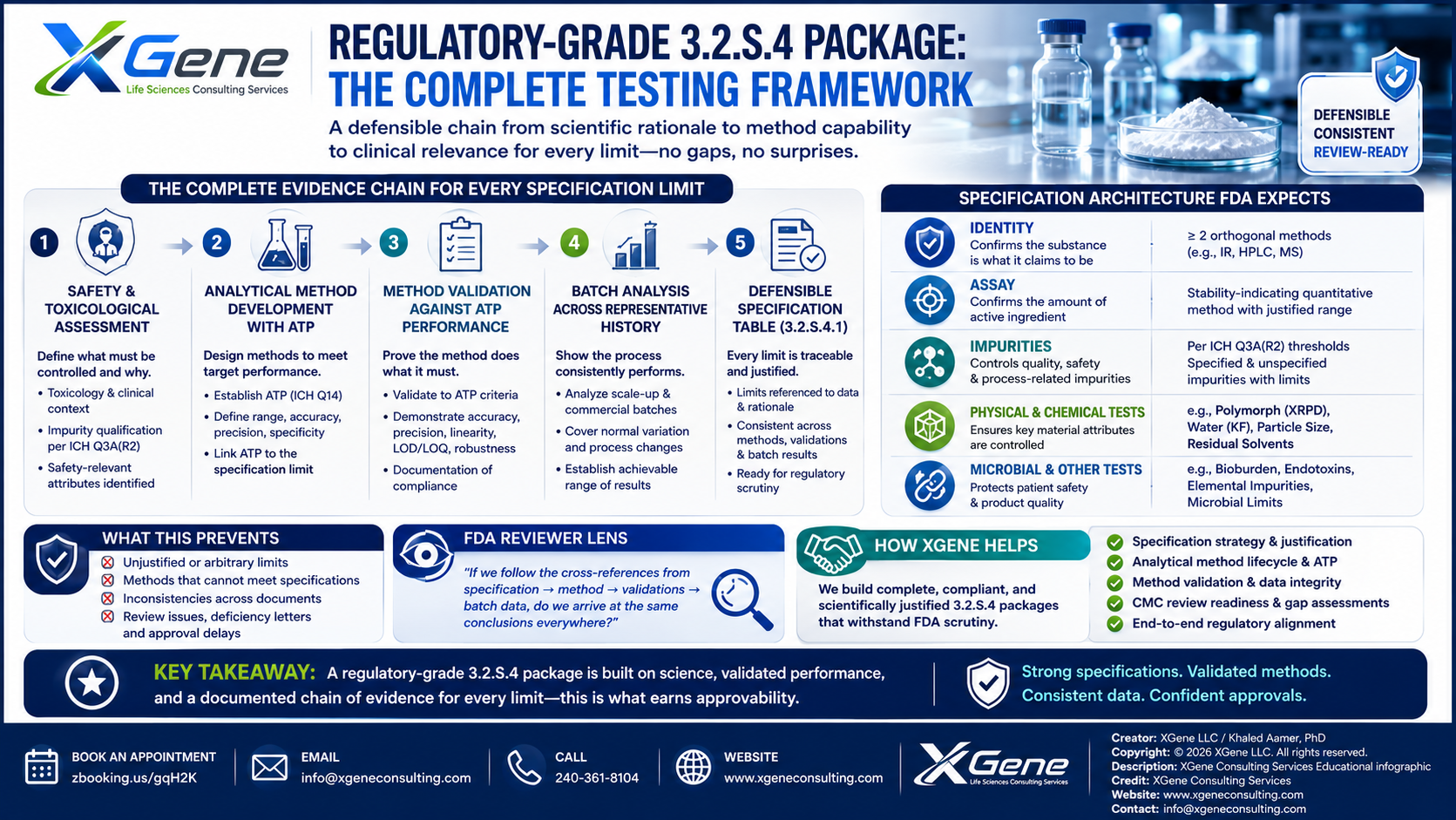
The practical implication is that the specification table should be the last document prepared, not the first. The sequence that produces a defensible specification starts with the safety and toxicological assessment of each attribute, proceeds through analytical method development with an ATP, continues through method validation against ATP performance criteria, includes batch analysis of a representative set of batches spanning the manufacturing history, and concludes with a specification table in which every limit is referenced back to the data that justify it.
Identity, Assay, Impurities, and Physical Tests: The Specification Architecture FDA Expects
The structural logic of a complete 3.2.S.4.1 specification reflects the hierarchy of analytical purpose. Description and appearance provide the most basic visual assessment of the drug substance and, while qualitative, must be defined specifically enough to flag atypical material. Identification testing must include at least two orthogonal tests — typically an IR spectrum compared to a reference standard and a second technique such as HPLC retention time, UV spectrum, or mass spectrometry — to ensure that a false positive from one technique alone cannot release an incorrect material. FDA has cited submissions in which identification relies on a single HPLC retention time comparison, which is insufficient because retention time alone does not confirm molecular identity.
Assay by HPLC or titrimetric method is the quantitative anchor of the specification and must be validated as stability-indicating. This is a point of recurring deficiency: assay methods that have not been challenged with forced degradation under ICH-recommended stress conditions — acid hydrolysis, base hydrolysis, oxidative stress, photolytic stress, and thermal stress — cannot be confirmed as stability-indicating, and FDA will issue a deficiency stating exactly that. Specificity under ICH Q2(R2) for an assay method requires demonstrating that degradation products are resolved from the principal peak, that peak purity is confirmed by photodiode array or mass detection, and that mass balance across the stress study is achieved. Without this demonstration, the assay limit in the specification carries an unresolved analytical uncertainty.
Related-substances testing controls the organic impurity profile, and the quantitation limit must be suitable for the intended specification, reporting strategy, and control decision. ICH Q2(R2) does not impose a universal rule that the LOQ must be no greater than 50% of every specification limit; accuracy, precision, specificity, and quantitation capability should instead be demonstrated over the range needed for the intended use. Intermediate precision must be demonstrated across at least two analysts and at least two separate days; a submission that includes precision data from a single analyst on a single day will draw a deficiency citing inadequate demonstration of intermediate precision under ICH Q2(R2) Section 3.2.
Residual solvents must be controlled per ICH Q3C class limits and tested by headspace GC per USP <621> or equivalent validated procedure. Elemental impurities must be assessed and controlled per USP <232> and ICH Q3D, with the testing strategy for each element documented and justified. Water content by Karl Fischer titration per USP <921> or loss on drying per USP <731> must be validated for specificity in the presence of the drug substance matrix. Where polymorphic form is critical to performance — bioavailability, solubility, or formulation stability — XRPD must appear as a specification attribute, with the acceptance criterion specifying the permitted form or forms, and the method must be capable of detecting form conversion at a level relevant to the clinical and formulation risk.
Release vs. Shelf-Life Specifications: The Regulatory Distinction and Its CMC Implications
ICH Q6A recognizes that some attributes appropriately carry different acceptance criteria at release than at the end of the approved shelf life. This distinction is not merely academic — it has direct implications for the structure of the 3.2.S.4.1 specification table and the stability program supporting it. For degradation-prone attributes such as assay and specified degradation products, a tighter release limit creates a buffer against degradation during storage, ensuring that a batch released at the tight end of the release window will still be within the shelf-life limit at expiry. The basis for any difference between release and shelf-life limits must be supported by stability data from the formal ICH stability program documented in 3.2.S.7.
The regulatory implications of this distinction extend to the analytical methods used at each stage. A release method and a stability method for the same attribute may differ in procedural details — the stability method may include additional specificity requirements, for example — and if they differ, both must be validated separately. Presenting a single validation report and implying it covers both contexts without explicit statement is a documentation gap that reviewers will flag.
The XGene S.4 Specification Justification Architecture operationalizes the entire sequence as a three-tier structure applied to every attribute before the specification table is finalized. Tier 1 establishes the Safety Anchor — the toxicological or clinical basis that defines the maximum acceptable level. Tier 2 establishes the Analytical Capability — the validated method performance data, including LOQ at or below 50% of the proposed limit. Tier 3 establishes the Process History — batch analysis data across a minimum of three representative batches including commercial-scale material, demonstrating consistent results within the proposed specification with adequate manufacturing margin. Only when all three tiers are documented is a specification limit considered justified and ready for the table. A specification set at the maximum observed batch result with no margin provides no process headroom and will draw scrutiny in any review.
For your current 3.2.S.4 specification package, can you identify today which limits are justified by toxicological data versus process capability alone, and whether your assay method has been validated for specificity under forced degradation conditions demonstrating it is stability-indicating?
XGene S.4 Specification Justification Architecture — Three-Tier Structure Applied Before Specification Finalization
TIER 1 — SAFETY ANCHOR Establish the toxicological or clinical basis for the maximum acceptable level of each attribute. For impurities, this means the ICH Q3A(R2) qualification threshold or a compound-specific qualified limit from nonclinical toxicology studies. For assay, this means the clinical exposure range and the therapeutic window established in clinical pharmacology studies. For physical attributes such as particle size and polymorphic form, this means the biopharmaceutical data linking the attribute to dissolution, bioavailability, or formulation performance. No specification limit is assigned without a Tier 1 Safety Anchor.
TIER 2 — ANALYTICAL CAPABILITY Validate the controlling method against the ICH Q2(R2) performance characteristics — specificity (including forced degradation for assay methods), accuracy, repeatability, intermediate precision, linearity, range, LOD, and LOQ — before the specification limit is fixed. The critical constraint is that LOQ must be no greater than 50% of the proposed specification limit for any impurity or degradation product. If the validated LOQ exceeds this threshold, the specification limit must be revised upward or the method must be improved. Tier 2 documentation includes the full validation report structured per ICH Q2(R2) and cross-referenced to the ATP per ICH Q14.
TIER 3 — PROCESS HISTORY Analyze a minimum of three representative batches, including commercial-scale or scale-representative batches, for each attribute. The batch analysis data must demonstrate that the process consistently produces results within the proposed specification with a margin that makes the limit practically meaningful — a specification limit set at the maximum observed batch result provides no process margin and will draw a deficiency. The Tier 3 data package should include batch-to-batch variability statistics and a statement of the manufacturing margin, defined as the difference between the tightest observed batch result and the proposed specification boundary.
COMPLETION CRITERION: The specification table is finalized only after all three tiers are documented for every attribute. Attributes for which Tier 1 cannot be established — because toxicological data are absent or incomplete — are escalated for nonclinical or clinical risk assessment before a limit is proposed.