AI and CMC Digital Transformation — What’s Real and What’s Hype
Every pharmaceutical conference in the past two years has featured a presentation claiming that AI will transform CMC development and regulatory review — almost none of them have explained which…
On this pageArticle overview
Every pharmaceutical conference in the past two years has featured a presentation claiming that AI will transform CMC development and regulatory review — almost none of them have explained which specific AI applications are genuinely ready for GMP-regulated use today and which are three to five years from regulatory acceptance.
The Regulatory Foundation: CSA, GAMP, and the AI/ML Discussion Paper
That gap between what is being promised on conference stages and what is operationally defensible in a GMP environment is not a minor detail. It is the difference between deploying a technology that creates competitive advantage and deploying one that creates a 483 observation, a warning letter, or — in a worst case — a product decision made by a system that was never qualified to support that decision. After twenty-five years working in pharmaceutical GMP, quality systems, and regulatory affairs, the single most concerning pattern I have observed in the current AI moment is the number of CMC and quality teams piloting AI tools without any documented intended use statement, any risk assessment under FDA’s Computer Software Assurance framework, or any testing evidence commensurate with the risk those tools actually carry.
FDA published its Computer Software Assurance for Production and Quality System Software guidance in 2022, and it fundamentally reoriented how the agency expects manufacturers to think about software validation. The old paradigm — install qualification, operational qualification, performance qualification, with exhaustive scripted testing regardless of what the software actually does — is explicitly replaced by a risk-based intended use approach. FDA’s CSA guidance states that the level of assurance activities and associated documentation should be commensurate with the risk that the software poses to product quality and patient safety. That is the regulatory foundation on which any AI tool used in a GMP-regulated context must be assessed. The question is no longer “did we run IQ/OQ/PQ?” The question is “what is the intended use of this tool in a GMP context, what is the risk if it fails or produces an incorrect output, and have we generated testing evidence commensurate with that risk?” These are precisely the questions most AI pilot programs I have reviewed have not formally answered.
GAMP 5 (second edition), the ISPE’s industry standard for pharmaceutical software validation, maps software into categories based on complexity and configurability — Category 4 for configurable software and Category 5 for custom software and algorithms. Most AI/ML systems used in CMC and GMP contexts fall into Category 4 or Category 5, depending on the degree to which the underlying model is pre-built versus trained on proprietary data. The validation burden for Category 5 software is substantial: the development, training, and testing logic of the algorithm itself must be understood and documented, not merely the user interface through which operators interact with it. An AI model trained on a manufacturer’s historical manufacturing data to predict process deviations is Category 5 software. Treating it as Category 3 or ignoring GAMP categorization entirely — which is exactly what many early AI deployments have done — creates systemic validation gaps that are exceptionally difficult to remediate retroactively.
FDA’s 2023 Discussion Paper on Using Artificial Intelligence and Machine Learning in the Development of Drug and Biological Products adds a second layer of complexity by addressing the regulatory submission dimension. The agency has signaled that AI/ML used in drug development must be disclosed when it materially contributed to decisions about formulation design, process parameters, or specification setting. Model performance must be documented. Data quality underlying training datasets must be justified. This is not a burdensome or unexpected position — it mirrors the same scientific rigor FDA expects for any other analytical or computational method supporting a regulatory submission. But it does mean that a team using an AI-assisted formulation prediction tool to select a drug-to-excipient ratio and then filing that formulation rationale without disclosing the AI contribution or the model’s training data provenance is creating a regulatory disclosure gap that could be exploited at review or post-approval.
ICH Q9(R1), the revised quality risk management guideline, reinforces the principle that risk management tools — including computational and AI-based tools — must be fit for purpose, scientifically sound, and applied with documented rationale. ICH Q10, the pharmaceutical quality system guideline, provides the organizational framework within which any such tool must sit: change control, CAPA, management review, and continual improvement. An AI system that influences GMP decisions but exists outside the quality system — without change control covering model updates, without CAPA linkage when the model produces anomalous outputs, without documented management review of model performance — is not a GMP-compliant tool regardless of how technically sophisticated it is.
Development vs. GMP Manufacturing: The Application Context That Determines Validation Burden
Against that regulatory landscape, it is possible to identify which AI applications are genuinely deployable today and which are not. The most important variable is whether the AI system is being used in a development context — where it informs decisions that will later be reviewed and documented through standard scientific and regulatory processes — or in a direct GMP manufacturing context, where its output triggers real-time process decisions or disposition decisions. Development-context AI carries a lower GMP burden. Predictive modeling for formulation development, AI-assisted design of experiments, literature mining for excipient compatibility, and regulatory submission drafting assistance all sit in a space where the AI’s output is reviewed by a qualified human, documented through conventional quality processes, and does not directly control a GMP system or issue a GMP decision. These applications can be deployed today with appropriate intended use statements, reasonable risk assessments under CSA guidance, and documented human oversight protocols.
The deployment timeline calculus changes entirely the moment AI output crosses into GMP decision-making territory. AI-based process monitoring and anomaly detection systems embedded in manufacturing execution systems or laboratory information management systems are subject to full 21 CFR Part 11 electronic records and electronic signatures requirements, full CSA validation including scripted and unscripted testing commensurate with risk, and must be integrated into the quality system with formal change control covering any model retrain or update. A realistic deployment timeline for a fully validated AI process monitoring tool — from concept through intended use definition, vendor assessment, risk-based validation planning, testing, and quality system integration — is twelve to eighteen months in an organization that already has a mature quality system and CSA-competent validation team. In organizations still operating under legacy validation paradigms, that timeline extends further.
FDA’s Emerging Technology Program offers a constructive pathway for sponsors who want to deploy genuinely novel AI applications in CMC development or manufacturing with advance regulatory alignment. ETP engagement allows sponsors to discuss proposed AI methodologies with FDA before regulatory submission, identify data quality and model documentation expectations specific to the application, and reduce the uncertainty that otherwise surrounds first-mover AI deployments. Several advanced therapy and complex formulation programs have used ETP to discuss AI-assisted process analytical technology integrations. That pathway exists and should be used more systematically.
Practical Synthesis: Deploying AI Now While Avoiding Regulatory Exposure
The practical synthesis of all of this is straightforward, even if execution is demanding. AI applications that inform human decisions in a development context — formulation prediction, design space exploration, regulatory document drafting assistance — are available now and carry manageable GMP burdens with proper governance. AI applications that make or directly support real-time GMP manufacturing or quality decisions require full CSA-compliant validation, 21 CFR Part 11 compliance, and quality system integration, and the organizations that have done this correctly have invested twelve to eighteen months and significant validation resource to get there. AI applications built on black-box models — where the decision logic is not interpretable by a qualified reviewer — should not be used for GMP decision support regardless of their technical predictive performance, because FDA’s interpretability requirement is not a preference; it is a criterion for scientific defensibility under both CSA guidance and the AI/ML discussion paper.
The industry’s AI enthusiasm is not misplaced. The applications are real. The value is genuine. But it is not realized by piloting tools outside the quality system and hoping regulatory scrutiny does not arrive before the business case is established. It is realized by doing the qualification work correctly, at the front end, with the same rigor that any GMP practitioner would bring to introducing any other system that influences product quality and patient safety. The organizations doing that now will have validated, defensible AI infrastructure when the regulatory environment fully matures. The organizations that do not will be remediating.
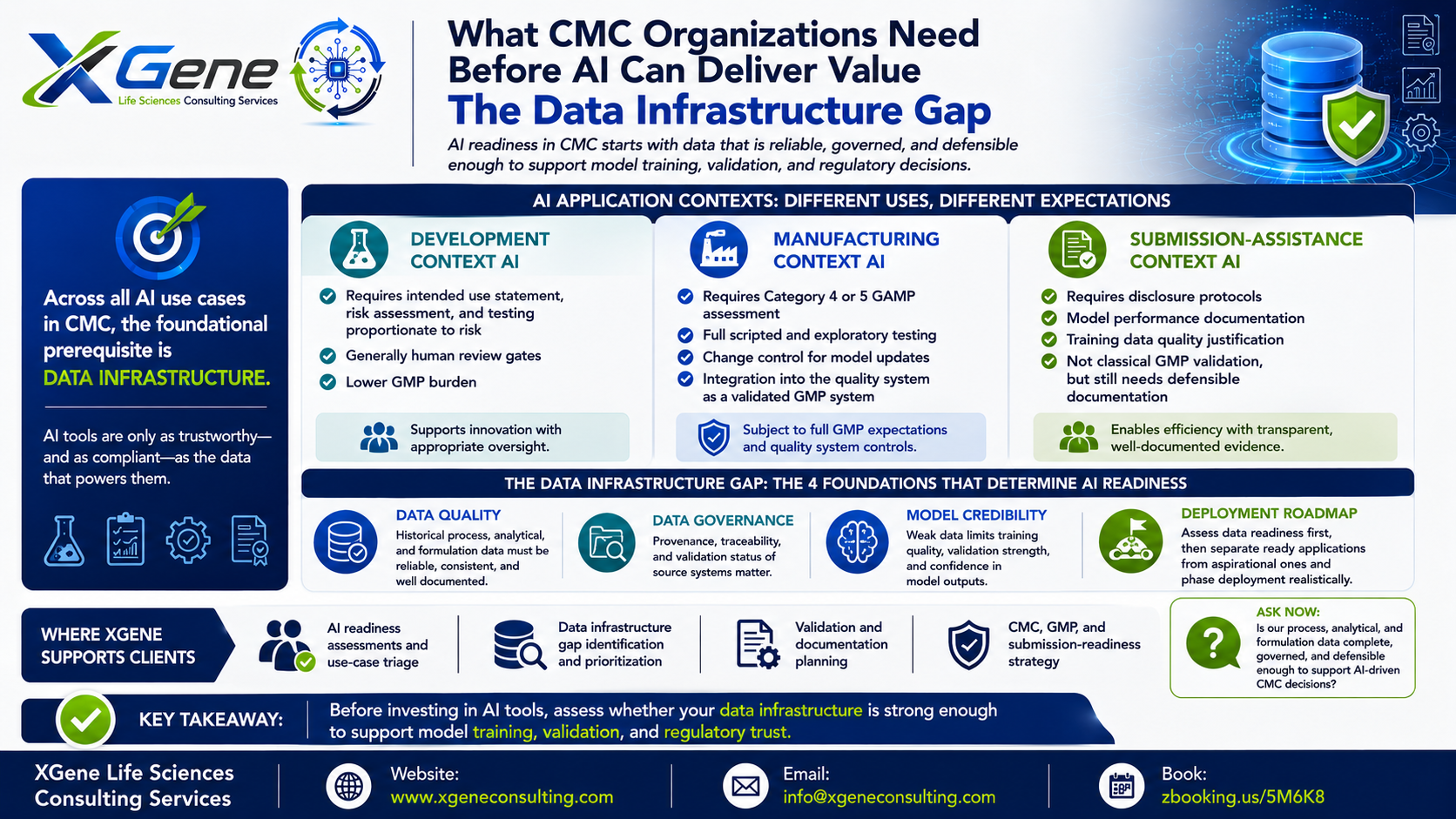
WHAT CMC ORGANIZATIONS NEED BEFORE AI CAN DELIVER VALUE: THE DATA INFRASTRUCTURE GAP
The XGene CMC AI Readiness and GMP Validation Framework categorizes each AI application across three GMP contexts — development, manufacturing, and regulatory submission — and maps required CSA validation actions by risk tier. A development-context AI tool with human review gates requires an intended use statement, a risk assessment, and documented testing proportionate to risk, but does not require the full 21 CFR Part 11 audit trail and electronic signature architecture required of a GMP manufacturing AI. A manufacturing-context AI tool triggering process adjustments or feeding into batch disposition requires Category 4 or 5 GAMP assessment, full scripted and exploratory testing, change control covering model updates, and integration into the quality system as a validated GMP system. A submission-assistance AI requires disclosure protocols, model performance documentation, and training data quality justification — but no GMP validation in the classical sense.
Across all three contexts, the foundational prerequisite is data infrastructure: AI models are only as reliable as the data they were trained on, and in pharmaceutical manufacturing, historical data quality is frequently inconsistent, incompletely documented, or drawn from systems that were themselves not validated to the standard now required. Before deploying any AI tool whose output will influence CMC decisions, organizations must assess whether their historical process, analytical, and formulation data meets the quality criteria required to train and validate a model whose outputs they will stake regulatory submissions on. In most organizations we have assessed, that data quality work — not the AI model development itself — is the limiting step. The AI readiness framework identifies this gap at the outset, before capital or validation resource is committed, and produces a phased deployment roadmap that separates genuinely ready applications from aspirational ones with realistic validation timelines attached to each phase.